
Edition: HamletAncient History and Mythology
Achilles
See
Pyrrhus.
Aeneas’s Tale to Dido
Para1Hamlet’s recital of a speech to the Players, which is then continued by the First
Player, is a blank-verse tragic composition written by Shakespeare as a partial redaction
of Virgil’s Aeneid, a Latin epic poem written ca. 29–19 BCE.
Para2Designed to grace the Roman literary world in the era of Caesar Augustus, to whom
Virgil dedicated the poem, the Aeneid clearly took as its model Homer’s Iliad and Odyssey. Virgil tells what purports to be a continuation of Homer’s account of the Trojan
War, with the Greeks having gained access to Troy by the ruse of the Trojan horse,
their sacking of that city, and Aeneas’s escape from the ruins with his father Anchises,
his wife Creusa, and his son Ascanius. It then continues with Aeneas’s journey to
Queen Dido’s Carthage (where he related to her the story of Troy’s fall), and then
Italy, where eventually Aeneas’s triumph over the Latins enabled him to found the
city of Rome. English historians regarded this foundational myth as the back-story
of their own civilization, since, according to a medieval continuation of that myth,
Aeneas’s great-grandson Brut or Brutus made an epic journey similar to his great-grandfather’s
that resulted in the founding of Troynovant (New Troy), or London.
Para3The passage beginning at 2, as recited by Hamlet and the First Player, retells the Virgilian story of the sack
of Troy, focusing on Pyrrhus’s savage slaughter of the old and unarmed Priam (King
of Troy) and then the grieving of Queen Hecuba. Pyrrhus, also known as Neoptolemus,
was the son of the heroic Greek warrior Achilles, usually regarded as the central
figure of Homer’s Iliad. The slaughter of Priam was the price that the furious Pyrrhus demanded as vengeance
for the death of his own father.
Para4Homer does not portray the death of Achilles, but other sources report that he was
killed near the end of the Trojan War by Paris, a son of Priam and husband of Helen.
Paris managed to shoot Achilles with an arrow in his heel, the one vulnerable spot
on his body since (according to the first-century Roman historian Statius in his Achilleid) Achilles’s mother, Thetis, had endeavored to bestow immortality on her son by dipping
him as an infant into the river Styx. In doing so, she left vulnerable that one part
of the body by which she was holding her son, the heel (hence,
Achilles’s heel or tendon).
Para5Christopher Marlowe and Thomas Nashe wrote Dido Queen of Carthage, ca. 1585, which is a dramatization of the love affair of Aeneas and Dido, and his
reluctant decision to leave in obedience to the gods, who have decreed that he is
to found Rome.
Alexander
Emperor Alexander III (Alexander the Great), 356–323 BCE, was famed for his conquest
of the known world all the way east to India.
When Hamlet playfully imagines, in conversing with Horatio, that the dust of Alexander’s
corpse might be made into the loam used to stop a bung-hole in a beer-barrel, he is
calling upon a commonplace view of Alexander’s worldly achievement as ultimately mocked
by his death and burial (1).
Andromache
See
Pyrrhus.
Apollo
The god of the sun, medicine, music, archery, and prophecy, known to the Romans as
Phoebus Apollo.
His
cartor chariot is emblematic of the sun as a heavenly body going around the earth daily and thus, at A3 Sc2 Sp54, a way of marking the passage of a year.
Brutus, Lucius Junius
The founder of the Roman Republic. His name,
Brutus,was synonymous with “stupid”. According to legend, he feigned madness in order to evade the plotting of his enemies, the Tarquins, whom he eventually overthrew.
Polonius and Hamlet exchange words about the assassination of Julius Caesar by Lucius
Junius Brutus’s descendant, Marcus Brutus, at A3 Sc2 Sp19–A3 Sc2 Sp23.
See
Caesar, Julius Gaius,and Henry V, A2 Sc4, where the Constable of France compares King Henry’s
vanities forespentto
the outside of the Roman Brutus, / Covering discretion with a coat of folly(A2 Sc4 Sp3).
Brutus, Marcus Junius
This patrician descendant of the Lucius Junius Brutus who founded the Roman Republic
was a leader of the Republican cause and was one of the conspirators who assassinated
Julius Caesar in 44 BCE.
Polonius and Hamlet refer to the assassination at A3 Sc2 Sp19–A3 Sc2 Sp23, in the action leading up to the performance of
The Murder of Gonzagobefore the King, Queen, and Court.
Caesar, Julius Gaius
Para6The assassination of Julius Gaius Caesar on 15 March 44 BCE is the subject of Shakespeare’s
1599 Julius Caesar. Horatio cites this famous episode in the first scene of Hamlet as an instance in which ominous prognostications preceded and foretold disaster (1).
Para7Later, when Polonius describes how he acted the part of Julius Caesar once in a play
i’th’ universityand was accounted
a good actorin the part, having been killed by Brutus
i’th’ Capitol,Hamlet replies with a biting wit that
It was a brute part of him to kill so capital a calf there(2–2). Here, the word
bruteplays on brutus, Latin for “stupid”, referring to a legendary story in the life of Lucius Junius Brutus, great ancestor of the assassin of Caesar. This earlier Brutus assumed a guise of madness in order to mislead his enemies, the Tarquins, whose tyrannies he overthrew in establishing the Roman Republic.
Centaur
Para8When Claudius, in conversation with Laertes, undertakes to praise the horsemanship
of a Frenchman named Lamord, he describes how the rider
brought his horse / As had been incorpsed and demi-natured / With the brave beast(A4 Sc7,7). The image Claudius has in mind is that of the centaur, a fabled creature shaped with the legs and body of a horse, and a man’s body in place of the horse’s head and neck.
Cyclops
These giants, supposedly the sons of Coelus (or Uranus, the most ancient of the gods)
and his own mother Terra (Earth), had only one eye positioned in the midst of the
forehead; hence, the name Cyclopes, literally “round eyed”.
Hesiod said they were three in number; other accounts speak of more of them, governed
by Polyphemus as their king in Sicily. This location places them near Mount Etna;
hence, the tradition that they were workers in the smithy of Vulcan. In Hamlet, at A3 Sc2, Hamlet speaks of faulty
imaginationsof evil things as
foul as Vulcan’s stithy(2).
The account of the fall of Troy in A2 Sc2 compares Pyrrhus’s vengeful rage to the remorseless blows with which
the Cyclops’(s) hammers fall / On Mars his armor forged for proof eterne(2). This reference shows no awareness of the well-known story in Book 9 of Homer’s Odyssey about Odysseus’s encounter with the man-eating Cyclops named Polyphemus, and Odysseus’s narrow escape by means of his wit.
Damon and Pythias
Hamlet evidently quotes, at 2, some unknown ballad about the fabled friendship of Damon and Pythias.
When Damon, condemned to death by the tyrant Dionysius, obtained leave to settle his
affairs before dying, his friend Pythias took his place as surety for Damon’s return.
Damon returned barely in time, inspiring Dionysius to spare them both in recognition
of their noble fidelity to each other.
Sources for this often-told tale include Aristoxenus (fl. 335 BCE), Cicero (De Officiis, 3.45), Diodorus Siculus (10.4), Valerius Maximus (first century CE), and Castiglione
(The Courtier).
Hamlet’s point here is elliptical, but does at least implicitly acknowledge his deep
friendship with Horatio as like that of Damon and Pythias.
Diana and the Moon
Para9The moon is associated with Diana, the Roman goddess, who is related to the Greek
moon-goddess Artemis, a virgin huntress of wildlife, and goddess of childbirth and
chaste affections. Artemis is sometimes conflated with Phoebe, a Titan associated
with the moon and with Phoebus Apollo. Elizabethans associated these goddesses with
their Queen Elizabeth, who readily adopted the myth.
The Moon is called
the moist starat A1 Sc1 because of its association with the ocean tides in
Neptune’s empireor, the sea (1). A lunar eclipse is here seen as a harbinger of ominous events, such as the assassination of Julius Caesar.
Enceladus
One of the Giants who rebelled against the Olympian gods and was imprisoned under
Mount Etna in Sicily.
See
Giants.
Enceladus
Greek Stoic philosopher, 55–136 CE.
See
Stoicism.
Etna, Mount
A volcanic mountain in Sicily, where Enceladus, one of the Giants, was imprisoned.
See
Giants.
Euripides
See
Seneca.
Fortune
The classical goddess Fortuna or Fortune, goddess of destiny, is one of the most ancient
of deities, able in her fickleness to give wealth or poverty, pleasure or misfortune,
success or failure.
In medieval iconography she is often represented as blindfolded, with a horn of plenty
in her hands and a wheel whose turning represents the vicissitudes of fortune in all
its inconsistency.
At A1 Sc4, Hamlet contrasts
Nature’s liveryand
Fortune’s star,reflecting a familiar Renaissance debate as to the comparative importance in human life of that which is inborn and that which depends on fate or necessity (4).
At A2 Sc2, Hamlet, Guildenstern, and Rosencrantz engage in a playful debate about where a person
can hope to rank in Fortune’s favor, whether that is on her cap at the very top or
at the bottom with the soles of her shoes, or
about her waist, or in the middle of her favors,with sexual suggestion of being among her
privatesor sexual parts (2–A2 Sc2 Sp71). As Hamlet wryly observes,
she is a strumpet(2).
At A2 Sc2, the First Player, in his recital of the saga of the fall of Troy, cries out against
strumpet Fortunebeseeching the Olympian gods in
general synodto take away her dreadful power by breaking the
spokes and felliesof her wheel and sending the
round naveof it
As low as to the fiends(2). The First Player similarly exclaims against
Fortune’s stateat A2 Sc2 for the goddess’s fatal role in the killing of King Priam and the deep misery that Hecuba suffered in the death of her husband (2).
At A3 Sc1, Hamlet, in the play’s famous soliloquy about
To be, or not to be,wonders whether it is nobler in the mind
to suffer / The slings and arrows of outrageous fortune,or to end such suffering by choosing
To die, to sleep(1).
At A3 Sc2, Hamlet warmly praises Horatio for his stoical resolve: he is
A man that Fortune’s buffets and rewards / Hast ta’en with equal thanks; Horatio is not
a pipe for Fortune’s finger / To sound what stop she please(2).
Also in A3 Sc2, the Player King addresses his Queen with a series of platitudes about love and fortune—another
favorite Renaissance debating topic—as to
Whether love lead fortune, or else fortune love(2). His point being that when a great man is favored with good fortune he is idolized by those seeking favor with him, whereas when he falls from good fortune he is sure to be deserted by his one-time followers and flatterers.
At A4 Sc4, Hamlet meditates wryly in soliloquy on the spectacle of a worldly prince like Fortinbras
risking his life and the lives of his solders
To all that fortune, death, and danger dare, / Even for an eggshell(4).
In all these instances, stoical resolve is seen as philosophy’s best way of resisting
the temptations offered by the false goddess Fortune.
See
Stoicism.
Giants
Para10When Claudius speaks of Laertes’s threatened rebellion as
giant-like,he may be referring to the unsuccessful rebellion of the Giants, sons of Ge or Earth, against Zeus and the Olympian gods (5). When the Giants were overthrown, Encedalus, one of their number, was buried under Mount Etna in Sicily. This rebellion is sometimes confused or conflated with that of the Titans against Uranus or Coelus; possibly Shakespeare has both in mind here. The Titans were also gigantic, and were the offspring of Uranus, and Ge, mother of the Giants, so that both the Giants and the Titans were imagined to have sprung from the earth (Ge).
Para11The wars of both the Giants and the Titans against the gods are often referred in
Greek mythology, and are sometimes conflated. When Laertes hyperbolically begs that
the dust of Ophelia’s grave be heaped upon him
Till of this flat a mountain you have made / T’o'ertop old Pelion, or the skyish head / Of blue Olympus,he evidently has in mind the attempts of the Giants to scale Mount Olympus by piling still another mountain, Ossa, on top of Mount Pelion (1). Hamlet matches Laertes allusion for allusion when he vaunts,
And if thou prate of mountains, let them throw / Millions of acres on us, till our ground, / Singeing his pate against the burning zone, / Make Ossa like a wart(1).
See also 2.
Hecate
Hecate, who is the goddess of witchcraft and is associated with Diana and the moon,
presided over magic and enchantments.
Lucianus, the murderer in
The Murder of Gonzago,invokes her baleful curse,
thrice blasted, thrice infectedin the poisonous concoction he pours into the sleeping ears of his royal victim (2).
Hector
See
Pyrrhus.
Hecuba
Para12The queen and then the grieving widow of King Priam of Troy.
Para13The recitation about the fall of Troy in A2 Sc2 is based on the Aeneid. It focuses at A3 Sc2 on the pitiable spectacle of the inconsolate Hecuba, running up and down as Troy
burns, bereft of crown and regal attire (2). Perhaps we are to understand that Hamlet has chosen this passage as an object lesson
for Queen Gertrude (even though she is not present on stage), whose mourning for her
dead husband has been, in Hamlet’s view, deplorably brief.
See also
Revenge.
Hercules
Para14He is the most famous hero of Greek mythology, noted especially for his fulfillment
of the twelve labors imposed on him by Eurystheus, King of Argos and Mycenae and grandson of Pelops. Eurystheus
was jealous of Hercules because Zeus had decreed that one of them would be subservient
to the other. The first of Hercules’s labors was the slaying of the Nemean lion, an
otherwise invulnerable monster; Hamlet alludes to this when he cries out to the soldiers
who are attempting to restrain him from following his father’s Ghost on the battlements:
My fate cries out / And makes each petty artery in this body / As hardy as the Nemean lion’s nerve(1). Earlier, Hamlet speaks of his hated uncle Claudius as
no more like my father / Than I to Hercules(2).
Para15In his conversation with Rosencrantz and Guildenstern about the rivalry between the
adult actors and the boy actors that is implicitly about London theater around the
time that Hamlet was written (a Folio-only passage, omitted in Q2), Hamlet asks,
Do the boys carry it away?to which Rosencrantz replies,
Ay, that they do, my lord, Hercules and his load too(A2 Sc2 Sp117–A2 Sc2 Sp118). The reference is seemingly to Hercules’s bearing the world on his shoulders; a veritable
Herculeanlabor even though it is not one of the twelve famous labors imposed on him by Eurystheus. According to one legend, it was Atlas who bore the world on his shoulders as a punishment meted out by Zeus. When Hercules sought Atlas’s help to fetch the apples of the Hesperides, Atlas agreed on the condition that Hercules take his place as upholder of the world, but Hercules then tricked Atlas into taking on the load briefly while Hercules found a pad for his shoulders, whereupon Hercules left Atlas with his burden. The familiar image of Hercules holding up the world may have been used as the sign of the Globe Theater; however, the evidence for this rests chiefly on this passage from Hamlet.
Para16Hamlet invokes the name of Hercules at Ophelia’s gravesite when he and Laertes have
quarreled violently. Hamlet asks Laertes,
What is the reason that you use me thus? / I loved you ever. But it is no matter. / Let Hercules himself do what he may, / The cat will mew, and dog will have his day(1).
Hyperion
In Greek, Hyperion means “\”. Hyperion was one of the twelve Titans, offspring of Gaia or Ge (Earth)
and Uranus (the sky, the heavens). In partnership with his sister, the Titaness Theia,
Hyperion fathered Helios (the sun), Selene (the moon), and Eos (the dawn).
The sun-god Hyperion is often invoked by poets as an embodiment of the sun itself,
as in Shakespeare’s Henry V, A4 Sc1, when King Henry, on the night before the Battle of Agincourt, reflects on the lot
of the happy peasant who sleeps peacefully after his day’s labor and then, at dawn
the next day,
Doth rise and help Hyperion to his horse(A4 Sc1 Sp75).
Led by Cronus, the Titans overthrew Uranus and ruled during the mythological Golden
Age until they were in turn displaced by Zeus and the Olympian gods. Hesiod’s Theogony depicts Cronus, the youngest of the Titans, as envious of Uranus’s power as ruler
of the universe.
John Keats wrote two versions of a fragment of a poem on Hyperion, in which this last
of the Titans is dethroned by Apollo.
To Hamlet at A1 Sc2, Hyperion is, like Hamlet’s own dead father, a type of regal splendor and gracious
majesty to be contrasted with the satyr-like Claudius (2).
Similarly, when Hamlet confronts his mother with two contrasting images, one of the
dead King Hamlet and the other of Claudius, he imagines his father’s graceful brow
to be adorned with
Hyperion’s curlsand
the front of Jove himself(4).
Hyrcanian Beast
I.e., the tiger.
Hyrcania was a satrapy bordering on the southern and southeastern shore of Caspian
Sea, in modern-day Iran and Turkmenistan.
The name Hyrcania suggests “wolf land”. The entire region, although fertile and beautiful, was fabled
to be inhabited by wild and dangerous beasts.
Jove
Jove is another name for Jupiter (Roman) or Zeus (Greek), the most powerful of the
Olympian gods. He overthrew his father Saturn for conspiring against him.
Mars
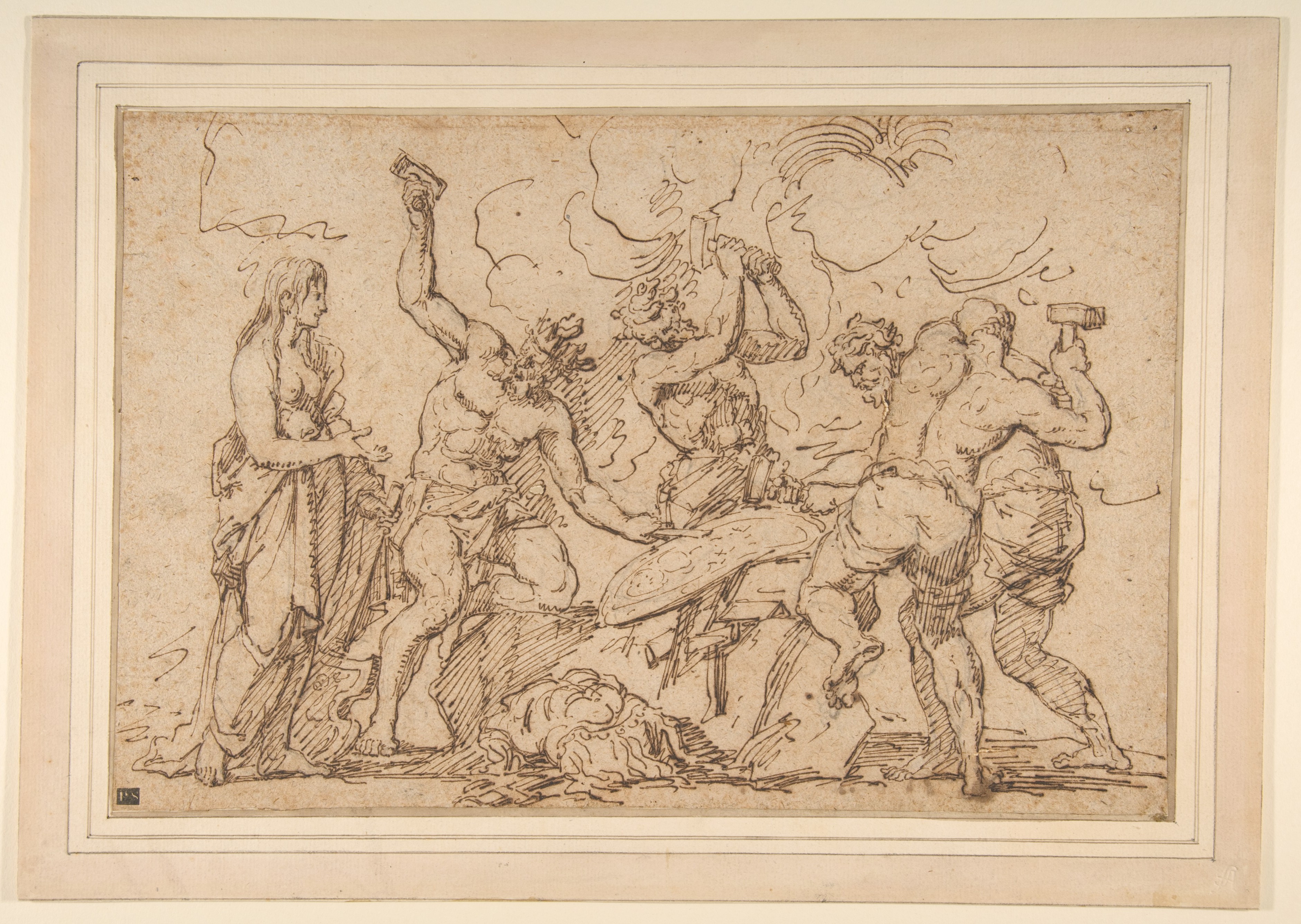
Para18A pen-and-ink sketch by the late seventeenth-century artist Raymond de la Fage shows
Venus watching Vulcan and Cyclops forge armor for Mars.In the sketch, Mars is accompanied by his workmen, the Cyclopes, as they hammer with a vengeful fury like that alluded to by the First Player in Hamlet when he exclaims,
And never did the Cyclops’(s) hammers fall / On Mars his armor forged for proof eterne / With less remorse than Pyrrhus’(s) bleeding sword(2). This episode reflects Vulcan’s (or Hephaestus’s) well-earned reputation as armorer for the gods.
Para19It also brings to mind the amusing episode in Book 8 of Homer’s Odyssey, relating how Vulcan, learning that his wife Venus was carrying on an affair with
the god of war, forged some unbreakable chains that were at the same time so fine
and subtle as to be undetectable. When Vulcan hung these chains from the ceiling and
bedposts of his sleeping chamber, the love-blinded Mars was soon ensnared in the arms
of the all-too-willing Venus. In answer to Vulcan’s summons, all the blessed gods
of Mount Olympus gathered around to roar with laughter at the unseemly spectacle of
the cuckolded lame husband and his randy wife. After Vulcan had reluctantly released
the amorous couple, Homer reports, Venus (Aphrodite) scampered off to Cyprus and her
sacred grove of Paphos, where the Graces bathed her, anointed her with sacred oil,
and clothed her in beautiful garments. Whether Shakespeare knew this episode is, however,
uncertain.
Mercury
The messenger of Jupiter on Mount Olympus, known as Hermes to the Greeks. He was often
portrayed with winged heels, enabling him to move with extraordinary rapidity.
Nemean Lion
See
Hercules,the first of whose twelve labors was to quell the Nemean lion.
This monster, born of the hundred-headed Typhon, terrorized the inhabitants of Nemea,
in Argolis in the Peloponnesus peninsula of Greece. Its chief town was Argos.
According to one legend the lion was thought to be protected by a fur that was impervious
to attack, but Hercules (Heracles) had the sagacity to use the beast’s own claws to
destroy the monster and then skin it, thereby fashioning for himself a cloak with
extraordinary protective properties.
In Hamlet, when Horatio and the guard attempt to prevent Hamlet from following his father’s
Ghost on the battlements, he throws off their restraint, exclaiming,
My fate cries out / And makes each petty artery in this body / As hardy as the Nemean lion’s nerve(4).
Neptune
The Roman god of the sea, with attributes of the Greek god Poseidon.
At A3 Sc2, the Player King reckons the amount of time that he and his Queen have been happily
married as
thirty dozen moons,during which span of time the sun, in
Phoebus’s cart,has gone around
Neptune’s salt wash and Tellus’s orbèd ground,i.e., the earth, some thirty times, or thirty years (A3 Sc2 Sp54). Twelve complete cycles of the moon are here seen as equivalent to a calendar year.
Horatio refers to
Neptune’s empireat 1.
Nero
Para20This Roman emperor from 54–68 CE was infamous for many things: for taking on female
identity and marrying one of his eunuchs, for bringing about the deaths of Seneca,
Lucan, Petronius, and his wife Octavia Poppaea, and much more. He caused Rome to be
set on fire in various places, and sang of the destruction of Troy while the city
burned. He built sumptuous palaces and indulged in every imaginable sort of debauchery.
He was fascinated with theater, and was himself an actor.
Para21Most relevant to Hamlet’s citing of him, at A3 Sc2, is Nero having ordered the assassination of his own mother. As Hamlet goes to confront
his mother with her guilty behavior, he vows to be cruel with her but not unnatural; he will not let
The soul of Nero enter this firm bosom.He will
speak daggers to her, but use none(2).
Niobe
Para22In Greek mythology, Niobe was the daughter of Tantalus, king of Sipylus in Lydia.
Her mother was either Dione, or Eurythemista, or Euryanassa. Her brothers were Pelops
and Broteas. This fateful lineage was to give rise to the house of Atreus, which was
doomed by a curse over successive generations that resulted in the conflict of Atreus
and his brother Thyestes, and in the tragic story of Agamemnon and his family, dramatized
by Aeschylus in his Oresteia.
Para23Niobe became the wife and queen of King Amphion of Thebes. Hubris prompted her to
boast that in her twelve or fourteen children (or twenty, in Hesiod’s account) she
was more fortunate than Leto (Latona in Roman myth), mother of Apollo and Artemis.
In some mythological accounts, Apollo avenged this insult by causing her to lose all
of her children; in some other accounts, Artemis joined in punishing Niobe.
Para24Shakespeare is likely to have encountered the story in Ovid’s Metamorphoses, Book 6, 145–310, where Niobe is turned into a marble slab atop Mt. Sipylus, incessantly
dropping tears. Shakespeare’s chief interest is the image of Niobe as
all tears(2).
Para25In Homer’s Iliad, Book 24, the children of Niobe are left lying in their own blood for nine days when
Zeus turns into stone all the people of Thebes who attempt to bury them. The gods
finally bury the children on the tenth day.
Para26The weeping rock on Mount Sipylus in Manisa, in western Turkey (not far from the Aegean)
still flows today, having been associated since ancient times with the legend of Niobe.
She also weeps in the stone statuary at the tomb of Harry Houdini in New York City.
Ossa
A mountain in Thessaly, at one point the residence of the Centaurs.
The Giants, in their war against the gods, attempted to scale Mount Olympus by piling
Ossa on top of Mount Pelion.
Hamlet refers to this incident. When Laertes, having jumped into Ophelia’s grave,
begs that he be covered with dust until a mountain is formed that will overtop Pelion
and Olympus (1), Hamlet replies in kind:
And if thou prate of mountains, let them throw / Millions of acres on us, till our ground, / Singeing his pate against the burning zone, / Make Ossa like a wart(1).
Pelion
A wooded mountain near the coast of Thessaly.
According to Greek mythology, some Giants, notably Otus and Ephialtes, attacked the
gods by attempting to pile Ossa on Olympus and then Pelion on Ossa in order to climb
to Olympus, but were destroyed by Zeus.
Laertes seemingly refers to this rebellion of the Giants when he leaps into Ophelia’s
grave and exclaims,
Now pile your dust upon the quick and dead, / Till of this flat a mountain you have made / T’o'ertop old Pelion, or the skyish head / Of blue Olympus(1.
See also 1.
Plautus
Para27Titus Maccus (or Maccius) Plautus, ca. 254–184 BCE, was widely regarded in the Renaissance
as the supreme exemplar of Roman comedy. Along with the younger Terence, Plautus excelled
as the Roman successor to Athenian comic writers, from the so-called Old Comedy of
Aristophanes (late fifth century BCE) and Middle Comedy to the New Comedy of Menander
(ca. 324–291 BCE).
Para28Renaissance England knew little about Aristophanes, but Latin drama was much more
widely read and studied, and the comedies of Plautus, often expurgated, were well
known and imitated.
Para29His focus on the lives of ordinary Romans typically featured charismatic young people
outwitting their elders. Character types included gullible or libertine fathers, knavish
servants who assisted their masters in their plotting, greedy parasite slaves and
pimps, courtesans, braggart soldiers (Miles gloriosus), and the like.
Para30Shakespeare’s The Comedy of Errors is modeled on Plautus’s Menaechmi or Twins, and Falstaff owes much to the tradition of the Miles Gloriosus. The love plot of Shakespeare’s The Taming of the Shrew is based on Ludivico Ariosto’s I Suppositi (1509), which in turn belongs to the comic tradition of Plautus’s Captivi and Terence’s Eunuchus.
Para31In Hamlet, Polonius fatuously preens himself on his knowledge of ancient drama by opining that
Seneca cannot be too heavy nor Plautus too light(2).
See
Seneca.
Polyxena
See
Pyrrhus.
Priam
Virgil’s Aeneid tells of Priam’s death in Book 2, lines 50–56ff.
The entire speech about the fall of Troy and the slaughter of Priam at 2 bears an interesting resemblance to Marlowe and Nashe’s Dido Queen of Carthage, late 1580s, 2.1 (TLN 1489–1490), which in turn is derived from Virgil’s Aeneid, Books 1, 2, and 4.
See also
Revenge.
Pyrrhus
Pyrrhus, meaning “yellow haired”, is a familiar name for Neoptolemus. After the death of
his father Achilles (at the hands of Paris, according to some post-Homeric accounts),
Neoptolemus was summoned to Troy, since the seer Calchas had decreed that Troy could
not be taken without the assistance of Achilles’s son.
Neoptolemus, meaning “new soldier”, was given to him as a name because he had come so late to
the field of battle.
He was the first warrior to enter the wooden horse, and was infamous for his barbaric
cruelty not only in the slaying of the old and defenseless Priam, but in other atrocities
as well. He furiously sacrificed Astyanax, the son of Hector and Andromache, and Polyxena,
the daughter of Priam and Hecuba. He was awarded Hector’s widow Andromache as his
prize among the captives.
In Hamlet, 2, the violence of his vengeful acts is there to be compared with the vengeful duties
imposed on Laertes, Fortinbras, and Hamlet.
Satyr
Para32In Greek mythology, a satyr was a follower of Pan and Dionysus, gods respectively
of shepherds and of wine and ritual frenzy. Satyrs were imagined to have a goat-like
body, with goat tail, legs, phallus, hooves, horns, and ears, combined with a human
torso, face, curly hair, and beard. Often they wore wreaths of vine or ivy leaves
on their balding heads, and played on flutelike pipes. They were associated with fertility,
sensual pleasure, wine, song, and the music of cymbals, castanets, and bagpipes. In
the cult of Dionysus, the males were satyrs and the females were maenads or bacchants.
Seneca
Para34Lucius Annaeus Seneca the Younger (ca. 4 BCE–65 CE) was widely regarded in the Renaissance
as the supreme writer of classical tragedy. (The works of Aeschylus, Sophocles, and
Euripides, to which Seneca was indebted, were less well known.)
Para35This second son of rhetorician Seneca the Elder became a major Stoic philosopher who
served as counselor for Emperor Nero, helping to keep the emperor under some control
for a time but then withdrawing from court when Nero’s conduct became unmanageable.
Seneca was ultimately ordered by Nero to take his own life because of alleged participation
in a conspiracy against the emperor. He died with notable calm in the stoic vein of
Socrates.
Para36Although his nine tragedies were much emulated in the Renaissance as models of Aristotelean
correctness of tragic form, they did not, on the whole, offer workable models for
a public and popular dramatist like Shakespeare. Dealing with the tragic accounts
of Agamemnon, Thyestes, Oedipus, Hercules, Phaedra, Medea, etc., that had fascinated
Aeschylus, Sophocles, and Euripides in the great days of Athens’s fifth century BCE,
Seneca’s tragedies feature long moral disquisitions in a declamatory style more suited
to philosophical inquiry than to the give and take of dramatic action.
Para37They may not have been intended for live dramatic presentation on stage. Nonetheless,
their influence, especially on classically correct tragedy in Italy, France, and England
during the Renaissance, was considerable. Stock characters of Senecan drama, including
the nurse, the ghost, and the remorseless villain, are an important part of theater’s
dramatic ancestry on the popular stage as well as in more rigorously classical plays
like Ben Jonson’s Sejanus (1603) and Catiline (1611). Thomas Kyd’s The Spanish Tragedy (1582 or later) owed much to Senecan drama, and Shakespeare’s Hamlet is fully aware of this theatrical ancestry.
Para38In Hamlet, Polonius fatuously preens himself on his knowledge of ancient drama by opining that
Seneca cannot be too heavy nor Plautus too light(2).
See
Plautus.
Socrates
See
Seneca.
Sophocles
See
Seneca.
Stoicism
Para39Although Hamlet never mentions Stoicism by name, the ideas of that ancient philosophy strongly emerge
Hamlet’s admiring account of Horatio as one who,
in suff’ring all […] suffers nothing; he is a man
that Fortune’s buffets and rewards / Hast ta’en with equal thanks.Hamlet enlarges this portrait to include all those
Whose blood and judgment are so well commingled / That they are not a pipe for Fortune’s finger / To sound what stop she please.Such a person
is not passion’s slave(2). Hamlet’s warm praise aptly summarizes some of the tenets of Stoicism, originally a school of Hellenistic philosophy founded in Athens by Zeno in the third century BCE and then practiced by such Roman philosophers as Seneca, Epictetus, and the emperor Marcus Aurelius.
Para40It taught wise persons how to avoid the destructive dangers of uncontrolled emotions
and flawed judgment. To learn a true indifference to the blandishments of Fortune
is to find the way to be immune to the vicissitudes of life. If one refuses to crave
the rewards of Fortune, one cannot be hurt by misfortune.
See
Fortune.
Styx
The river of hatred, one of the five rivers of Hades.
See
Lethe.
Tellus
The Roman goddess of the earth, an ancient Titan, mother of Hyperion, Saturn, and
Phoebe, among others. She was associated with agricultural growth and decay.
She represents the earth itself when the Player King, in the performance of
The Murder of Gonzago,marks the passage of thirty years by the number of times that
Phoebus’s carthas gone around
Neptune’s salt wash and Tellus’s orbèd ground(A3 Sc2 Sp54).
Thetis
A sea nymph—one of the fifty Nereids—who, as mother of Achilles, held him by the ankle
as an infant into the River Styx.
She is not mentioned directly in Hamlet, but is pertinent to the story of Achilles and his son Pyrrhus.
Titans
Para41The Titans were the gigantic primeval offspring of Coelus (or Uranus) and Coelus’s
mother Terra (or Ge), a marriage of Heaven and Earth. According to Hesiod their number
included Oceanus, Hyperion, Cronus, Themis, Mnemosysne, Phoebe, and Tethys. Cronus,
who corresponds with the Roman Saturn, led a rebellion against Uranus (who had confined
his children to Tartarus) and castrated him. Cronus presided over the Golden Age.
Warned in turn that one of his children would overthrow him, Cronus swallowed them
as they were born, but Zeus, the youngest, was saved by the wiles of his mother, Rhea.
Olympus formed itself into a home for the gods after the defeat of the Titans, when
Cronus or Saturn was replaced on the throne by his son Jupiter or Zeus.
The Trojan Horse
The memorable episode about the Trojan horse and the fall of Troy is post-Homeric.
It figures prominently in Virgil’s Aeneid, to which the recitation in A2 Sc2 of Hamlet about the fall of Troy is indebted.
The First Player, in his recital, refers to Pyrrhus as lying
couchèd in the ominous horse(2), assuming that his hearers would be easily able understand what he refers to.
See
Virgil, Aeneidand
Aeneas’s Tale to Dido.
Uranus
This ancient deity was overthrown by his son Cronus (Saturn) in the unsuccessful rebellion
of the Giants that is sometimes conflated with that of the Titans against Uranus.
See
Giants.
Virgil, Aeneid
Para42Publius Vergilius Maro, known universally as Virgil (70–19 BCE), became the great
poet of the early Roman Empire under Augustus.
Para43He completed his Ecloguesin 37 BCE and the Georgics in 30 BCE, whereupon he devoted the remaining eleven years of his life to the Aeneid. Consciously modeled on Homer’s Iliad and Odyssey, its purpose was to tell the story of the founding of Rome and to celebrate its religious
heritage. The Aeneid was extraordinarily important to Renaissance England as a foundational epic that
embraced the history of England as well as that of Rome. Aeneas’s journeyings took
him to the Carthage of Queen Dido, where he told her the story of the fall of Troy,
and thence eventually to the founding of Rome.
Para44A subsequent legend, first told by the British historian Nennius in the ninth century
and then by Geoffrey of Monmouth in his Historia Regum Britanniae or History of the Kings of Britain (twelfth century), proposed that Aeneas’s great-grandson (or grandson), Brut (or
Brutus), responding to a divine vision of the land where he was destined to found
a new nation, set sail across the Mediterranean and through the Straits of Gibraltar
until he finally arrived at a place on the banks of what was to be known as the River
Thames, where he founded Troia Nova, or New Troy. The name of this settlement was
in time corrupted to Trinovantum, and eventually became known as London. Brut’s three
sons, Locrinus, Albanactus, and Kamber, divided the kingdom after Brut’s death into
the regions of England, Scotland, and Wales. In this way, Nennius and Geoffrey provided
England with a dignified and glorious foundational ancestry based on the Aeneid, a work read and studied by virtually all those in England who acquired Latin during
the Middle Ages and Renaissance.
Para45Versions of the Brut story after Geoffrey of Monmouth included the Roman de Brut (ca. 1155), a verse chronicle in Anglo-Saxon by the Norman poet Wace, a subsequent
chronicle in early Middle English by the English priest Layamon that is generally
known as Layamon’s Brut (c. 1190–1215), and at least two Welsh medieval chronicles.
Para46The Chronicles of England, printed in 1480 by William Caxton, was one of the earliest books in English to be
produced by the new method of printing. An immensely popular work in its time, it
comprehensively gave an account of supposed British history from Brut and Locrinus
on downward through a succession of legendary rulers, including Mempricius, Bladud,
Leir or Lear, Gorboduc and his sons Ferrex and Porrex, and many more, going on then
to the recorded British history of the Norman conquest of 1066 and all that.
Para47This legendary account of British history remained part of the record throughout the
sixteenth century. It was included in Raphael Holinshed’s Chronicles of England, Scotland, and Ireland, first printed in 1577. Shakespeare used this historical text extensively in its
second edition of 1587.
Vulcan
Vulcan’s stithy (characterized as
foulat 2 n.) was the smithy or place of stiths (anvils), where Vulcan and his menials fashioned armor, weapons, and the like.
Vulcan, the Roman counterpart of the Greek deity Hephaestos, was the god of fire and
volcanoes, often portrayed as crippled and with a blacksmith’s hammer in hand.
The worship of Vulcan began very early in Roman history. As the husband of Aphrodite
(Venus) in Greek legend, this god was sometimes portrayed as a cuckold betrayed by
his voluptuous wife with Ares or Mars. The scene in Book 8 of Homer’s Odyssey is highly satirical: the jealous husband fashions in his forge a net with which to
entrap his wife and her lover in flagante delicto, and then hoists the two aloft for all the gods to laugh at.
In Hamlet, 2, Hamlet’s dark brooding on Claudius’s seduction of his dead brother’s wife calls
to mind Vulcan’s plot to ensnare his wife and her lover.
Zeno of Elea
Pre-Socratic Greek philosopher, 490–430 BCE.
See
Stoicism.
Prosopography
Bryan Valdes
David Bevington
David Bevington was the Phyllis Fay Horton Distinguished Service Professor Emeritus
in the Humanities at the University of Chicago. His books include From
Mankindto Marlowe (1962), Tudor Drama and Politics (1968), Action Is Eloquence (1985), Shakespeare: The Seven Ages of Human Experience (2005), This Wide and Universal Theater: Shakespeare in Performance, Then and Now (2007), Shakespeare’s Ideas (2008), Shakespeare and Biography (2010), and Murder Most Foul: Hamlet Through the Ages (2011). He was the editor of Medieval Drama (1975), The Bantam Shakespeare, and The Complete Works of Shakespeare. The latter was published in a seventh edition in 2014. He was a senior editor of the Revels Student Editions, the Revels Plays, The Norton Anthology of Renaissance Drama, and The Cambridge Edition of the Works of Ben Jonson (2012). Professor Bevington passed away on August 2, 2019.
Donald Bailey
Eric Rasmussen
Eric Rasmussen is Regents Teaching Professor and Foundation Professor of English at
the University of Nevada. He is co-editor with Sir Jonathan Bate of the RSC William Shakespeare Complete Works and general editor, with Paul Werstine, of the New Variorum Shakespeare. He has received the Falstaff Award from PlayShakespeare.com for Best Shakespearean Book of the Year in 2007, 2012, and 2013.
James D. Mardock
James Mardock is Associate Professor of English at the University of Nevada, Associate
General Editor for the Internet Shakespeare Editions, and a dramaturge for the Lake
Tahoe Shakespeare Festival and Reno Little Theater. In addition to editing quarto
and folio Henry V for the ISE, he has published essays on Shakespeare, Ben Jonson, and other Renaissance
literature in The Seventeenth Century, Ben Jonson Journal, Borrowers and Lenders, and contributed to the collections Representing the Plague in Early Modern England (Routledge 2010) and Shakespeare Beyond Doubt (Cambridge 2013). His book Our Scene is London (Routledge 2008) examines Jonson’s representation of urban space as an element in
his strategy of self-definition. With Kathryn McPherson, he edited Stages of Engagement (Duquesne 2013), a collection of essays on drama in post-Reformation England, and
he is currently at work on a monograph on Calvinism and metatheatrical awareness in
early modern English drama.
Janelle Jenstad
Janelle Jenstad is a Professor of English at the University of Victoria, Director
of The Map of Early Modern London, and Director of Linked Early Modern Drama Online. With Jennifer Roberts-Smith and Mark Beatrice Kaethler, she co-edited Shakespeare’s Language in Digital Media: Old Words, New Tools (Routledge). She has edited John Stow’s A Survey of London (1598 text) for MoEML and is currently editing The Merchant of Venice (with Stephen Wittek) and Heywood’s 2 If You Know Not Me You Know Nobody for DRE. Her articles have appeared in Digital Humanities Quarterly, Elizabethan Theatre, Early Modern Literary Studies, Shakespeare Bulletin, Renaissance and Reformation, and The Journal of Medieval and Early Modern Studies. She contributed chapters to Approaches to Teaching Othello (MLA); Teaching Early Modern Literature from the Archives (MLA); Institutional Culture in Early Modern England (Brill); Shakespeare, Language, and the Stage (Arden); Performing Maternity in Early Modern England (Ashgate); New Directions in the Geohumanities (Routledge); Early Modern Studies and the Digital Turn (Iter); Placing Names: Enriching and Integrating Gazetteers (Indiana); Making Things and Drawing Boundaries (Minnesota); Rethinking Shakespeare Source Study: Audiences, Authors, and Digital Technologies (Routledge); and Civic Performance: Pageantry and Entertainments in Early Modern London (Routledge). For more details, see janellejenstad.com.
Jasmeen Boparai
Joey Takeda
Joey Takeda is LEMDO’s Consulting Programmer and Designer, a role he assumed in 2020
after three years as the Lead Developer on LEMDO.
Kate LeBere
Project Manager, 2020–2021. Assistant Project Manager, 2019–2020. Textual Remediator
and Encoder, 2019–2021. Kate LeBere completed her BA (Hons.) in History and English
at the University of Victoria in 2020. During her degree she published papers in The Corvette (2018), The Albatross (2019), and PLVS VLTRA (2020) and presented at the English Undergraduate Conference (2019), Qualicum History
Conference (2020), and the Digital Humanities Summer Institute’s Project Management
in the Humanities Conference (2021). While her primary research focus was sixteenth
and seventeenth century England, she completed her honours thesis on Soviet ballet
during the Russian Cultural Revolution. She is currently a student at the University
of British Columbia’s iSchool, working on her masters in library and information science.
Martin Holmes
Martin Holmes has worked as a developer in the UVic’s Humanities Computing and Media
Centre for over two decades, and has been involved with dozens of Digital Humanities
projects. He has served on the TEI Technical Council and as Managing Editor of the
Journal of the TEI. He took over from Joey Takeda as lead developer on LEMDO in 2020.
He is a collaborator on the SSHRC Partnership Grant led by Janelle Jenstad.
Michael Best
Michael Best is Professor Emeritus at the University of Victoria, BC. He is the Founding
Editor of the Internet Shakespeare Editions, of which he was the Coordinating Editor
until 2017. In print, he has published editions of works of Elizabethan magic and
huswifery, a collection of letters from the Australian goldfields, and Shakespeare on the Art of Love (2008). He contributed regular columns for the Shakespeare Newsletter on
Electronic Shakespeares,and has written many articles and chapters for both print and online books and journals, principally on questions raised by the new medium in the editing and publication of texts. He has delivered papers and plenary lectures on electronic media and the Internet Shakespeare Editions at conferences in Canada, the USA, the UK, Spain, Australia, and Japan.
Navarra Houldin
Training and Documentation Lead 2025–present. LEMDO project manager 2022–2025. Textual
remediator 2021–present. Navarra Houldin (they/them) completed their BA with a major
in history and minor in Spanish at the University of Victoria in 2022. Their primary
research was on gender and sexuality in early modern Europe and Latin America. They
are continuing their education through an MA program in Gender and Social Justice
Studies at the University of Alberta where they will specialize in Digital Humanities.
Rae S. Rostron
Rae is studying a BA in English Literature at Durham University. She is particularly
interested in representations of grief and trauma in literature and is currently researching
femicide in the novel. Rae has interned for Creative Media Agency (NYC) and is an
acting student researcher for King College London’s Psychology Department exploring
loneliness in students.
Tracey El Hajj
Junior Programmer 2019–2020. Research Associate 2020–2021. Tracey received her PhD
from the Department of English at the University of Victoria in the field of Science
and Technology Studies. Her research focuses on the algorhythmics of networked communications. She was a 2019–2020 President’s Fellow in Research-Enriched
Teaching at UVic, where she taught an advanced course on
Artificial Intelligence and Everyday Life.Tracey was also a member of the Map of Early Modern London team, between 2018 and 2021. Between 2020 and 2021, she was a fellow in residence at the Praxis Studio for Comparative Media Studies, where she investigated the relationships between artificial intelligence, creativity, health, and justice. As of July 2021, Tracey has moved into the alt-ac world for a term position, while also teaching in the English Department at the University of Victoria.
William Shakespeare
Bibliography
Castiglione, Baldassarre. The courtyer of Count Baldessar Catilio diuided into foure bookes. Very necessary
and profitatable for yonge gentilmen and gentilwomen abiding in court, plaice or place. Trans. Thomas Hoby. London: William Seres, 1561. STC 4778. ESTC S122029.
Jonson, Ben. Catiline his conspiracy. London: Printed by W. Stansby for Walter Burre, 1611. STC 14759. ESTC S107869. Greg 269a. DEEP 570.
Jonson, Ben. Seianus his fall. London: Printed by G. Elld for Thomas Thorpe, 1605. STC 14782. ESTC S109239.
Marlowe, Christopher. The Tragedie of Dido Queene of Carthage. London: Thomas Woodcocke, 1594. STC 17441. ESTC S109880. DEEP 196.
North, Thomas, trans. The liues of the noble Grecians and Romanes, compared together by that graue learned
philosopher and historiographer, Plutarke of Chæronea: translated out of Greeke into
French by Iames Amyot, Abbot of Bellozane, Bishop of Auxerre, one of teh Kings priuy
cousel, and great Amner of Fraunce, and out of French into Englishe, by Thomas North. London: Thomas Vautroullier, 1579. STC 20065. ESTC S121873.
Orgography
Internet Shakespeare Editions (ISE1)
The Internet Shakespeare Editions (ISE) was a major digital humanities project created
by Emeritus Professor Michael Best at the University of Victoria. The ISE server was retired in 2018 but a final staticized HTML version of the Internet Shakespeare Editions project is still hosted at UVic.
LEMDO Team (LEMD1)
The LEMDO Team is based at the University of Victoria and normally comprises the project
director, the lead developer, project manager, junior developers(s), remediators,
encoders, and remediating editors.
University of Victoria (UVIC1)
https://www.uvic.ca/Metadata
| Authority title | Ancient History and Mythology |
| Type of text | Critical |
| Publisher | University of Victoria on the Linked Early Modern Drama Online Platform |
| Series | New Internet Shakespeare Editions |
| Source |
File was created by Navarra Houldin. Content was pulled from the larger emdHam_Encyclopedia file, which has now been
divided into four seperate files
(including this one). Content was originally written for the Internet Shakespeare
Editions platform by David Bevington with the help of Jasmeen Boparai. It was transformed from IML, the SGML markup language of the Internet Shakespeare
Editions platform, by the LEMDO Team.
|
| Editorial declaration | n/a |
| Edition | Released with the New Internet Shakespeare Editions 1.0 |
| Sponsor(s) |
Internet Shakespeare EditionsThe Internet Shakespeare Editions (ISE) was a major digital humanities project created
by Emeritus Professor Michael Best at the University of Victoria. The ISE server was retired in 2018 but a final staticized HTML version of the Internet Shakespeare Editions project is still hosted at UVic.
New Internet Shakespeare EditionsThe Coordinating Editors of the NISE are Brett Greatley-Hirsch, Janelle Jenstad, James
Mardock, and Sarah Neville.
|
| Encoding description | Encoded in TEI P5 according to the LEMDO Customization and Encoding Guidelines |
| Document status | IML-TEI_INP |
| Funder(s) | Social Sciences and Humanities Research Council of Canada |
| License/availability |