LEMDO has standard styling that applies to stage directions in your modernized texts.
How your stage directions appear is dependent on two factors:
The type of stage direction, and
whether or not the stage direction occurs inside of a speech.
This documentation explains what you can expect your stage directions to look like
when rendered online based on those two factors.
Stage Direction Alignment
LEMDO allows several types of stage directions to be encoded using a set list of values
on the
@type attribute. When a stage direction is outside of any dialogue (i.e., the
<stage>
element is not a child of an
<l>
or a
<p>
element), its alignment is dependent on the value of the
@type attribute as described in the following table:
Type
Alignment
"business"
Aligned left
"delivery"
Aligned left
"dumbShow"
Aligned left
"entrance"
Aligned left
"exit"
Aligned right
"location"
Aligned left
"remain"
Aligned left
"setting"
Aligned left
"sound"
Aligned left
Rendering of Stage Directions in Speeches
When stage directions are encoded inside of speeches, you can expect the following
rendering:
If the
<stage>
element is a direct child of the
<sp>
element then the stage direction will render on its own line and be aligned as described
in the table above.
If the
<stage>
element is a child of either
<p>
or
<l>
then the stage direction will render on the same line as the dialogue. It will no
longer have special alignment; it will simply follow the other text on the line. It
will also be wrapped in parentheses.
Special Case: Supplied Stage Directions
When you wrap a stage direction in a
<supplied>
element, the stage direction will be wrapped in square brackets. If your stage direction
is inline with dialogue text (i.e., if it is a child of
<l>
or
<p>
), it will not get regular parentheses to avoid double brackets.
Examples
Non-Exit Stage Directions
Encoding:
<sp> <speaker>Lawrence</speaker> <p>Marry, content, neighbor, let us sleep.</p> </sp><stage type="business"> <supplied>John and Lawrence lie down and sleep.</supplied> </stage><stage type="entrance">Enter Derrick roving.</stage>
Rendering:
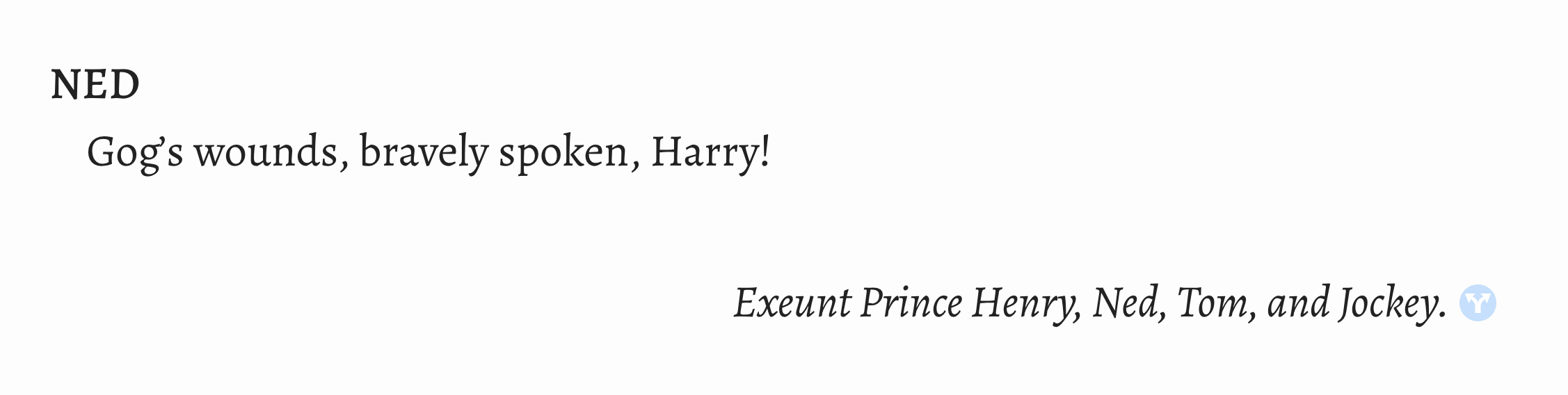
Exits
Encoding:
<sp> <speaker>Ned</speaker> <p>Gog’s wounds, bravely spoken, Harry!</p> </sp><stage type="exit">Exeunt Prince Henry, Ned, Tom, and Jockey.</stage>
Rendering:
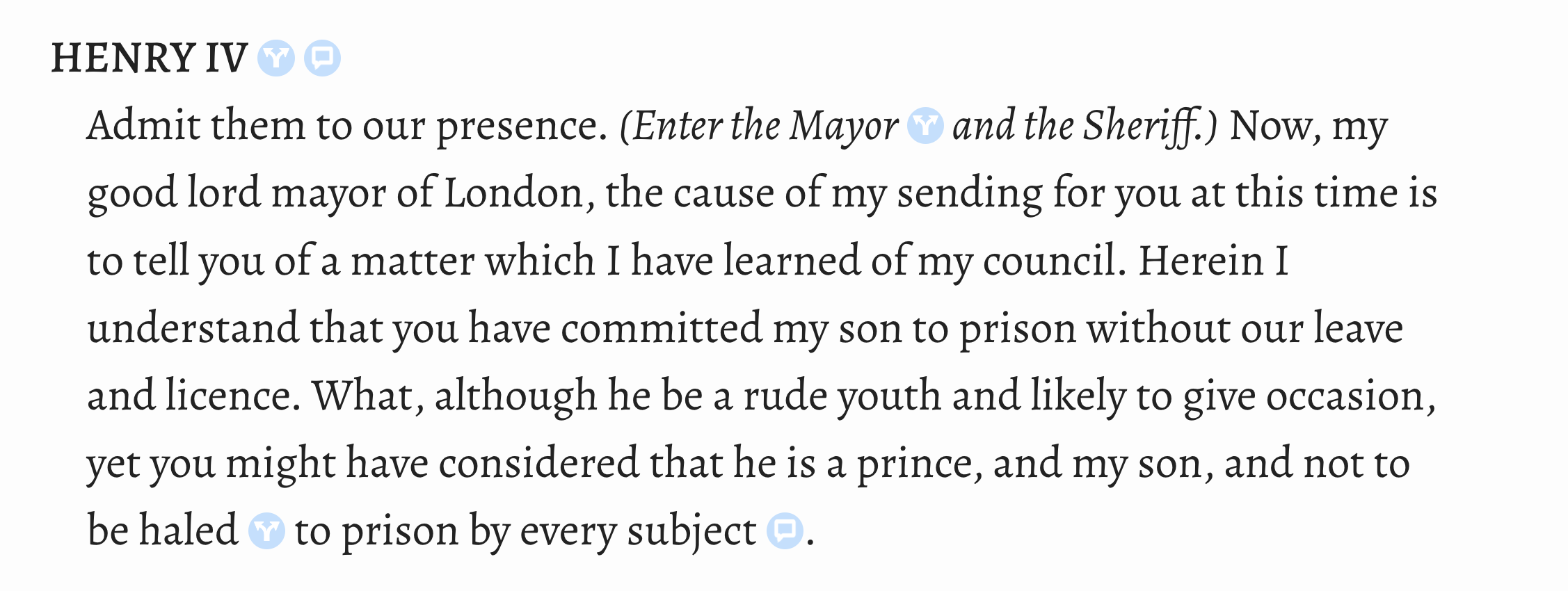
Inline Stage Directions
Encoding:
<sp> <speaker>Henry IV</speaker> <p>Admit them to our presence. <stage type="entrance">Enter the Mayor and the Sheriff.</stage> Now, my good lord mayor of London, <!-- … --></p> </sp>
Rendering:
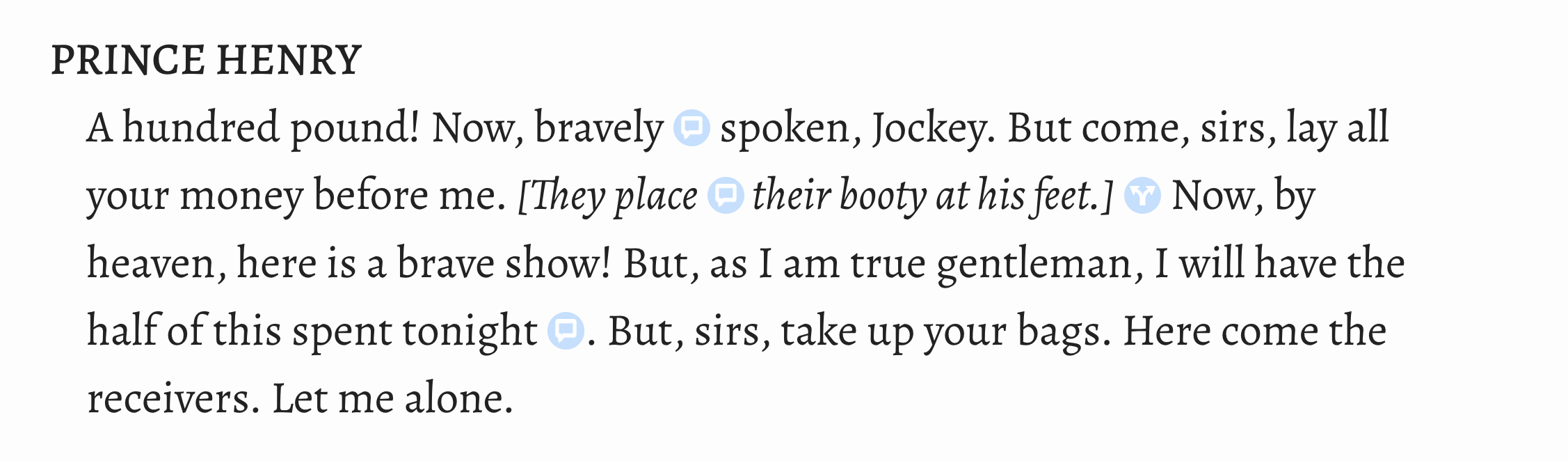
Inline Supplied Stage Direction
Encoding:
<sp> <speaker>Prince Henry</speaker> <p><!-- … --> But come, sirs, lay all your money before me. <stage type="business"> <supplied>They place their booty at his feet.</supplied> </stage> Now, by heaven, here is a brave show! <!-- … --></p> </sp>
Rendering:
Prosopography
Illya
Illya has a BA in English and Sociocultural Anthropology and an MA in English. Prior
to joining the HCMC, he was a PhD candidate in English and Book History at the University
of Toronto and worked on Records of Early English Drama and on the Modernist Archives Publishing Project. His work at the HCMC focuses on creating web-based applications for research projects
led by members of the faculty of Humanities at the University of Victoria. This involves
creating schemas for new and existing datasets, writing XSLT and build files to transform
datasets into structured TEI and HTML formats, implementing staticSearch, and ensuring
that new projects are Endings Principles compliant.
Janelle Jenstad
Janelle Jenstad is a Professor of English at the University of Victoria, Director
of The Map of Early Modern London, and Director of Linked Early Modern Drama Online. With Jennifer Roberts-Smith and Mark Beatrice Kaethler, she co-edited Shakespeare’s Language in Digital Media: Old Words, New Tools (Routledge). She has edited John Stow’s A Survey of London (1598 text) for MoEML and is currently editing The Merchant of Venice (with Stephen Wittek) and Heywood’s 2 If You Know Not Me You Know Nobody for DRE. Her articles have appeared in Digital Humanities Quarterly, Elizabethan Theatre, Early Modern Literary Studies, Shakespeare Bulletin, Renaissance and Reformation, and The Journal of Medieval and Early Modern Studies. She contributed chapters to Approaches to Teaching Othello (MLA); Teaching Early Modern Literature from the Archives (MLA); Institutional Culture in Early Modern England (Brill); Shakespeare, Language, and the Stage (Arden); Performing Maternity in Early Modern England (Ashgate); New Directions in the Geohumanities (Routledge); Early Modern Studies and the Digital Turn (Iter); Placing Names: Enriching and Integrating Gazetteers (Indiana); Making Things and Drawing Boundaries (Minnesota); Rethinking Shakespeare Source Study: Audiences, Authors, and Digital Technologies (Routledge); and Civic Performance: Pageantry and Entertainments in Early Modern London (Routledge). For more details, see janellejenstad.com.
Joey Takeda
Joey Takeda is LEMDO’s Consulting Programmer and Designer, a role he assumed in 2020
after three years as the Lead Developer on LEMDO.
Mahayla Galliford
Project Manager, 2025-present; Assistant Project Manager, 2024-2025; Research Assistant,
2021-present. Mahayla Galliford (she/her) graduated from the University of Victoria
with a BA (honours with distinction) in 2024, and an MA English in 2026. Mahayla’s
undergraduate research explored early modern stage directions and civic water pageantry.
Her SSHRC-funded MA thesis project focuses on transcribing, editing, and encoding
early modern girls’ manuscripts, specifically Lady Rachel Fane’s May Masque in collaboration with LEMDO.
Martin Holmes
Martin Holmes has worked as a developer in the UVic’s Humanities Computing and Media
Centre for over two decades, and has been involved with dozens of Digital Humanities
projects. He has served on the TEI Technical Council and as Managing Editor of the
Journal of the TEI. He took over from Joey Takeda as lead developer on LEMDO in 2020.
He is a collaborator on the SSHRC Partnership Grant led by Janelle Jenstad.
Navarra Houldin
Training and Documentation Lead 2025–present. LEMDO project manager 2022–2025. Textual
remediator 2021–present. Navarra Houldin (they/them) completed their BA with a major
in history and minor in Spanish at the University of Victoria in 2022. Their primary
research was on gender and sexuality in early modern Europe and Latin America. They
are continuing their education through an MA program in Gender and Social Justice
Studies at the University of Alberta where they will specialize in Digital Humanities.
Samuel Seaberg
Samuel Seaberg, a University of Victoria English undergrad, enjoys riding his bike.
During the summer of 2025, he began working with LEMDO as a recipient of the Valerie
Kuehne Undergraduate Research Award (VKURA). Unfortunately, due to his summer being
spent primarily in working to establish an edition of Thomas Heywood’s If You Know Not Me, You Know Nobody, Part 2 and consequently working out how to represent multi-text works in a digital space,
his bike has suffered severely of sheltered seclusion from the sun. Note: Samuel now
works for LEMDO as the Assistant Project Manager, much to his bike’s chagrin.
Sofia Spiteri
Sofia Spiteri is currently completing her Bachelor of Arts in History at the University
of Victoria. During the summer of 2023, she had the opportunity to work with LEMDO
as a recipient of the Valerie Kuehne Undergraduate Research Award (VKURA). Her work
with LEMDO primarily includes semi-diplomatic transcriptions for The Winter’s Tale and Mucedorus.
Tracey El Hajj
Junior Programmer 2019–2020. Research Associate 2020–2021. Tracey received her PhD
from the Department of English at the University of Victoria in the field of Science
and Technology Studies. Her research focuses on the algorhythmics of networked communications. She was a 2019–2020 President’s Fellow in Research-Enriched
Teaching at UVic, where she taught an advanced course on Artificial Intelligence and Everyday Life. Tracey was also a member of the Map of Early Modern London team, between 2018 and 2021. Between 2020 and 2021, she was a fellow in residence
at the Praxis Studio for Comparative Media Studies, where she investigated the relationships
between artificial intelligence, creativity, health, and justice. As of July 2021,
Tracey has moved into the alt-ac world for a term position, while also teaching in
the English Department at the University of Victoria.
Orgography
LEMDO Team (LEMD1)
The LEMDO Team is based at the University of Victoria and normally comprises the project
director, the lead developer, project manager, junior developers(s), remediators,
encoders, and remediating editors.
Metadata
Authority title
Stage Direction Rendering in Modernized Texts
Type of text
Documentation
Publisher
University of Victoria on the Linked Early Modern Drama Online Platform
Released with Linked Early Modern Drama Online 1.0
Encoding description
Encoded in TEI P5 according to the LEMDO Customization and Encoding Guidelines
Document status
prgGenerated
Funder(s)
Social Sciences and Humanities Research Council of Canada
License/availability
This file is licensed under a CC BY-NC_ND 4.0 license, which means that it is freely downloadable without permission under the following
conditions: (1) credit must be given to the author and LEMDO in any subsequent use
of the files and/or data; (2) the content cannot be adapted or repurposed (except
in quotations for the purposes of academic review and citation); and (3) commercial
uses are not permitted without the knowledge and consent of the editor and LEMDO.
This license allows for pedagogical use of the documentation in the classroom.