
Pregnancy and Childbirth
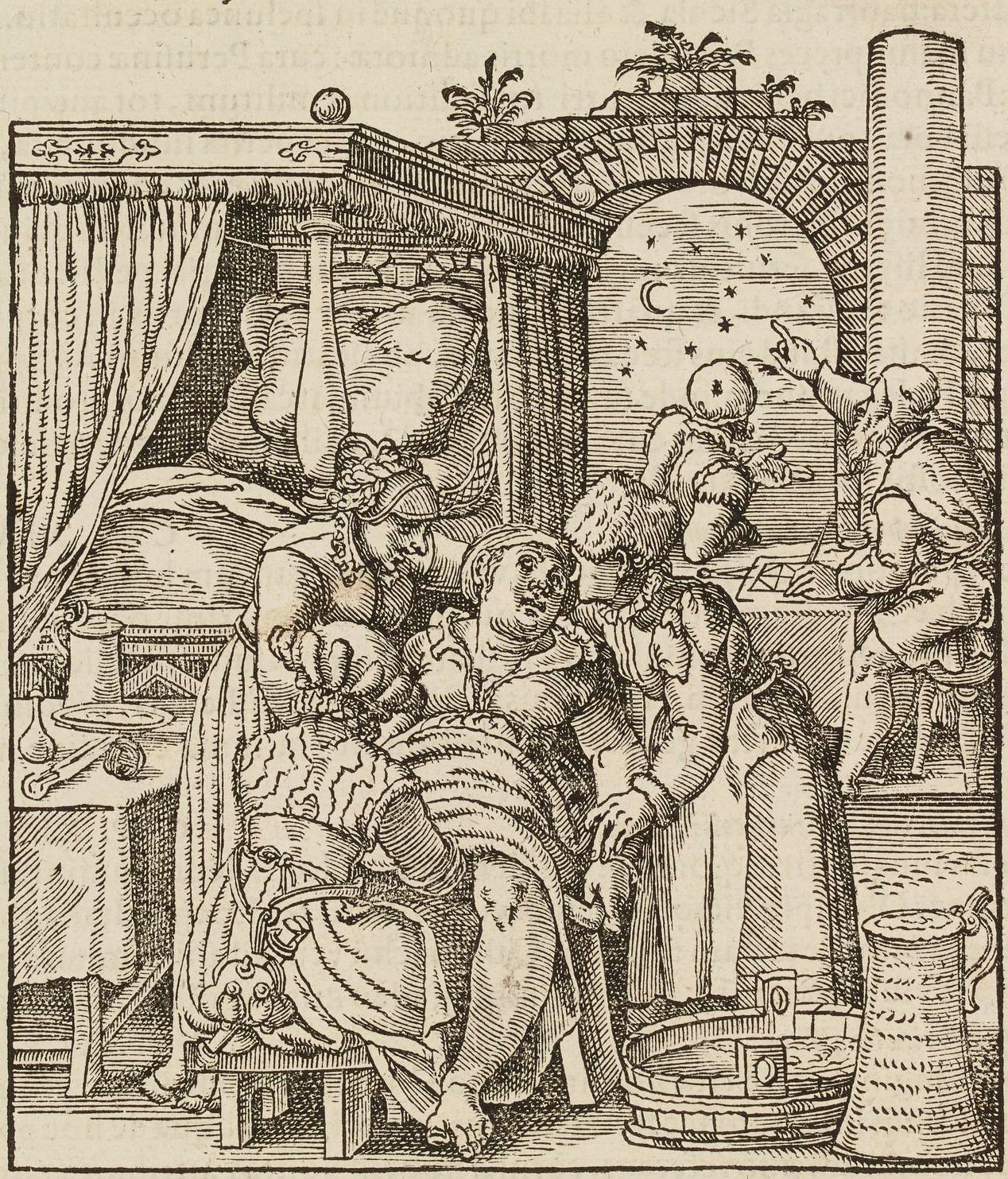
Preparations During Pregnancy
Para1In the early modern era, women normally bore between six
and ten children, but sometimes many more. Despite its frequency, pregnancy was
seldom confirmed until the child quickened or began to move in utero.
Throughout the era, women prepared for childbirth by preparing a
lying-in chamber (a separate room that could be kept warm and
dimly-lit during their labor). They also gathered childbed linens for the birth and
for swaddling the newborn infant. It was common to ask help from
friends, relatives, or neighbour women. These women were called gossips(
a contraction of god-siblings’) and they helped to tend the new mother
during delivery and the month of recovery common afterwards.
Childbirth
Para2Once labor began, women were typically attended by
a midwife and delivered the baby in a seated position using a birthing stool. Only
the midwife, who did not have formal training but had a great deal of experience in
assisting births, was allowed to examine the woman. The midwife cut the umbilical
cord after delivery and swaddled the newborn babe. Only seldom did a male physician
attend a woman giving birth. Fathers and husbands often waited just outside the
birthing chamber for news. The father and the gossips, without the mother, attended
the baptism of the newborn a few days after the birth.
The Curse of Eve
Para3Midwife Jane Sharp’s observed in 1671 in her popular
midwifery manual that
To conceive with child is the earnest desire if not all yet of most women, nature having put into all a will to effect and produce their like. Some there are who hold conception to be a curse, because God laid it upon Eve for tasting the forbidden fruit, I will greatly multiply thy conception: but forsasmuch as encrease and multiply, was the blessing of God, it is not the conception but the sorrow to bring forth that was laid as a curse. (Sharp 76)This religiously informed attitude towards pregnancy and childbirth was common. Many women repeated similar sentiments in their letters and diaries, although they did lament the pain and suffering of becoming a mother, as well.
Para4Christian scriptures gave women’s natural suffering
during childbirth a spiritual framework. In the King James Version, both Genesis 3:16
(
in sorrow thou shalt bring forth children) and 1 Timothy 2:15 (
Notwithstanding she shall be saved in childbearing, if they continue in faith and charity and holiness with sobriety) established the message of many early modern texts about childbearing: women suffered during childbirth as repayment for Eve’s sin and their only hope of redemption lay in motherhood combined with virtuous behavior.
Para5Midwifery manuals, which began to be published regularly
in English in the 1580s, comment extensively upon women’s behavior. Eucharius
Roesselin’s The Birth of Man-Kinde indicates that difficult
women may have difficult births, and those who are
fearful, divers, waywarde, or such a one that will not be ruled, removing herself from one place to another, all such things causeth the labor to be more painful(Rosselin 100). A woman’s
failure to be ruled,in terms of both attitude (if she’s
diversor argumentative) and her desire to choose her own physical location (
removing herself from one place to another) were thought to affect how easy her labour might be.
Childbirth in Shakespeare’s Plays
In The Winter’s Tale, the newly-delivered Hermione complains that she has been denied
child-bed privilegeby her jealous husband Leontes, as she is forced to appear in front of the court into
th’ open air before/I have got the strength of limitsoon after the delivery of her daughter (3.2.103-106). She expected to have but was denied her lying-in.
The grieving Pericles also laments his wife’s difficult and apparently fatal childbirth
experience aboard a ship during a storm:
A terrible childbed hast thou had, my dear;/No light, no fire: the unfriendly elements/Forgot thee utterly(3.1.56-57). Shakespeare compounds the pathos of her death by emphasizing her lack of the familiar traditions surrounding childbirth.
Sources
Aughterson, Kate. Renaissance Woman: A Sourcebook, Constructions of Femininity in England. Routledge, 1995.
Cressy, David. Birth, Marriage, and Death: Ritual, Religion, and the Life-Cycle in Tudor and Stuart
England. Oxford UP, 1999.
Moncrief, Kathryn M.
McPherson, Kathryn R.
Performing Maternity in Early Modern England
Ashgate
2007
Paster, Gail Kern. The Body Embarrassed: Drama and the Disciplines of Shame in Early Modern England. Cornell UP, 1993.
Rosselin, Eucharius. The Birth of Mankind, Otherwise Named The Womans Book. Edited by Elaine Hobby. Routledge, 2017.
Open-Access Digital Resources
Schwartz, Louis.
17th Century Childbirth: “Exquisite torment and infinite grace”.The Lancet. vol. 37, no. 9776. 30 April 2011, doi: https://doi.org/10.1016/S0140-6736(11)60590-4. Accessed 11 Feb. 2026.
Sharp, Jane.The Midwives Book: Or, the whole art of midwifery discovered. London, 1671. Edited by Elaine Hobby. Oxford UP, 1999, https://www.google.com/books/edition/The_Midwives_Book/VizP6wtqtQIC?hl=en&gbpv=1&dq=%22it%20is%20not%20the%20conception%20but%20the%20sorrow%20to%20bring%20forth%20that%20was%20laid%20as%20a%20curse%22&pg=PP1&printsec=frontcover. Accessed 11 Feb. 2026.
Michel, Michelle.
The Birth of mankind: a 16th Century Guide to Pregnancy and Labour.Shakespeare Birthpace Trust, 31 March 2019, https://www.shakespeare.org.uk/explore-shakespeare/blogs/birth-mankind-16th-century-guide-pregnancy-and-labour/. Accessed 11 Feb. 2026.
Prosopography
Janelle Jenstad
Janelle Jenstad is a Professor of English at the University of Victoria, Director
of The Map of Early Modern London, and Director of Linked Early Modern Drama Online. With Jennifer Roberts-Smith and Mark Beatrice Kaethler, she co-edited Shakespeare’s Language in Digital Media: Old Words, New Tools (Routledge). She has edited John Stow’s A Survey of London (1598 text) for MoEML and is currently editing The Merchant of Venice (with Stephen Wittek) and Heywood’s 2 If You Know Not Me You Know Nobody for DRE. Her articles have appeared in Digital Humanities Quarterly, Elizabethan Theatre, Early Modern Literary Studies, Shakespeare Bulletin, Renaissance and Reformation, and The Journal of Medieval and Early Modern Studies. She contributed chapters to Approaches to Teaching Othello (MLA); Teaching Early Modern Literature from the Archives (MLA); Institutional Culture in Early Modern England (Brill); Shakespeare, Language, and the Stage (Arden); Performing Maternity in Early Modern England (Ashgate); New Directions in the Geohumanities (Routledge); Early Modern Studies and the Digital Turn (Iter); Placing Names: Enriching and Integrating Gazetteers (Indiana); Making Things and Drawing Boundaries (Minnesota); Rethinking Shakespeare Source Study: Audiences, Authors, and Digital Technologies (Routledge); and Civic Performance: Pageantry and Entertainments in Early Modern London (Routledge). For more details, see janellejenstad.com.
Kate McPherson
Kate McPherson is Professor of English and Honors Program Director at Utah Valley
University (Orem, UT, USA). In 2015, she began working to redevelop Shakespeare’s Life and Times, created by Michael Best, into the Early Modern England Encyclopedia. Her other publications include commentary on Pericles and The Comedy of Errors for the New Oxford Shakespeare (2016); the co-edited volumes Stages of Engagement: Drama and Religion in Post-Reformation England with James Mardock (Duquesne University Press, 2014) and Shakespeare Expressed: Page, Stage, and Classroom in Shakespeare and His Contemporaries, with Kathryn M. Moncrief and Sarah Enloe (Fairleigh Dickinson University Press,
2013). With Kathryn M. Moncrief, Kate has also two edited collections, Performing Pedagogy in Early Modern England: Gender, Instruction, and Performance (Ashgate, 2011) and Performing Maternity in Early Modern England (Ashgate 2008). She has also published numerous articles on early modern maternity
in scholarly journals. Kate participated in the 2008 National Endowment for the Humanities
Institute,
Shakespeare’s Blackfriars: The Study, the Stage, the Classroom,at the American Shakespeare Center. She also served as Play Seminar Director, a public humanities position, for the Utah Shakespeare Festival in 2017 and 2018.
Leah Hamby
Leah Hamby is the primary encoder for the Early Modern England Encyclopedia. Aside from encoding, she also works as an editor for the project and contributed
several articles of her own. She has been working on the EMEE since February 2023. As of February 2026, she is soon to graduate with honours from
Utah Valley University with a major in history and a minor in creative writing. Her
other work with the LEMDO program includes remediating William Kemp’s Kemp’s Nine Day’s Wonder for the Digital Renaissance Editions.
Michael Best
Michael Best is Professor Emeritus at the University of Victoria, BC. He founded the
Internet Shakespeare Editions in 1996, and was Coordinating Editor until 2017, contributing two editions to the
ISE: King John and King Lear (the latter also available in print from Broadview Press). In print, he has published editions of works of Elizabethan magic and huswifery,
a collection of letters from the Australian goldfields, and Shakespeare on the Art of Love (2008). He contributed regular columns for the Shakespeare Newsletter on
Electronic Shakespeares,and has written many articles and chapters for both print and online books and journals, principally on questions raised by the new medium in the editing and publication of texts. He has delivered papers and plenary lectures on electronic media and the Internet Shakespeare Editions at conferences in Canada, the USA, the UK, Spain, Australia, and Japan.
Navarra Houldin
Training and Documentation Lead 2025–present. LEMDO project manager 2022–2025. Textual
remediator 2021–present. Navarra Houldin (they/them) completed their BA with a major
in history and minor in Spanish at the University of Victoria in 2022. Their primary
research was on gender and sexuality in early modern Europe and Latin America. They
are continuing their education through an MA program in Gender and Social Justice
Studies at the University of Alberta where they will specialize in Digital Humanities.
Orgography
LEMDO Team (LEMD1)
The LEMDO Team is based at the University of Victoria and normally comprises the project
director, the lead developer, project manager, junior developers(s), remediators,
encoders, and remediating editors.
University of Victoria (UVIC1)
https://www.uvic.ca/Metadata
| Authority title | Pregnancy and Childbirth |
| Type of text | Critical |
| Publisher | University of Victoria on the Linked Early Modern Drama Online Platform |
| Series | Early Modern England Encyclopedia |
| Source |
By Kate McPherson, inspired by Michael Best’s Shakespeare’s Life and Times, Internet Shakespeare Editions
|
| Editorial declaration | This document uses Canadian English spelling |
| Edition | Released with Early Modern England Encyclopedia 1.0 |
| Sponsor(s) |
Early Modern England EncyclopediaAnthology Leads: Kate McPherson and Kate Moncrief.
|
| Encoding description | Encoded in TEI P5 according to the LEMDO Customization and Encoding Guidelines |
| Document status | published |
| Funder(s) |
Social Sciences and Humanities Research Council of Canada
Mitacs Globalink Research Internship Utah Valley University |
| License/availability |
Unless otherwise noted, intellectual copyright in EMEE Anthology pages is held by
Kate McPherson on behalf of the contributors. Copyright on the TEI-XML markup is held by the University of Victoria on behalf of the LEMDO Team. The content and TEI-XML markup in this file are licensed under a CC BY-NC-ND 4.0 license. This file is freely downloadable without permission under the following conditions:
(1) credit must be given to the authors, EMEE, and LEMDO in any subsequent use of
the files and /or data; (2) this availability statement must remain in the file; (3)
the content cannot be adapted or repurposed (except for quotations for the purposes
of academic review and citation); and (4) commercial uses are not permitted without
the knowledge and consent of the authors, EMEE, and LEMDO. Neither the content nor
the code in this file is licensed for training large language models (LLMs), ingestion
into an LLM, or any use in any artificial intelligence applications; such uses are
considered to be commercial uses and are strictly prohibited.
|