
Early Modern Witchcraft Accusations
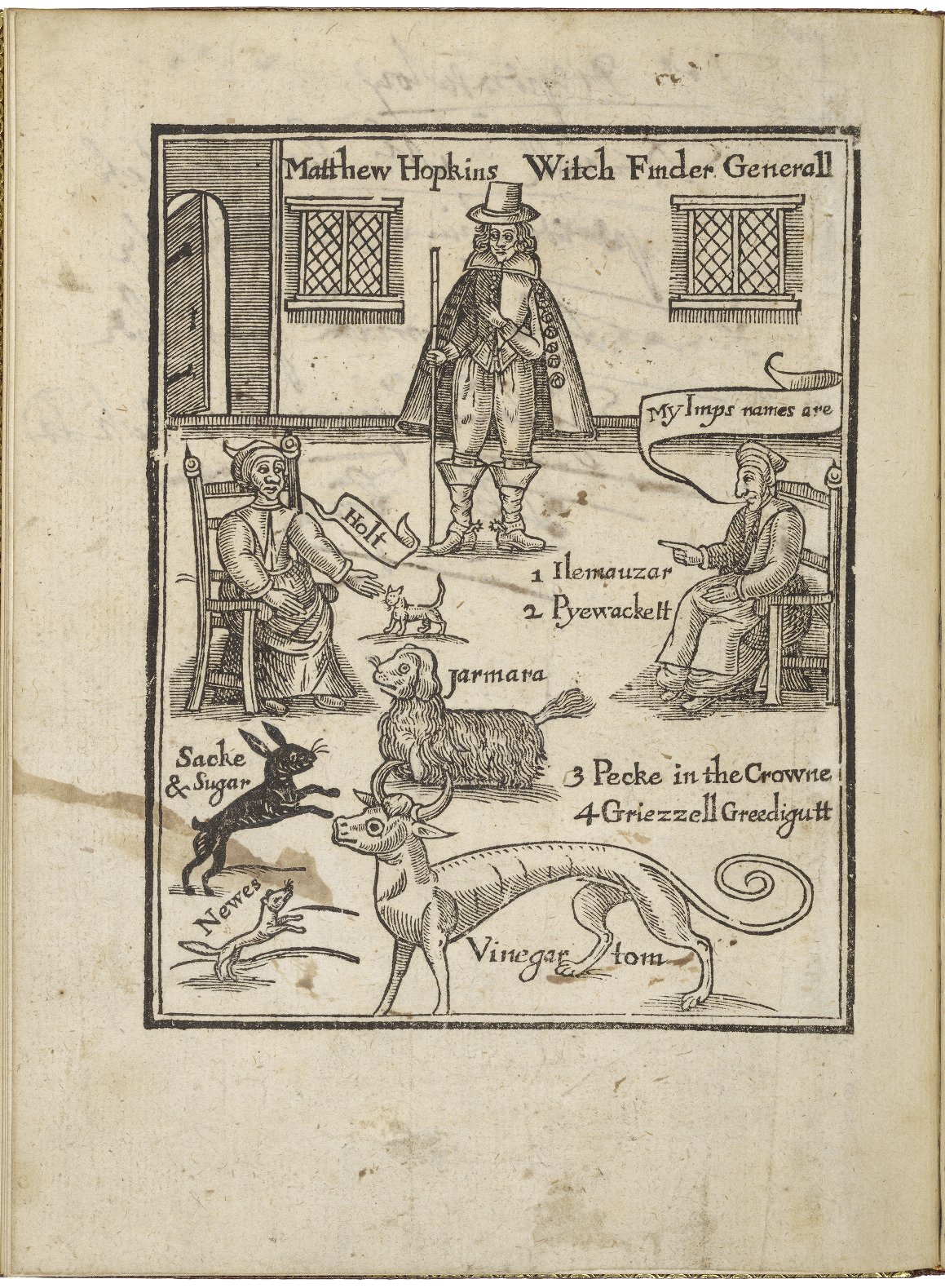
The Discovery of Witches.The image shows Hopkins interrogating two witches and their familiars.
Background to Witchcraft
Para1Witchcraft accusations occurred in the early modern period from 1450–1750, peaking
in Germany from about 1560–1670 and in England during the Puritan rule in the 1650s.
Between 1560 and 1700, 513 people were tried in England, Scotland, or Wales by the
Courts for witchcraft, and 112 were executed.
Para2Europeans in this period defined a witch as someone who used the practice of magic
and/or worshipped the Devil. Witchcraft was viewed as a type of heresy, a spiritual
crime but also one that violated secular laws. This understanding of witchcraft was
passed through handbooks such as the Malleus Maleficarum, published in 1486 by Heinrich Kramer, although the viewpoints it presents were never
officially endorsed by the Catholic Church. Malleus Maleficarum remained influential, republished 26 times in the early modern period.
Witchcraft Accusations of Women and Men
Para3For early modern English culture, witchcraft was also largely thought of as a feminine
weakness and result of feminine deviancy. Women were more likely to be accused of
witchcraft because the Church of England, as did the Church of Rome, viewed women
as the weaker sex and therefore, more vulnerable to seduction by the Devil, as Eve
had been in Genesis. In this sense, witchcraft accusations in early modern society
demonstrate the persistent oppression of women, particularly any woman who did not
conform to societal norms in appearance, speech, and behavior.
Para4On the other hand, men were also accused of witchcraft, but not as often as women.
In fact, Reginald Scot’s book The Discoverie of Witchcraft describes how a practice in magic was both
irrational and un-Christian.Practicing magic was a deviance from social order which led to many male witchcraft accusations.
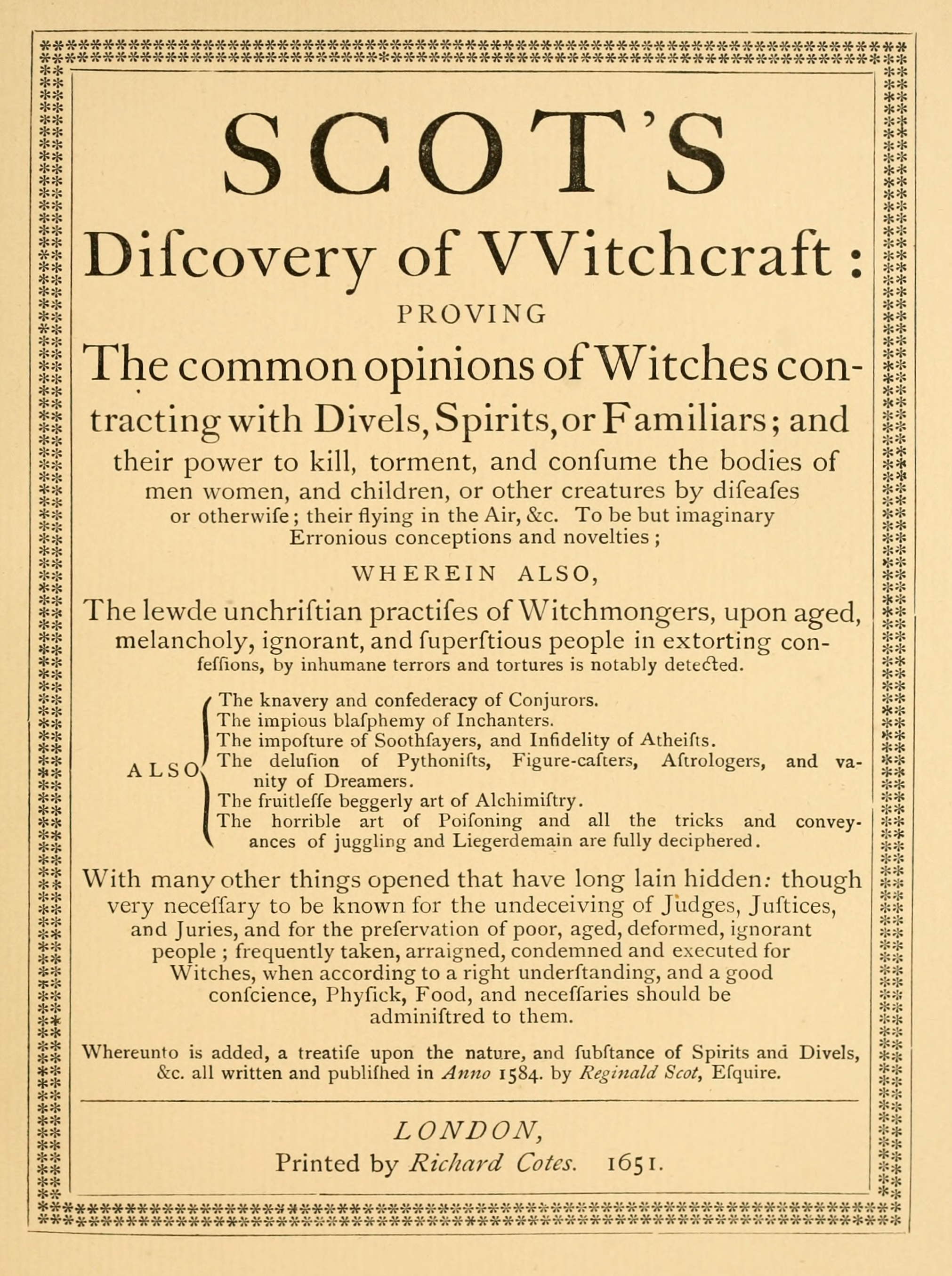
The Discoverie of Witchcraft.
Witchcraft Accusations and Neighborly Feuds
Para5Many forms of interpersonal conflict could lead to an accusation of witchcraft. For
instance, neighborly tensions were a likely cause of witchcraft accusations, and ordinary
people were sometimes accused of witchcraft by their neighbors over disputes regarding
property lines, noise, and other common issues. This increased general fear in local
communities as some people who were disliked by their neighbors may have been more
prone to being accused.
Para6The 1621 play The Witch of Edmonton by William Rowley, John Ford, and Thomas Dekker is based on a true story which directly
addresses witchcraft accusations. The play describes how a woman named Elizabeth Sawyer
is falsely accused of witchcraft by her neighbors who are suspicious of her. After
hearing these false claims, Sawyer takes revenge by actually making a pact with the
Devil. The play and Sawyer’s story is an example of how witchcraft accusations were
made as result of village feuds and basic human conflict.
Witchcraft Accusations and the Poor
Para7The historian Alan McFarlane hypothesizes that witchcraft accusations resulted from
charity refused(Sharpe 35–37) within villages. They were a kind of economically inflected result of scarcity. When individuals with money and status denied poor people financial assistance, they might name them as witches as a result of their guilt for not fulfilling their Christian duties.
Para8Since witches were characterized as poor, weak, and vulnerable, people of lower social
status and wealth were often accused of witchcraft. Additionally, the belief was that
the poor were more likely to sell magical cures and to make pacts with the Devil in
order to survive. At the same time, witchcraft accusations also existed in larger,
more prosperous communities. One reason for this is that
the practice of politically inspired sorceryoccurred in big, urbanized environments (Levack 139). Like revenge for disputes over petty interactions, witchcraft accusations may also have resulted from political or ideological disagreements.
The End of Witchcraft?
Para9In Scotland, the last of the panics about witchcraft occurred in 1662. By 1736, the
United Kingdom’s Parliament repealed the 1563 law that allowed for the trial and execution
of witches, although the law did allow for fining or imprisoning those who claimed
to practice magic. That law was not repealed until 1951.
Sources
Dekker Thomas et al. The Witch of Edmonton. edited by Shelby Richardson. Broadview, 2021.
Eaton, Scott. John Stearne’s Confirmation and Discovery of Witchcraft: Text, Context and Afterlife. Routledge, 2020.
Goodare, Matthew.
A Royal Obsession with Black Magic Started Europe’s Most Brutal Witch Hunts.National Geographic, 19 Oct. 2019.
Levack, Brian P. The Witch-Hunt in Early Modern Europe. 3rd ed., Pearson Longman, 2006.
Sharpe, J.A. Witchcraft in Early Modern England. 2nd ed., Routledge, 2019.
Open-Access Digital Resources
Best, Michael
Witches.Shakespeare’s Life and Times. Internet Shakespeare Editions. University of Victoria, 04 Jan. 2011, https://internetshakespeare.uvic.ca/Library/SLT/ideas/the%20supernatural/witches.html. Accessed 11 Feb. 2026.
Scot, ReginaldThe Discovery of Witchcraft. 1665. Early English Books Online. University of Michigan. http://name.umdl.umich.edu/A62397.0001.001. Accessed 11 Feb. 2026.
Witchcraft.UK Parliament Official Website, https://www.parliament.uk/about/living-heritage/transformingsociety/private-lives/religion/overview/witchcraft/. Accessed 11 Feb. 2026.
Witch Trials in Early Modern Europe and New England.Berkeley Law, 2022, https://www.law.berkeley.edu/research/the-robbins-collection/exhibitions/witch-trials-in-early-modern-europe-and-new-england/. Accessed 11 Feb. 2026.
Worthen, Hannah.
Early Modern Witch Trials.The National Archives, https://www.nationalarchives.gov.uk/education/resources/early-modern-witch-trials/. Accessed 11 Feb. 2026.
Image Source
Scot, Reginald. The Discoverie of Witchcraft. Wikimedia Commons Open Access, 1651, https://commons.wikimedia.org/wiki/File:The_Discoverie_of_Witchcraft_(1651).jpg.
.jpg)
Prosopography
Jasmin Randhawa
Jasmin Randhawa was a student at the University of Fraser Valley.
Kate McPherson
Kate McPherson is Professor of English and Honors Program Director at Utah Valley
University (Orem, UT, USA). In 2015, she began working to redevelop Shakespeare’s Life and Times, created by Michael Best, into the Early Modern England Encyclopedia. Her other publications include commentary on Pericles and The Comedy of Errors for the New Oxford Shakespeare (2016); the co-edited volumes Stages of Engagement: Drama and Religion in Post-Reformation England with James Mardock (Duquesne University Press, 2014) and Shakespeare Expressed: Page, Stage, and Classroom in Shakespeare and His Contemporaries, with Kathryn M. Moncrief and Sarah Enloe (Fairleigh Dickinson University Press,
2013). With Kathryn M. Moncrief, Kate has also two edited collections, Performing Pedagogy in Early Modern England: Gender, Instruction, and Performance (Ashgate, 2011) and Performing Maternity in Early Modern England (Ashgate 2008). She has also published numerous articles on early modern maternity
in scholarly journals. Kate participated in the 2008 National Endowment for the Humanities
Institute,
Shakespeare’s Blackfriars: The Study, the Stage, the Classroom,at the American Shakespeare Center. She also served as Play Seminar Director, a public humanities position, for the Utah Shakespeare Festival in 2017 and 2018.
Leah Hamby
Leah Hamby is the primary encoder for the Early Modern England Encyclopedia. Aside from encoding, she also works as an editor for the project and contributed
several articles of her own. She has been working on the EMEE since February 2023. As of February 2026, she is soon to graduate with honours from
Utah Valley University with a major in history and a minor in creative writing. Her
other work with the LEMDO program includes remediating William Kemp’s Kemp’s Nine Day’s Wonder for the Digital Renaissance Editions.
Melissa Walter
Melissa Walter is Associate Professor of English at the University of the Fraser Valley.
Her research focuses on early modern English drama and English and European prose
fiction. She is the author of The Italian Novella and Shakespeare’s Comic Heroines (U of Toronto, 2019), and co-editor, with Dennis Britton, of Rethinking Shakespeare Source Study: Authors, Audiences, Digital Technologies (Routledge, 2018). Her work on English theatre and the European novella has appeared
in several edited collections, including Transnational Exchange in Early Modern Theater (Ashgate, 2008), and Transnational Mobility in Early Modern Theater (Ashgate, 2012). She has also written about
Translation and Identity in the Dialogues in English and Malaiane Languages(Indographies, ed. Jonathan Gil Harris. Palgrave 2012). At the University of the Fraser Valley, she is a lead coordinator of UFV’s Shakespeare and Reconciliation Garden.
Michael Best
Michael Best is Professor Emeritus at the University of Victoria, BC. He founded the
Internet Shakespeare Editions in 1996, and was Coordinating Editor until 2017, contributing two editions to the
ISE: King John and King Lear (the latter also available in print from Broadview Press). In print, he has published editions of works of Elizabethan magic and huswifery,
a collection of letters from the Australian goldfields, and Shakespeare on the Art of Love (2008). He contributed regular columns for the Shakespeare Newsletter on
Electronic Shakespeares,and has written many articles and chapters for both print and online books and journals, principally on questions raised by the new medium in the editing and publication of texts. He has delivered papers and plenary lectures on electronic media and the Internet Shakespeare Editions at conferences in Canada, the USA, the UK, Spain, Australia, and Japan.
Navarra Houldin
Training and Documentation Lead 2025–present. LEMDO project manager 2022–2025. Textual
remediator 2021–present. Navarra Houldin (they/them) completed their BA with a major
in history and minor in Spanish at the University of Victoria in 2022. Their primary
research was on gender and sexuality in early modern Europe and Latin America. They
are continuing their education through an MA program in Gender and Social Justice
Studies at the University of Alberta where they will specialize in Digital Humanities.
Orgography
LEMDO Team (LEMD1)
The LEMDO Team is based at the University of Victoria and normally comprises the project
director, the lead developer, project manager, junior developers(s), remediators,
encoders, and remediating editors.
University of Victoria (UVIC1)
https://www.uvic.ca/Metadata
| Authority title | Early Modern Witchcraft Accusations |
| Type of text | Critical |
| Publisher | University of Victoria on the Linked Early Modern Drama Online Platform |
| Series | Early Modern England Encyclopedia |
| Source |
By Jasmin Randhawa, inspired by Michael Best’s Shakespeare’s Life and Times, Internet Shakespeare Editions
|
| Editorial declaration | This document uses Canadian English spelling |
| Edition | Released with Early Modern England Encyclopedia 1.0 |
| Sponsor(s) |
Early Modern England EncyclopediaAnthology Leads: Kate McPherson and Kate Moncrief.
|
| Encoding description | Encoded in TEI P5 according to the LEMDO Customization and Encoding Guidelines |
| Document status | published, peer-reviewed |
| Funder(s) |
Social Sciences and Humanities Research Council of Canada
Mitacs Globablink Research Internship |
| License/availability |
Intellectual copyright in this entry is held by Kate McPherson on behalf of the contributors. Copyright on the TEI-XML markup is held by the University of Victoria on behalf of the LEMDO Team. The content and TEI-XML markup in this file are licensed under a CC BY-NC_ND 4.0 license. This file is freely downloadable without permission under the following conditions:
(1) credit must be given to the authors, EMEE, and LEMDO in any subsequent use of
the files and /or data; (2) this availability statement must remain in the file; (3)
the content cannot be adapted or repurposed (except for quotations for the purposes
of academic review and citation); and (4) commercial uses are not permitted without
the knowledge and consent of the authors, EMEE, and LEMDO. Neither the content nor
the code in this file is licensed for training large language models (LLMs), ingestion
into an LLM, or any use in any artificial intelligence applications; such uses are
considered to be commercial uses and are strictly prohibited.
|