
Composition and Publication of Shakespeare’s Sonnets
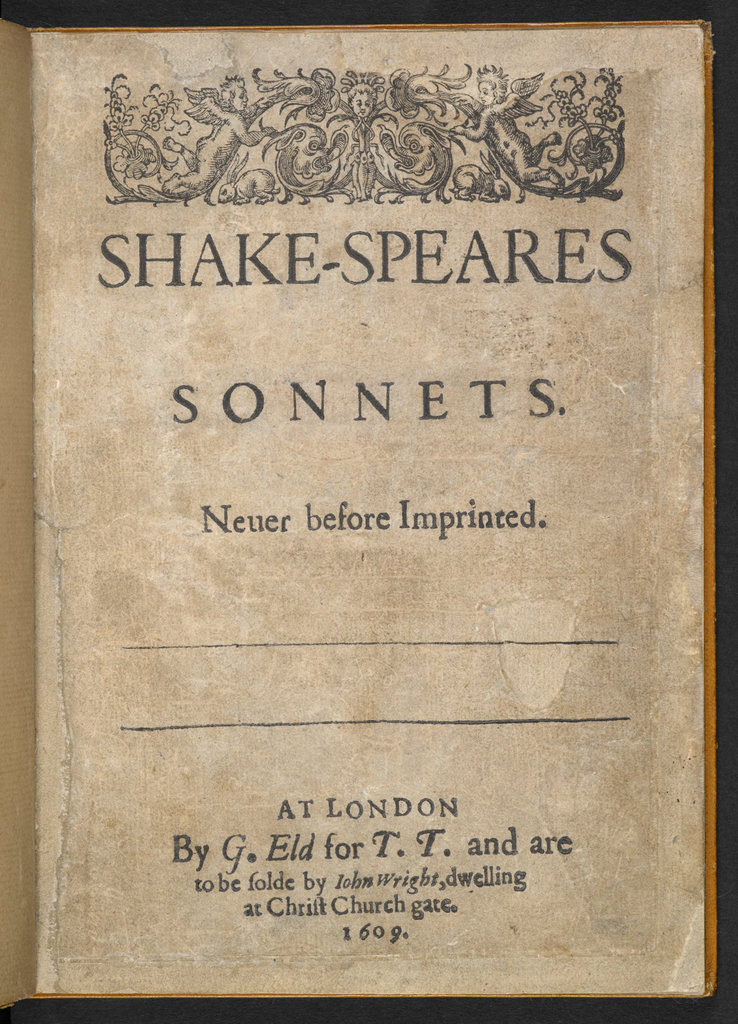
Overview of Shakespeare’s Sonnets
Para1
Believed to have been written in the early to mid-1590s, Shakespeare’s collection
of 154 sonnets was published in 1609 by the printer and bookseller Thomas Thorpe.
Scholars presume that at least some of the sonnets were written earlier, because in
1598, Francis Meres mentions Shakespeare’s
sugared Sonnets among his private friends, etc.in the same document where he lists some of Shakespeare’s popular plays. Circulation of handwritten, recopied poems like Shakespeare’s sonnets between friends and acquaintances was a common literary practice of the time. It was viewed as more genteel than publication.
Para2Two of the poems, #28 and 144, had already been printed in a 1599 literary anthology
called The Passionate Pilgrim. Scholars see ties between several plays of the mid to late 1590s, such as A Midsummer Night’s Dream and Richard II, with the sonnets as they appeared in the 1609 volume.
Dates of Composition for the Sonnets
Para3Many scholars have sought to date the composition of the sonnets using language and
style, with strong consensus that they were not written in the sequence in which they
appeared in 1609. The latest conclusions group them as follows:
Sonnet 145 (about Anne Hathaway?), composed around 1582
Sonnets 127–144, 146-154, composed 1590–1595
Sonnets 87–103, composed 1594–1595
Sonnets 61–77, composed 1594–1595
Sonnets 1–60, composed 1595-97 and revised 1600–1609
Sonnets 78–86 (the
Rival Poetsequence), composed 1598–1600
Sonnets 104–26 (mostly to the
Friend), composed 1600–1604
Puzzles About the Dedication to Shakespeare’s Sonnets
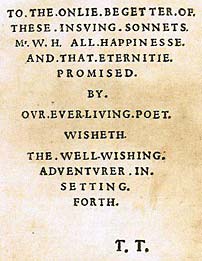
the onlie begetter of these insuing sonnetsto
Mr. W.H.Wikimedia Commons. Public Domain.
Para4On the dedication page when the Sonnets were printed, the following dedication appears,
presumably written by Thomas Thorpe, whose initials appear at the end:
TO THE ONLIE BEGETTER OFTHESE INSUING SONNETSMR. W.H. ALL HAPPINESSEAND THAT ETERNITIEPROMISEDBYOUR EVER-LIVING POETWISHETHTHE WELL-WISHINGADVENTURER INSETTINGFORTHT.T.
Para5Scholars and literary historians believe the main candidates for
Mr. W.H.are
Henry Wriothesley, Earl of Southampton, but his initials are H.W., not “W.H.”. If
he is the dedicatee, it is very unusual that he is addressed as “Mr.” and not
Lord.Southhampton was an young nobleman who sailed on various expeditions and was an investor in the Virginia Colony in North America.
William Herbert, Earl of Pembroke, which is also suspect due to an earl being addressed
as “Mr.” William Herbert was a patron of the arts, as was his wife, Mary Sidney Herbert.
Para6Some have argued that
W.H.is a misprint for “W.S.”, that is, William Shakespeare, who is the creator or
onlie begetter,the creator of the poems. In this period, dedications use the word
begetterto indicate the author, rather than the dedicatee or inspiration. This dedication, signed
T.T.,was presumably written by the bookseller (what we would call the publisher) Thomas Thorpe. However, it is farfetched to assume he would write to the noblemen who had previously acted as patrons of Shakespeare’s work because he did not have a connection with them, as Shakespeare did when he dedicated his narrative poems to them in the 1590s. In the end, the dedication to the sonnets raises more questions than it answers.
Sources
A Companion to Shakespeare’s Sonnets. Edited by Michael Schoenfeldt. Blackwell, 2007.
Shakespeare, William. Shakespeare’s Sonnets. Edited by Paul Edmondsonand Stanley Wells. Oxford UP, 2004.
Shakespeare, William. Shakespeare’s Sonnets and Poems. Edited by Barbara A. Mowat and Paul Werstine. Simon and Schuster, 2006.
Taylor, Gary, and Rory Loughame.
The Canon and Chronology of Shakespeare’s Works.In The New Oxford Shakespeare, edited by Gary Taylor, John Jowett, Terri Bourous, and Gabriel Egan. Oxford UP, 2016, pp. 417-602.
Open-Access Digital Resources
Best, Michael. An ambiguous dedication. Shakespeare’s Life and Times.Internet Shakespeare Editions. University of Victoria, 04 Jan. 2011, https://internetshakespeare.uvic.ca/Library/SLT/life/youth/mrwh.html. Accessed 11 Feb. 2026.
Best, Michael.
The plot thickens.Shakespeare’s Life and Times.Internet Shakespeare Editions. University of Victoria, 04 Jan. 2011, https://internetshakespeare.uvic.ca/Library/SLT/life/youth/sonnets.html. Accessed 11 Feb. 2026.
McCarthy, Erin A.
Sonnets, First Edition.Shakespeare Documented, doi: doi.org/doi.org/10.37078/557.
Neary, Lynn.
Did Shakespeare Want to Suppress His Sonnets?.National Public Radio, 20 May 2009, https://www.npr.org/2009/05/20/104317503/did-shakespeare-want-to-suppress-his-sonnets. Accessed 11 Feb. 2026.
Image Sources
Shakespeare, William. Shakespeare’Sonnets. London: G. Eld, 1609. Title page. British Library. https://www.imagesonline.bl.uk/asset/171318/.
Shakespeare, William. Shakespeare’Sonnets. London: G. Eld, 1609. Composite image of the title page and dedication page. Wikimedia Commons. https://commons.wikimedia.org/wiki/File:SonnetsDedication.jpg.

Prosopography
Kate McPherson
Kate McPherson is Professor of English and Honors Program Director at Utah Valley
University (Orem, UT, USA). In 2015, she began working to redevelop Shakespeare’s Life and Times, created by Michael Best, into the Early Modern England Encyclopedia. Her other publications include commentary on Pericles and The Comedy of Errors for the New Oxford Shakespeare (2016); the co-edited volumes Stages of Engagement: Drama and Religion in Post-Reformation England with James Mardock (Duquesne University Press, 2014) and Shakespeare Expressed: Page, Stage, and Classroom in Shakespeare and His Contemporaries, with Kathryn M. Moncrief and Sarah Enloe (Fairleigh Dickinson University Press,
2013). With Kathryn M. Moncrief, Kate has also two edited collections, Performing Pedagogy in Early Modern England: Gender, Instruction, and Performance (Ashgate, 2011) and Performing Maternity in Early Modern England (Ashgate 2008). She has also published numerous articles on early modern maternity
in scholarly journals. Kate participated in the 2008 National Endowment for the Humanities
Institute,
Shakespeare’s Blackfriars: The Study, the Stage, the Classroom,at the American Shakespeare Center. She also served as Play Seminar Director, a public humanities position, for the Utah Shakespeare Festival in 2017 and 2018.
Leah Hamby
Leah Hamby is the primary encoder for the Early Modern England Encyclopedia. Aside from encoding, she also works as an editor for the project and contributed
several articles of her own. She has been working on the EMEE since February 2023. As of February 2026, she is soon to graduate with honours from
Utah Valley University with a major in history and a minor in creative writing. Her
other work with the LEMDO program includes remediating William Kemp’s Kemp’s Nine Day’s Wonder for the Digital Renaissance Editions.
Michael Best
Michael Best is Professor Emeritus at the University of Victoria, BC. He founded the
Internet Shakespeare Editions in 1996, and was Coordinating Editor until 2017, contributing two editions to the
ISE: King John and King Lear (the latter also available in print from Broadview Press). In print, he has published editions of works of Elizabethan magic and huswifery,
a collection of letters from the Australian goldfields, and Shakespeare on the Art of Love (2008). He contributed regular columns for the Shakespeare Newsletter on
Electronic Shakespeares,and has written many articles and chapters for both print and online books and journals, principally on questions raised by the new medium in the editing and publication of texts. He has delivered papers and plenary lectures on electronic media and the Internet Shakespeare Editions at conferences in Canada, the USA, the UK, Spain, Australia, and Japan.
Navarra Houldin
Training and Documentation Lead 2025–present. LEMDO project manager 2022–2025. Textual
remediator 2021–present. Navarra Houldin (they/them) completed their BA with a major
in history and minor in Spanish at the University of Victoria in 2022. Their primary
research was on gender and sexuality in early modern Europe and Latin America. They
are continuing their education through an MA program in Gender and Social Justice
Studies at the University of Alberta where they will specialize in Digital Humanities.
Orgography
LEMDO Team (LEMD1)
The LEMDO Team is based at the University of Victoria and normally comprises the project
director, the lead developer, project manager, junior developers(s), remediators,
encoders, and remediating editors.
University of Victoria (UVIC1)
https://www.uvic.ca/Metadata
| Authority title | Composition and Publication of Shakespeare’s Sonnets |
| Type of text | Critical |
| Publisher | University of Victoria on the Linked Early Modern Drama Online Platform |
| Series | Early Modern England Encyclopedia |
| Source |
By Kate McPherson, inspired by Michael Best’s Shakespeare’s Life and Times, Internet Shakespeare Editions
|
| Editorial declaration | This document uses Canadian English spelling |
| Edition | Released with Early Modern England Encyclopedia 1.0 |
| Sponsor(s) |
Early Modern England EncyclopediaAnthology Leads: Kate McPherson and Kate Moncrief.
|
| Encoding description | Encoded in TEI P5 according to the LEMDO Customization and Encoding Guidelines |
| Document status | published |
| Funder(s) |
Social Sciences and Humanities Research Council of Canada
Mitacs Globalink Research Internship Utah Valley University |
| License/availability |
Unless otherwise noted, intellectual copyright in EMEE Anthology pages is held by
Kate McPherson on behalf of the contributors. Copyright on the TEI-XML markup is held by the University of Victoria on behalf of the LEMDO Team. The content and TEI-XML markup in this file are licensed under a CC BY-NC-ND 4.0 license. This file is freely downloadable without permission under the following conditions:
(1) credit must be given to the authors, EMEE, and LEMDO in any subsequent use of
the files and /or data; (2) this availability statement must remain in the file; (3)
the content cannot be adapted or repurposed (except for quotations for the purposes
of academic review and citation); and (4) commercial uses are not permitted without
the knowledge and consent of the authors, EMEE, and LEMDO. Neither the content nor
the code in this file is licensed for training large language models (LLMs), ingestion
into an LLM, or any use in any artificial intelligence applications; such uses are
considered to be commercial uses and are strictly prohibited.
|