
Scandals Involving Shakespeare
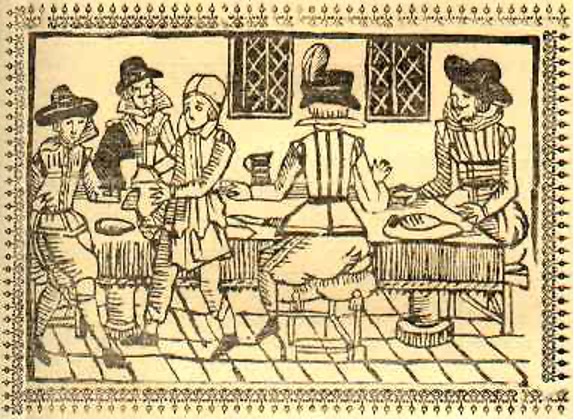
Shakespeare, Burbage, and a Woman
Para1As Shakespeare’s reputation increased in the early 1600s, he became the subject of
gossip. One of the most famous tales involving Shakespeare circulated among law students,
recorded on 13 March 1602 in the diary of John Manningham:
Upon a time when Burbidge played Richard III there was a citizen grew so far in liking with him that, before she went from the play, she appointed him to come that night unto her by the name of Richard the Third.Shakespeare, overhearing their conclusion, went before, was entertained and at his game ere Burbidge came. Then, message being brought that Richard the Third was at the door, Shakespeare caused return to be made that William the Conqueror was before Richard the Third.
This is merely gossip, however, so it cannot be taken as fact. It does demonstrate
that Shakespeare was famous enough in his own time for people to be writing down scandalous
stories about him, however.
Shakespeare’s Illegitimate Son?
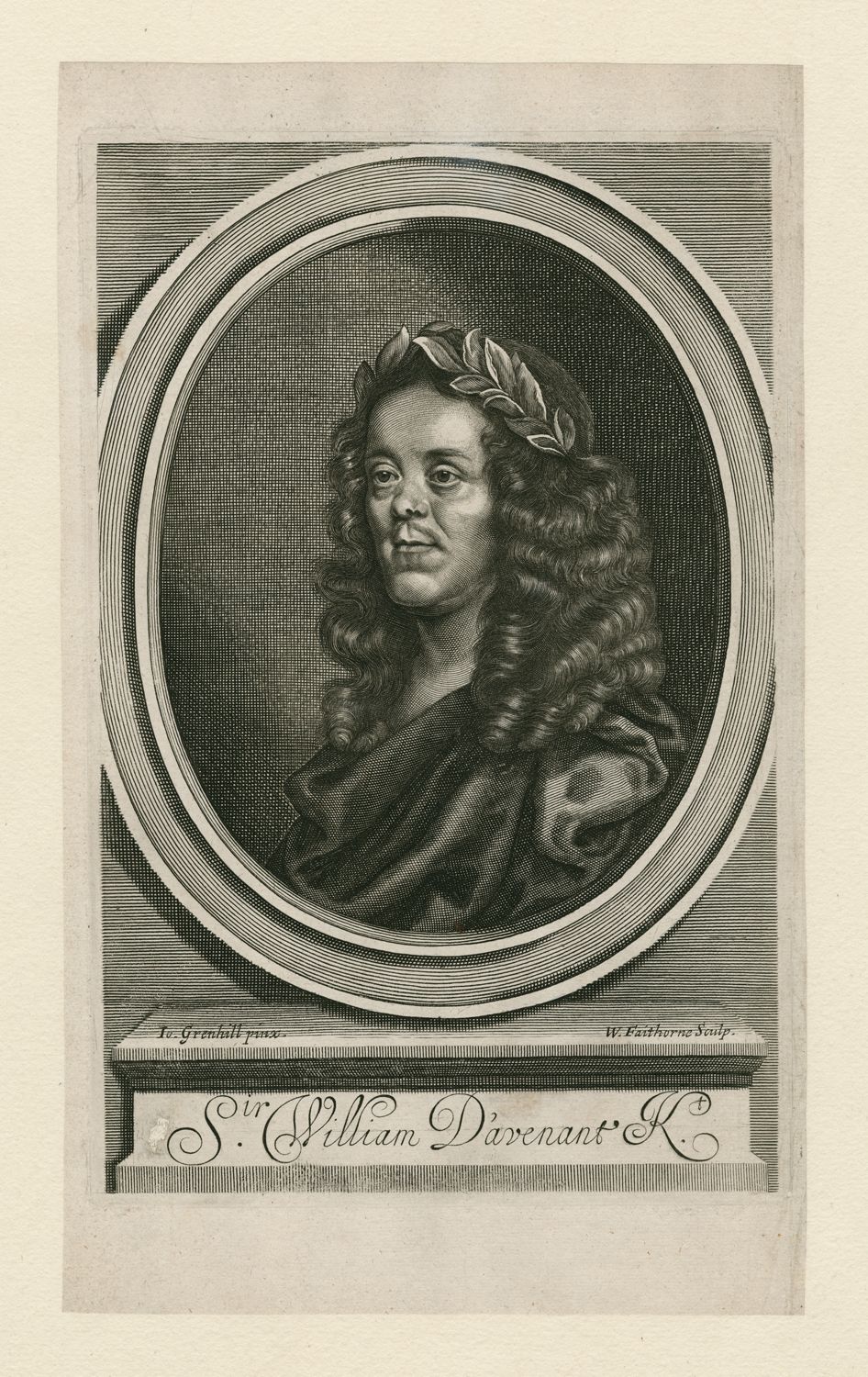
Para2Another legend reports that Shakespeare became lovers with the wife of the proprietor
of the Crown Tavern in Oxford. The legend claims that on one of his frequent stops
between Stratford and London (sometime in June or July 1605), he fathered her fourth
son, William. William Davenant was born in 1606 and went on to be a famous theater
entrepreneur who collaborated with Ben Jonson in the mid-17th century. He publicly
claimed to be Shakespeare’s illegitimate son, but there is no substantive evidence
to demonstrate his claim.
Para3Biographer John Aubrey (1626–1697), who personally knew the Davenant family, records
that William Davenant
when he was pleasant over a glass of wine with his most intimate friends […] say that it seemed to him that he writ with the very spirit that Shakespeare had and was seemed contented enough to be thought his son.
Para4It is perhaps worth noting that William Shakespeare does not mention William Davenant
in his will, where he does make bequests to all his legitimate children.
Para5Historian and conspiracy theorist Simon Stirling supports the view that Davenant was
Shakespeare’s son, drawing on various pieces of circumstantial evidence. He reports
that the 17th century poet Thomas Carew referred to them both as
we of the adulterate mixture (So, oft the bastard nobler fortune meets, / Than the dull Issue of the lawfull sheets).Stirling also notes a 1655 poem that puns on Davenant in relation to Avon, the river that flows through Shakespeare’s hometown. These bits of poetry are far from conclusive indicators.
Para6The rumor about Davenant’s parentage persisted into the 19th century, when novelist
Sir Walter Scott included the incident in Woodstock, or The Cavalier (1826). In it, the following scene occurs:
Why we are said to have one of Shakespeare’s descendants among us—Sir William D’Avenant […] It seems that his mother was a good-looking, laughing, buxom mistress of an inn between Stratford and London, at which Will Shakespeare often quartered as he went down to his native town; and that out of friendship and gossipred relationship between two persons, as we say in Scotland, Will Shakespeare became godfather to Will D’Avenant; and not contented with this spiritual affinity, the younger Will is for establishing some claim to a natural one, alleging that his mother was a great admirer of wit, and there were no bounds to her complaisance for men of genius.
Para7Rumors aside, William Davenant was responsible for re-introducing Shakespeare onto
the English stage after theaters were reopened following the defeat of the Puritans
and the restoration of Charles II in 1660. Davenant’s adaptation of Macbeth in 1663 became a popular revival of the play, albeit with some adaptation of the
language. Lady Macbeth’s famous speech,
Come You Spirits,becomes:
Come, and fill my BreastsWith Gall instead of Milk: make haste dark NightAnd hide me in a smoke as black as Hell,That my keen steel see not the wound it makes,Nor heave’n peep through the curtains of the darkTo cry(1.5.283-92)Hold, hold!
Sources
Davenant, Sir William.The Oxford Companion to Shakespeare. Edited by Michael Dobson and Stanley Wells. 2nd ed., Oxford UP, 2015. p. 106.
Edmond, Mary.
Davenant D’Avenant, Sir William (1606–1668).Oxford Dictionary of National Biography. Oxford UP, 23 Sep. 2004.
Richmond, H. M. Shakespeare’s Theatre: A Dictionary of His Stage Context. Continuum Press, 2002.
Open-Access Digital Resources
Best, Michael.
A Blasting and Scandalous Breath.Shakespeare’s Life and Times. Internet Shakespeare Editions. University of Victoria, 04 Jan. 2011, https://internetshakespeare.uvic.ca/Library/SLT/life/maturity/scandal.html. Accessed 11 Feb. 2026.
Morris, Sylvia.
Sir William Davenant and Adapting Shakespeare, Restoration-Style..The Shakespeare Blog, 13 May 2013, https://theshakespeareblog.com/2013/05/sir-john-davenant-and-adapting-shakespeare-restoration-style/. Accessed 11 Feb. 2026.
Image Sources
Faithorne, William. Sir William Davenant. 1672. Print. Folger Digital Collections. Call number ART File D246.3 no.1. https://digitalcollections.folger.edu/img28494.
Hindley, Charles. The Roxburghe Ballads. Vol. 1. Reeves and Turner, 1873. 93.
Prosopography
Kate McPherson
Kate McPherson is Professor of English and Honors Program Director at Utah Valley
University (Orem, UT, USA). In 2015, she began working to redevelop Shakespeare’s Life and Times, created by Michael Best, into the Early Modern England Encyclopedia. Her other publications include commentary on Pericles and The Comedy of Errors for the New Oxford Shakespeare (2016); the co-edited volumes Stages of Engagement: Drama and Religion in Post-Reformation England with James Mardock (Duquesne University Press, 2014) and Shakespeare Expressed: Page, Stage, and Classroom in Shakespeare and His Contemporaries, with Kathryn M. Moncrief and Sarah Enloe (Fairleigh Dickinson University Press,
2013). With Kathryn M. Moncrief, Kate has also two edited collections, Performing Pedagogy in Early Modern England: Gender, Instruction, and Performance (Ashgate, 2011) and Performing Maternity in Early Modern England (Ashgate 2008). She has also published numerous articles on early modern maternity
in scholarly journals. Kate participated in the 2008 National Endowment for the Humanities
Institute,
Shakespeare’s Blackfriars: The Study, the Stage, the Classroom,at the American Shakespeare Center. She also served as Play Seminar Director, a public humanities position, for the Utah Shakespeare Festival in 2017 and 2018.
Leah Hamby
Leah Hamby is the primary encoder for the Early Modern England Encyclopedia. Aside from encoding, she also works as an editor for the project and contributed
several articles of her own. She has been working on the EMEE since February 2023. As of February 2026, she is soon to graduate with honours from
Utah Valley University with a major in history and a minor in creative writing. Her
other work with the LEMDO program includes remediating William Kemp’s Kemp’s Nine Day’s Wonder for the Digital Renaissance Editions.
Michael Best
Michael Best is Professor Emeritus at the University of Victoria, BC. He founded the
Internet Shakespeare Editions in 1996, and was Coordinating Editor until 2017, contributing two editions to the
ISE: King John and King Lear (the latter also available in print from Broadview Press). In print, he has published editions of works of Elizabethan magic and huswifery,
a collection of letters from the Australian goldfields, and Shakespeare on the Art of Love (2008). He contributed regular columns for the Shakespeare Newsletter on
Electronic Shakespeares,and has written many articles and chapters for both print and online books and journals, principally on questions raised by the new medium in the editing and publication of texts. He has delivered papers and plenary lectures on electronic media and the Internet Shakespeare Editions at conferences in Canada, the USA, the UK, Spain, Australia, and Japan.
Navarra Houldin
Training and Documentation Lead 2025–present. LEMDO project manager 2022–2025. Textual
remediator 2021–present. Navarra Houldin (they/them) completed their BA with a major
in history and minor in Spanish at the University of Victoria in 2022. Their primary
research was on gender and sexuality in early modern Europe and Latin America. They
are continuing their education through an MA program in Gender and Social Justice
Studies at the University of Alberta where they will specialize in Digital Humanities.
Orgography
LEMDO Team (LEMD1)
The LEMDO Team is based at the University of Victoria and normally comprises the project
director, the lead developer, project manager, junior developers(s), remediators,
encoders, and remediating editors.
University of Victoria (UVIC1)
https://www.uvic.ca/Metadata
| Authority title | Scandals Involving Shakespeare |
| Type of text | Critical |
| Publisher | University of Victoria on the Linked Early Modern Drama Online Platform |
| Series | Early Modern England Encyclopedia |
| Source |
By Kate McPherson, inspired by Michael Best’s Shakespeare’s Life and Times, Internet Shakespeare Editions
|
| Editorial declaration | This document uses Canadian English spelling |
| Edition | Released with Early Modern England Encyclopedia 1.0 |
| Sponsor(s) |
Early Modern England EncyclopediaAnthology Leads: Kate McPherson and Kate Moncrief.
|
| Encoding description | Encoded in TEI P5 according to the LEMDO Customization and Encoding Guidelines |
| Document status | published |
| Funder(s) |
Social Sciences and Humanities Research Council of Canada
Mitacs Globalink Research Internship Utah Valley University |
| License/availability |
Unless otherwise noted, intellectual copyright in EMEE Anthology pages is held by
Kate McPherson on behalf of the contributors. Copyright on the TEI-XML markup is held by the University of Victoria on behalf of the LEMDO Team. The content and TEI-XML markup in this file are licensed under a CC BY-NC-ND 4.0 license. This file is freely downloadable without permission under the following conditions:
(1) credit must be given to the authors, EMEE, and LEMDO in any subsequent use of
the files and /or data; (2) this availability statement must remain in the file; (3)
the content cannot be adapted or repurposed (except for quotations for the purposes
of academic review and citation); and (4) commercial uses are not permitted without
the knowledge and consent of the authors, EMEE, and LEMDO. Neither the content nor
the code in this file is licensed for training large language models (LLMs), ingestion
into an LLM, or any use in any artificial intelligence applications; such uses are
considered to be commercial uses and are strictly prohibited.
|