
Shakespeare’s Royal Patron
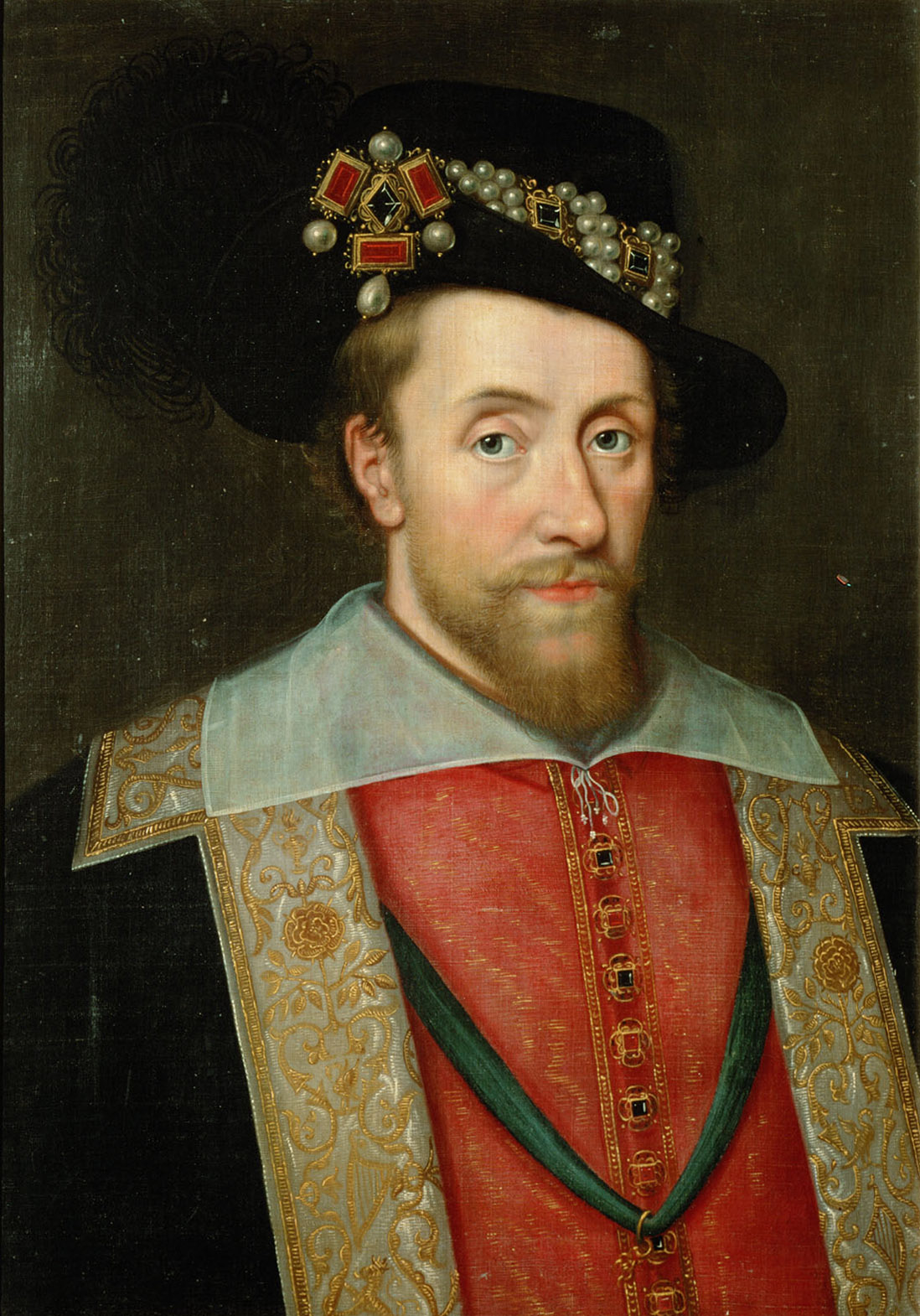
James I Creates The King’s Men
Para1On March 25, 1603, following the death of Queen Elizabeth the previous day, King James
VI of Scotland also became King James I of England. Shortly after his arrival in London
in May 1603, James I granted a formal patent transforming the Lord Chamberlain’s Men
into the King’s Men. Both prestige and profit increased for the theater company, William
Shakespeare included.
The King’s Men and the Coronation of James I of England
Para2James I was not formally crowned king until nearly a year later due to the long progress
(a formal royal journey with many stops at the houses of nobles) from Edinburgh to
London, combined with a severe outbreak of the plague in London. To prepare for his
coronation, more than 1000 royal servants, including members of the King’s Men, were
given the substantial sum £4 each to buy expensive scarlet cloth for a formal uniform
for the procession.
Royal Patrons of the Theater
Para3The King’s household (King James, Queen Anna of Denmark, and their son Prince Henry)
each sponsored their own theater companies in London and were enthusiastic audience
members at court performances. The leading players from those three companies are
listed by name in a document recording the issuing of coronation cloth. The charter
lists 28 players, with the leading player or shareholder listed first. William Shakespeare’s
name appears second in the list, indicating he was among the chief sharers in the
newly named King’s Men.
Para4 The coronation was an occasion that demanded extensive civic pageantry. Other playwrights
and poets of the time such as Ben Jonson and Thomas Dekker helped create pageants
(short performances) along the coronation route, but apparently James rushed past
many of them in his eagerness to be formally crowned in Westminster Abbey.
The King’s Men worked hard after receiving royal patronage, performing nightly for
the court at Hampton Court Palace during Christmas festivities in 1603, in addition
to other private performances for the royal family. By 1604, The King’s Men were performing
plays that connected with James I’s interests, such as Measure for Measure, which deals with the ruler’s responsibilities to the people and the moral improvement
of a city.
The Royal Patent
Para5The Records of the Lord Chancellor contains a document granting Shakespeare’s company
the right to perform under patronage of the king throughout the realm. A modern-spelling
transcription of that royal patent reads:
To all Justices, Mayors, Sheriffs, Constables, Headboroughs, and other our officers and loving subjects, Greeting. Know ye that we of our special grace, certain knowledge, and mere motion, have licensed and authorized, and by these present do license and authorize, these our servants Lawrence Fletcher, William Shakespeare, Richard Burbage, Augustine Phillipps, John Hennings, Henry Condell, William Sly, Robert Armyn, Richard Cowley, and the rest of their associates freely to use and exercise the art and faculty of playing comedies, tragedies, histories, interludes, morals, pastorals, stage plays, and such other like as they have already studied or hereafter shall use or study, as well for the recreation of our loving subjects as for our solace and pleasure when we shall think good to see them during our pleasure. (Nelson)
Para6The document goes on to allow the King’s Men to perform outside of London when the
theaters are closed due to plague. Another privilege came to Shakespeare as part of
this royal patent: along with the other sharers in The King’s Men, Shakespeare became
a Groom Extraordinary of the Chamber (a largely ceremonial post as a minor courtier),
although The King’s Men did serve as attendants to the Spanish Ambassador when he
visited the English court in 1604.
Sources
Potter, Lois.The Life of William Shakespeare: A Critical Biography. Wiley-Blackwell, 2012.
Range, Matthias. Music and Ceremonial at British Coronations: From James I to Elizabeth II. Cambridge UP, 2012.
Open-Access Digital Resources
Kewes, Paulina.Interview with Ian Archer: The Royal Entry of James I 1604. Stuarts Online, https://stuarts-online.com/wp-content/uploads/2017/07/1604.pdf. Accessed 11 Feb. 2026.
Best, Michael.
A Royal Patron, James I.Shakespeare’s Life and Times. Internet Shakespeare Editions. University of Victoria, 04 Jan. 2011, https://internetshakespeare.uvic.ca/Library/SLT/life/maturity/kingsmen.html. Accessed 11 Feb. 2026.
Caldicott, Joshua.
From Foreign Enemy to Great Unifying Leader: Performances of King James VI and I between 1599 and 1624 in the Works of Ben Jonson and William Shakespeare.Innvervate vol. 9, 2016–2017, pp. 167–172. U of Nottingham, https://www.nottingham.ac.uk/english/documents/innervate/16-17/19.-caldicott-j-q33398.pdf. Accessed 11 Feb. 2026.
Nelson, Alan H..
King James Establishes the King’s Men: Warrant Under Privy Seal.Shakespeare Documented, doi: doi.org/doi.org/10.37078/125. Accessed 11 Feb. 2026.
Image Sources
King James I (1566–1625) of England and Scotland, Half-Length Portrait. After 1605. Oil on canvas. Kunsthistorisches Museum Vienna. https://www.khm.at/kunstwerke/koenig-jakob-i-1566-1625-von-england-und-schottland-brustbild-2438.
Prosopography
Kate McPherson
Kate McPherson is Professor of English and Honors Program Director at Utah Valley
University (Orem, UT, USA). In 2015, she began working to redevelop Shakespeare’s Life and Times, created by Michael Best, into the Early Modern England Encyclopedia. Her other publications include commentary on Pericles and The Comedy of Errors for the New Oxford Shakespeare (2016); the co-edited volumes Stages of Engagement: Drama and Religion in Post-Reformation England with James Mardock (Duquesne University Press, 2014) and Shakespeare Expressed: Page, Stage, and Classroom in Shakespeare and His Contemporaries, with Kathryn M. Moncrief and Sarah Enloe (Fairleigh Dickinson University Press,
2013). With Kathryn M. Moncrief, Kate has also two edited collections, Performing Pedagogy in Early Modern England: Gender, Instruction, and Performance (Ashgate, 2011) and Performing Maternity in Early Modern England (Ashgate 2008). She has also published numerous articles on early modern maternity
in scholarly journals. Kate participated in the 2008 National Endowment for the Humanities
Institute,
Shakespeare’s Blackfriars: The Study, the Stage, the Classroom,at the American Shakespeare Center. She also served as Play Seminar Director, a public humanities position, for the Utah Shakespeare Festival in 2017 and 2018.
Leah Hamby
Leah Hamby is the primary encoder for the Early Modern England Encyclopedia. Aside from encoding, she also works as an editor for the project and contributed
several articles of her own. She has been working on the EMEE since February 2023. As of February 2026, she is soon to graduate with honours from
Utah Valley University with a major in history and a minor in creative writing. Her
other work with the LEMDO program includes remediating William Kemp’s Kemp’s Nine Day’s Wonder for the Digital Renaissance Editions.
Michael Best
Michael Best is Professor Emeritus at the University of Victoria, BC. He founded the
Internet Shakespeare Editions in 1996, and was Coordinating Editor until 2017, contributing two editions to the
ISE: King John and King Lear (the latter also available in print from Broadview Press). In print, he has published editions of works of Elizabethan magic and huswifery,
a collection of letters from the Australian goldfields, and Shakespeare on the Art of Love (2008). He contributed regular columns for the Shakespeare Newsletter on
Electronic Shakespeares,and has written many articles and chapters for both print and online books and journals, principally on questions raised by the new medium in the editing and publication of texts. He has delivered papers and plenary lectures on electronic media and the Internet Shakespeare Editions at conferences in Canada, the USA, the UK, Spain, Australia, and Japan.
Navarra Houldin
Training and Documentation Lead 2025–present. LEMDO project manager 2022–2025. Textual
remediator 2021–present. Navarra Houldin (they/them) completed their BA with a major
in history and minor in Spanish at the University of Victoria in 2022. Their primary
research was on gender and sexuality in early modern Europe and Latin America. They
are continuing their education through an MA program in Gender and Social Justice
Studies at the University of Alberta where they will specialize in Digital Humanities.
Orgography
LEMDO Team (LEMD1)
The LEMDO Team is based at the University of Victoria and normally comprises the project
director, the lead developer, project manager, junior developers(s), remediators,
encoders, and remediating editors.
University of Victoria (UVIC1)
https://www.uvic.ca/Metadata
| Authority title | Shakespeare’s Royal Patron |
| Type of text | Critical |
| Publisher | University of Victoria on the Linked Early Modern Drama Online Platform |
| Series | Early Modern England Encyclopedia |
| Source |
By Kate McPherson, inspired by Michael Best’s Shakespeare’s Life and Times, Internet Shakespeare Editions
|
| Editorial declaration | This document uses Canadian English spelling |
| Edition | Released with Early Modern England Encyclopedia 1.0 |
| Sponsor(s) |
Early Modern England EncyclopediaAnthology Leads: Kate McPherson and Kate Moncrief.
|
| Encoding description | Encoded in TEI P5 according to the LEMDO Customization and Encoding Guidelines |
| Document status | published |
| Funder(s) |
Social Sciences and Humanities Research Council of Canada
Mitacs Globalink Research Internship Utah Valley University |
| License/availability |
Unless otherwise noted, intellectual copyright in EMEE Anthology pages is held by
Kate McPherson on behalf of the contributors. Copyright on the TEI-XML markup is held by the University of Victoria on behalf of the LEMDO Team. The content and TEI-XML markup in this file are licensed under a CC BY-NC-ND 4.0 license. This file is freely downloadable without permission under the following conditions:
(1) credit must be given to the authors, EMEE, and LEMDO in any subsequent use of
the files and /or data; (2) this availability statement must remain in the file; (3)
the content cannot be adapted or repurposed (except for quotations for the purposes
of academic review and citation); and (4) commercial uses are not permitted without
the knowledge and consent of the authors, EMEE, and LEMDO. Neither the content nor
the code in this file is licensed for training large language models (LLMs), ingestion
into an LLM, or any use in any artificial intelligence applications; such uses are
considered to be commercial uses and are strictly prohibited.
|