
Shakespeare’s New Home in Stratford
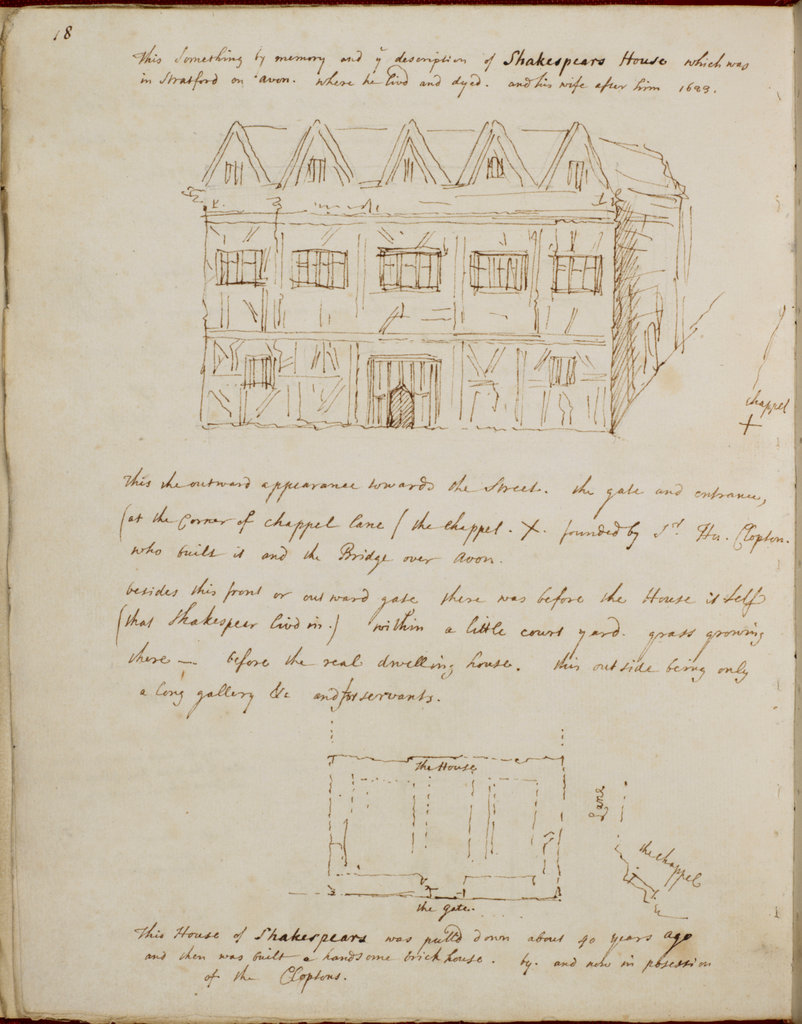
Shakespeare Buys a Home
Para1At the age of 33, the year following his son Hamnet’s death, William Shakespeare had
enough money to invest perhaps £120 (about $25,000) in a new house in his hometown.
At 60 feet long, New Place was the second largest home in Stratford-upon-Avon. The
brick house was equipped with leaded windows and ten chimneys. It had two barns and
two orchards on the property. Unfortunately, the building no longer exists. The home
was demolished by a subsequent owner, Reverend Francis Gastrill, in 1759.
A History of New Place
Para2Built toward the end of the 1400s by Hugh Clopton, New Place was about 100 years old
when Shakespeare bought the property in 1597. After Clopton’s descendants sold the
house, it was passed between several owners before William Underhill purchased the
house in the fall of 1567. He owned the home until his death three years later, upon
which ownership of the house passed to his son, William Underhill II. He owned New
Place for nearly thirty years before selling it to Shakespeare. As the owner of New
Place, Shakespeare had a special pew reserved for him at church, named the “Clopton
Pew ” after the home’s original builder.
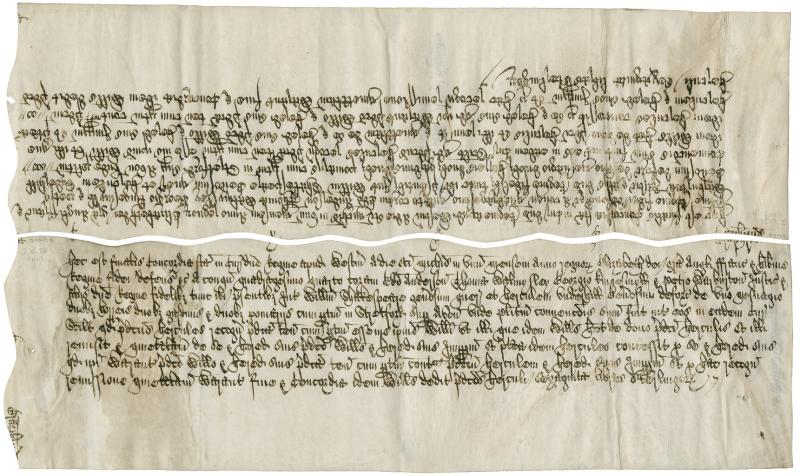
Para3The purchase of New Place illustrates Shakespeare’s increasing affluence at the time.
He was a successful theatrical entrepreneur in London who maintained his family’s
position and comfort in Stratford while he lived in London in rented rooms. Later,
prior to his retirement to his hometown, from 1609 until 1611, his good friend Thomas
Greene’s family shared the spacious house with the Shakespeares while Greene’s home
was being finished.
A Complicated Purchase
Para4The process of purchasing the house was complicated, since there was a scandal to
clear up before Shakespeare could take full possession. William Underhill, the previous
owner of New Place, was poisoned two months after selling the property and died in
July 1597. His 19-year-old son, Fulke, was found guilty of the crime and hanged in
March 1599. Following this complex drama of his home’s previous owners, Shakespeare
had to wait until 1602, when Underhill’s second son Hercules came of age, before he
could finally conclude the last aspects of the property deal, though some sources
argue that he had nearly full ownership and was in possession of the house by February
of 1598.
Para5The expense of buying New Place may have created some financial problems for Shakespeare,
since his name appears as a defaulter on the payment of taxes on 15 November 1597.
He owed a sum of five shillings (1/4 of one pound). Nearly a year later, on 1 October
1598, Shakespeare was listed again as being in arrears, this time for thirteen shillings
and four pence.
New Place Today
Para6 Although New Place was demolished in 1759, The Shakespeare Birthplace Trust owns
the property on which it sat, as well as the property next door, a home once owned
by Thomas Nash. In celebration of the 400th anniversary of Shakespeare’s death in
2016, the Trust unveiled a newly renovated garden with numerous new sculptures and
other displays at New Place that allows visitors to walk the footprint of the home
and explore Shakespeare’s life through an exhibition.
Sources
Bearman, Robert.
Shakespeare’s Purchase of New Place.Shakespeare Quarterly, vol. 63, no. 4. Winter 2012, pp. 465-486.
Edmondson, Paul.
A Renaissance For New Place in Shakespearean Biography?.Critical Survey, vol. 25. no. 1, 2013, pp. 90-98.
Pogue, Kate. Shakespeare’s Friends.. Praeger, 2006.
Potter, Lois. The Life of William Shakespeare: A Critical Biography. Wiley-Blackwell, 2012.
Open-Access Digital Resources
Bearman, Robert, and Alan H. Nelson et al..
Shakespeare Purchases New Place.Shakespeare Documented, doi: doi.org/10.37078/675. Accessed 11 Feb. 2026.
Best, Michael.
A Major Purchase in Stratford, 1597.Shakespeare’s Life and Times. Internet Shakespeare Editions. University of Victoria, 04 Jan. 2011, https://internetshakespeare.uvic.ca/Library/SLT/life/early%20maturity/newplace.html.. Accessed 11 Feb. 2026.
Image Sources
Final Concord between William Shakespeare and Hercules Underhill, Gent. 1602. Folger Digital Collections. https://digitalcollections.folger.edu/img3321.
Vertue, George. Sketch of New Place. 1737. Pencil on paper. British Library, Shelfmark Add. 70438. https://www.imagesonline.bl.uk/asset/46831/.
Prosopography
Kate McPherson
Kate McPherson is Professor of English and Honors Program Director at Utah Valley
University (Orem, UT, USA). In 2015, she began working to redevelop Shakespeare’s Life and Times, created by Michael Best, into the Early Modern England Encyclopedia. Her other publications include commentary on Pericles and The Comedy of Errors for the New Oxford Shakespeare (2016); the co-edited volumes Stages of Engagement: Drama and Religion in Post-Reformation England with James Mardock (Duquesne University Press, 2014) and Shakespeare Expressed: Page, Stage, and Classroom in Shakespeare and His Contemporaries, with Kathryn M. Moncrief and Sarah Enloe (Fairleigh Dickinson University Press,
2013). With Kathryn M. Moncrief, Kate has also two edited collections, Performing Pedagogy in Early Modern England: Gender, Instruction, and Performance (Ashgate, 2011) and Performing Maternity in Early Modern England (Ashgate 2008). She has also published numerous articles on early modern maternity
in scholarly journals. Kate participated in the 2008 National Endowment for the Humanities
Institute,
Shakespeare’s Blackfriars: The Study, the Stage, the Classroom,at the American Shakespeare Center. She also served as Play Seminar Director, a public humanities position, for the Utah Shakespeare Festival in 2017 and 2018.
Leah Hamby
Leah Hamby is the primary encoder for the Early Modern England Encyclopedia. Aside from encoding, she also works as an editor for the project and contributed
several articles of her own. She has been working on the EMEE since February 2023. As of February 2026, she is soon to graduate with honours from
Utah Valley University with a major in history and a minor in creative writing. Her
other work with the LEMDO program includes remediating William Kemp’s Kemp’s Nine Day’s Wonder for the Digital Renaissance Editions.
Michael Best
Michael Best is Professor Emeritus at the University of Victoria, BC. He founded the
Internet Shakespeare Editions in 1996, and was Coordinating Editor until 2017, contributing two editions to the
ISE: King John and King Lear (the latter also available in print from Broadview Press). In print, he has published editions of works of Elizabethan magic and huswifery,
a collection of letters from the Australian goldfields, and Shakespeare on the Art of Love (2008). He contributed regular columns for the Shakespeare Newsletter on
Electronic Shakespeares,and has written many articles and chapters for both print and online books and journals, principally on questions raised by the new medium in the editing and publication of texts. He has delivered papers and plenary lectures on electronic media and the Internet Shakespeare Editions at conferences in Canada, the USA, the UK, Spain, Australia, and Japan.
Navarra Houldin
Training and Documentation Lead 2025–present. LEMDO project manager 2022–2025. Textual
remediator 2021–present. Navarra Houldin (they/them) completed their BA with a major
in history and minor in Spanish at the University of Victoria in 2022. Their primary
research was on gender and sexuality in early modern Europe and Latin America. They
are continuing their education through an MA program in Gender and Social Justice
Studies at the University of Alberta where they will specialize in Digital Humanities.
Orgography
LEMDO Team (LEMD1)
The LEMDO Team is based at the University of Victoria and normally comprises the project
director, the lead developer, project manager, junior developers(s), remediators,
encoders, and remediating editors.
University of Victoria (UVIC1)
https://www.uvic.ca/Metadata
| Authority title | Shakespeare’s New Home in Stratford |
| Type of text | Critical |
| Publisher | University of Victoria on the Linked Early Modern Drama Online Platform |
| Series | Early Modern England Encyclopedia |
| Source |
By Kate McPherson, inspired by Michael Best’s Shakespeare’s Life and Times, Internet Shakespeare Editions
|
| Editorial declaration | This document uses Canadian English spelling |
| Edition | Released with Early Modern England Encyclopedia 1.0 |
| Sponsor(s) |
Early Modern England EncyclopediaAnthology Leads: Kate McPherson and Kate Moncrief.
|
| Encoding description | Encoded in TEI P5 according to the LEMDO Customization and Encoding Guidelines |
| Document status | published, peer-reviewed |
| Funder(s) |
Social Sciences and Humanities Research Council of Canada
Mitacs Globalink Research Internship Utah Valley University |
| License/availability |
Unless otherwise noted, intellectual copyright in EMEE Anthology pages is held by
Kate McPherson on behalf of the contributors. Copyright on the TEI-XML markup is held by the University of Victoria on behalf of the LEMDO Team. The content and TEI-XML markup in this file are licensed under a CC BY-NC-ND 4.0 license. This file is freely downloadable without permission under the following conditions:
(1) credit must be given to the authors, EMEE, and LEMDO in any subsequent use of
the files and /or data; (2) this availability statement must remain in the file; (3)
the content cannot be adapted or repurposed (except for quotations for the purposes
of academic review and citation); and (4) commercial uses are not permitted without
the knowledge and consent of the authors, EMEE, and LEMDO. Neither the content nor
the code in this file is licensed for training large language models (LLMs), ingestion
into an LLM, or any use in any artificial intelligence applications; such uses are
considered to be commercial uses and are strictly prohibited.
|