
Shakespeare’s Marriage
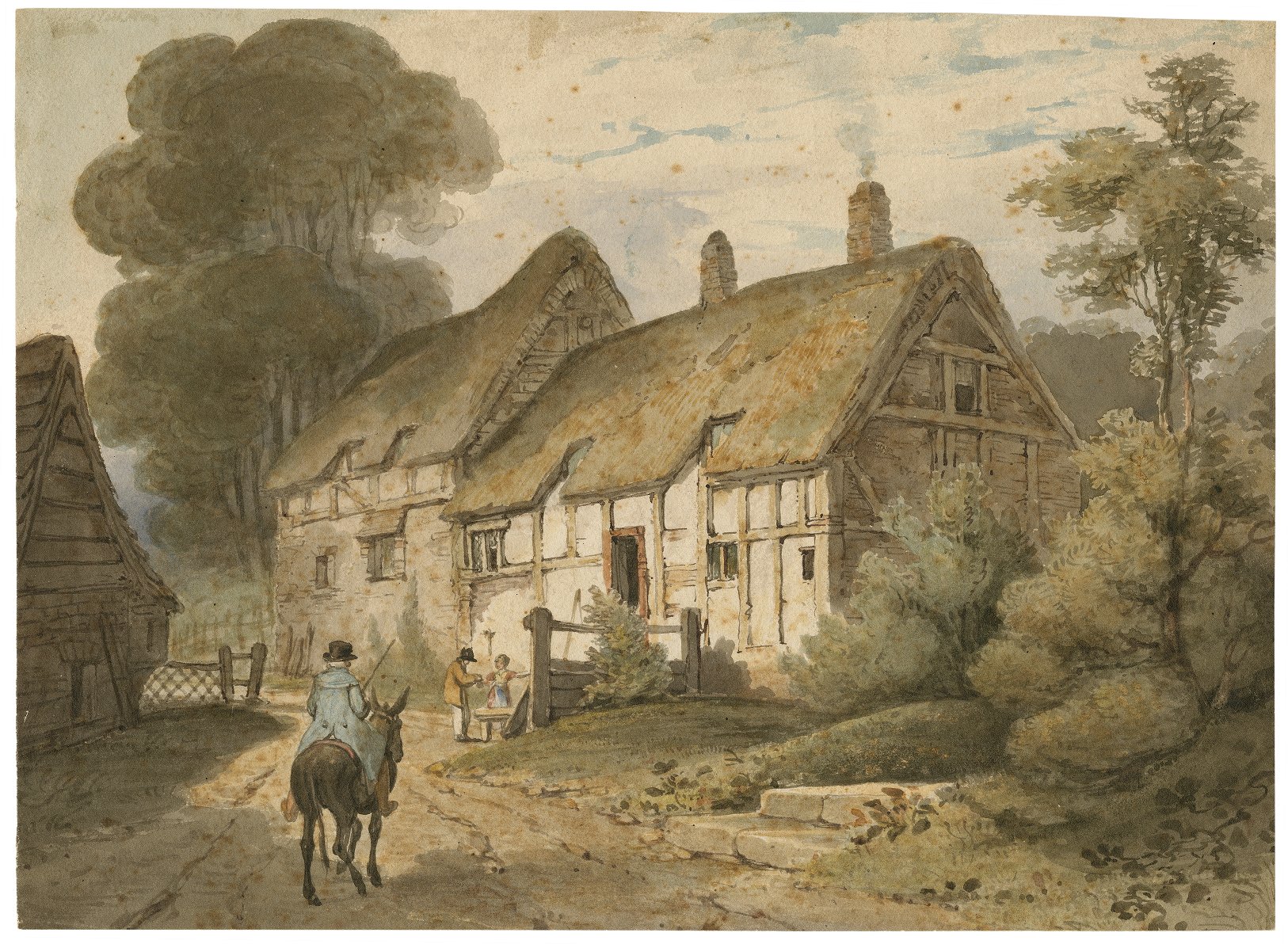
Records of Shakespeares Marriage
On 27 November 1582, a marriage license was granted by the Bishop of Worcestor to
Wm Shaxpere et and Anne Whateley.Nothing more is known of Anne Whateley, who is listed as residing in Temple Grafton, a village about 6 miles west of Shakespeare’s home town. Scholars believe it may be a clerical error that led to her name being recorded, however some Whateleys did live in the Stratford-upon-Avon area.
Para2The following day, on 28 November 1582, a £40 pound bond was posted by two Warwickshire
farmers for the legality of a marriage between “William Shagspere” and “Anne Hathwey”,
who was the daughter of a prosperous farmer in Shottery, a village less than a mile
from central Stratford-upon-Avon. The two men were close friends of Anne Hathaway’s
recently deceased father. The payment of this bond and the presence of witnesses meant
that the couple could get around the normal procedure of having the impending marriage
announced in their local parish church on three consecutive Sundays, a process called
reading the banns. This process allowed the local community to be informed about upcoming
marriages, in part to make sure that couples were not too closely related and that
neither had been betrothed to another person.
Explanation for Two Marriage Records
Para3 Scholar David Kathman notes that the apparent confusion of the two Annes (Whateley
and Hathaway) is later cleared up in a bequest in the will of Thomas Whittington,
the man who served as shepherd to the Hathaway family. When he died in 1601, Whittington
left 40 shillings to the poor people of Stratford and asked that the money be payed
by
anne Shaxpere, wyf unto Mr. Wyllyam Shakspere.As the Shakespeare Documented project notes,
William Shakespeare married Anne Hathaway late in November 1582. However, the marriage did not take place in the couple’s parish church at Stratford-upon-Avon and nor were the banns read there three times, as would normally have been required. Instead application was made to the bishop of Worcester, in whose diocese Stratford then lay, for a license for the marriage to take place elsewhere after a single reading of banns. The license itself, which would have been addressed to the minister of the church at which the ceremony was to take place, is not extant. However, no existing surviving parish register records the event; therefore, Shakespeare’s marriage may have taken place at any local church without a surviving register.(Bearman)It seems likely that the couple wished to accelerate their marriage date because Anne Hathaway was certainly pregnant in late November 1582. The next public record indicates that six months later, on 26 May 1583, Shakespeare’s first daughter Susanna was christened.
Speculation About Shakespeare’s Marriage
Para4 While the discrepancies between the marriage license and the bond have raised questions,
other unusual facts have led to speculation. Anne Hathaway was a woman eight years
older than William; at the time of their marriage, she would have been 26 years old
and he only 18. It was typical among the common people in early modern England to
marry in the mid-20s, with the average age of marriage for men being 26 and for women,
24. Thus, Anne was slightly older than was typical, but William was considerably younger.
He was also eight years younger than his bride, which was also atypical.
Para5The existence of two Annes in the legal records has also given rise to speculation
about Shakespeare’s romantic life. Anne Whateley was probably the creation of a careless
clerk transcribing records; but perhaps Shakespeare was caught in a lover’s triangle.
Perhaps he was seeing two women and wished only to marry the one from Temple Grafton,
but neighbors of the Anne from Shottery carried him off to the Bishop to honor his
word and keep Anne Hathaway from the embarrassment bearing an illegitimate child.
The birth of their first daughter only six months after the wedding could mean that
Shakespeare was compelled to marry Anne Hathaway.
Para6However, it is also possible that the couple had previously been joined by pledge
or in a handfast marriage, which was a legally binding contract between individuals
in the period. Also called betrothal or troth plight, handfasting occurred when a
couple vowed to marry and exchanged a kiss and a ring before witnesses. If followed
by sexual intercourse, it formed a legal marriage. Any children born between this
betrothal and solemnization of the marriage by the Church of England were considered
legitimate. Shakespeare highlights some potential problems with handfasting in his
play Measure for Measure, where the young Claudio claims that
[…] upon a true contractClaudio’s statement reveals the widespread belief that people could engage in a socially accepted form of marriage outside the bounds of ecclesiastical law.I got possession of Julietta’s bed.You know the lady, she is fast my wife,Save that we do the denunciation lackOf outward order(1.2.148-152)
Sources
Cooper, Tarnya.Searching for Shakespeare. National Portrait Gallery, 2007.
Greer, Germaine. Shakespeare’s Wife. Bloomsbury Press, 2007.
Potter, Lois. The Life of William Shakespeare: A Critical Biography. Wiley-Blackwell, 2012.
Shakespeare, William. Mr William Shakespeares comedies, histories & tragedies: Published according to the
true originall copies. London: William Jaggard, 1623. STC 22273. ESTC S111228. DEEP 5081.
Open-Access Digital Resources
Bearman, Robert.
Parish Register Entry Recording Susanna Shakespeare’s Baptism.Shakespeare Documented, 22 May 2020. doi: doi.org/10.37078/514. Accessed 11 Feb. 2026.
Bearman, Robert.
The Shakespeare Marriage Bond..Shakespeare Documented. 25 January 2020. doi: doi.org/10.37078/679. Accessed 11 Feb. 2026.
Best, Michael.
Shakespeare in Love?Shakespeare’s Life and Times. Internet Shakespeare Editions. University of Victoria, 04 Jan. 2011, https://internetshakespeare.uvic.ca/Library/SLT/life/youth/marriage.html. Accessed 11 Feb. 2026.
Image Source
Anne Hathaway’s Cottage, Shottery Near Warwick. 19th century. Folger Digital Collections. Call number ART Box S898 no.3. https://digitalcollections.folger.edu/img35299.
Prosopography
Kate McPherson
Kate McPherson is Professor of English and Honors Program Director at Utah Valley
University (Orem, UT, USA). In 2015, she began working to redevelop Shakespeare’s Life and Times, created by Michael Best, into the Early Modern England Encyclopedia. Her other publications include commentary on Pericles and The Comedy of Errors for the New Oxford Shakespeare (2016); the co-edited volumes Stages of Engagement: Drama and Religion in Post-Reformation England with James Mardock (Duquesne University Press, 2014) and Shakespeare Expressed: Page, Stage, and Classroom in Shakespeare and His Contemporaries, with Kathryn M. Moncrief and Sarah Enloe (Fairleigh Dickinson University Press,
2013). With Kathryn M. Moncrief, Kate has also two edited collections, Performing Pedagogy in Early Modern England: Gender, Instruction, and Performance (Ashgate, 2011) and Performing Maternity in Early Modern England (Ashgate 2008). She has also published numerous articles on early modern maternity
in scholarly journals. Kate participated in the 2008 National Endowment for the Humanities
Institute,
Shakespeare’s Blackfriars: The Study, the Stage, the Classroom,at the American Shakespeare Center. She also served as Play Seminar Director, a public humanities position, for the Utah Shakespeare Festival in 2017 and 2018.
Leah Hamby
Leah Hamby is the primary encoder for the Early Modern England Encyclopedia. Aside from encoding, she also works as an editor for the project and contributed
several articles of her own. She has been working on the EMEE since February 2023. As of February 2026, she is soon to graduate with honours from
Utah Valley University with a major in history and a minor in creative writing. Her
other work with the LEMDO program includes remediating William Kemp’s Kemp’s Nine Day’s Wonder for the Digital Renaissance Editions.
Michael Best
Michael Best is Professor Emeritus at the University of Victoria, BC. He founded the
Internet Shakespeare Editions in 1996, and was Coordinating Editor until 2017, contributing two editions to the
ISE: King John and King Lear (the latter also available in print from Broadview Press). In print, he has published editions of works of Elizabethan magic and huswifery,
a collection of letters from the Australian goldfields, and Shakespeare on the Art of Love (2008). He contributed regular columns for the Shakespeare Newsletter on
Electronic Shakespeares,and has written many articles and chapters for both print and online books and journals, principally on questions raised by the new medium in the editing and publication of texts. He has delivered papers and plenary lectures on electronic media and the Internet Shakespeare Editions at conferences in Canada, the USA, the UK, Spain, Australia, and Japan.
Navarra Houldin
Training and Documentation Lead 2025–present. LEMDO project manager 2022–2025. Textual
remediator 2021–present. Navarra Houldin (they/them) completed their BA with a major
in history and minor in Spanish at the University of Victoria in 2022. Their primary
research was on gender and sexuality in early modern Europe and Latin America. They
are continuing their education through an MA program in Gender and Social Justice
Studies at the University of Alberta where they will specialize in Digital Humanities.
Bibliography
Shakespeare, William. Mr William Shakespeares comedies, histories & tragedies: Published according to the
true originall copies. London: William Jaggard, 1623. STC 22273. ESTC S111228. DEEP 5081.
Orgography
LEMDO Team (LEMD1)
The LEMDO Team is based at the University of Victoria and normally comprises the project
director, the lead developer, project manager, junior developers(s), remediators,
encoders, and remediating editors.
University of Victoria (UVIC1)
https://www.uvic.ca/Metadata
| Authority title | Shakespeare’s Marriage |
| Type of text | Critical |
| Publisher | University of Victoria on the Linked Early Modern Drama Online Platform |
| Series | Early Modern England Encyclopedia |
| Source |
By Kate McPherson, inspired by Michael Best’s Shakespeare’s Life and Times, Internet Shakespeare Editions
|
| Editorial declaration | This document uses Canadian English spelling |
| Edition | Released with Early Modern England Encyclopedia 1.0 |
| Sponsor(s) |
Early Modern England EncyclopediaAnthology Leads: Kate McPherson and Kate Moncrief.
|
| Encoding description | Encoded in TEI P5 according to the LEMDO Customization and Encoding Guidelines |
| Document status | published |
| Funder(s) |
Social Sciences and Humanities Research Council of Canada
Mitacs Globalink Research Internship Utah Valley University |
| License/availability |
Unless otherwise noted, intellectual copyright in EMEE Anthology pages is held by
Kate McPherson on behalf of the contributors. Copyright on the TEI-XML markup is held by the University of Victoria on behalf of the LEMDO Team. The content and TEI-XML markup in this file are licensed under a CC BY-NC-ND 4.0 license. This file is freely downloadable without permission under the following conditions:
(1) credit must be given to the authors, EMEE, and LEMDO in any subsequent use of
the files and /or data; (2) this availability statement must remain in the file; (3)
the content cannot be adapted or repurposed (except for quotations for the purposes
of academic review and citation); and (4) commercial uses are not permitted without
the knowledge and consent of the authors, EMEE, and LEMDO. Neither the content nor
the code in this file is licensed for training large language models (LLMs), ingestion
into an LLM, or any use in any artificial intelligence applications; such uses are
considered to be commercial uses and are strictly prohibited.
|