
Shakespeare’s Longer Poems
Para1
In 1592 and 1593, the plague in London was so severe that city officials closed all
the theaters to help limit the spread of disease. Shakespeare had already written
and performed in several plays, including this list as proposed by the editors of
New Oxford Shakespeare:
With no ability to make money by writing for the stage, Shakespeare likely turned
his creative energies to poetry. His early poems Venus and Adonis and Lucrece were published by printer Richard Field, who was also from Stratford-upon-Avon. Both
poems were based on classical mythology that Shakespeare likely studied in grammar
school, so they were familiar subject matter to him and many other literate young
men of the age. In an effort to earn recognition and patronage, Shakespeare dedicated
both poems to, Henry Wriothesley, the Earl of Southampton.
The Two Gentlemen of Verona (1587?)
Titus Andronicus (1590; printed 1594)
Henry VI, Part II (1590)
Henry VI, Part III (1590–91)
The Taming of the Shrew (1591?)
Richard III (1592?)
Henry VI, Part I (1592; written by Christopher Marlowe and Shakespeare)
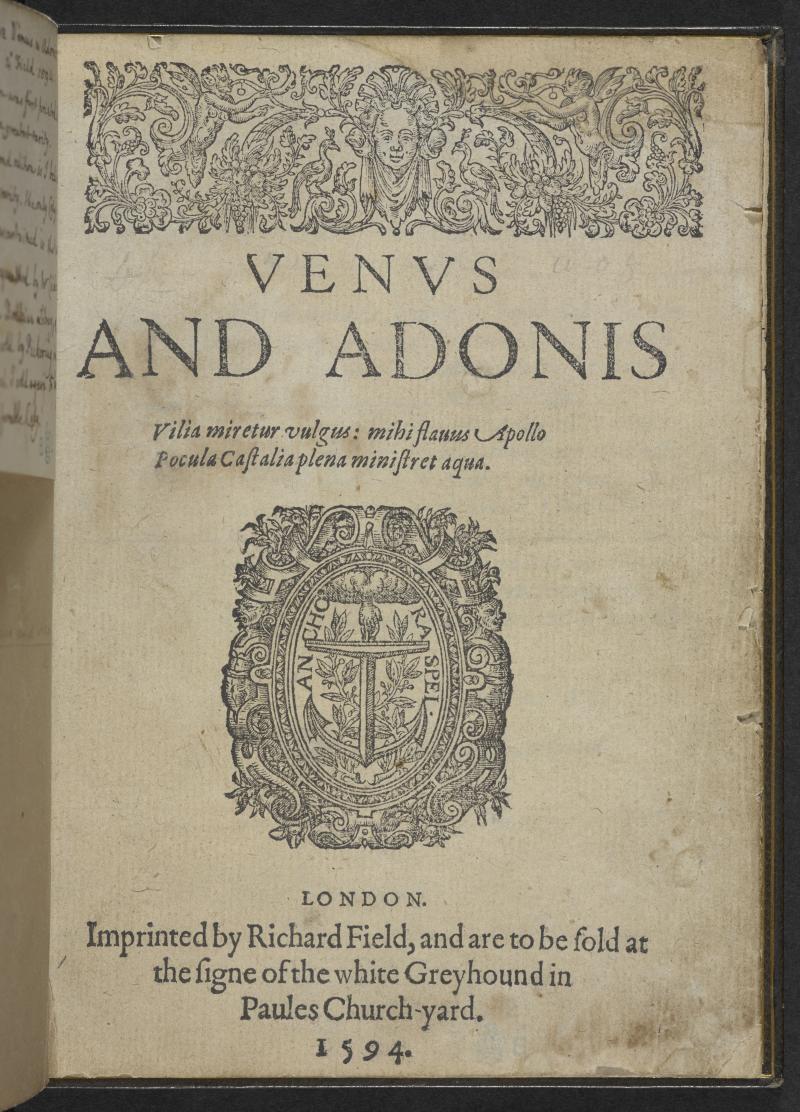
Venus and Adonis
Para2In 1593, Shakespeare published his first work of poetry, Venus and Adonis, a sensuous narrative poem about the Roman goddess of love and a mortal man she pursues.
It remained his most popular published work, with 10 editions printed by his death
in 1616.
The poem is 1172 lines long, with 199 six-line stanzas that rhyme ABABCC.
It is an epyllion (a minor epic), a poetic form that uses a sophisticated eroticism
to explores events from classical legends or myths.
Para3In Shakespeare’s version, Adonis rejects Venus rather than being her willing companion.
She attempts to convince him to be her lover while he protests. Shakespeare thus reverses
most of the story’s original ideas. The poem’s sixth stanza reads:
Over one arm the lusty courser’s rein,Under her other was the tender boy,Who blush’d and pouted in a dull disdain,With leaden appetite, unapt to toy;The red and hot as coals of glowing fire,He red for shame, but frosty in desire.(Venus and Adonis ll. 31-36)
Para4The poem’s popularity meant that it is mentioned by other writers of the time, such
as Francis Meres, who commented in 1598 that
the sweet witty soul of Ovid lives in mellifluous and honey-tongued Shakespeare, witness his Venus and Adonis.Thomas Middleton’s play, A Mad World, My Masters features a jealous husband named Harebrain who forbids his wife to have a copy of the poem for fear it will incite her lust.
Shakespeare and Classical Curriculum
Para5Boys’ schooling of the time often used classical literature, such as Ovid’s Metamorphosis, to teach Latin. Shakespeare would have therefore been very familiar with classical
mythology. In Ovid’s version, Venus (the Roman goddess of love) takes a young hunter,
Adonis, as one of her many lovers, but he dies in an accident while hunting a boar.
She hears his dying groans and hurries down to assist him but she cannot save him.
She transforms him into a flower, the anemone. It is one of the many origin stories
that Ovid includes in his nearly 12,000 line poem that is divided into 15 sections.
Para6Ovid’s Fasti, published in 8 CE, also tells the tale that Shakespeare takes up in his other narrative
poem, Lucrece. Ovid’s poem tells various stories of Roman holidays and customs. The story of Lucrece
is part of the tale related to the founding of Rome. Lucrece’s story is the tragic
chronicle of a woman widely admired for her chastity who is later brutally assaulted
and dies by suicide.
Lucrece
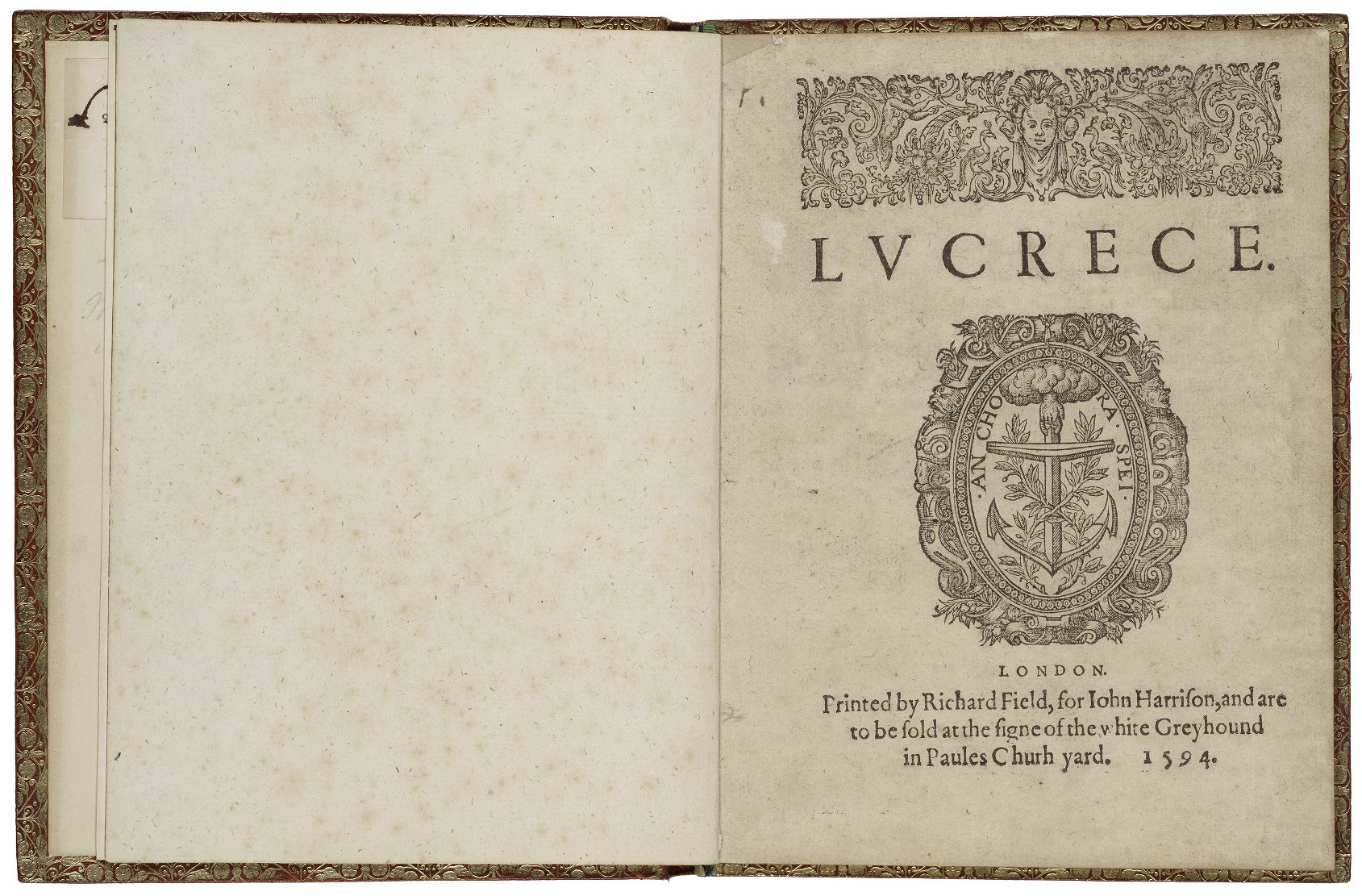
Para7In 1594, Shakespeare published Lucrece, often called The Rape of Lucrece. It also retells a tale from Roman mythology, and it was also quite popular, with
six editions printed before 1616.
It is a 1855 line poem, in 265 rhyme royal stanzas
In terms of genre, it is a complaint by Lucrece about her corrupt assailant
The assailant Tarquin and his family are stripped of their power
Lucrece dies by suicide
Para8Another of Shakespeare’s sources may have included the History of Rome by the famous historian Livy (59 BCE- 17 CE). Both Ovid’s and Livy’s narratives relate
the legendary tale of Lucrece being sexually assaulted by a nobleman, Tarquin.
Para9 The character of Lucrece was widely admired in the early modern period as a woman
who erases her family’s shame through her death. Chastity was seen in this era as
a woman’s primary virtue, and once lost, it could not be regained. The poem’s serious
and moralistic tone is exemplified in stanzas such as this one:
But she hath lost a dearer thing than life,And he hath won what he would lose again:This forced league doth force a further strife;This momentary joy breeds months of pain;This hot desire converts to cold disdain:Pure Chastity is rifled of her store,And Lust, the thief, far poorer than before. (Lucrece, ll. 687-693)
Sources
Ovid.Metamorphoses. Translated by Stephanie McCarter. Penguin, 2022.
Shakespeare, William. Venus and Adonis Edited by Francis X. Connor. In .The New Oxford Shakespeare: The Complete Works: Modern Critical Edition. Edited by Gary Taylor, John Jowett, Terri Bourous, and Gabriel Egan. Oxford UP, 2016, pp. 643-672.
Shakespeare, William. Lucrece Edited by Francis X. Connor. In The New Oxford Shakespeare: The Complete Works: Modern Critical Edition. Edited by Gary Taylor, John Jowett, Terri Bourous, and Gabriel Egan. Oxford UP, 2016, pp. 673-721.
Shohet, Lauren.
Shakespeare’s Eager Adonis.Studies in English Literature, 1500–1900 vol. 42, no.1, 2002, pp. 85-98.
Open-Access Digital Resources
Best, Michael.
A Plague, a Patron, Poems, and a Plot.Shakespeare’s Life and Times. Internet Shakespeare Editions, University of Victoria, 04 Jan. 2011, https://internetshakespeare.uvic.ca/Library/SLT/life/youth/v&a.html. Accessed 11 Feb. 2026.
Mowat, Barbara A., and Paul Werstine.
About Shakespeare’s Venus and Adonis..The Folger Shakespeare, https://www.folger.edu/explore/shakespeares-works/venus-and-adonis/about-shakespeares-venus-and-adonis/. Accessed 11 Feb. 2026.
Mowat, Barbara A., and Paul Werstine.
About Shakespeare’s Lucrece..The Folger Shakespeare, https://www.folger.edu/explore/shakespeares-works/lucrece/. Accessed 11 Feb. 2026.
Shakespeare, William. Venus and Adonis. Shakespeare’s Words. Edited by David Crystal and Ben Crystal, https://www.shakespeareswords.com/Public/About.aspx. Accessed 11 Feb. 2026.
Prosopography
Kate McPherson
Kate McPherson is Professor of English and Honors Program Director at Utah Valley
University (Orem, UT, USA). In 2015, she began working to redevelop Shakespeare’s Life and Times, created by Michael Best, into the Early Modern England Encyclopedia. Her other publications include commentary on Pericles and The Comedy of Errors for the New Oxford Shakespeare (2016); the co-edited volumes Stages of Engagement: Drama and Religion in Post-Reformation England with James Mardock (Duquesne University Press, 2014) and Shakespeare Expressed: Page, Stage, and Classroom in Shakespeare and His Contemporaries, with Kathryn M. Moncrief and Sarah Enloe (Fairleigh Dickinson University Press,
2013). With Kathryn M. Moncrief, Kate has also two edited collections, Performing Pedagogy in Early Modern England: Gender, Instruction, and Performance (Ashgate, 2011) and Performing Maternity in Early Modern England (Ashgate 2008). She has also published numerous articles on early modern maternity
in scholarly journals. Kate participated in the 2008 National Endowment for the Humanities
Institute,
Shakespeare’s Blackfriars: The Study, the Stage, the Classroom,at the American Shakespeare Center. She also served as Play Seminar Director, a public humanities position, for the Utah Shakespeare Festival in 2017 and 2018.
Leah Hamby
Leah Hamby is the primary encoder for the Early Modern England Encyclopedia. Aside from encoding, she also works as an editor for the project and contributed
several articles of her own. She has been working on the EMEE since February 2023. As of February 2026, she is soon to graduate with honours from
Utah Valley University with a major in history and a minor in creative writing. Her
other work with the LEMDO program includes remediating William Kemp’s Kemp’s Nine Day’s Wonder for the Digital Renaissance Editions.
Michael Best
Michael Best is Professor Emeritus at the University of Victoria, BC. He founded the
Internet Shakespeare Editions in 1996, and was Coordinating Editor until 2017, contributing two editions to the
ISE: King John and King Lear (the latter also available in print from Broadview Press). In print, he has published editions of works of Elizabethan magic and huswifery,
a collection of letters from the Australian goldfields, and Shakespeare on the Art of Love (2008). He contributed regular columns for the Shakespeare Newsletter on
Electronic Shakespeares,and has written many articles and chapters for both print and online books and journals, principally on questions raised by the new medium in the editing and publication of texts. He has delivered papers and plenary lectures on electronic media and the Internet Shakespeare Editions at conferences in Canada, the USA, the UK, Spain, Australia, and Japan.
Navarra Houldin
Training and Documentation Lead 2025–present. LEMDO project manager 2022–2025. Textual
remediator 2021–present. Navarra Houldin (they/them) completed their BA with a major
in history and minor in Spanish at the University of Victoria in 2022. Their primary
research was on gender and sexuality in early modern Europe and Latin America. They
are continuing their education through an MA program in Gender and Social Justice
Studies at the University of Alberta where they will specialize in Digital Humanities.
Orgography
LEMDO Team (LEMD1)
The LEMDO Team is based at the University of Victoria and normally comprises the project
director, the lead developer, project manager, junior developers(s), remediators,
encoders, and remediating editors.
University of Victoria (UVIC1)
https://www.uvic.ca/Metadata
| Authority title | Shakespeare’s Longer Poems |
| Type of text | Critical |
| Publisher | University of Victoria on the Linked Early Modern Drama Online Platform |
| Series | Early Modern England Encyclopedia |
| Source |
By Kate McPherson, inspired by Michael Best’s Shakespeare’s Life and Times, Internet Shakespeare Editions
|
| Editorial declaration | This document uses Canadian English spelling |
| Edition | Released with Early Modern England Encyclopedia 1.0 |
| Sponsor(s) |
Early Modern England EncyclopediaAnthology Leads: Kate McPherson and Kate Moncrief.
|
| Encoding description | Encoded in TEI P5 according to the LEMDO Customization and Encoding Guidelines |
| Document status | published |
| Funder(s) |
Social Sciences and Humanities Research Council of Canada
Mitacs Globalink Research Internship Utah Valley University |
| License/availability |
Unless otherwise noted, intellectual copyright in EMEE Anthology pages is held by
Kate McPherson on behalf of the contributors. Copyright on the TEI-XML markup is held by the University of Victoria on behalf of the LEMDO Team. The content and TEI-XML markup in this file are licensed under a CC BY-NC-ND 4.0 license. This file is freely downloadable without permission under the following conditions:
(1) credit must be given to the authors, EMEE, and LEMDO in any subsequent use of
the files and /or data; (2) this availability statement must remain in the file; (3)
the content cannot be adapted or repurposed (except for quotations for the purposes
of academic review and citation); and (4) commercial uses are not permitted without
the knowledge and consent of the authors, EMEE, and LEMDO. Neither the content nor
the code in this file is licensed for training large language models (LLMs), ingestion
into an LLM, or any use in any artificial intelligence applications; such uses are
considered to be commercial uses and are strictly prohibited.
|