
Shakespeare Becomes a Gentleman
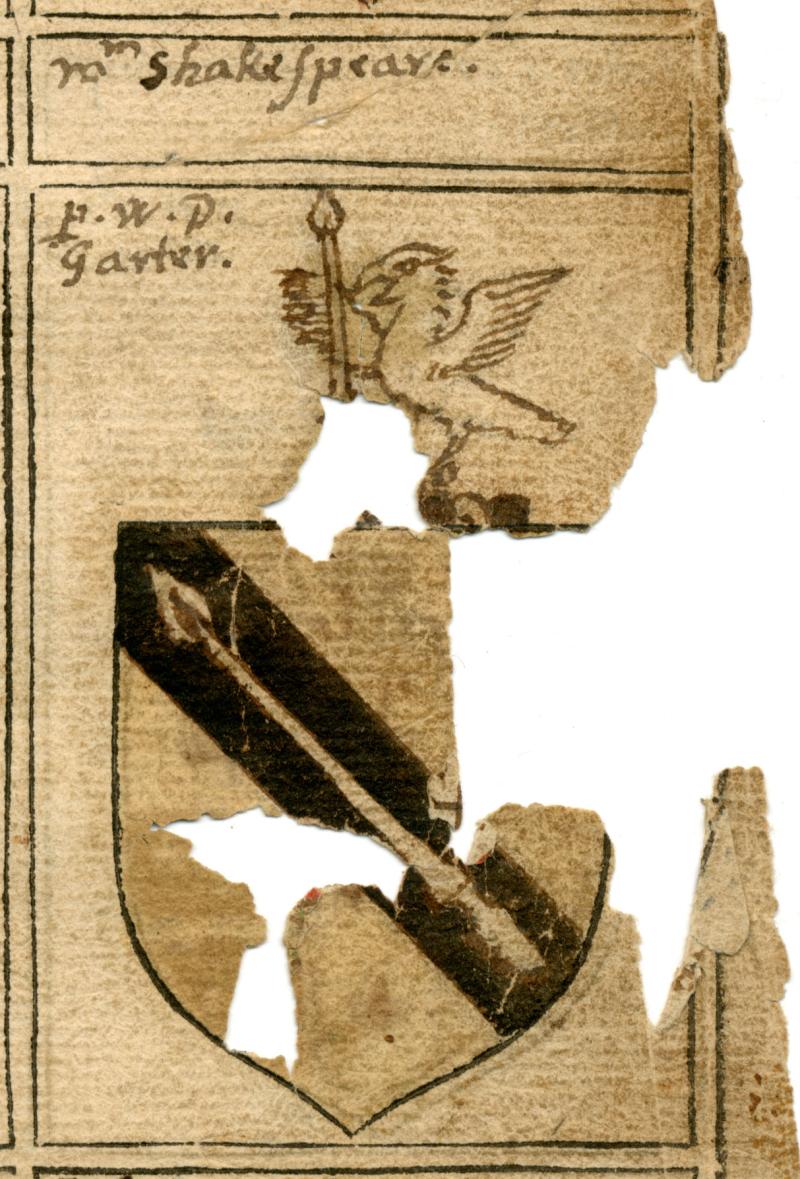
Shakespeare’s Application for a Coat of Arms
Para1
William Shakespeare, son of the businessman John Shakespeare, was born a commoner.
But in October of 1596, the Shakespeare family became gentry, the class of people
just below nobility. This means Shakespeare could have signed
Gent.or
Gentlemanafter his name, not that such a signature exists. The College of Arms granted a coat of arms to John Shakespeare after an initial application in the 1570s, when John was thriving as a civic figure in Stratford-upon-Avon. The application was approved just two months after William Shakespeare had lost his son Hamnet, the only male heir in his family to whom the arms could descend. The grant was approved on the basis of the “faithefull and approved service to H7 King Henry VII, who reigned from 1485–1509” performed by John’s great-grandfather and because John Shakespeare himself had “maryed the daughter and one of the heyrs of Robert Arden of Wellingcote” (Wolfe), referring to Shakespeare’s mother, Mary Arden. Scholars generally accept that William must have nudged the College of Arms to take action on the petition made by his father some two decades before.

The Shakespeare Coat of Arms
Para2The coat of arms designed for the Shakespeare family in heraldic language is described
as follows on the Shakespeare Documented website:
Gould, on a Bend, Sable, a Speare of the first steeled argent. And for his crest or cognizaunce a falcon, his winges displayed Argent, standing on a wreath of his coullers.
Para3In other words, the Shakespeare coat of arms was designed as gold in color with a
black diagonal band across the shield and a silver-tipped spear on the shield as well.
The cognizance, or distinguishing mark of the arms, would be a falcon with silver
wings spread out in flight, standing on a wreath of the Shakespeare family colors.
The family motto “Non sanz droict”, meaning “not without right”, is often included
with the coat of arms. The two spears, on the shield and clutched in the falcon’s
claws, could be considered a pun on the name Shakespeare.
Signficance of the Shakespeare Coat of Arms
Scholars have long accepted that the man from Stratford, William Shakespeare, is the
author of the plays published under his name both during his lifetime and after his
death. The debate over the coat of arms between some officials in the College of Arms
adds weight to that conclusion. One of the members of the College of Arms, Ralph Brooke,
objected to the grant of arms to “Shakespeare the player”, although the application
was initially made on behalf of John Shakespeare and was granted in 1596. Brooke’s
objections, voiced in 1602, and which also reference other London tradesmen’s applications,
have been researched by Heather Wolfe, curator of manuscripts at the Folger Shakespeare
Library and co-creator of the Shakespeare Documented website. The coat of arms, which appears in four separate manuscripts compiled before
William Shakespeare’s death in 1616, along with other evidence of Shakespeare as a
player, ensure certainty that the man from Stratford is the author of the plays that
bear his name.
Sources
Honan, ParkShakespeare: A Life. Oxford UP, 1998.
Rasmussen, Eric.
Beginnings of a Life in Performance.In Shakespeare in Ten Acts. Edited by Gordon McMullanand Zoe Wilcox. The British Library, 2016.
Open-Access Digital Resources
Best, Michael.
A Gentleman Born..Shakespeare’s Life and Times. Internet Shakespeare Editions. University of Victoria, 04 Jan. 2011, https://internetshakespeare.uvic.ca/Library/SLT/life/early%20maturity/arms.html. Accessed 11 Feb. 2026.
Duncan-Jones, Katherine.
Shakespeare Among the Heralds.The Heraldry Society. Winter 2000, https://www.theheraldrysociety.com/articles/shakespeare-part-2-shakespeare-among-the-heralds/ Accessed 11 Feb. 2026.
Ramsay, Nigel.
William Dethick and the Shakespeare Grants of Arms.The Folger Shakespeare Library, 01 July 2014, https://www.folger.edu/blogs/collation/william-dethick-and-the-shakespeare-grants-of-arms/. Accessed 11 Feb. 2026.
Wilcox, Zoe.
Shakespeare: Gentleman or Player?English and Drama Blog. The British Library. 9 Jul. 2016. https://web.archive.org/web/20250803082238/https://blogs.bl.uk/english-and-drama/2016/07/shakespeare-gentleman-or-player.html. Archived 7 Dec. 2020.
Wolfe, Heather and Michael Witmore.
William Shakespeare, Poet and Gentleman.Folger Shakespeare Library, 18 Jan. 2017, https://www.folger.edu/blogs/collation/william-shakespeare-post-gentleman/. Accessed 11 Feb. 2026.
Image Sources
Steifer, Tomasz. Coat of arms of William Shakespeare. 2008. Wikimedia. https://commons.wikimedia.org/wiki/File:Shakespeare1COA.png.

The Book of Coates and Creasts. Promptuarium Armorum. Begonne the 28 of May 1602.
Per William Smith, Rougedragon. 28 May 1602. Shakespeare Documented. https://doi.org/10.37078/906.
Prosopography
Chantel England
Chantel England was an Honors student at Utah Valley University.
Kate McPherson
Kate McPherson is Professor of English and Honors Program Director at Utah Valley
University (Orem, UT, USA). In 2015, she began working to redevelop Shakespeare’s Life and Times, created by Michael Best, into the Early Modern England Encyclopedia. Her other publications include commentary on Pericles and The Comedy of Errors for the New Oxford Shakespeare (2016); the co-edited volumes Stages of Engagement: Drama and Religion in Post-Reformation England with James Mardock (Duquesne University Press, 2014) and Shakespeare Expressed: Page, Stage, and Classroom in Shakespeare and His Contemporaries, with Kathryn M. Moncrief and Sarah Enloe (Fairleigh Dickinson University Press,
2013). With Kathryn M. Moncrief, Kate has also two edited collections, Performing Pedagogy in Early Modern England: Gender, Instruction, and Performance (Ashgate, 2011) and Performing Maternity in Early Modern England (Ashgate 2008). She has also published numerous articles on early modern maternity
in scholarly journals. Kate participated in the 2008 National Endowment for the Humanities
Institute,
Shakespeare’s Blackfriars: The Study, the Stage, the Classroom,at the American Shakespeare Center. She also served as Play Seminar Director, a public humanities position, for the Utah Shakespeare Festival in 2017 and 2018.
Leah Hamby
Leah Hamby is the primary encoder for the Early Modern England Encyclopedia. Aside from encoding, she also works as an editor for the project and contributed
several articles of her own. She has been working on the EMEE since February 2023. As of February 2026, she is soon to graduate with honours from
Utah Valley University with a major in history and a minor in creative writing. Her
other work with the LEMDO program includes remediating William Kemp’s Kemp’s Nine Day’s Wonder for the Digital Renaissance Editions.
Michael Best
Michael Best is Professor Emeritus at the University of Victoria, BC. He founded the
Internet Shakespeare Editions in 1996, and was Coordinating Editor until 2017, contributing two editions to the
ISE: King John and King Lear (the latter also available in print from Broadview Press). In print, he has published editions of works of Elizabethan magic and huswifery,
a collection of letters from the Australian goldfields, and Shakespeare on the Art of Love (2008). He contributed regular columns for the Shakespeare Newsletter on
Electronic Shakespeares,and has written many articles and chapters for both print and online books and journals, principally on questions raised by the new medium in the editing and publication of texts. He has delivered papers and plenary lectures on electronic media and the Internet Shakespeare Editions at conferences in Canada, the USA, the UK, Spain, Australia, and Japan.
Navarra Houldin
Training and Documentation Lead 2025–present. LEMDO project manager 2022–2025. Textual
remediator 2021–present. Navarra Houldin (they/them) completed their BA with a major
in history and minor in Spanish at the University of Victoria in 2022. Their primary
research was on gender and sexuality in early modern Europe and Latin America. They
are continuing their education through an MA program in Gender and Social Justice
Studies at the University of Alberta where they will specialize in Digital Humanities.
Orgography
LEMDO Team (LEMD1)
The LEMDO Team is based at the University of Victoria and normally comprises the project
director, the lead developer, project manager, junior developers(s), remediators,
encoders, and remediating editors.
University of Victoria (UVIC1)
https://www.uvic.ca/Metadata
| Authority title | Shakespeare Becomes a Gentleman |
| Type of text | Critical |
| Publisher | University of Victoria on the Linked Early Modern Drama Online Platform |
| Series | Early Modern England Encyclopedia |
| Source |
By Kate McPherson and Chantel England, inspired by Michael Best’s Shakespeare’s Life and Times, Internet Shakespeare Editions
|
| Editorial declaration | This document uses Canadian English spelling |
| Edition | Released with Early Modern England Encyclopedia 1.0 |
| Sponsor(s) |
Early Modern England EncyclopediaAnthology Leads: Kate McPherson and Kate Moncrief.
|
| Encoding description | Encoded in TEI P5 according to the LEMDO Customization and Encoding Guidelines |
| Document status | published |
| Funder(s) |
Social Sciences and Humanities Research Council of Canada
Mitacs Globalink Research Internship Utah Valley University |
| License/availability |
Unless otherwise noted, intellectual copyright in EMEE Anthology pages is held by
Kate McPherson on behalf of the contributors. Copyright on the TEI-XML markup is held by the University of Victoria on behalf of the LEMDO Team. The content and TEI-XML markup in this file are licensed under a CC BY-NC-ND 4.0 license. This file is freely downloadable without permission under the following conditions:
(1) credit must be given to the authors, EMEE, and LEMDO in any subsequent use of
the files and /or data; (2) this availability statement must remain in the file; (3)
the content cannot be adapted or repurposed (except for quotations for the purposes
of academic review and citation); and (4) commercial uses are not permitted without
the knowledge and consent of the authors, EMEE, and LEMDO. Neither the content nor
the code in this file is licensed for training large language models (LLMs), ingestion
into an LLM, or any use in any artificial intelligence applications; such uses are
considered to be commercial uses and are strictly prohibited.
|