
Shakespeare’s First Patron
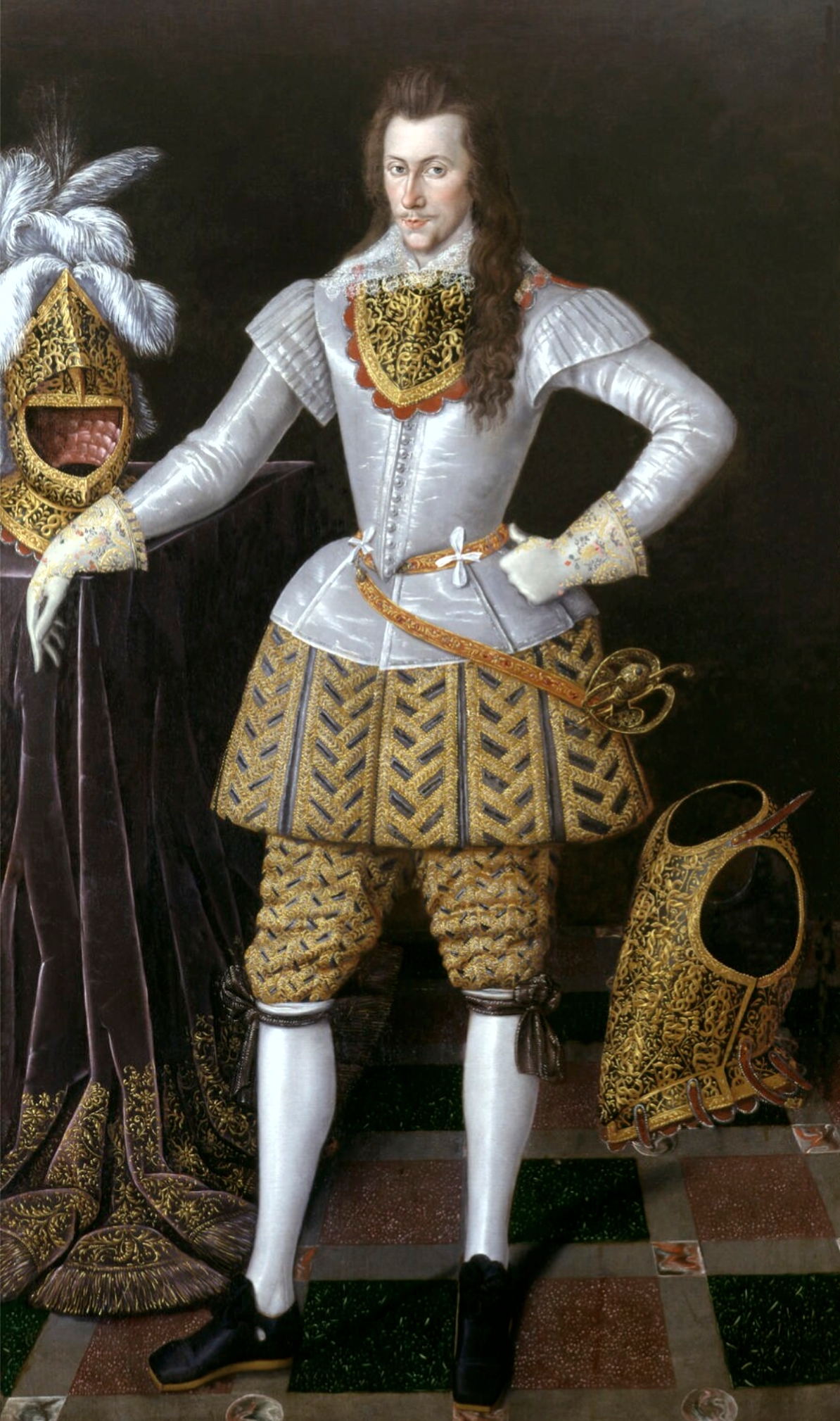
Henry Wriothesley, 3rd Earl of Southhampton
Para1
Nine years younger than Shakespeare, Henry Wriothesley (pronounced
rihs-lee or rise-lee), the 3rd Earl of Southampton was a Cambridge-educated nobleman and a patron of literature. At university, he showed strong interest in literature, sending Latin poems to his guardian, Lord Burghley, the Queen’s Chancellor. When he finished at Cambridge, he went to London and enrolled at Gray’s Inn, one of the law schools, but never took a degree. He was a handsome nobleman who soon succeeded at the court, becoming a favorite of Queen Elizabeth I. The young earl lost favor in 1598 by wooing, impregnating, and quickly marrying a young noblewoman, Elizabeth Vernon, who was a relative of one of Elizabeth I’s favorite courtiers, the Earl of Essex.
Para2Southhampton, who went on expeditions with the Earl Essex to the Azores and Ireland,
was also later imprisoned for his part in the Earl of Essex’s ill-fated rebellion
against Queen Elizabeth I in 1601. He was convicted of treason, stripped of his titles,
and sentenced to die. However, the intervention of Robert Cecil, the son of Southampton’s
guardian, led to his sentence being commuted to life in prison. When James I came
to the throne in 1603, Southampton was released and had his titles restored. He later
became an investor in the Virginia Company and the East India Company. He died in
in 1624 from fever while fighting against Spanish forces in the Netherlands.
Shakespeare and the Earl of Southhampton
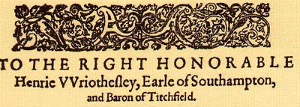
Para3Clear documentation of the young Southampton’s relationship with the poet exists in
the dedications of Shakespeare’s two narrative poems, Venus and Adonis (published in 1593) and Lucrece (published in 1594). Both are carefully and accurately printed, unlike the texts
of his plays. Scholars believe the poems were both prepared by Shakespeare for publication
between June of 1592 and April of 1593, when all the theaters in London were closed
due to plague. Both poems were popular and were reprinted numerous times in the period.
Dedications to the Poems
Para4
The 1593 dedication, with spelling slightly modernized, to Venus and Adonis is formal in tone and phrasing:
Right Honourable, I know not how I shall offend in dedicating my unpolished lines to your Lordship, nor how the world will censure me for choosing so strong a prop to support so weak a burden, only if your Honour seeme but pleased, I account my selfe highly praised, and vow to take advantage of all idle hours, till I have honoured you with some graver labour. But if the first heir of my invention prove deformed, I shall be sorry it had so noble a god-father: and never after ear plough so barren a land, for feare it yield me still so bad a harvest. (Venus and Adonis)
Para5 The difference between this formally phrased dedication and the more casual dedication
to the 1594 Lucrece, again with spelling slightly modernized, has suggested to some biographers that
Southampton had become friendly with Shakespeare:
The love I dedicate to your Lordship is without end: whereof this Pamphlet without beginning is but a superfluous moiety portion. The warrant I have of your Honourable disposition, not the worth of my untutored lines makes it assured of acceptance. What I have done is yours, what I have to do is yours, being part in all I have, devoted yours... Your Lordship’s in all duty. William Shakespeare. (Lucrece)However, no direct evidence exists of their growing familiarity beyond the language in this dedication.
Southhampton and the Sonnets
Para6The relationship between the poet and his patron may have developed further with the
completion The Sonnets, which were written and widely circulated in the 1590s although not printed as a
book until 1609. The poems feature the poet praising his unnamed patron and fearing
the work of rival poets competing for his favor and funding. An unsubstantiated story
(reported by late 17th century editor of Shakespeare’s works, Nicholas Rowe) that
Southampton once gave Shakespeare a gift of £1000, an enormous amount at the time,
has fostered speculation that Southampton was the
Mr. W. H.of the Sonnets dedication on the printed edition. However, Southampton’s initials were “H.W.”, so this theory is based on thin speculation of the reversed initials as well as the improbable chance that Shakespeare, vastly Southhampton’s social inferior, would address his patron by a version of his given name rather than his title.
Sources
McMullan, Gordon and Zoe Wilcox, eds. Shakespeare in Ten Acts. The British Library, 2016.
Potter, Lois. The Life of William Shakespeare: A Critical Biography. Wiley-Blackwell, 2012.
Shakespeare, William. Shakespeare’s Sonnets and Poems.. Edited by Barbara A. Mowat, and Paul Werstine. Folger Shakespeare Library. Simon and Shuster, 2006.
Open-Access Digital Resources
Best, Michael.
Dedication and Friendship.Shakespeare’s Life and Times.Internet Shakespeare Editions. University of Victoria, 04 Jan. 2011, https://internetshakespeare.uvic.ca/Library/SLT/life/youth/. Accessed 11 Feb. 2026.
Best, Michael.
More About the Patron..Shakespeare’s Life and Times. Internet Shakespeare Editions. University of Victoria, 04 Jan. 2011, https://internetshakespeare.uvic.ca/Library/SLT/life/youth/southampton.html. Accessed 11 Feb. 2026.
Best, Michael.
A Plague, a Patron, Poems, and a Plot.Shakespeare’s Life and Times. Internet Shakespeare Editions. University of Victoria, 04 Jan. 2011, https://internetshakespeare.uvic.ca/Library/SLT/life/youth/. Accessed 11 Feb. 2026.
Britannica Editors.
Henry Wriothesley, 3rd earl of Southampton..Encyclopedia Britannica, 6 Nov. 2022, https://www.britannica.com/biography/Henry-Wriothesley-3rd-earl-of-Southampton.. Accessed 11 Feb. 2026.
Image Sources
Henry Wriothesley, 3rd Earl of Southampton. Cira 1600. Oil on canvas. Wikimedia Commons. https://commons.wikimedia.org/wiki/File:Henry_Wriothesley_(1573-1624)_3rd_Earl_of_Southampton_(15389105069).jpg.
_3rd_Earl_of_Southampton_(15389105069).jpg)
Shakespeare, William. Venus and Adonis. 1593. Shakespeare Documented. Folger Shakespeare Library, https://doi.org/10.37078/114.
Prosopography
Kate McPherson
Kate McPherson is Professor of English and Honors Program Director at Utah Valley
University (Orem, UT, USA). In 2015, she began working to redevelop Shakespeare’s Life and Times, created by Michael Best, into the Early Modern England Encyclopedia. Her other publications include commentary on Pericles and The Comedy of Errors for the New Oxford Shakespeare (2016); the co-edited volumes Stages of Engagement: Drama and Religion in Post-Reformation England with James Mardock (Duquesne University Press, 2014) and Shakespeare Expressed: Page, Stage, and Classroom in Shakespeare and His Contemporaries, with Kathryn M. Moncrief and Sarah Enloe (Fairleigh Dickinson University Press,
2013). With Kathryn M. Moncrief, Kate has also two edited collections, Performing Pedagogy in Early Modern England: Gender, Instruction, and Performance (Ashgate, 2011) and Performing Maternity in Early Modern England (Ashgate 2008). She has also published numerous articles on early modern maternity
in scholarly journals. Kate participated in the 2008 National Endowment for the Humanities
Institute,
Shakespeare’s Blackfriars: The Study, the Stage, the Classroom,at the American Shakespeare Center. She also served as Play Seminar Director, a public humanities position, for the Utah Shakespeare Festival in 2017 and 2018.
Leah Hamby
Leah Hamby is the primary encoder for the Early Modern England Encyclopedia. Aside from encoding, she also works as an editor for the project and contributed
several articles of her own. She has been working on the EMEE since February 2023. As of February 2026, she is soon to graduate with honours from
Utah Valley University with a major in history and a minor in creative writing. Her
other work with the LEMDO program includes remediating William Kemp’s Kemp’s Nine Day’s Wonder for the Digital Renaissance Editions.
Michael Best
Michael Best is Professor Emeritus at the University of Victoria, BC. He founded the
Internet Shakespeare Editions in 1996, and was Coordinating Editor until 2017, contributing two editions to the
ISE: King John and King Lear (the latter also available in print from Broadview Press). In print, he has published editions of works of Elizabethan magic and huswifery,
a collection of letters from the Australian goldfields, and Shakespeare on the Art of Love (2008). He contributed regular columns for the Shakespeare Newsletter on
Electronic Shakespeares,and has written many articles and chapters for both print and online books and journals, principally on questions raised by the new medium in the editing and publication of texts. He has delivered papers and plenary lectures on electronic media and the Internet Shakespeare Editions at conferences in Canada, the USA, the UK, Spain, Australia, and Japan.
Navarra Houldin
Training and Documentation Lead 2025–present. LEMDO project manager 2022–2025. Textual
remediator 2021–present. Navarra Houldin (they/them) completed their BA with a major
in history and minor in Spanish at the University of Victoria in 2022. Their primary
research was on gender and sexuality in early modern Europe and Latin America. They
are continuing their education through an MA program in Gender and Social Justice
Studies at the University of Alberta where they will specialize in Digital Humanities.
Orgography
LEMDO Team (LEMD1)
The LEMDO Team is based at the University of Victoria and normally comprises the project
director, the lead developer, project manager, junior developers(s), remediators,
encoders, and remediating editors.
University of Victoria (UVIC1)
https://www.uvic.ca/Metadata
| Authority title | Shakespeare’s First Patron |
| Type of text | Critical |
| Publisher | University of Victoria on the Linked Early Modern Drama Online Platform |
| Series | Early Modern England Encyclopedia |
| Source |
By Kate McPherson, inspired by Michael Best’s Shakespeare’s Life and Times, Internet Shakespeare Editions
|
| Editorial declaration | This document uses Canadian English spelling |
| Edition | Released with Early Modern England Encyclopedia 1.0 |
| Sponsor(s) |
Early Modern England EncyclopediaAnthology Leads: Kate McPherson and Kate Moncrief.
|
| Encoding description | Encoded in TEI P5 according to the LEMDO Customization and Encoding Guidelines |
| Document status | published |
| Funder(s) |
Social Sciences and Humanities Research Council of Canada
Mitacs Globalink Research Internship Utah Valley University |
| License/availability |
Unless otherwise noted, intellectual copyright in EMEE Anthology pages is held by
Kate McPherson on behalf of the contributors. Copyright on the TEI-XML markup is held by the University of Victoria on behalf of the LEMDO Team. The content and TEI-XML markup in this file are licensed under a CC BY-NC-ND 4.0 license. This file is freely downloadable without permission under the following conditions:
(1) credit must be given to the authors, EMEE, and LEMDO in any subsequent use of
the files and /or data; (2) this availability statement must remain in the file; (3)
the content cannot be adapted or repurposed (except for quotations for the purposes
of academic review and citation); and (4) commercial uses are not permitted without
the knowledge and consent of the authors, EMEE, and LEMDO. Neither the content nor
the code in this file is licensed for training large language models (LLMs), ingestion
into an LLM, or any use in any artificial intelligence applications; such uses are
considered to be commercial uses and are strictly prohibited.
|