
Shakespeare’s Family
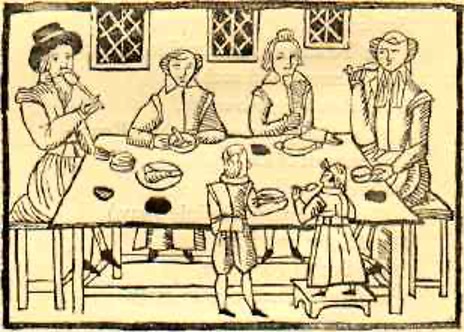
Father, John Shakespeare (1531–1601)
Para1Although few records exist for Shakespeare’s youth, a fair amount of information has
survived about his father, a glove-maker who also held a number of public offices
over a twenty-year period, ranging from borough ale-taster to alderman (like a city
council member) to high bailiff (the equivalent of mayor). Stratford was a market
center for the county of Warwickshire in the rural heartland of England and a major
center for the wool trade, England’s most profitable product, so holding the position
of high baliff was an important marker of respect and influence.
Para2Records of his business dealings and legal transactions indicate that John Shakespeare
became a prosperous man through buying and selling wool, hides, leather, and land,
as well as investing in property that he leased. He was twice fined for usury, meaning
he charged interest on loans greater than the law allowed. His ability to lend large
sums of money in the 1570s (£220, the equivalent of tens of thousands of pounds) indicates
his success as a businessman.
Para3About 1577, when William was 13, John Shakespeare suffered financial setbacks and
ceased to play a part in local government. In 1575, John Shakespeare was wealthy enough
to buy two houses, but by 1577 he had stopped attending council meetings, although
he was an alderman. In 1578, he mortgaged a property of his wife’s and sold her share
in another. Later, he faced various fines and lost his position as alderman. In 1592,
he was listed among those who failed to attend church
for fearre of process for debtte,although other reasons for church avoidance may be possible.
Para4Some scholars assert that John Shakespeare’s wool trade prospered from the mid-1580s
onward, which may have supplied William’s funding for his purchase of a share in the
Lord Chamberlain’s men. Some speculation exists that ties William’s move to London
to the family’s thriving wool business.
Para5In 1596, John Shakespeare applied for and was granted a coat of arms, which made him
and his family members of the gentry. In 1597, William bought the splendid house New
Place on the main street of Stratford. It seems likely that William’s success as a
shareholder in the Lord Chamberlain’s Men in London allowed him to restore some of
his father’s fortunes.
Para6Some doubts exist about John Shakespeare’s religion, specifically about whether he
truly converted to the Church of England as was required by law in 16th century England.
In 1757, a six-page document with his signature on each page was found in the rafters
of the Henley Street house in which William was born and the family lived for decades.
It is a Catholic testament of faith. The document was examined at the time by the
scholar Edmund Malone and he asserted it was a Tudor document, but doubted it belong
to the playwright’s father. The original document was subsequently lost and most scholars
came to believe it a forgery. However, in the 20th century, versions of similar documents
with identical wording were discovered, one in Spanish and another printed version
in English from 1634 of a testament written by a Spanish cardinal. John’s signature,
combined with these other copies of similar testaments, seems to indicate that John
Shakespeare’s failure to attend church in the early 1590s may have been because he
wanted to avoid taking Holy Communion in a Protestant church.
Para7John Shakespeare died in 1601 in the same town in which he’d been born and lived.
Mother, Mary Arden (1537–1608)
Para8Shakespeare’s mother was born Mary Arden, the daughter of a well-to-do landowner in
a lesser branch of an aristocratic family. The family gave its name to the nearby
Forest of Arden, the setting of Shakespeare’s As You Like It. She was raised in Wilmcote, a few miles outside Stratford. She later inherited the
family’s farmhouse there, a home built in 1514 and altered significantly since that
time. That house and a neighboring, larger property, Palmer’s Farm (once called Mary
Arden’s House), are owned by the Shakespeare Birthplace Trust. They are operated as
museums demonstrating 16th century rural and agricultural life.
Para9She married John Shakespeare when she was about 20 years old and bore him eight children.
Little else is known about her, and no portrait of her has been identified. It is
typical of the period that, though many references to John Shakespeare’s business
and legal activities survive, only the date of Mary Shakespeare’s burial (9 September
1608) was recorded. She left no will.
Siblings:
Joan, born 1558, died before 1569.
Margaret, born 1562, died 1563 (aged 5 months).
William, born 1564, died 1616.
Gilbert, born 1566, haberdasher, died 1612. (A haberdasher sells hats, clothes, thread,
ribbons, etc.)
Joan, born 1569, married William Hart, died 1646. William left his sister
all his wearing Apparrell […] and the house with the appurtenances in Stratford wherein she dwelleth.
Anne, born 1571, died 1579.
Richard, born 1574, occupation unknown, died 1613.
Edmund, born 1580,
player,died 1607.
Sources
Bearman, Robert.
John Shakespeare: A Papist or Just Penniless?.Shakespeare Quarterly, vol. 56, no. 4, Winter 2005, pp.411–433.
The Shakespeare Circle: An Alternative Biography. Edited by Paul Edmondson and Stanley Wells. Cambridge UP, 2015.
Wood, Michael. Shakespeare. Companion Volume to In Search of Shakespeare.Basic Books, 2003.
Open-Access Digital Resources
Bearman, Robert.
Parish Register Entry Recording John Shakespeare’s Burial.Shakespeare Documented, 22 May 2020, doi: doi.org/10.37078/465. Accessed 11 Feb. 2026.
Bearman, Robert.
Parish Register Entry Recording Mary Arden Shakespeare’s Burial.Shakespeare Documented, 22 May 2020, doi: doi.org/10.37078/469. Accessed 11 Feb. 2026.
Best, Michael.
Shakespeare’s Family..Shakespeare’s Life and Times. Internet Shakespeare Editions. University of Victoria, 04 Jan. 2011, https://internetshakespeare.uvic.ca/Library/SLT/life/childhood/family.html. Accessed 11 Feb. 2026.
Sheir, Rebecca and Brian Cummings, hosts.
The Story of My Life from Year to Year.Shakespeare Unlimited, Folger Shakespeare Library, 8 Apr. 2015, Folger Shakespeare Library, https://www.folger.edu/podcasts/shakespeare-unlimited/shakespeare-unlimited-episode-22/. Accessed 11 Feb. 2026.
Prosopography
Kate McPherson
Kate McPherson is Professor of English and Honors Program Director at Utah Valley
University (Orem, UT, USA). In 2015, she began working to redevelop Shakespeare’s Life and Times, created by Michael Best, into the Early Modern England Encyclopedia. Her other publications include commentary on Pericles and The Comedy of Errors for the New Oxford Shakespeare (2016); the co-edited volumes Stages of Engagement: Drama and Religion in Post-Reformation England with James Mardock (Duquesne University Press, 2014) and Shakespeare Expressed: Page, Stage, and Classroom in Shakespeare and His Contemporaries, with Kathryn M. Moncrief and Sarah Enloe (Fairleigh Dickinson University Press,
2013). With Kathryn M. Moncrief, Kate has also two edited collections, Performing Pedagogy in Early Modern England: Gender, Instruction, and Performance (Ashgate, 2011) and Performing Maternity in Early Modern England (Ashgate 2008). She has also published numerous articles on early modern maternity
in scholarly journals. Kate participated in the 2008 National Endowment for the Humanities
Institute,
Shakespeare’s Blackfriars: The Study, the Stage, the Classroom,at the American Shakespeare Center. She also served as Play Seminar Director, a public humanities position, for the Utah Shakespeare Festival in 2017 and 2018.
Leah Hamby
Leah Hamby is the primary encoder for the Early Modern England Encyclopedia. Aside from encoding, she also works as an editor for the project and contributed
several articles of her own. She has been working on the EMEE since February 2023. As of February 2026, she is soon to graduate with honours from
Utah Valley University with a major in history and a minor in creative writing. Her
other work with the LEMDO program includes remediating William Kemp’s Kemp’s Nine Day’s Wonder for the Digital Renaissance Editions.
Michael Best
Michael Best is Professor Emeritus at the University of Victoria, BC. He founded the
Internet Shakespeare Editions in 1996, and was Coordinating Editor until 2017, contributing two editions to the
ISE: King John and King Lear (the latter also available in print from Broadview Press). In print, he has published editions of works of Elizabethan magic and huswifery,
a collection of letters from the Australian goldfields, and Shakespeare on the Art of Love (2008). He contributed regular columns for the Shakespeare Newsletter on
Electronic Shakespeares,and has written many articles and chapters for both print and online books and journals, principally on questions raised by the new medium in the editing and publication of texts. He has delivered papers and plenary lectures on electronic media and the Internet Shakespeare Editions at conferences in Canada, the USA, the UK, Spain, Australia, and Japan.
Navarra Houldin
Training and Documentation Lead 2025–present. LEMDO project manager 2022–2025. Textual
remediator 2021–present. Navarra Houldin (they/them) completed their BA with a major
in history and minor in Spanish at the University of Victoria in 2022. Their primary
research was on gender and sexuality in early modern Europe and Latin America. They
are continuing their education through an MA program in Gender and Social Justice
Studies at the University of Alberta where they will specialize in Digital Humanities.
Orgography
LEMDO Team (LEMD1)
The LEMDO Team is based at the University of Victoria and normally comprises the project
director, the lead developer, project manager, junior developers(s), remediators,
encoders, and remediating editors.
University of Victoria (UVIC1)
https://www.uvic.ca/Metadata
| Authority title | Shakespeare’s Family |
| Type of text | Critical |
| Publisher | University of Victoria on the Linked Early Modern Drama Online Platform |
| Series | Early Modern England Encyclopedia |
| Source |
By Kate McPherson, inspired by Michael Best’s Shakespeare’s Life and Times, Internet Shakespeare Editions
|
| Editorial declaration | This document uses Canadian English spelling |
| Edition | Released with Early Modern England Encyclopedia 1.0 |
| Sponsor(s) |
Early Modern England EncyclopediaAnthology Leads: Kate McPherson and Kate Moncrief.
|
| Encoding description | Encoded in TEI P5 according to the LEMDO Customization and Encoding Guidelines |
| Document status | published |
| Funder(s) |
Social Sciences and Humanities Research Council of Canada
Mitacs Globalink Research Internship Utah Valley University |
| License/availability |
Unless otherwise noted, intellectual copyright in EMEE Anthology pages is held by
Kate McPherson on behalf of the contributors. Copyright on the TEI-XML markup is held by the University of Victoria on behalf of the LEMDO Team. The content and TEI-XML markup in this file are licensed under a CC BY-NC-ND 4.0 license. This file is freely downloadable without permission under the following conditions:
(1) credit must be given to the authors, EMEE, and LEMDO in any subsequent use of
the files and /or data; (2) this availability statement must remain in the file; (3)
the content cannot be adapted or repurposed (except for quotations for the purposes
of academic review and citation); and (4) commercial uses are not permitted without
the knowledge and consent of the authors, EMEE, and LEMDO. Neither the content nor
the code in this file is licensed for training large language models (LLMs), ingestion
into an LLM, or any use in any artificial intelligence applications; such uses are
considered to be commercial uses and are strictly prohibited.
|