
Shakespeare’s Death and Monument
Shakespeare’s Final Days
Para1
Several years after returning to his hometown in about 1612 for semi-retirement, William
Shakespeare apparently became ill, and he drafted his last will and testament in the
spring of 1616. Scholars speculate that he may have been declining from a chronic
illness. By March 25, he had re-drafted and altered his will, possibly signifying
his impending death. Some scholars have suggested that the shaky signatures on the
will indicate that he was already very unwell at that time. Shakespeare died a few
weeks later, on April 23. His death was likely attended by his son-in-law and executor
of his will, the physician John Hall.
Shakespeare’s Burial and Cause of Death
Para2Shakespeare’s burial is recorded in the Stratford Parish Register as occurring on
25 April, 1616, a normal interval between death and burial at the time. The burial
was entered in the parish register in a list of deaths that month as “Will Shakspere
gent.”.
Para3His tomb, which lies beneath the floor of the church, is inside the chancel rail adjacent
to the monument. As befitting a prominent citizen of the town, it is covered by an
inscribed stone, featuring this now-famous curse in poetry that does not sound much
like Shakespeare’s:
Good friend for Jesus sake forbearTo dig the dust enclosed here!Blest be the man that spares these stones,And curst be he that moves my bones.
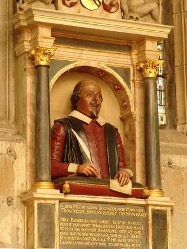
Para4The monument erected in his memory on the wall of the church sometime before 1623
is mentioned in a commendatory poem in the First Folio, listing his age as 53. Several
scholars have analyzed the monument as it appears now in comparison to the sketch
of it from Dugdale’s Antiquities of Warwickshire, speculating on the significance of the alterations in the items Shakespeare holds
in his hands. he currently hold a pen and quill resting on a cushion, but initial
sketchs in Dugdale show a wool sack, leading some people to wonder if the monument
was originally for his father, John, who dealt in wool as a commodity.
Para5 Like the other citizens of Stratford who died that year, the cause of death is not
listed. His brother-in-law had died the week before, so it is possible that an outbreak
of typhoid or other minor epidemic affected the town at that time.
Partying with the Poets?
Para6A story surfaced in the mid-17th century that Shakespeare died from fever after drinking
with two other poets, Michael Drayton and Ben Jonson. John Ward, a physician and vicar
in Stratford-upon-Avon, kept a notebook in 1662 with comments about Shakespeare, his
family, and his reputation as a playwright. Ward notes that
Shakespeare, Drayton, and Ben Jonson had a merry meeting and it seems drank too hard for Shakespeare died of a fever there contracted.(Potter 407. Written so long after the actual time of Shakespeare’s death, the story cannot be substantiated. Scholar Paul Edmondson accepts Ward’s account as plausible and thinks may indicate that the men were celebrating Jonson’s new status as unofficial poet laureate of the nation, or perhaps the publication of his The Workes of Benjamin Jonson in the large format of a folio, a bold statement by Jonson that his literary works were worthy of respect (and sale). This may have paved the way for Shakespeare’s colleagues to publish his collected plays in a folio format in 1623.
What’s in the Tomb?
Para7Despite the rhyming curse over Shakespeare’s gravesite and the long-held belief in
its sanctity, the tomb seems to have been opened sometime in the past 400 years. In
2016, scientists were given permission by the Church of England to explore the tomb
with ground penetrating radar, although not to open it. The scans determined that
the body under the inscription lies undisturbed about one meter below the stone, but
that the area where the skull should be may have been disturbed. It is inconclusive
whether the skull is in the tomb, or as rumor has long held, was removed from the
grave in the late 18th century.
Other Tributes to Shakespeare
Para8The monument to Shakespeare in Westminster Abbey’s Poets Corner was erected in 1741,
after having been approved in 1726. Some idea to place Shakespeare near other famous
British poets must have occurred not long after his death if we believe Ben Jonson’s
words from
To the Memory of my Beloved, the Author, William Shakespeare and What He Hath Left Us,published in the prefatory pages of the First Folio in 1623:
Soul of the age!The applause, delight, the wonder of our stage!My Shakespeare, rise! I will not lodge thee byChaucer, or Spenser, or bid Beaumont lieA little further, to make thee a room:Thou art a monument without a tomb,And art alive still while thy book doth liveAnd we have wits to read and praise to give.
Sources
Greenblatt, Stephen. Will in the World: How Shakespeare Became Shakespeare. W.W. Norton, 2004.
Greer, Germaine. Shakespeare’s Wife. Bloomsbury Press, 2007.
Potter, Lois. The Life of William Shakespeare: A Critical Biography. Wiley-Blackwell, 2012.
McMullan, Gordon and Zoe Wilcox, eds. Shakespeare in Ten Acts. The British Library, 2016.
Open-Access Digital Resources
Bearman, Robert.
Parish Register Entry Recording William Shakespeare’s Burial.Shakespeare Documented. doi: doi.org/10.37078/124. Accessed 11 Feb. 2026.
Best, Michael.
Shakespeare’s Death..Shakespeare’s Life and Times. Internet Shakespeare Editions. University of Victoria, 04 Jan. 2011, https://https://internetshakespeare.uvic.ca/Library/SLT/life/retirement/death.html.. Accessed 11 Feb. 2026.
Brown, Mark.
Shakespeare’s Skull Probably Stolen by Grave Robbers, Study Finds.The Guardian, 23 Mar. 2016, https://www.theguardian.com/culture/2016/mar/23/shakespeare-stolen-skull-grave-robbing-tale-true. Accessed 11 Feb. 2026.
Weinberg, Abbie and Elizabeth DeBold.
The Other First Folio.Folger Shakespeare Library, 11 Oct. 2016, hhttps://www.folger.edu/blogs/collation/the-other-first-folio/. Accessed 11 Feb. 2026.
William Shakespeare.Westminster Abbey, https://www.westminster-abbey.org/abbey-commemorations/commemorations/william-shakespeare. Accessed 11 Feb. 2026.
Prosopography
Kate McPherson
Kate McPherson is Professor of English and Honors Program Director at Utah Valley
University (Orem, UT, USA). In 2015, she began working to redevelop Shakespeare’s Life and Times, created by Michael Best, into the Early Modern England Encyclopedia. Her other publications include commentary on Pericles and The Comedy of Errors for the New Oxford Shakespeare (2016); the co-edited volumes Stages of Engagement: Drama and Religion in Post-Reformation England with James Mardock (Duquesne University Press, 2014) and Shakespeare Expressed: Page, Stage, and Classroom in Shakespeare and His Contemporaries, with Kathryn M. Moncrief and Sarah Enloe (Fairleigh Dickinson University Press,
2013). With Kathryn M. Moncrief, Kate has also two edited collections, Performing Pedagogy in Early Modern England: Gender, Instruction, and Performance (Ashgate, 2011) and Performing Maternity in Early Modern England (Ashgate 2008). She has also published numerous articles on early modern maternity
in scholarly journals. Kate participated in the 2008 National Endowment for the Humanities
Institute,
Shakespeare’s Blackfriars: The Study, the Stage, the Classroom,at the American Shakespeare Center. She also served as Play Seminar Director, a public humanities position, for the Utah Shakespeare Festival in 2017 and 2018.
Leah Hamby
Leah Hamby is the primary encoder for the Early Modern England Encyclopedia. Aside from encoding, she also works as an editor for the project and contributed
several articles of her own. She has been working on the EMEE since February 2023. As of February 2026, she is soon to graduate with honours from
Utah Valley University with a major in history and a minor in creative writing. Her
other work with the LEMDO program includes remediating William Kemp’s Kemp’s Nine Day’s Wonder for the Digital Renaissance Editions.
Michael Best
Michael Best is Professor Emeritus at the University of Victoria, BC. He founded the
Internet Shakespeare Editions in 1996, and was Coordinating Editor until 2017, contributing two editions to the
ISE: King John and King Lear (the latter also available in print from Broadview Press). In print, he has published editions of works of Elizabethan magic and huswifery,
a collection of letters from the Australian goldfields, and Shakespeare on the Art of Love (2008). He contributed regular columns for the Shakespeare Newsletter on
Electronic Shakespeares,and has written many articles and chapters for both print and online books and journals, principally on questions raised by the new medium in the editing and publication of texts. He has delivered papers and plenary lectures on electronic media and the Internet Shakespeare Editions at conferences in Canada, the USA, the UK, Spain, Australia, and Japan.
Navarra Houldin
Training and Documentation Lead 2025–present. LEMDO project manager 2022–2025. Textual
remediator 2021–present. Navarra Houldin (they/them) completed their BA with a major
in history and minor in Spanish at the University of Victoria in 2022. Their primary
research was on gender and sexuality in early modern Europe and Latin America. They
are continuing their education through an MA program in Gender and Social Justice
Studies at the University of Alberta where they will specialize in Digital Humanities.
Orgography
LEMDO Team (LEMD1)
The LEMDO Team is based at the University of Victoria and normally comprises the project
director, the lead developer, project manager, junior developers(s), remediators,
encoders, and remediating editors.
University of Victoria (UVIC1)
https://www.uvic.ca/Metadata
| Authority title | Shakespeare’s Death and Monument |
| Type of text | Critical |
| Publisher | University of Victoria on the Linked Early Modern Drama Online Platform |
| Series | Early Modern England Encyclopedia |
| Source |
By Kate McPherson, inspired by Michael Best’s Shakespeare’s Life and Times, Internet Shakespeare Editions
|
| Editorial declaration | This document uses Canadian English spelling |
| Edition | Released with Early Modern England Encyclopedia 1.0 |
| Sponsor(s) |
Early Modern England EncyclopediaAnthology Leads: Kate McPherson and Kate Moncrief.
|
| Encoding description | Encoded in TEI P5 according to the LEMDO Customization and Encoding Guidelines |
| Document status | published |
| Funder(s) |
Social Sciences and Humanities Research Council of Canada
Mitacs Globalink Research Internship Utah Valley University |
| License/availability |
Unless otherwise noted, intellectual copyright in EMEE Anthology pages is held by
Kate McPherson on behalf of the contributors. Copyright on the TEI-XML markup is held by the University of Victoria on behalf of the LEMDO Team. The content and TEI-XML markup in this file are licensed under a CC BY-NC-ND 4.0 license. This file is freely downloadable without permission under the following conditions:
(1) credit must be given to the authors, EMEE, and LEMDO in any subsequent use of
the files and /or data; (2) this availability statement must remain in the file; (3)
the content cannot be adapted or repurposed (except for quotations for the purposes
of academic review and citation); and (4) commercial uses are not permitted without
the knowledge and consent of the authors, EMEE, and LEMDO. Neither the content nor
the code in this file is licensed for training large language models (LLMs), ingestion
into an LLM, or any use in any artificial intelligence applications; such uses are
considered to be commercial uses and are strictly prohibited.
|