
Shakespeare’s Children
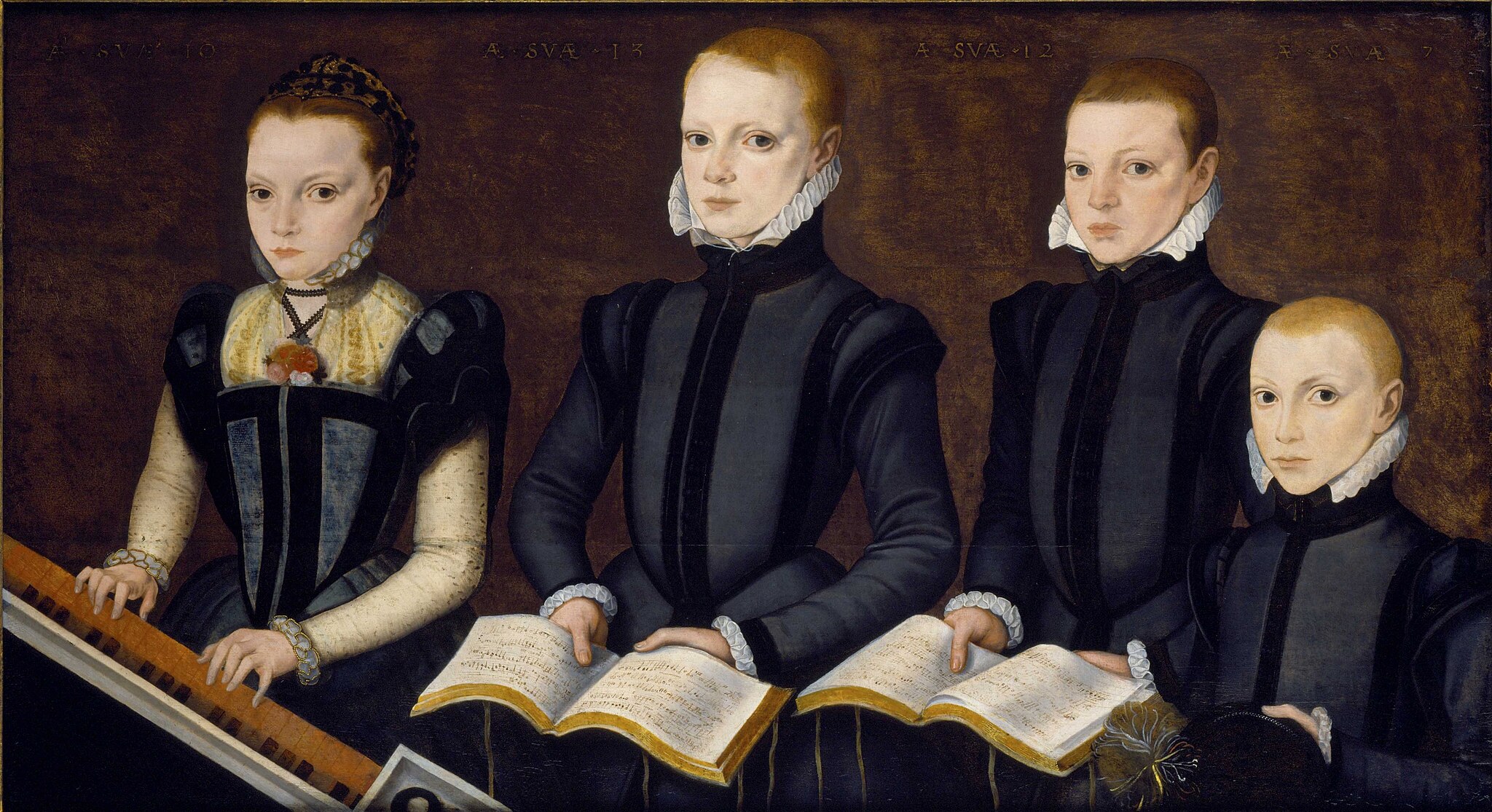
Para1William Shakespeare and his wife had three children, all born in Stratford-upon-Avon
and all within a few years of their marriage in 1583. No other offspring are known.
No known portraits exist of any of Shakespeare’s family.
Susanna Shakespeare
Para2Susanna Shakespeare, born in 1583, appears to have lived and prospered in her hometown.
At the age of 24, she married Dr. John Hall and later had one child, a daughter named
Elizabeth in 1608. Hall, who was educated at Cambridge University, was 32 years old
at the time of his marriage. He was a physician like this father, and thus entitled
to call himself a gentleman, as the parish register denotes.
Para3It is possible that Susanna may have had Catholic sympathies, because in 1606 she
and 21 others in Stratford were charged with not taking Communion on Easter Sunday.
Refusal to take Communion became an offense after the 1605 Gunpowder Plot by Catholic
sympathizers attempted to blow up Parliament. The case against her was eventually
dismissed.
Para4In 1613, she and her husband moved into their newly built home, Hall’s Croft, less
than ¼ mile from her father’s spacious home. John Hall appears to have practiced medicine
in part of the home. His records do include some discussion of his wife’s ailments,
including that she suffered from Cholick, an abdominal illness.
Para5Later in her life, Susanna Hall hosted Queen Henrietta Maria at her home in Stratford.
In 1643, the Queen visited the town and borrowed a book from the Halls. The book,
a tirade against Queen of France Catherine de Medici’s involvement in a Protestant
massacre in France in 1572, was an odd choice by Catherine’s granddaughter, Henrietta.
Para6Because she was his eldest child, Shakespeare left his large Stratford home, New Place,
to Susanna in his will; the estate was entailed, meaning it must be left to lineal
descendants. Since Susanna had no more children, it passed on to Shakespeare’s granddaughter,
Elizabeth Hall.
Para7Susanna Hall left no will when she died in 1649, although her sister Judith and her
daughter were still living. She was buried in Holy Trinity Church. Her epitaph bears
witness to her and her father’s reputation:
Witty above her sexe, but that’s not all,Wise to salvation was good Mistris Hall.Something of Shakespeare was in that, but thisWholy of him with whom she’s now in blisse.Then Passenger, hast nere a teare,To weepe with her that wept with all;That wept, yet set her self to chereThem up with comforts cordiall.Her love shall live, her mercy spread,When thou hast ner’e a teare to shed.
Hamnet Shakespeare
Para8Not quite two years after the birth of Susanna, the Holy Trinity Church parish register
records the christening of twin children on 2 February 1585, Hamnet and Judith,
sonne and daughter to William Shakspeare.

Para9The boy’s unusual name (it was sometimes spelled Hamlet in this period) is significant.
Naming traditions from the era indicate that a local burgess (a citizen and often
a town official), Hamnet Sadler, and his wife Judith may have acted as the twins’
godparents at their baptism. Sadler’s very legible signature on later documents indicate
he was formally educated, perhaps at King Edward VI’s school in the town. Sadler later
witnessed William Shakespeare’s will, suggesting the two men had a long and close
relationship.
Para10On 11 August 1596, Hamnet died at the age of 11, likely of plague, and was buried
in the Holy Trinity Churchyard.

Para11Shakespeare is not known to have left behind any elegies or records of his fatherly
feelings in response to Hamnet’s death. In contrast, when Shakespeare’s colleague
Ben Jonson lost his own son in 1603, he published an emotional poem in the boy’s memory
titled
On My First Son.
Para12Robert Berman concludes that it is possible but not likely that Shakespeare would
have attended his son’s funeral, as the boy died in August’s warm weather. It was
unusual to delay funerals beyond 2-3 days after death. It was a two day journey on
horseback to and from London, where Shakespeare worked, although it’s possible the
Lord Chamberlain’s Men were on tour in Kent during that time, making it even harder
to send news to Shakespeare about his son’s death.
Judith Shakespeare
Para13Hamnet’s twin sister Judith outlived her brother by many years. In 1616, at the rather
late age of 31, she married the 26-year-old vinter (wine merchant) Thomas Quiney just a few weeks before her father’s death. They were
married during Lent, which was typically forbidden, and the couple was censured by
the church court. Their marriage may well have been hastened by a scandal: Thomas
Quiney was named as the father of an illegitimate child born to Margaret Wheeler about
a month after the wedding. Neither Margaret nor her child survived.
Para14Thomas Quiney’s family was prosperous, and they lived on the High Street, just a few
minutes’ walk away from Judith’s home at New Place. Thomas could read and write in
English, French, and Latin. Perhaps because of the scandal, Shakespeare seems to have
doubted Thomas Quiney would prove a good husband. In Shakespeare’s will, Judith was
given £150, £100 of which was to be paid within a year of his death; a further £150
was to be bequeathed to her if she had children. In that will, dated 25 March 1616,
the phrase
son-in-lawwas crossed out and replaced by
daughter Judith,indicating that Shakespeare did not want the bequests to go to Thomas.
Para15A scant nine months after the wedding, and a few months after her father’s death,
Judith Quiney bore a son on November 23, 1616. He was named Shakespere Quiney, but
sadly died the following spring. She bore two more sons, Richard (b. 1618) and Thomas
(b. 1620). Both died within weeks of each other in 1639, perhaps due to an epidemic.
Para16Judith may have experienced significant separation from her family, as her mother
Anne’s epitaph notes only one daughter. Her husband Thomas also appears to have fallen
on hard times, since his more prosperous brother Richard made provision in his will
for money to fund Thomas’s burial. Thomas died in 1655, and Judith died in 1662 at
the ripe age of 77.
Other Descendants
Para17Some people still claim descent from William Shakespeare, even though his direct line
died out with the death of his granddaughter Elizabeth in 1670.
Para18People today can be descended from Shakespeare’s sister, Joan. Prior to 1600, she
married William Hart, with whom she had four children. Their son Thomas (1605–1670)
went on to have two sons, so many descendants of Shakespeare’s nephew can be accurately
located.
Sources
The Shakespeare Circle: An Alternative Biography. Edited by Paul Edmondson and Stanley Wells. Cambridge UP, 2015.
Potter, Lois. The Life of William Shakespeare: A Critical Biography. Chichester, Wiley-Blackwell, 2012.
Schoenbaum, Samuel. William Shakespeare: A Compact Documentary Life. Oxford UP, 1977.
Open-Access Digital Resources
Bearman, Robert.
Parish Register Entry recording Hamnet and Judith Shakespeare’s Baptism.Shakespeare Documented, 22 May 2020, doi: doi.org/10.37078/461. Accessed 11 Feb. 2026.
Bearman, Robert.
Parish Register Entry Recording Hamnet Shakespeare’s Burial..Shakespeare Documented, 22 May 2020, https://shakespearedocumented.folger.edu/node/462. Accessed 11 Feb. 2026.
Bearman, Robert.
Parish Register Entry Recording Judith Shakespeare Quiney’s BurialShakespeare Documented, 22 May 2020, doi: doi.org/10.37078/438. Accessed 11 Feb. 2026.
Bearman, Robert.
Parish Register Entry Recording Susanna Shakespeare’s Baptism.Shakespeare Documented, 22 May 2020, https://shakespearedocumented.folger.edu/node/514. Accessed 11 Feb. 2026.
Bearman, Robert.
Parish Register Entry Recording Susanna Shakespeare Hall’s Burial.Shakespeare Documented, 22 May 2020, doi.org/10.37078/439. Accessed 11 Feb. 2026.
Best, Michael.
Married Life.Shakespeare’s Life and Times. Internet Shakespeare Editions. University of Victoria, 04 Jan. 2011, https://internetshakespeare.uvic.ca/Library/SLT/life/youth/children.html. Accessed 17 Mar. 2023.
Best, Michael.
The Shakespeare Family..Shakespeare’s Life and Times. Internet Shakespeare Editions. University of Victoria, 04 Jan. 2011, https://internetshakespeare.uvic.ca/Library/SLT/life/youth/children.html. Accessed 17 Mar. 2023.
Joynes, Victoria.
Shakespeare’s Family—The Halls.Shakespeare Birthplace Trust, 26 Jul. 2016, https://www.shakespeare.org.uk/explore-shakespeare/blogs/shakespeares-family-halls/. Accessed 11 Feb. 2026.
Image Sources
Warwick, Master of the Countess of, attributed to. Four Children Making Music. Oil on panel. Circa 1565. Wikimedia Commons. https://commons.wikimedia.org/wiki/File:Four_children_making_music.jpg.

Parish Register Entry Recording Hamnet and Judith Shakespeare’s Baptisms.MS. 2 February 1585. Shakespeare Documented. Folger Shakespeare Library, https://doi.org/10.37078/461.
Parish Register Entry Recording Hamnet Shakespeare’s Burial..MS. 11 August 1596. Shakespeare Documented. Folger Shakespeare Library, https://doi.org/10.37078/462.
Prosopography
Kate McPherson
Kate McPherson is Professor of English and Honors Program Director at Utah Valley
University (Orem, UT, USA). In 2015, she began working to redevelop Shakespeare’s Life and Times, created by Michael Best, into the Early Modern England Encyclopedia. Her other publications include commentary on Pericles and The Comedy of Errors for the New Oxford Shakespeare (2016); the co-edited volumes Stages of Engagement: Drama and Religion in Post-Reformation England with James Mardock (Duquesne University Press, 2014) and Shakespeare Expressed: Page, Stage, and Classroom in Shakespeare and His Contemporaries, with Kathryn M. Moncrief and Sarah Enloe (Fairleigh Dickinson University Press,
2013). With Kathryn M. Moncrief, Kate has also two edited collections, Performing Pedagogy in Early Modern England: Gender, Instruction, and Performance (Ashgate, 2011) and Performing Maternity in Early Modern England (Ashgate 2008). She has also published numerous articles on early modern maternity
in scholarly journals. Kate participated in the 2008 National Endowment for the Humanities
Institute,
Shakespeare’s Blackfriars: The Study, the Stage, the Classroom,at the American Shakespeare Center. She also served as Play Seminar Director, a public humanities position, for the Utah Shakespeare Festival in 2017 and 2018.
Leah Hamby
Leah Hamby is the primary encoder for the Early Modern England Encyclopedia. Aside from encoding, she also works as an editor for the project and contributed
several articles of her own. She has been working on the EMEE since February 2023. As of February 2026, she is soon to graduate with honours from
Utah Valley University with a major in history and a minor in creative writing. Her
other work with the LEMDO program includes remediating William Kemp’s Kemp’s Nine Day’s Wonder for the Digital Renaissance Editions.
Michael Best
Michael Best is Professor Emeritus at the University of Victoria, BC. He founded the
Internet Shakespeare Editions in 1996, and was Coordinating Editor until 2017, contributing two editions to the
ISE: King John and King Lear (the latter also available in print from Broadview Press). In print, he has published editions of works of Elizabethan magic and huswifery,
a collection of letters from the Australian goldfields, and Shakespeare on the Art of Love (2008). He contributed regular columns for the Shakespeare Newsletter on
Electronic Shakespeares,and has written many articles and chapters for both print and online books and journals, principally on questions raised by the new medium in the editing and publication of texts. He has delivered papers and plenary lectures on electronic media and the Internet Shakespeare Editions at conferences in Canada, the USA, the UK, Spain, Australia, and Japan.
Navarra Houldin
Training and Documentation Lead 2025–present. LEMDO project manager 2022–2025. Textual
remediator 2021–present. Navarra Houldin (they/them) completed their BA with a major
in history and minor in Spanish at the University of Victoria in 2022. Their primary
research was on gender and sexuality in early modern Europe and Latin America. They
are continuing their education through an MA program in Gender and Social Justice
Studies at the University of Alberta where they will specialize in Digital Humanities.
Orgography
LEMDO Team (LEMD1)
The LEMDO Team is based at the University of Victoria and normally comprises the project
director, the lead developer, project manager, junior developers(s), remediators,
encoders, and remediating editors.
University of Victoria (UVIC1)
https://www.uvic.ca/Metadata
| Authority title | Shakespeare’s Children |
| Type of text | Critical |
| Publisher | University of Victoria on the Linked Early Modern Drama Online Platform |
| Series | Early Modern England Encyclopedia |
| Source |
By Kate McPherson, inspired by Michael Best’s Shakespeare’s Life and Times, Internet Shakespeare Editions
|
| Editorial declaration | This document uses Canadian English spelling |
| Edition | Released with Early Modern England Encyclopedia 1.0 |
| Sponsor(s) |
Early Modern England EncyclopediaAnthology Leads: Kate McPherson and Kate Moncrief.
|
| Encoding description | Encoded in TEI P5 according to the LEMDO Customization and Encoding Guidelines |
| Document status | published |
| Funder(s) |
Social Sciences and Humanities Research Council of Canada
Mitacs Globalink Research Internship Utah Valley University |
| License/availability |
Unless otherwise noted, intellectual copyright in EMEE Anthology pages is held by
Kate McPherson on behalf of the contributors. Copyright on the TEI-XML markup is held by the University of Victoria on behalf of the LEMDO Team. The content and TEI-XML markup in this file are licensed under a CC BY-NC-ND 4.0 license. This file is freely downloadable without permission under the following conditions:
(1) credit must be given to the authors, EMEE, and LEMDO in any subsequent use of
the files and /or data; (2) this availability statement must remain in the file; (3)
the content cannot be adapted or repurposed (except for quotations for the purposes
of academic review and citation); and (4) commercial uses are not permitted without
the knowledge and consent of the authors, EMEE, and LEMDO. Neither the content nor
the code in this file is licensed for training large language models (LLMs), ingestion
into an LLM, or any use in any artificial intelligence applications; such uses are
considered to be commercial uses and are strictly prohibited.
|