
Princess Elizabeth
Early Life
Para1Princess Elizabeth Tudor was born September 7, 1533, at Greenwich Palace, England
to King Henry VIII and his second wife, Anne Boleyn. Elizabeth’s gender was a disappointment
to the King. He wanted a son and heir. King Henry VIII had recently divorced his first
wife Catherine of Aragon, because she had not given him a suitable heir. Henry married
Anne Boleyn, Elizabeth’s mother, after years of courtship during the divorce proceedings.
Anne may have already been with child at the time of the formal wedding on January
25, 1533, which followed a secret wedding in France the previous November. However,
Boleyn also failed to provide the king with an heir. Later in 1536, Boleyn was accused
of adultery and treason. She was executed when Elizabeth was only two years old.
Para2After her mother’s execution, Elizabeth’s position was precarious. She was declared
illegitimate and thus unable to inherit the throne. Her title changed from Princess
Elizabeth to Lady Elizabeth. In her childhood, she lived at various country estates
under guardianship rather than at the king’s court.
Education
Para3Lady Margaret Bryan, Elizabeth’s great-aunt and sister of Anne Boleyn’s mother, was
given full charge of raising Elizabeth. Two other women, Kat Ashley and Blanche Parry,
served Elizabeth, with Ashley as governess and nurse. When Elizabeth was seven years
old, her formal schooling began, likley under the direction of Katherine Champernowne.
Para4When Elizabeth’s half-brother Edward was born in 1537, they shared the same nursery
and many of the same tutors. Unusually, Elizabeth learned from male tutors as she
was taught jointly with her younger brother. Some of the tutors included Sir Anthony
Cooke, Sir John Cheke, William Grindal, and Roger Ascham. Ascham used a humanist curriculum
for his students, which were published as a book called The Schoolmaster, which appeared in 1570 after his death. Over time, Elizabeth became fluent in Latin,
French, and Italian, with competant skills in Greek and Spanish.
Katherine Parr
Para5When her father married his sixth and final wife, Katherine Parr in 1543, Elizabeth’s
life improved. At Parr’s urging, the ten-year old Elizabeth was brought back to the
court and, through the Act of Succession in 1544, was retitled as Princess. Parr was
also an enthusiastic Protestant and may have help shape Elizabeth’s strong commitment
to the Church of England.
Thomas Seymour
Para6In 1547, Henry VIII died and was succeeded by Edward VI, Elizabeth’s nine-year-old
younger brother. Elizabeth continued living with her stepmother Katherine Parr. The
King’s will had left Elizabeth rich, so she became a target for men seeking a high
advantageous marriage. Thomas Seymour took aim at Elizabeth. Seymour was the brother
of Edward Seymour, the Duke of Somerset, Edward VI’s Lord Protector. Thomas Seymour
intended to marry one of Henry VIII’s daughters, either Mary or Elizabeth, to strengthen
his political power. However, his suit was rejected by the Royal Council. He married
the widowed queen Katherine Parr instead.
Para7Princess Elizabeth lived with Katherine Parr, and the hitorical record indicates Thomas
Seymour took liberties with Elizabeth. Seymour entered Elizabeth’s bedchamber before
she rose, teasing and tickling her as Elizabeth retreated under the bedclothes. Parr
enjoyed her husband’s mischief, and one time she held Elizabeth down in the garden
while Seymour used scissors to cut Elizabeth’s gown in pieces. When Parr found out
Thomas Seymour’s flirtation was causing scandal, Elizabeth was sent away to stay with
Kat Ashley’s sister in Hertfordshire.
Para8In 1549, Seymour was imprisoned due to the suspicion of attempting to marry Princess
Elizabeth, encouraging pirates, receiving stolen goods, and plotting to obtain control
of the king’s person. Due to the potentially intimate relationship between Seymour
and Princess Elizabeth, she was put under interrogation but was publicly exonerated.
Seymour was executed later that year.
Imprisonment and Accession
Para9When Edward VI died in 1553, Elizabeth’s Catholic half-sister Mary Tudor inherited
the throne. Elizabeth was in a precarious position again. In 1554, Elizabeth was imprisoned
in the Tower of London under suspicion of involvement in Protestant insurrection.
Later she was moved to a royal property in Oxfordshire, Woodstock Palace, where she
spent almost a year under house arrest. In 1558, Mary I died, and the accession of
the throne came to Princess Elizabeth. She became Queen Elizabeth I, the last monarch
of the Tudor period.
Sources
Loades, D. M. Elizabeth I. Hambledon and London, 2003.
Stump, Donald V., and Susan M. Felch. Elizabeth I and Her Age : Authoritative Texts, Commentary and Criticism. W.W. Norton, 2009.
Open-Access Digital Resources
Best, Michael.
Princess Elizabeth.Shakespeare’s Life and Times. Internet Shakespeare Editions. University of Victoria, 4 Jan. 2011, https://internetshakespeare.uvic.ca/Library/SLT/history/elizabeth/childhood.html. Accessed 16 Oct. 2018.
Henry VIII’s Children.Historic Royal Palaces, 2018, https://www.hrp.org.uk/hampton-court-palace/history-and-stories/henry-viiis-children/. Accessed 16 Oct. 2018.
Prisoner of the Tower.Historic Royal Palaces, 2018, https://www.hrp.org.uk/tower-of-london/history-and-stories/tower-of-london-prison/. Accessed 17 Jun. 2023.
Queen Elizabeth I Facts and Myths.Royal Museums at Greenwich, https://www.rmg.co.uk/stories/royal-history/queen-elizabeth-i-facts-myths. Accessed 23 Feb. 2023.
Image Source
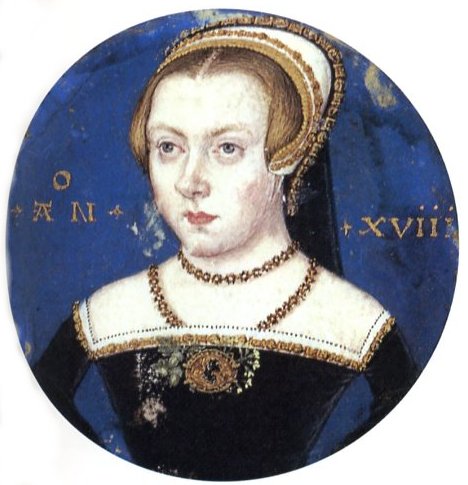
Horenbout, Lucas. Portrait of an Unknown Lady. c. 1535. Gouach paint on thin card. Yale Center for British Art. Wikimedia. https://commons.wikimedia.org/wiki/File:Tudor-era_portrait_of_a_lady_in_her_18th_year_B1974.2.59.jpg.

Prosopography
Chun To Mok
Chun To Mok was a student at Utah Valley University.
Kate McPherson
Kate McPherson is Professor of English and Honors Program Director at Utah Valley
University (Orem, UT, USA). In 2015, she began working to redevelop Shakespeare’s Life and Times, created by Michael Best, into the Early Modern England Encyclopedia. Her other publications include commentary on Pericles and The Comedy of Errors for the New Oxford Shakespeare (2016); the co-edited volumes Stages of Engagement: Drama and Religion in Post-Reformation England with James Mardock (Duquesne University Press, 2014) and Shakespeare Expressed: Page, Stage, and Classroom in Shakespeare and His Contemporaries, with Kathryn M. Moncrief and Sarah Enloe (Fairleigh Dickinson University Press,
2013). With Kathryn M. Moncrief, Kate has also two edited collections, Performing Pedagogy in Early Modern England: Gender, Instruction, and Performance (Ashgate, 2011) and Performing Maternity in Early Modern England (Ashgate 2008). She has also published numerous articles on early modern maternity
in scholarly journals. Kate participated in the 2008 National Endowment for the Humanities
Institute,
Shakespeare’s Blackfriars: The Study, the Stage, the Classroom,at the American Shakespeare Center. She also served as Play Seminar Director, a public humanities position, for the Utah Shakespeare Festival in 2017 and 2018.
Leah Hamby
Leah Hamby is the primary encoder for the Early Modern England Encyclopedia. Aside from encoding, she also works as an editor for the project and contributed
several articles of her own. She has been working on the EMEE since February 2023. As of February 2026, she is soon to graduate with honours from
Utah Valley University with a major in history and a minor in creative writing. Her
other work with the LEMDO program includes remediating William Kemp’s Kemp’s Nine Day’s Wonder for the Digital Renaissance Editions.
Michael Best
Michael Best is Professor Emeritus at the University of Victoria, BC. He founded the
Internet Shakespeare Editions in 1996, and was Coordinating Editor until 2017, contributing two editions to the
ISE: King John and King Lear (the latter also available in print from Broadview Press). In print, he has published editions of works of Elizabethan magic and huswifery,
a collection of letters from the Australian goldfields, and Shakespeare on the Art of Love (2008). He contributed regular columns for the Shakespeare Newsletter on
Electronic Shakespeares,and has written many articles and chapters for both print and online books and journals, principally on questions raised by the new medium in the editing and publication of texts. He has delivered papers and plenary lectures on electronic media and the Internet Shakespeare Editions at conferences in Canada, the USA, the UK, Spain, Australia, and Japan.
Navarra Houldin
Training and Documentation Lead 2025–present. LEMDO project manager 2022–2025. Textual
remediator 2021–present. Navarra Houldin (they/them) completed their BA with a major
in history and minor in Spanish at the University of Victoria in 2022. Their primary
research was on gender and sexuality in early modern Europe and Latin America. They
are continuing their education through an MA program in Gender and Social Justice
Studies at the University of Alberta where they will specialize in Digital Humanities.
Orgography
LEMDO Team (LEMD1)
The LEMDO Team is based at the University of Victoria and normally comprises the project
director, the lead developer, project manager, junior developers(s), remediators,
encoders, and remediating editors.
University of Victoria (UVIC1)
https://www.uvic.ca/Metadata
| Authority title | Princess Elizabeth |
| Type of text | Critical |
| Publisher | University of Victoria on the Linked Early Modern Drama Online Platform |
| Series | Early Modern England Encyclopedia |
| Source |
By Chun To Mok, inspired by Michael Best’s Shakespeare’s Life and Times, Internet Shakespeare Editions
|
| Editorial declaration | This document uses Canadian English spelling |
| Edition | Released with Early Modern England Encyclopedia 1.0 |
| Sponsor(s) |
Early Modern England EncyclopediaAnthology Leads: Kate McPherson and Kate Moncrief.
|
| Encoding description | Encoded in TEI P5 according to the LEMDO Customization and Encoding Guidelines |
| Document status | published, peer-reviewed |
| Funder(s) |
Social Sciences and Humanities Research Council of Canada
Mitacs Globablink Research Internship |
| License/availability |
Intellectual copyright in this entry is held by Kate McPherson on behalf of the contributors. Copyright on the TEI-XML markup is held by the University of Victoria on behalf of the LEMDO Team. The content and TEI-XML markup in this file are licensed under a CC BY-NC_ND 4.0 license. This file is freely downloadable without permission under the following conditions:
(1) credit must be given to the authors, EMEE, and LEMDO in any subsequent use of
the files and /or data; (2) this availability statement must remain in the file; (3)
the content cannot be adapted or repurposed (except for quotations for the purposes
of academic review and citation); and (4) commercial uses are not permitted without
the knowledge and consent of the authors, EMEE, and LEMDO. Neither the content nor
the code in this file is licensed for training large language models (LLMs), ingestion
into an LLM, or any use in any artificial intelligence applications; such uses are
considered to be commercial uses and are strictly prohibited.
|