
The Publication of Shakespeare’s Plays
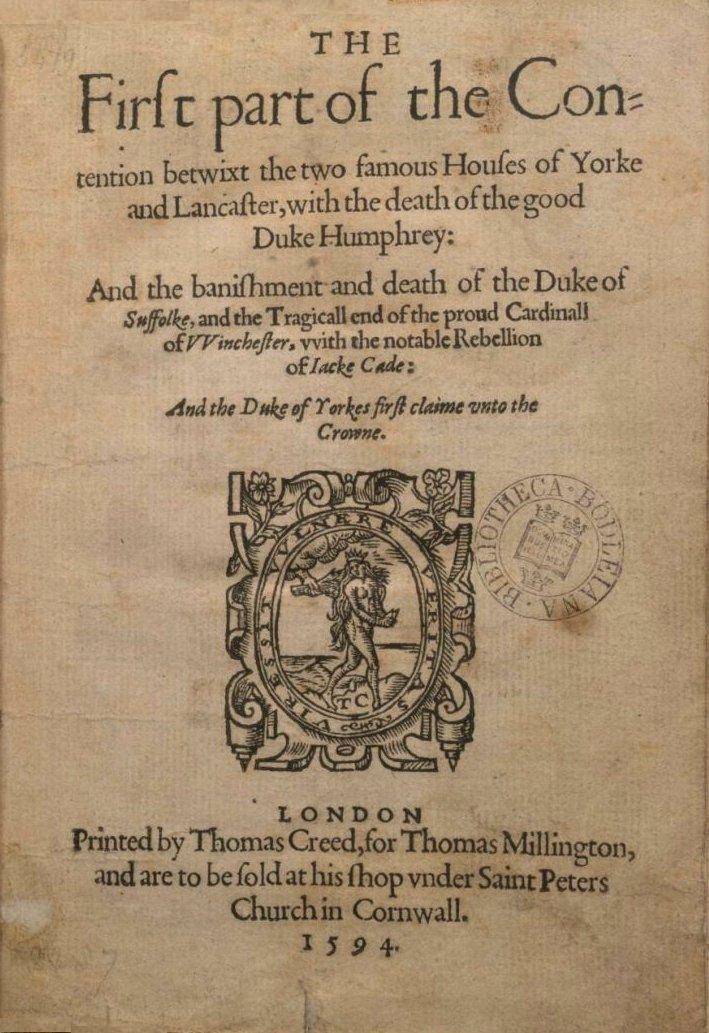
Para1William Shakespeare’s first plays to be published did not have his name on the title
page. In the 16th century, plays were not generally considered literature bur rather
were viewed as commercial entertainment. Prior to Shakespeare’s death, about half
of his 38 plays were published in quarto versions, a small book equivalent to a thin
modern paperback.
Para2Nineteen of Shakespeare’s plays were published in his lifetime, the later ones with
his name on the title page. The name clearly became a selling point as his reputation
grew; in fact, some plays clearly not by Shakespeare were published with his name
on the title page during the 17th century in an apparent attempt to make them more
attractive to the buyer.
Play Publication Practices
Para3In general, playing companies did not publish their plays. They kept them closely
guarded as important intellectuall property until the play lost popularity. This may
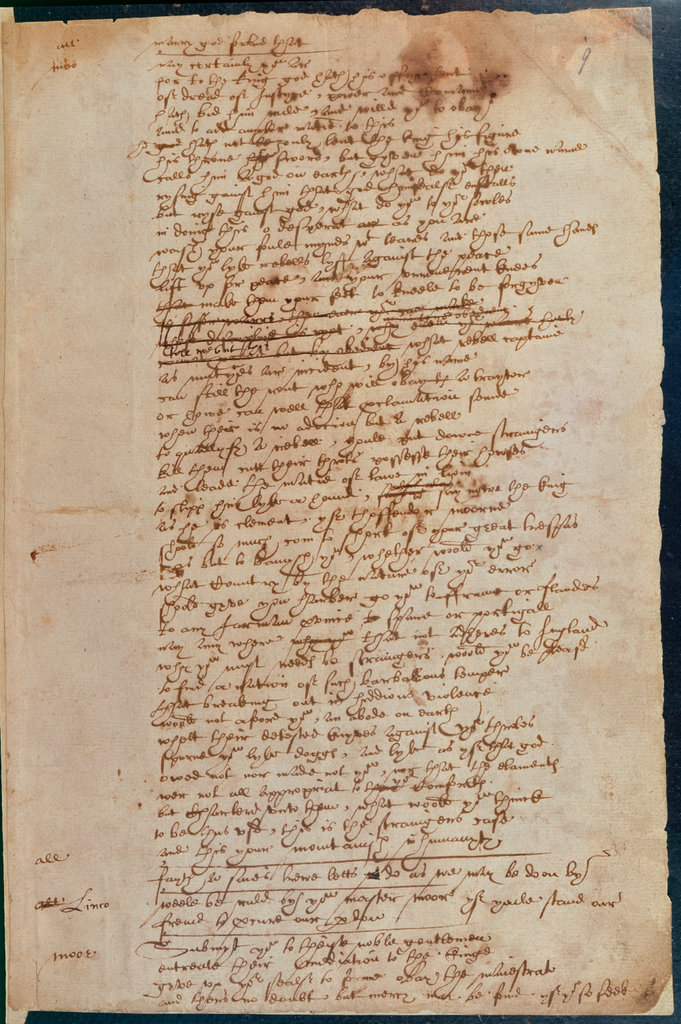
be the reason why, apart from 147 lines of the play Sir Thomas More, none of Shakespeare’s plays survive in his handwriting. No one knows what became
of the playbooks in his hand owned by the Lord Chamberlain’s Men.
Early Plays in Print
Para4Scholars have long speculated how Shakespeare’s early plays came into print. His two
earliest plays in print, Titus Andronicus and Henry VI, Part One both appeared in print in 1594, neither with Shakespeare’s name on the title page.
In fact, the first version of Henry VI, Part Two which appeared in 1594 may be one of the untidy and problematic texts that are sometimes
thought to have been pirated, or reconstructed from memory by an actor, spectator,
or rival playwright. Some of the quarto publications are substantially shorter than
the versions later prepared by his colleagues John Heminges and Henry Condell for
publication in 1623. This version, which is now called the First Folio, proclaims
on its title page that it is from the
True Originall Copies,presumably meaning the manuscript pages in Shakespeare’s hand.
Para5In any case the appearance of both Titus Andronicus and Henry VI, Part One suggest they were popular enough with audiences that a printing house believed it
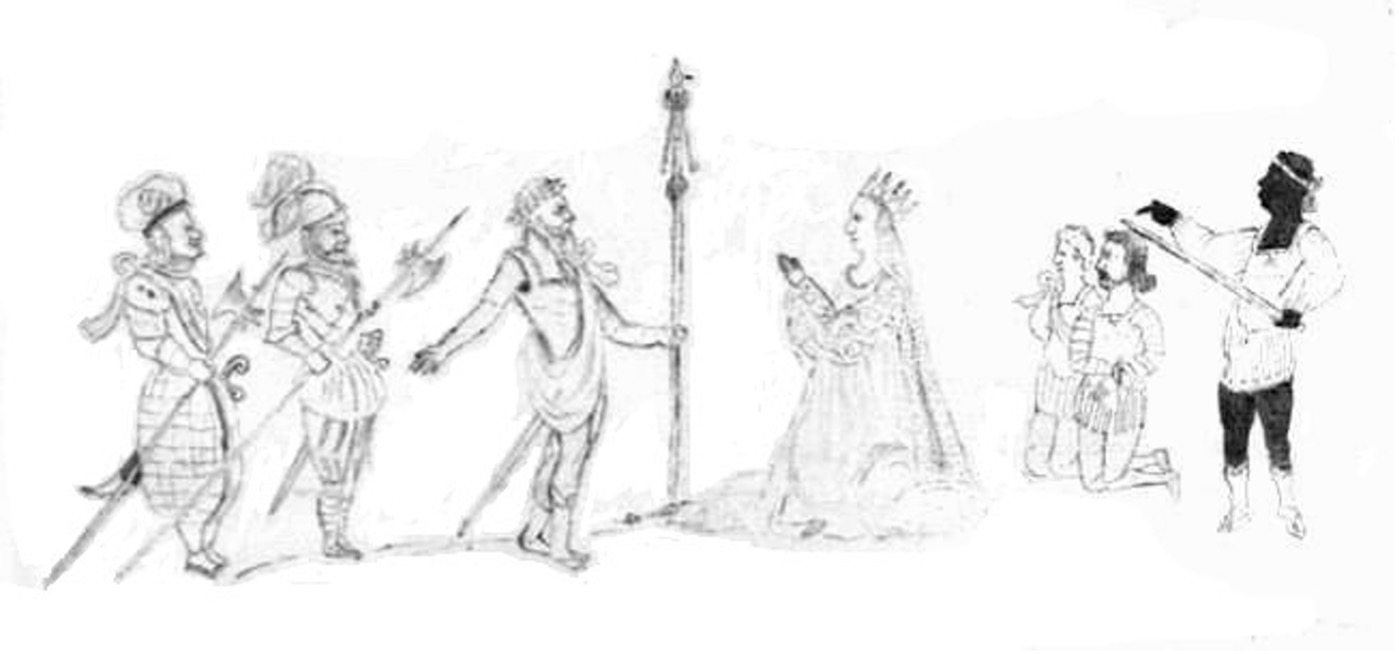
could make a profit on selling them. We know that Titus was popular enough that a man named Henry Peachum made a sketch of one of its scenes,
the only illustration we have presumably made from an audience member.
16th Century Printing Practices
Para6Plays were much more difficult to print than poems or sermons because of early modern
printing practices. A book printed in quarto is made from sheets of paper folded twice
so that there are eight sides on which to print. The pages were not typeset or printed
in order, but instead pages 1, 8, 4, and 5 were printed on one side (called recto, or “right” in Latin), with pages 2, 7, 3, and 6 on the reverse (called verso, or “reverse”). Because plays mix lines of speech in poetry with lines in prose,
and because characters speak partial lines, interrupt each other, and the language
features other things that mimic human speech, it is much more complicated to typeset
a play on a page.
Sources
Berger, Thomas L. and Jesse M. Lander.
Shakespeare in Print, 1593–1640.In A Companion to Shakespeare, edited by David Scott Kastan. Blackwell, 1999, pp. 395–413.
Farley-Hills, David.
The Date of Titus Andronicus.Notes and Queries, vol. 47, no. 4, 2000, pp.441–444.
The New Oxford Shakespeare. Edited by Gary Taylor et al..Oxford UP, 2016.
Taylor, Gary, and Rory Loughnane.
The Canon and Chronology of Shakespeare’s Works.The New Oxford Shakespeare, edited by Gary Taylor et al.. Oxford UP, 2016, pp. 417–602.
Open-Access Digital Resources
Best, Michael.
Experimental Plays: from about 1589 to 1594.Shakespeare’s Life and Times. Internet Shakespeare Editions. University of Victoria, 4 Jan. 2011, https://internetshakespeare.uvic.ca/Library/SLT/life/youth/earlyplaygroup.html. Accessed 2 Mar. 2023.
Best, Michael.
Popularity and Publication.Shakespeare’s Life and Times. Internet Shakespeare Editions. University of Victoria, 4 Jan. 2011, https://internetshakespeare.uvic.ca/Library/SLT/life/youth/publication.html. Accessed 2 Mar. 2023.
Best, Michael.
Years 1593–1594.Shakespeare’s Life and Times. Internet Shakespeare Editions. University of Victoria, 4 Jan. 2011, https://internetshakespeare.uvic.ca/Library/SLT/reference/chronology/years1593-1594.html. Accessed 2 Mar. 2023.
Timeline of Shakespeare’s Plays,The Royal Shakespeare Company, https://www.rsc.org.uk/shakespeares-plays/histories-timeline/timeline. Accessed 2 Mar. 2023.
Wolfe, Heather.
Titus Andronicus, First Edition: Only Surviving Copy of Shakespeare’s First Printed Play.Shakespeare Documented, 23 Feb. 2020, doi: https://doi.org/10.37078/87. Accessed 11 Feb. 2026.
Image Sources
Munday, Anthony et. al..
Hand D, The Booke of Sir Thomas Moore.Wikimedia Commons, 1591–1593, https://commons.wikimedia.org/wiki/File:Sir_Thomas_More_Hand_D.jpg.

Peacham, Henry.
Sketch of Titus Andronicus.Wikimedia, 1595, https://upload.wikimedia.org/wikipedia/commons/f/ff/Peacham_drawing_%281595%29_Titus_Andronicus.jpg.

Shakespeare, William.
Title Page of the First Quarto of Henry VI.Wikimedia, 1594, https://commons.wikimedia.org/wiki/File:Henry_VI_pt_2_quarto.jpg.

Prosopography
Kate McPherson
Kate McPherson is Professor of English and Honors Program Director at Utah Valley
University (Orem, UT, USA). In 2015, she began working to redevelop Shakespeare’s Life and Times, created by Michael Best, into the Early Modern England Encyclopedia. Her other publications include commentary on Pericles and The Comedy of Errors for the New Oxford Shakespeare (2016); the co-edited volumes Stages of Engagement: Drama and Religion in Post-Reformation England with James Mardock (Duquesne University Press, 2014) and Shakespeare Expressed: Page, Stage, and Classroom in Shakespeare and His Contemporaries, with Kathryn M. Moncrief and Sarah Enloe (Fairleigh Dickinson University Press,
2013). With Kathryn M. Moncrief, Kate has also two edited collections, Performing Pedagogy in Early Modern England: Gender, Instruction, and Performance (Ashgate, 2011) and Performing Maternity in Early Modern England (Ashgate 2008). She has also published numerous articles on early modern maternity
in scholarly journals. Kate participated in the 2008 National Endowment for the Humanities
Institute,
Shakespeare’s Blackfriars: The Study, the Stage, the Classroom,at the American Shakespeare Center. She also served as Play Seminar Director, a public humanities position, for the Utah Shakespeare Festival in 2017 and 2018.
Leah Hamby
Leah Hamby is the primary encoder for the Early Modern England Encyclopedia. Aside from encoding, she also works as an editor for the project and contributed
several articles of her own. She has been working on the EMEE since February 2023. As of February 2026, she is soon to graduate with honours from
Utah Valley University with a major in history and a minor in creative writing. Her
other work with the LEMDO program includes remediating William Kemp’s Kemp’s Nine Day’s Wonder for the Digital Renaissance Editions.
Michael Best
Michael Best is Professor Emeritus at the University of Victoria, BC. He founded the
Internet Shakespeare Editions in 1996, and was Coordinating Editor until 2017, contributing two editions to the
ISE: King John and King Lear (the latter also available in print from Broadview Press). In print, he has published editions of works of Elizabethan magic and huswifery,
a collection of letters from the Australian goldfields, and Shakespeare on the Art of Love (2008). He contributed regular columns for the Shakespeare Newsletter on
Electronic Shakespeares,and has written many articles and chapters for both print and online books and journals, principally on questions raised by the new medium in the editing and publication of texts. He has delivered papers and plenary lectures on electronic media and the Internet Shakespeare Editions at conferences in Canada, the USA, the UK, Spain, Australia, and Japan.
Navarra Houldin
Training and Documentation Lead 2025–present. LEMDO project manager 2022–2025. Textual
remediator 2021–present. Navarra Houldin (they/them) completed their BA with a major
in history and minor in Spanish at the University of Victoria in 2022. Their primary
research was on gender and sexuality in early modern Europe and Latin America. They
are continuing their education through an MA program in Gender and Social Justice
Studies at the University of Alberta where they will specialize in Digital Humanities.
Orgography
LEMDO Team (LEMD1)
The LEMDO Team is based at the University of Victoria and normally comprises the project
director, the lead developer, project manager, junior developers(s), remediators,
encoders, and remediating editors.
University of Victoria (UVIC1)
https://www.uvic.ca/Metadata
| Authority title | The Publication of Shakespeare’s Plays |
| Type of text | Critical |
| Publisher | University of Victoria on the Linked Early Modern Drama Online Platform |
| Series | Early Modern England Encyclopedia |
| Source |
By Kate McPherson, inspired by Michael Best’s Shakespeare’s Life and Times, Internet Shakespeare Editions
|
| Editorial declaration | This document uses Canadian English spelling |
| Edition | Released with Early Modern England Encyclopedia 1.0 |
| Sponsor(s) |
Early Modern England EncyclopediaAnthology Leads: Kate McPherson and Kate Moncrief.
|
| Encoding description | Encoded in TEI P5 according to the LEMDO Customization and Encoding Guidelines |
| Document status | published, peer-reviewed |
| Funder(s) |
Social Sciences and Humanities Research Council of Canada
Mitacs Globalink Research Internship Utah Valley University |
| License/availability |
Unless otherwise noted, intellectual copyright in EMEE Anthology pages is held by
Kate McPherson on behalf of the contributors. Copyright on the TEI-XML markup is held by the University of Victoria on behalf of the LEMDO Team. The content and TEI-XML markup in this file are licensed under a CC BY-NC-ND 4.0 license. This file is freely downloadable without permission under the following conditions:
(1) credit must be given to the authors, EMEE, and LEMDO in any subsequent use of
the files and /or data; (2) this availability statement must remain in the file; (3)
the content cannot be adapted or repurposed (except for quotations for the purposes
of academic review and citation); and (4) commercial uses are not permitted without
the knowledge and consent of the authors, EMEE, and LEMDO. Neither the content nor
the code in this file is licensed for training large language models (LLMs), ingestion
into an LLM, or any use in any artificial intelligence applications; such uses are
considered to be commercial uses and are strictly prohibited.
|