
Masques
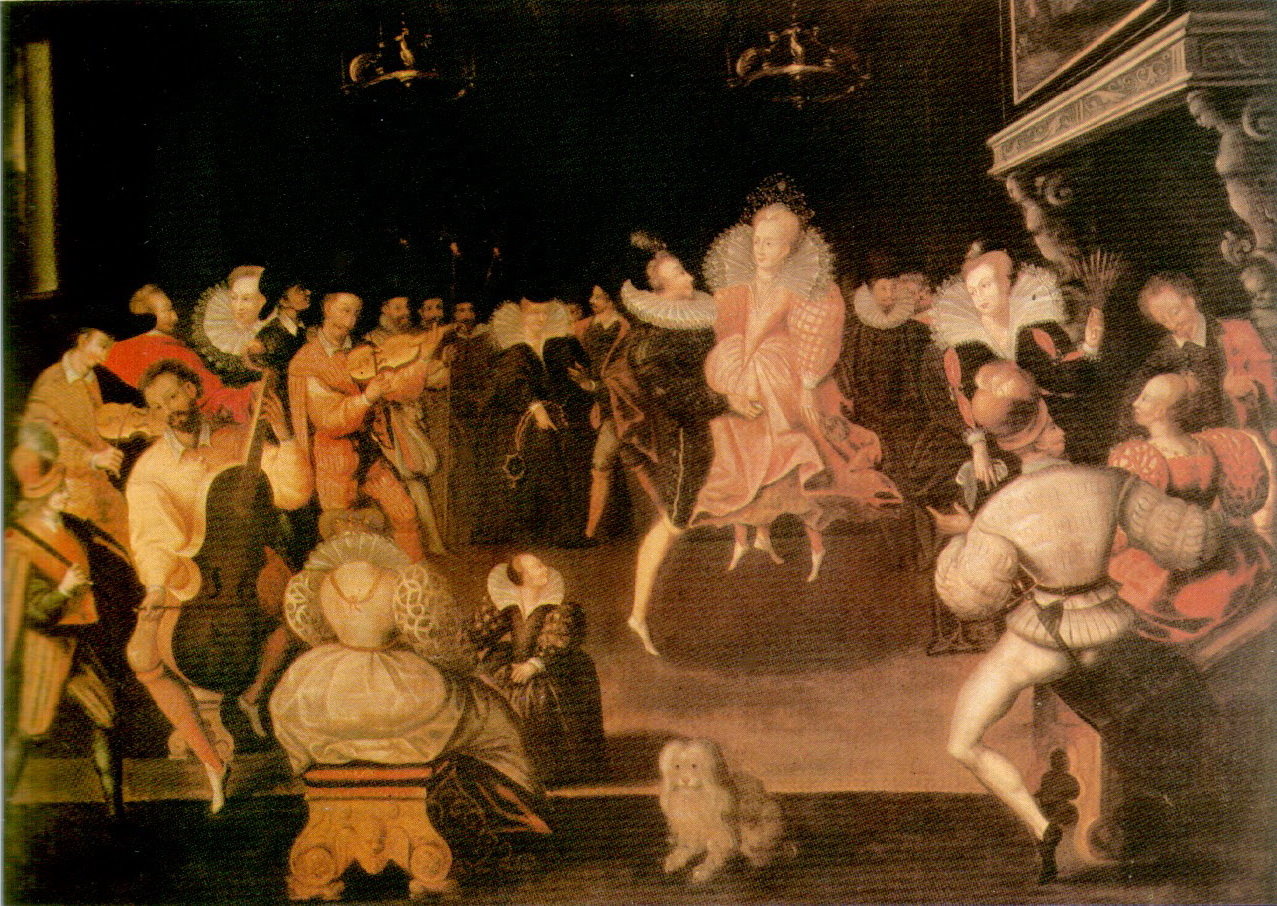
The Masque
Para1A masque was a form of aristocratic and court entertainment in the 16th and 17th centuries.
It consisted of elaborate productions of song, dance, sets, costumes, and dialogue,
Masques were often custom productions written to celebrate either the lord or lady
of the house or the main guest in the aristocratic court. Records indicate they frequently
accompanied marriage celebrations.
Para2Masques evolved in England from the medieval practice of mumming (“masked, silent
entertainments”) probably tied to religious or community rituals. As early as 1377,
records show a group of citizens disguised as members of the court visited the royal
court, gambled over jewelry, then ended the night with dance, with the mummers and
the aristocrats dancing on opposite sides of the hall.
Para3The masque was also strongly influenced by a theatrical form called intermezzo, which
originated in Renaissance Italy. The intermezzo was an entertainment form introduced
by Lorenzo de Medici, the de facto ruler of Florence from 1469–1492. In Italy, intermezzi
were essentially court plays, with actors on a stage. Intermezzi included song, dance,
scenery, and elalaborate stage effects produced by stage machinery.
The Masque in England
Para4During Queen Elizabeth’s reign, masques were used to further her political endeavours.
The designation of the dancing couples who were paired, the order in which the attendees
danced, and the position of the dancers in relation to each other on the dance floor
could all have political meaning and purposes. Queen Elizabeth was also able to influence
political objectives with her own performing abilities. She made sure to take control
of the court with her polished dance, thereby influencing how she was perceived by
the attendees of the masques, many of whom were ruling members of foreign nations.
Para5In the court of King James I, masques became even more prominent. They featured spectacular
stage effects and costumes, specific dances, music, and the intermingling of professional
entertainers and members of the court. An elaborate series of masques was presented
as part of the celebrations surrounding the wedding of James I’s daughter Elizabeth
in 1612. The expensive entertainments were performed only once, despite their high
cost.
Para6Under King James I, who was a patron of Shakespeare’s theater company, the masque
reached its peak under the creative control of scenic designer and architect Inigo
Jones and the playwright Ben Jonson. Queen Anna and the ladies of the court performed
in elaborate costumes, even though women were prohibited from performing on the public
stage.
Shakespeare and the Masque
Para7Shakespeare did not participate directly in the creation of masques at the Stuart
Court, although he alludes heavily to the features of the masque in The Tempest, which was presented at court at the same time many masques were performed for the
wedding of Princess Elizabeth in 1612. In The Tempest, many special effects appear in the stage directions, including the one that opens
the play:
of thunder and lightning heard.Many other fantastic scenes occur in the play, such as when the spirit Ariel appears as a harpy to steal away the banquet in Act 3 with
a quaint deviceand is assisted by others
shapeswho enter
and dance, with mocks and mows, and carrying out the table.After the theaters were closed in 1642, the masque never regained popularity as a theatrical art form.
Sources
Barroll, Leeds.
Inventing the Stuart Masque.In The Politics of the Stuart Court Masque. Edited by David Bevington and Peter Holbrook. Cambridge UP, 1998, pp. 121–143.
Demaray, John G. Shakespeare and the Spectacles of Strangeness: The Tempest and the Transformation of Renaissance Theatrical Forms. Duquesne UP, 1998.
Egan, Gabriel.
Masque.The Oxford Companion to Shakespeare. Edited by Michael Dobson and Stanley Wells. Oxford UP, 2001.
Open-Access Digital Resources
History of the Masque Genre.In John Milton’s A Maske or Comus. Edited by Meg F. Pearson, Erin A. Sadler, and Helen L. Hull. U of Maryland, https://archive.mith.umd.edu/comus/final/cegenre.htm. Accessed Oct. 2020.
Mirabella, Bella.
Early Theater, 2012, https://earlytheatre.org/earlytheatre/article/view/898. Accessed Oct. 2020.In the sight of all: Queen Elizabeth and the Dance of Diplomacy.
Image Sources
Queen Elizabeth I Dancing with Robert Dudley, Earl of Leicester. circa 1580. Penshurst
Palace, Kent. Wikimedia Commons. https://commons.wikimedia.org/w/index.php?title=File:Robert_Dudley_Elizabeth_Dancing.jpg&oldid=323321756.

Prosopography
Anna Horkoff
Anna Horkoff was a student at the University of Fraser Valley.
Kate McPherson
Kate McPherson is Professor of English and Honors Program Director at Utah Valley
University (Orem, UT, USA). In 2015, she began working to redevelop Shakespeare’s Life and Times, created by Michael Best, into the Early Modern England Encyclopedia. Her other publications include commentary on Pericles and The Comedy of Errors for the New Oxford Shakespeare (2016); the co-edited volumes Stages of Engagement: Drama and Religion in Post-Reformation England with James Mardock (Duquesne University Press, 2014) and Shakespeare Expressed: Page, Stage, and Classroom in Shakespeare and His Contemporaries, with Kathryn M. Moncrief and Sarah Enloe (Fairleigh Dickinson University Press,
2013). With Kathryn M. Moncrief, Kate has also two edited collections, Performing Pedagogy in Early Modern England: Gender, Instruction, and Performance (Ashgate, 2011) and Performing Maternity in Early Modern England (Ashgate 2008). She has also published numerous articles on early modern maternity
in scholarly journals. Kate participated in the 2008 National Endowment for the Humanities
Institute,
Shakespeare’s Blackfriars: The Study, the Stage, the Classroom,at the American Shakespeare Center. She also served as Play Seminar Director, a public humanities position, for the Utah Shakespeare Festival in 2017 and 2018.
Leah Hamby
Leah Hamby is the primary encoder for the Early Modern England Encyclopedia. Aside from encoding, she also works as an editor for the project and contributed
several articles of her own. She has been working on the EMEE since February 2023. As of February 2026, she is soon to graduate with honours from
Utah Valley University with a major in history and a minor in creative writing. Her
other work with the LEMDO program includes remediating William Kemp’s Kemp’s Nine Day’s Wonder for the Digital Renaissance Editions.
Melissa Walter
Melissa Walter is Associate Professor of English at the University of the Fraser Valley.
Her research focuses on early modern English drama and English and European prose
fiction. She is the author of The Italian Novella and Shakespeare’s Comic Heroines (U of Toronto, 2019), and co-editor, with Dennis Britton, of Rethinking Shakespeare Source Study: Authors, Audiences, Digital Technologies (Routledge, 2018). Her work on English theatre and the European novella has appeared
in several edited collections, including Transnational Exchange in Early Modern Theater (Ashgate, 2008), and Transnational Mobility in Early Modern Theater (Ashgate, 2012). She has also written about
Translation and Identity in the Dialogues in English and Malaiane Languages(Indographies, ed. Jonathan Gil Harris. Palgrave 2012). At the University of the Fraser Valley, she is a lead coordinator of UFV’s Shakespeare and Reconciliation Garden.
Michael Best
Michael Best is Professor Emeritus at the University of Victoria, BC. He founded the
Internet Shakespeare Editions in 1996, and was Coordinating Editor until 2017, contributing two editions to the
ISE: King John and King Lear (the latter also available in print from Broadview Press). In print, he has published editions of works of Elizabethan magic and huswifery,
a collection of letters from the Australian goldfields, and Shakespeare on the Art of Love (2008). He contributed regular columns for the Shakespeare Newsletter on
Electronic Shakespeares,and has written many articles and chapters for both print and online books and journals, principally on questions raised by the new medium in the editing and publication of texts. He has delivered papers and plenary lectures on electronic media and the Internet Shakespeare Editions at conferences in Canada, the USA, the UK, Spain, Australia, and Japan.
Navarra Houldin
Training and Documentation Lead 2025–present. LEMDO project manager 2022–2025. Textual
remediator 2021–present. Navarra Houldin (they/them) completed their BA with a major
in history and minor in Spanish at the University of Victoria in 2022. Their primary
research was on gender and sexuality in early modern Europe and Latin America. They
are continuing their education through an MA program in Gender and Social Justice
Studies at the University of Alberta where they will specialize in Digital Humanities.
Orgography
LEMDO Team (LEMD1)
The LEMDO Team is based at the University of Victoria and normally comprises the project
director, the lead developer, project manager, junior developers(s), remediators,
encoders, and remediating editors.
University of Victoria (UVIC1)
https://www.uvic.ca/Metadata
| Authority title | Masques |
| Type of text | Critical |
| Publisher | University of Victoria on the Linked Early Modern Drama Online Platform |
| Series | Early Modern England Encyclopedia |
| Source |
By Anna Horkoff, inspired by Michael Best’s Shakespeare’s Life and Times, Internet Shakespeare Editions
|
| Editorial declaration | This document uses Canadian English spelling |
| Edition | Released with Early Modern England Encyclopedia 1.0 |
| Sponsor(s) |
Early Modern England EncyclopediaAnthology Leads: Kate McPherson and Kate Moncrief.
|
| Encoding description | Encoded in TEI P5 according to the LEMDO Customization and Encoding Guidelines |
| Document status | published, peer-reviewed |
| Funder(s) |
Social Sciences and Humanities Research Council of Canada
Mitacs Globalink Research Internship Utah Valley University |
| License/availability |
Intellectual copyright in this entry is held by Kate McPherson on behalf of the contributors. Copyright on the TEI-XML markup is held by the University of Victoria on behalf of the LEMDO Team. The content and TEI-XML markup in this file are licensed under a CC BY-NC_ND 4.0 license. This file is freely downloadable without permission under the following conditions:
(1) credit must be given to the authors, EMEE, and LEMDO in any subsequent use of
the files and /or data; (2) this availability statement must remain in the file; (3)
the content cannot be adapted or repurposed (except for quotations for the purposes
of academic review and citation); and (4) commercial uses are not permitted without
the knowledge and consent of the authors, EMEE, and LEMDO. Neither the content nor
the code in this file is licensed for training large language models (LLMs), ingestion
into an LLM, or any use in any artificial intelligence applications; such uses are
considered to be commercial uses and are strictly prohibited.
|