
The Age of Marriage
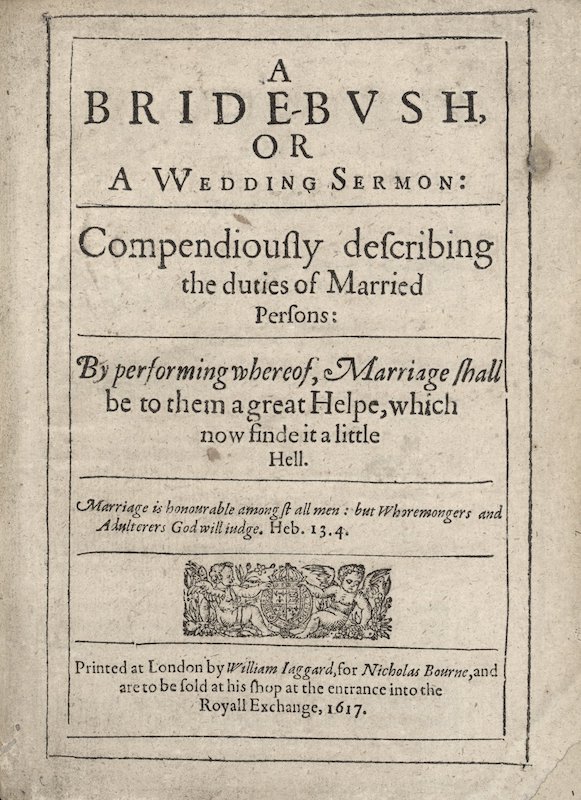
A Bride-bush or a Wedding Sermon,a 1617 sermon by William Whately that describes the duties of a husband and wife. Image courtesy of Folger Shakespeare Library. Public Domain.
Overview
Para1One common belief about the early modern period is that
children, especially girls, married young. In some noble or very wealthy houses,
marriages were indeed contracted at a young age, for reasons of property and family
alliance, but in fact the average age of marriage was only slightly younger than the
average age of marriage in many Western countries in the 21st century—in the middle
twenties.
Para2The very young age of Shakespeare’s Juliet—who is not quite fourteen—is part of what
the playwright did to heighten the tragedy he
was writing in the mid-1590s, but he was not reflecting the historical reality of
either early modern England or Italy. In the source material for that play, Arthur
Brooke’s 1562 poem The Tragical History of Romeus and
Juliet, the young woman who falls so impetuously in love is sixteen. The couple’s
youth in Shakespeare’s version gives the tragedy much of its force, but the
play’s popularity and widespread use in secondary schools has led to incorrect
assumptions about how and when young noblewomen married.
Marriage Statistics
Para3Marriage statistics indicate that the mean marriage age
for the Elizabethan and Jacobean eras was higher than many people think. Data taken
from baptism records and marriage certificates reveals mean marriage ages for women
to have
been as follows:
The marriage age of men was probably the same as or a bit older than that of
women. During this period, the age of consent was twelve for a girl and fourteen for
a boy, but
for most children puberty came two or three years later than it does today. And even
if a young noblewoman was contracted in marriage, the union would not have been
consummated until she had passed through puberty.
| 1566–1619 | 27.0 years |
| 1647–1719 | 29.6 years |
| 1719–1779 | 26.8 years |
| 1770–1837 | 25.1 years |
Para4Oddly, there seems to be a time in the late
sixteenth century when the mean marriage age of women in and around the area of
Stratford-on- Avon dropped as low as 21 years: the mean marriage age from 1580 to
1589 was about 20.6 years. It was in this decade that Shakespeare, at the age of
eighteen, married Anne Hathaway.
Marriage Among Common People
Para5The reason for late marriage among the labouring and the
middle classes was simple enough: it took a long time for a couple to acquire enough
wealth and belongings to set up housekeeping, even in a room of their parents’ home.
Young men in training for a skilled trade via an apprenticeship also had to complete
that seven-year commitment before they could marry. Young love, however romantic,
had
to be kept in check if the two lovers were to survive in a world where subsistence
earnings would not purchase a roof over their heads and put food on the table.
Marriage in the Nobility
Para6Children of gentle or noble birth ran a great risk if
they tried to marry without the approval of their parents, since they would be left
without resources. Perhaps the caution of young Claudio in Much Ado
About Nothing has something to do with the fear of acting without
permission: he is careful to make sure that his beloved, Hero, is the sole heir to
her father’s estate (see 1.1.242–243). His inquiry demonstrates that
financial concerns were top of mind for many members of the privileged classes, as
was ensuring that the parents consented to the match. In Romeo and
Juliet, Lord Capulet’s rage at Juliet when she resists his suggestion that
she marry Prince Paris (see 3.5.203-207) indicates the severe consequences
that marrying without parental permission might have, although like Juliet’s age,
Capulet’s rage may also have been exaggerated for dramatic effect by the playwright.
Sources
Crawford, Patricia, and Laura Gowing. Women’s Worlds in Seventeenth-Century England. Routledge, 2008.
Stone, Lawrence. The Family, Sex, and Marriage in England 1500–1800. Harper and Row, 1979.
Open-Access Digital Resources
Best, Michael.
The Age of Marriage.Shakespeare’s Life and Times. Internet Shakespeare Editions. University of Victoria, 04 Jan. 2011, https://internetshakespeare.uvic.ca/Library/SLT/society/family/marriage.html. Accessed 17 Feb. 2023.
Brabcová, Alice.
Marriage in Seventeenth-Century England: The Woman’s Story.University of West Bohemia, https://www.phil.muni.cz/angl/thepes/thepes_02_02.pdf. Accessed 17 Feb. 2023.
Dunne, Derek.
“Deny thy father and refuse thy name”: The Generation Gap in Romeo and Juliet.Academia.edu, https://web.archive.org/web/20240420110950/https://www.academia.edu/9645370/The_Generation_Gap_in_Romeo_and_Juliet_for_Playing_Shakespeare_2013_. Accessed 17 Feb. 2023.
Image Sources
Whately, William.
A Bride-bush, or A VVedding sermon: Compendiously Describing the Duties of Married Persons: by Performing Whereof, marriage Shall be to them a Great Helpe, which now Finde it a Little Hell.1617. Folger Shakespeare Library. https://digitalcollections.folger.edu/bib158813-150532.
Prosopography
Kate McPherson
Kate McPherson is Professor of English and Honors Program Director at Utah Valley
University (Orem, UT, USA). In 2015, she began working to redevelop Shakespeare’s Life and Times, created by Michael Best, into the Early Modern England Encyclopedia. Her other publications include commentary on Pericles and The Comedy of Errors for the New Oxford Shakespeare (2016); the co-edited volumes Stages of Engagement: Drama and Religion in Post-Reformation England with James Mardock (Duquesne University Press, 2014) and Shakespeare Expressed: Page, Stage, and Classroom in Shakespeare and His Contemporaries, with Kathryn M. Moncrief and Sarah Enloe (Fairleigh Dickinson University Press,
2013). With Kathryn M. Moncrief, Kate has also two edited collections, Performing Pedagogy in Early Modern England: Gender, Instruction, and Performance (Ashgate, 2011) and Performing Maternity in Early Modern England (Ashgate 2008). She has also published numerous articles on early modern maternity
in scholarly journals. Kate participated in the 2008 National Endowment for the Humanities
Institute,
Shakespeare’s Blackfriars: The Study, the Stage, the Classroom,at the American Shakespeare Center. She also served as Play Seminar Director, a public humanities position, for the Utah Shakespeare Festival in 2017 and 2018.
Leah Hamby
Leah Hamby is the primary encoder for the Early Modern England Encyclopedia. Aside from encoding, she also works as an editor for the project and contributed
several articles of her own. She has been working on the EMEE since February 2023. As of February 2026, she is soon to graduate with honours from
Utah Valley University with a major in history and a minor in creative writing. Her
other work with the LEMDO program includes remediating William Kemp’s Kemp’s Nine Day’s Wonder for the Digital Renaissance Editions.
Orgography
LEMDO Team (LEMD1)
The LEMDO Team is based at the University of Victoria and normally comprises the project
director, the lead developer, project manager, junior developers(s), remediators,
encoders, and remediating editors.
University of Victoria (UVIC1)
https://www.uvic.ca/Metadata
| Authority title | The Age of Marriage |
| Type of text | Critical |
| Publisher | University of Victoria on the Linked Early Modern Drama Online Platform |
| Series | Early Modern England Encyclopedia |
| Source |
By Kate McPherson, inspired by Michael Best’s Shakespeare’s Life and Times, Internet
Shakespeare Editions
|
| Editorial declaration | This document uses Canadian English spelling |
| Edition | Released with Early Modern England Encyclopedia 1.0 |
| Sponsor(s) |
Early Modern England EncyclopediaAnthology Leads: Kate McPherson and Kate Moncrief.
|
| Encoding description | Encoded in TEI P5 according to the LEMDO Customization and Encoding Guidelines |
| Document status | published |
| Funder(s) |
Social Sciences and Humanities Research Council of Canada
Mitacs Globalink Research Internship Utah Valley University |
| License/availability |
Unless otherwise noted, intellectual copyright in EMEE Anthology pages is held by
Kate McPherson on behalf of the contributors. Copyright on the TEI-XML markup is held by the University of Victoria on behalf of the LEMDO Team. The content and TEI-XML markup in this file are licensed under a CC BY-NC-ND 4.0 license. This file is freely downloadable without permission under the following conditions:
(1) credit must be given to the authors, EMEE, and LEMDO in any subsequent use of
the files and /or data; (2) this availability statement must remain in the file; (3)
the content cannot be adapted or repurposed (except for quotations for the purposes
of academic review and citation); and (4) commercial uses are not permitted without
the knowledge and consent of the authors, EMEE, and LEMDO. Neither the content nor
the code in this file is licensed for training large language models (LLMs), ingestion
into an LLM, or any use in any artificial intelligence applications; such uses are
considered to be commercial uses and are strictly prohibited.
|