
Kitchens and Cooking
Kitchen Activities
Para1In smaller homes in early modern England, the kitchen was typically one of two main
rooms on the ground floor. Sharing a central chimney with the parlor in larger homes,
the kitchen was often secluded from the rest of the household and had
external entrances to facilitate access to wood/coal sheds, cisterns, gardens and yards(Pennell 204) to make cooking easier. Like today, the kitchen was a key room in any home, used for cooking and eating, but it was also a place for conversation, discussion, and family disputes. The kitchen usually included:
A chimney, with hooks for hanging meats to be smoked
An oven, for baking bread, pies, and pastries
A cooking hearth, including a spit for roasting meat
Cooking implements such as hooks, tongs, and spoons of iron and wood
Cookware of metals such iron, copper, brass, and tin
Dishes, bowls, sppons, ladels, and platters of pottery, wood, and pewter for serving
and eating
Vessels like mugs, cups, and tankards of pottery, wood, pewter, horn, and leather
for drinking
A table for food preparation and eating
A chair or stool for sitting by the hearth
The Complexities of the Early Modern Kitchen
Para2In small households, the wife was often the cook of the house, whereas in bigger households,
a male cook or cooking staff might be employed as servants. Housewives had the responsibility
to provide food for the family, especially over winter when carefully allocating resources
was necessary. Therefore, the family would need to trust the cook with managing quantities
of ingredients for daily and longer-term use. Before refrigerators, food preservation
was naturally very important. A cook in a household needed to know a variety of techniques
to preserve food. Some of the foods preserved commonly included
Fruit
Nuts
Meat
Vegetables
And even candied flowers
Women in the Kitchen
Para3The housewife or cook would need to understand how to effectively preserve food and
adapt for differences in recipes. In terms of gender roles, being the cook of the
house provided many women with a purpose considering the kitchen was, at its core,
a domestic and feminine space. Historian Sara Pennell notes that, for married women,
the kitchen was perceived as the public locus in which that virtuous persona was made visible and accountable(212).
Para4The 1594 book The Good Huswifes Handmaid for the Kitchen has the following very lengthy subtitle that indicates how crucial the role of women
was in making food and preserving the household’s health, noted here in modern spelling
and punctuation:
Containing many principal points of cookery, as well how to dress meats, after sundry after many of the best fashions used in England and other Countries, with their apt and proper sauces, both for flesh and fish, as also the orderly serving of the same to the table. Hereunto are annexed, sundry necessary conceits for the preservation of health. Very meet suitable to be adjoined to the good housewife’s closet private chamber for of provision for her household.
Recipes and Recipe Books in Early Modern England
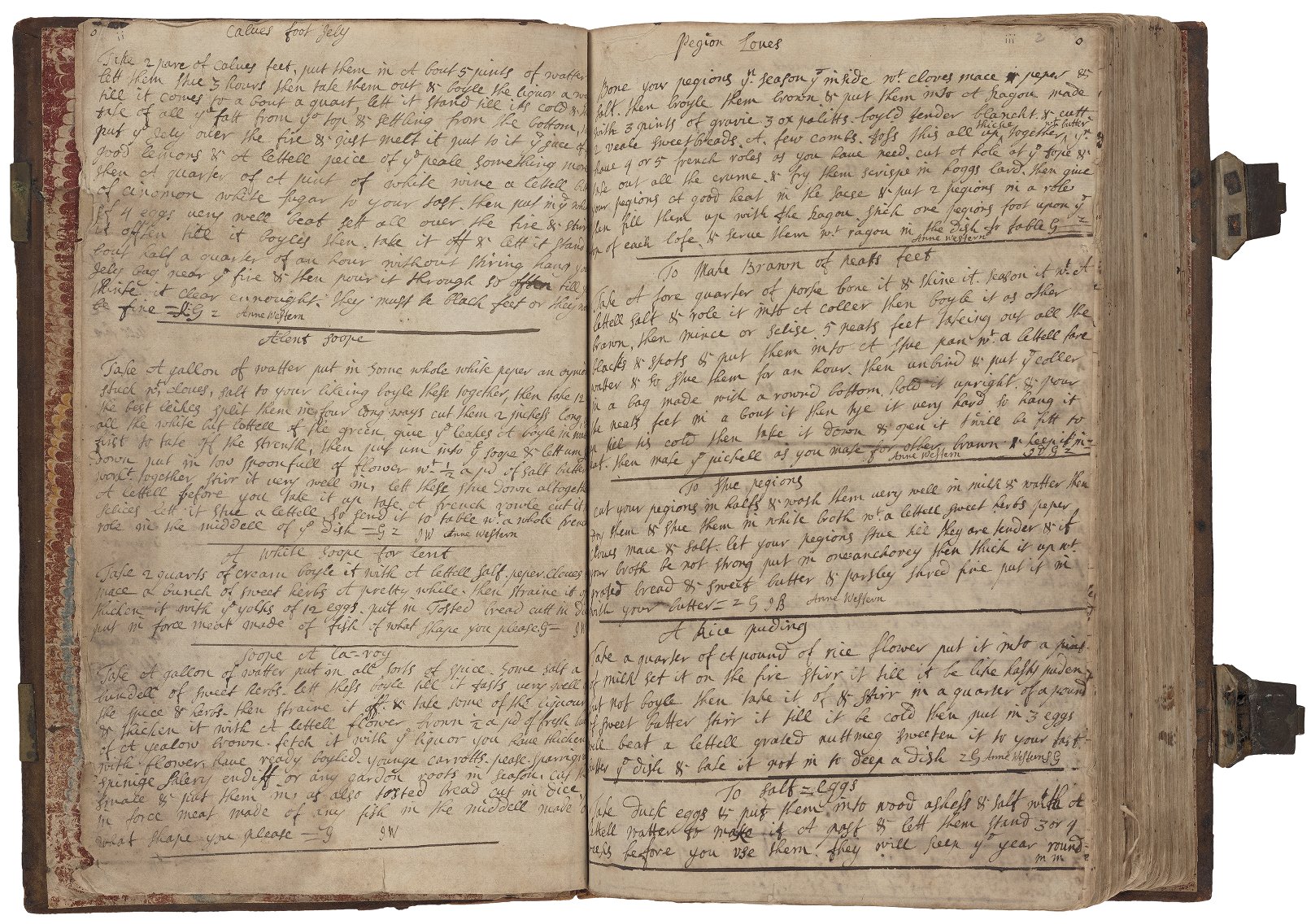
Para5Both handwritten and printed recipe books offer evidence of the kinds of domestic
knowledge that the people of early modern England had or needed. Within the books,
household tips as well as helpful recipes appeared. Recipes were integral to early
modern households, and many women made recipe books for themselves and their families.
Recipe books were used for record keeping and as a way to move the verbal culture
of recipe creation and knowledge to written form. The Folger Shakespeare Library holds the world’s largest collection of manuscript recipe books from the early modern
period, with 125 catalogued manuscripts.
Para6Recipe books contained many useful facts. For example, one shared how to salt and
dry meat; animals were often slaughtered at the start of winter, so the meat had to
be preserved through drying, salting, or smoking. Recipes like this one were often
edited over a lifetime and reflected the social context of the time in which they
were created.
Para7Printed books of recipes, as opposed to handwritten ones, began appearing in the mid-16th
century, with dozens of printed texts of recipes for food and medicines, as well as
household management appearing before 1700.
Para8An example of how to
Bake Red Deereis demonstrated in the 1656 The Compleat Cook, Expertly Prescribing The Most Ready Wayes, Whether Italian, Spanish Or French, For Dressing Of Flesh And Fish, Ordering Of Sauces Or Making Of Pastry. This recipe for a venison pie shows the different techniques and seasonings used in early modern kitchens.
Parboyl it, and then sauce it in Vinegar then Lard it very thick, and season it with Pepper, Ginger and Nutmegs, put it into a deep Pye with good store of sweet butter, and let it bake, when it is baked, take a pint of Hippocras spiced wine, halfe a pound of sweet butter, two or three Nutmeg, little Vinegar, poure it into the Pye in the Oven and let it lye and soake an hour, then take it out, and when it is cold stop the vent hole.
Sources
Orlin, Lena Cowen. Elizabethan Households: An Anthology. Folger Shakespeare Library, 1995.
Pennell, Sara.
Pots and Pans History: The Material Culture of the Kitchen in Early Modern England.Journal of Design History, vol. 11, no. 3, 1998, pp. 201–216.
Tigner, A. L., and D. B. Goldstein. Culinary Shakespeare: Staging Food and Drink in Early Modern England. Duquesne UP, 2016.
Open-Access Digital Resoures
A Good Huswife’s Handmaide for the Kitchin. 1594. Internet Archive, https://archive.org/details/bim_early-english-books-1475–1640_the-good-huswifes-handma_book_1594. Accessed 10 Oct. 2023.
Best, Michael.
Of women and kitchens.Shakespeare’s Life and Times.Internet Shakespeare Editions. University of Victoria, 04. Jan. 2011, https://internetshakespeare.uvic.ca/Library/SLT/society/huswifery/women&kitchen.html. Accessed 13 Feb. 2023.
Best, Michael.
Cooks.Shakespeare’s Life and Times.Internet Shakespeare Editions. University of Victoria, 04. Jan. 2011, https://internetshakespeare.uvic.ca/Library/SLT/society/city%20life/trades/cooks.html. Accessed 13 Feb. 2023.
Caton, Mary Ellen.
Fooles and Fricasses: Food in Shakespeare’s England.Folger Shakespeare Library Exhibition, 10 Sep.–30 Dec., 1999, https://folgerpedia.folger.edu/Fooles_and_Fricassees:_Food_in_Shakespeare%27s_England. Accessed 13 Oct. 2023.
Early Modern Recipes Online Collective, Hypotheses. 4 Oct 2023, https://emroc.hypotheses.org/about. Accessed 12 Oct. 2023.
Havard, Lucy J.
“Preserve or Perish”: Food Preservation Practices in the Early Modern Kitchen.The Royal Society Journal of the History of Science, vol. 74, no. 1, 20 Mar. 2020, pp. 5–33. http://doi.org/10.1098/rsnr.2019.0004. Accessed 12 Oct. 2023.
Martha Carlin. Medieval and Early Modern Cookery, https://sites.uwm.edu/carlin/medieval-and-early-modern-cookery/. Accessed 10 Oct. 2023.
Recipe books at the Folger Shakespeare Library.Folgerpedia. The Folger Shakespeare Library, 21 Jul. 2020, hhttps://folgerpedia.folger.edu/_mw/index.php?title=Recipe_books_at_the_Folger_Shakespeare_Library. Accessed 10 Oct. 2023.
Image Source
English Cookery and Medicine Book. c. 1677–1711. MS. Pg. 4. Folger Shakespeare Library. LUNA: Folger Digital Image Collection. Call number V.b.380. https://digitalcollections.folger.edu/img142914.
Prosopography
Kate McPherson
Kate McPherson is Professor of English and Honors Program Director at Utah Valley
University (Orem, UT, USA). In 2015, she began working to redevelop Shakespeare’s Life and Times, created by Michael Best, into the Early Modern England Encyclopedia. Her other publications include commentary on Pericles and The Comedy of Errors for the New Oxford Shakespeare (2016); the co-edited volumes Stages of Engagement: Drama and Religion in Post-Reformation England with James Mardock (Duquesne University Press, 2014) and Shakespeare Expressed: Page, Stage, and Classroom in Shakespeare and His Contemporaries, with Kathryn M. Moncrief and Sarah Enloe (Fairleigh Dickinson University Press,
2013). With Kathryn M. Moncrief, Kate has also two edited collections, Performing Pedagogy in Early Modern England: Gender, Instruction, and Performance (Ashgate, 2011) and Performing Maternity in Early Modern England (Ashgate 2008). She has also published numerous articles on early modern maternity
in scholarly journals. Kate participated in the 2008 National Endowment for the Humanities
Institute,
Shakespeare’s Blackfriars: The Study, the Stage, the Classroom,at the American Shakespeare Center. She also served as Play Seminar Director, a public humanities position, for the Utah Shakespeare Festival in 2017 and 2018.
Leah Hamby
Leah Hamby is the primary encoder for the Early Modern England Encyclopedia. Aside from encoding, she also works as an editor for the project and contributed
several articles of her own. She has been working on the EMEE since February 2023. As of February 2026, she is soon to graduate with honours from
Utah Valley University with a major in history and a minor in creative writing. Her
other work with the LEMDO program includes remediating William Kemp’s Kemp’s Nine Day’s Wonder for the Digital Renaissance Editions.
Mackenzie Krahn
Mackenzie Krahn was a student at the University of Fraser Valley.
Melissa Walter
Melissa Walter is Associate Professor of English at the University of the Fraser Valley.
Her research focuses on early modern English drama and English and European prose
fiction. She is the author of The Italian Novella and Shakespeare’s Comic Heroines (U of Toronto, 2019), and co-editor, with Dennis Britton, of Rethinking Shakespeare Source Study: Authors, Audiences, Digital Technologies (Routledge, 2018). Her work on English theatre and the European novella has appeared
in several edited collections, including Transnational Exchange in Early Modern Theater (Ashgate, 2008), and Transnational Mobility in Early Modern Theater (Ashgate, 2012). She has also written about
Translation and Identity in the Dialogues in English and Malaiane Languages(Indographies, ed. Jonathan Gil Harris. Palgrave 2012). At the University of the Fraser Valley, she is a lead coordinator of UFV’s Shakespeare and Reconciliation Garden.
Michael Best
Michael Best is Professor Emeritus at the University of Victoria, BC. He founded the
Internet Shakespeare Editions in 1996, and was Coordinating Editor until 2017, contributing two editions to the
ISE: King John and King Lear (the latter also available in print from Broadview Press). In print, he has published editions of works of Elizabethan magic and huswifery,
a collection of letters from the Australian goldfields, and Shakespeare on the Art of Love (2008). He contributed regular columns for the Shakespeare Newsletter on
Electronic Shakespeares,and has written many articles and chapters for both print and online books and journals, principally on questions raised by the new medium in the editing and publication of texts. He has delivered papers and plenary lectures on electronic media and the Internet Shakespeare Editions at conferences in Canada, the USA, the UK, Spain, Australia, and Japan.
Navarra Houldin
Training and Documentation Lead 2025–present. LEMDO project manager 2022–2025. Textual
remediator 2021–present. Navarra Houldin (they/them) completed their BA with a major
in history and minor in Spanish at the University of Victoria in 2022. Their primary
research was on gender and sexuality in early modern Europe and Latin America. They
are continuing their education through an MA program in Gender and Social Justice
Studies at the University of Alberta where they will specialize in Digital Humanities.
Orgography
LEMDO Team (LEMD1)
The LEMDO Team is based at the University of Victoria and normally comprises the project
director, the lead developer, project manager, junior developers(s), remediators,
encoders, and remediating editors.
University of Victoria (UVIC1)
https://www.uvic.ca/Metadata
| Authority title | Kitchens and Cooking |
| Type of text | Critical |
| Publisher | University of Victoria on the Linked Early Modern Drama Online Platform |
| Series | Early Modern England Encyclopedia |
| Source |
By Mackenzie Krahn, inspired by Michael Best’s Shakespeare’s Life and Times, Internet Shakespeare Editions
|
| Editorial declaration | This document uses Canadian English spelling |
| Edition | Released with Early Modern England Encyclopedia 1.0 |
| Sponsor(s) |
Early Modern England EncyclopediaAnthology Leads: Kate McPherson and Kate Moncrief.
|
| Encoding description | Encoded in TEI P5 according to the LEMDO Customization and Encoding Guidelines |
| Document status | published, peer-reviewed |
| Funder(s) |
Social Sciences and Humanities Research Council of Canada
Mitacs Globalink Research Internship Utah Valley University |
| License/availability |
Intellectual copyright in this entry is held by Kate McPherson on behalf of the contributors. Copyright on the TEI-XML markup is held by the University of Victoria on behalf of the LEMDO Team. The content and TEI-XML markup in this file are licensed under a CC BY-NC_ND 4.0 license. This file is freely downloadable without permission under the following conditions:
(1) credit must be given to the authors, EMEE, and LEMDO in any subsequent use of
the files and /or data; (2) this availability statement must remain in the file; (3)
the content cannot be adapted or repurposed (except for quotations for the purposes
of academic review and citation); and (4) commercial uses are not permitted without
the knowledge and consent of the authors, EMEE, and LEMDO. Neither the content nor
the code in this file is licensed for training large language models (LLMs), ingestion
into an LLM, or any use in any artificial intelligence applications; such uses are
considered to be commercial uses and are strictly prohibited.
|