
Henry VIII’s First Divorce
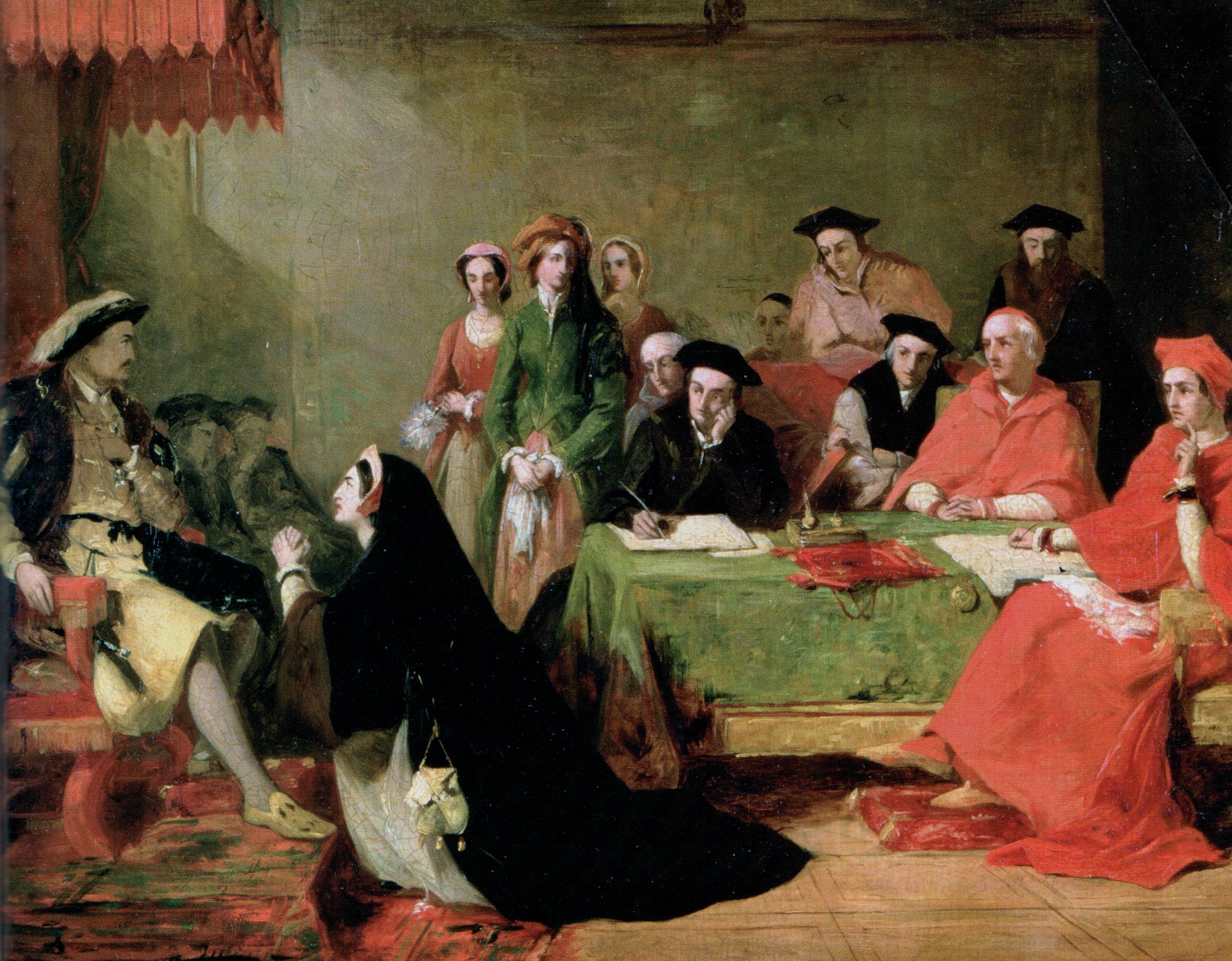
Henry’s Unconventional Marriage
Para1Upon the untimely death of Henry VII’s 15-year-old son and heir Prince Arthur in 1502,
his second son, Henry, became next in line for the throne. Arthur had been married
to the 17-year-old Catherine of Aragon for only five months when he died. The young
couple was assumed to have consummated the marriage and did live together immediately
afterwards. Henry VII himself suggested the marriage of Arthur’s widow Catherine to
England’s next king, likely seeking diplomatic and financial advantage from keeping
Catherine in England.
Para2In 1503, the future Henry VIII and Catherine were betrothed, but as Prince Henry was
still too young to consummate the marriage (he was only 12), Catherine could not officially
take her place as his wife. At the age of 14, Henry rejected the marriage. Only when
Henry VII died in 1509 did the new King Henry VIII agreed to honor the wishes of his
father and marry Catherine, who had remained in England.
Catherine of Aragon and King Henry VIII’s Children
Para3Once the couple was married, Catherine began to regularly bear children, although,
like many mothers of the time, she was sadly and frequently bereaved.
1510: Catherine gave birth to a stillborn daughter.
1511: Catherine gave birth to a son, Henry, Duke of Cornwall, who died two months
afterwards.
1513: Catherine and Henry’s unnamed son died minutes after his birth.
1515: Catherine birthed another stillborn son.
1516: Catherine gave birth to Mary, her only surviving child; Mary would become Queen
in 1553.
Affairs
Para4During the early years of their marriage, Henry VIII began an affair with Catherine’s
lady-in-waiting, Mary Boleyn. As he became more irritable towards Catherine’s inability
to produce a male heir, by 1525 he began to romantically pursue Mary’s sister, Anne
Boleyn. At the age of 34, Henry VIII longed to annul his marriage with Catherine,
who was now 40 and presumably unlikely to bear children, and pursue Anne as his wife.
Para5As Catherine could not produce a male heir, Henry VIII came to believe his marriage
to be unlawful in the eyes of God. He believed that because he had married his brother’s
wife, God was punishing her by not granting them a healthy son. The urge for an annulment
became the king’s Great Matter as he focused almost entirely on it.
Papal Authority
Para6By 1527, Henry VIII was convinced that his union with Catherine was immoral and unnatural
due to the biblical text from Leviticus 20:21:
If a man shall take his brother’s wife, it is an impurity. He hath uncovered his brother’s nakedness; they shall be childless.Henry VIII beseeched Pope Clement VII for an annulment of the marriage but was rejected. Pope Clement VII did not wish to override Pope Julius II’s decision in confirming the union between Henry and Catherine that was permitted only by special dispensation in 1509.
Para7Catherine claimed her marriage to Henry VIII was valid because she and Prince Arthur
had not consummated their marriage prior to his death in 1502. At the time of her
marriage to Henry in 1509, her chief lady-in-waiting and King Ferdinand of Spain both
attested to Catherine being a virgin.
Para8Historians believe Henry VIII also wished for the monetary gains that parting from
the Church of Rome would allow, particularly the income and lands from the monasteries.
When Parliament passed the first Act of Succession in 1533, Henry VIII claimed Papal
Authority for himself and no longer recognized the authority of Pope Clement. The
Act annulled his marriage to Catherine, allowing him to marry Anne Boleyn immediately
in 1533. This Act confirmed England’s separation from the Church of Rome and the founding
of the Church of England.
Shakespeare and the King’s Great Matter
Para9Shakespeare’s late play, All Is True, more commonly known as Henry VIII, was co-authored with John Fletcher and performed at the Globe in 1613. During a
performance on June 29, a cannon fired to mark the King’s entrance accidentally misfired
and set the thatched roof of the Globe alight. The theater burned to the ground, although
no actors or audience members were injured.
Shakespeare and Fletcher compress historical events to focus on the fall of Cardinal
Thomas Wolsey, who fell from favor in part due to his failure to convince Pope Clement
to grant the divorce from Catherine that Henry so desperately wanted. The play offers
Catherine an extensive speech in which she defends herself and the validity of her
marriage at a trial in Act 2, Scene 4. In addition to the fall of Wolsey and Catherine,
the play features Anne Boleyn’s coronation and the birth and baptism of Princess Elizabeth,
carefully omitting Anne’s imminent fall.
Sources
Davies, Anthony.
All is True (Henry VIII)in The Oxford Companion to Shakespeare. Edited by Stanley Wells and Michael Dobson. Oxford University Press, 2000, pp. 6–8.
Loades, David. The Tudors: The History of a Dynasty. Bloomsbury, 2013.
Goodman, Ruth. How to Be a Tudor: A Dawn-to-Dusk Guide to Tudor Life. Liveright Publishing Corporation, 2016.
Streissguth, Tom.
Tudor Dynasty.The Greenhaven Encyclopedia of The Renaissance, edited by Konrad Eisenbichler, Greenhaven Press, 2008, pp. 308–309.
Tudor Dynasty.Encyclopedia of the Renaissance, edited by Paul F. Grendler, Charles Scribner and Sons, 2000.
Open-Access Digital Resources
Best, Michael.
The Divorce.Shakespeare’s Life and Times. Internet Shakespeare Editions. University of Victoria, 04 Jan. 2011, https://internetshakespeare.uvic.ca/Library/SLT/history/henry%20VIII/divorce.html. Accessed 10 Oct. 2018.
Morrill, John S. and Geoffrey R. Elton.
Henry VIII.Encyclopedia Britannica, 19 Mar. 2026, https://www.britannica.com/biography/Henry-VIII-king-of-England. Accessed 10 Oct. 2018.
Image Source
O’Neil, Henry Nelson. Catherine of Aragon Pleads her Case Against Divorce from Henry VIII. C. 1846. Birmingham Art Museum. Wikimedia. https://upload.wikimedia.org/wikipedia/commons/b/bd/Catherine_Aragon_Henri_VIII_by_Henry_Nelson_ONeil.jpg.
Prosopography
Kate McPherson
Kate McPherson is Professor of English and Honors Program Director at Utah Valley
University (Orem, UT, USA). In 2015, she began working to redevelop Shakespeare’s Life and Times, created by Michael Best, into the Early Modern England Encyclopedia. Her other publications include commentary on Pericles and The Comedy of Errors for the New Oxford Shakespeare (2016); the co-edited volumes Stages of Engagement: Drama and Religion in Post-Reformation England with James Mardock (Duquesne University Press, 2014) and Shakespeare Expressed: Page, Stage, and Classroom in Shakespeare and His Contemporaries, with Kathryn M. Moncrief and Sarah Enloe (Fairleigh Dickinson University Press,
2013). With Kathryn M. Moncrief, Kate has also two edited collections, Performing Pedagogy in Early Modern England: Gender, Instruction, and Performance (Ashgate, 2011) and Performing Maternity in Early Modern England (Ashgate 2008). She has also published numerous articles on early modern maternity
in scholarly journals. Kate participated in the 2008 National Endowment for the Humanities
Institute,
Shakespeare’s Blackfriars: The Study, the Stage, the Classroom,at the American Shakespeare Center. She also served as Play Seminar Director, a public humanities position, for the Utah Shakespeare Festival in 2017 and 2018.
Leah Hamby
Leah Hamby is the primary encoder for the Early Modern England Encyclopedia. Aside from encoding, she also works as an editor for the project and contributed
several articles of her own. She has been working on the EMEE since February 2023. As of February 2026, she is soon to graduate with honours from
Utah Valley University with a major in history and a minor in creative writing. Her
other work with the LEMDO program includes remediating William Kemp’s Kemp’s Nine Day’s Wonder for the Digital Renaissance Editions.
Mashaela Ferris
Mashaela Ferris was a student at Utah Valley University
Michael Best
Michael Best is Professor Emeritus at the University of Victoria, BC. He founded the
Internet Shakespeare Editions in 1996, and was Coordinating Editor until 2017, contributing two editions to the
ISE: King John and King Lear (the latter also available in print from Broadview Press). In print, he has published editions of works of Elizabethan magic and huswifery,
a collection of letters from the Australian goldfields, and Shakespeare on the Art of Love (2008). He contributed regular columns for the Shakespeare Newsletter on
Electronic Shakespeares,and has written many articles and chapters for both print and online books and journals, principally on questions raised by the new medium in the editing and publication of texts. He has delivered papers and plenary lectures on electronic media and the Internet Shakespeare Editions at conferences in Canada, the USA, the UK, Spain, Australia, and Japan.
Navarra Houldin
Training and Documentation Lead 2025–present. LEMDO project manager 2022–2025. Textual
remediator 2021–present. Navarra Houldin (they/them) completed their BA with a major
in history and minor in Spanish at the University of Victoria in 2022. Their primary
research was on gender and sexuality in early modern Europe and Latin America. They
are continuing their education through an MA program in Gender and Social Justice
Studies at the University of Alberta where they will specialize in Digital Humanities.
Orgography
LEMDO Team (LEMD1)
The LEMDO Team is based at the University of Victoria and normally comprises the project
director, the lead developer, project manager, junior developers(s), remediators,
encoders, and remediating editors.
University of Victoria (UVIC1)
https://www.uvic.ca/Metadata
| Authority title | Henry VIII’s First Divorce |
| Type of text | Critical |
| Publisher | University of Victoria on the Linked Early Modern Drama Online Platform |
| Series | Early Modern England Encyclopedia |
| Source |
By Michaela Ferris and Kate McPherson, inspired by Michael Best’s Shakespeare’s Life and Times, Internet Shakespeare Editions
|
| Editorial declaration | This document uses Canadian English spelling |
| Edition | Released with Early Modern England Encyclopedia 1.0 |
| Sponsor(s) |
Early Modern England EncyclopediaAnthology Leads: Kate McPherson and Kate Moncrief.
|
| Encoding description | Encoded in TEI P5 according to the LEMDO Customization and Encoding Guidelines |
| Document status | published |
| Funder(s) |
Social Sciences and Humanities Research Council of Canada
Mitacs Globalink Research Internship Utah Valley University |
| License/availability |
Unless otherwise noted, intellectual copyright in EMEE Anthology pages is held by
Kate McPherson on behalf of the contributors. Copyright on the TEI-XML markup is held by the University of Victoria on behalf of the LEMDO Team. The content and TEI-XML markup in this file are licensed under a CC BY-NC-ND 4.0 license. This file is freely downloadable without permission under the following conditions:
(1) credit must be given to the authors, EMEE, and LEMDO in any subsequent use of
the files and /or data; (2) this availability statement must remain in the file; (3)
the content cannot be adapted or repurposed (except for quotations for the purposes
of academic review and citation); and (4) commercial uses are not permitted without
the knowledge and consent of the authors, EMEE, and LEMDO. Neither the content nor
the code in this file is licensed for training large language models (LLMs), ingestion
into an LLM, or any use in any artificial intelligence applications; such uses are
considered to be commercial uses and are strictly prohibited.
|