
Early Modern Hell
Concept and Location
Para1Early modern ideas of Christian Hell mostly align with common depictions today. A
bottomless pit of darkness, hellfire that produces heat but no light, sounds of screaming,
and the torture of the damned by demons were all present. The Book of Revelations
20:10 describes Hell as
a lake of fire,as in this passage from the 1599 Geneva Bible:
And the devil that deceived them, was cast into a lake of fire and brimstone, where that beast and that false prophet are, and shall be tormented even day and night for evermore.
Para2The traditional location of Hell is inside the earth, although debates around this
conception occurred. In Christopher Marlowe’s 1594 play Doctor Faustus, the demon Mephistophilis is summoned and questioned about where Hell is by the title
character:
As this passage explains, the demon answers that Hell is within the Earth but at the same time present everywhere except Heaven.Faustus: Tell me, where is that place that men call hell?Mephistophilis: Under the heavens.Faustus: Ay, but whereabouts?Mephistophilis: Within the bowels of these elements,Where we are tortured and remain forever.Hell hath no limits, nor is circumscribedIn one self place, for where we are is hell,And where hell is there must we ever be.And, to be short, when all the world dissolves,And every creature shall be purified,All places shall be hell that is not heaven.Faustus: I think hell’s a fable.Mephistophilis: Aye, think so still, till experience change thy mind.(2.1.117–28)
Types of Torture
Para3Early modern preachers divided the torments of Hell into two separate categories:
poena sensus and poena damni. Poena sensus was the physical pain inflicted on the senses of the body, from hellfire specifically,
although it was preached that all senses would be sources of pain in Hell. These types
of torture featured strongly in artistic representations of Hell throughout the medieval
and early modern periods. Poena damni was the spiritual pain of being forever separated from God. Paintings of the Last
Judgement by prominent European artists like Michaelangelo reflect both these types
of pain.
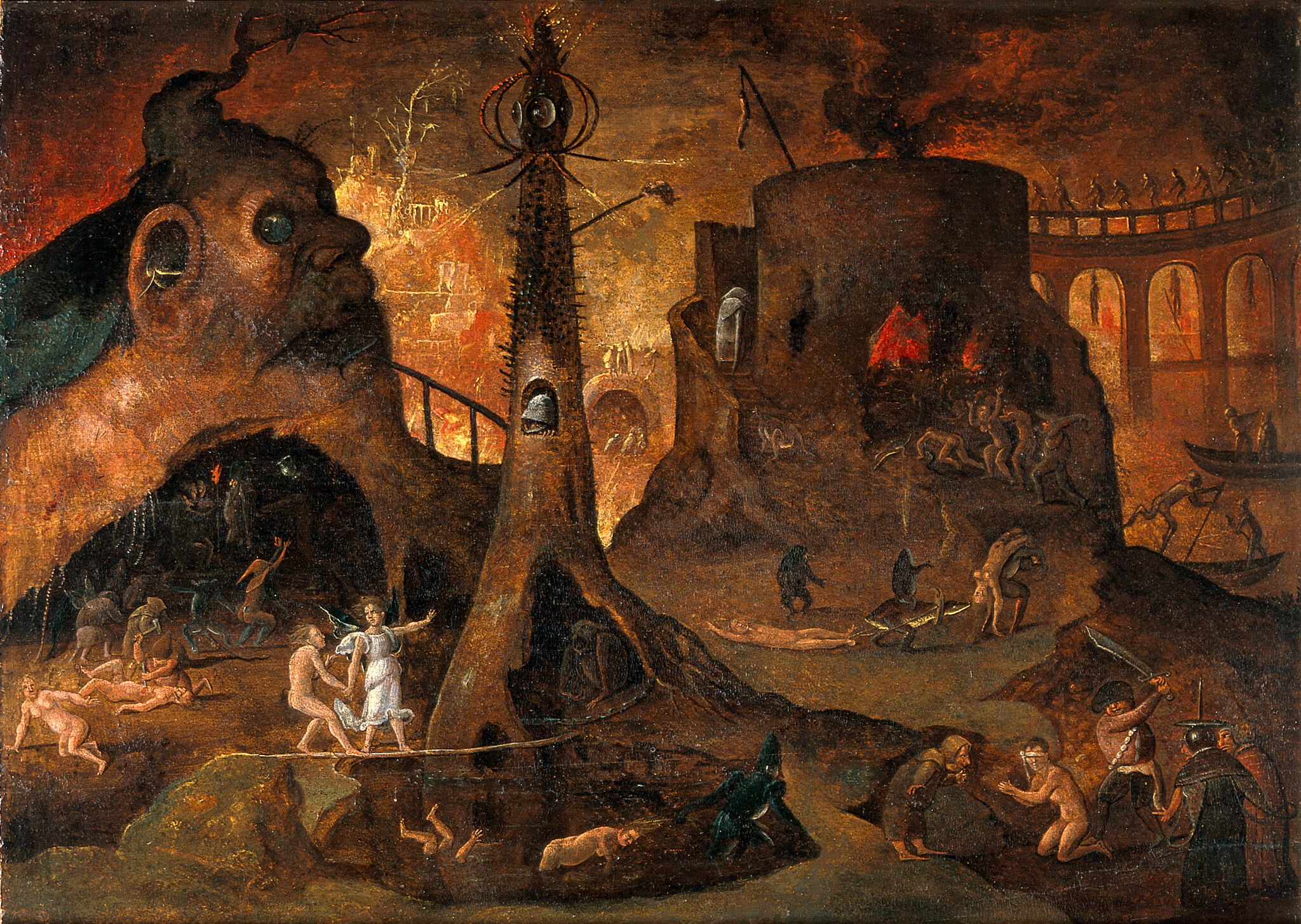
Para4While depictions of the glories of Heaven, both in speech and art, tended to be vague,
depictions of the sufferings of Hell were detailed and varied. English painter David
Teniers painted The Rich Man Being Led Into Hell in about 1647, for example. Early modern people throughout Europe were familiar with
suffering from pain, disease, and famine, and therefore had much inspiration to draw
on when imagining Hell. Frescoes and paintings of Hell adorned many church walls to
vividly illustrate the punishments the damned might expect.
Different Levels of Hell
Para5The idea of degrees of suffering in Hell comes from the theologian Augustine, who
insisted that unbaptized babies would suffer in Hell but endure only the mildest kind
of pain. This idea of gradations of suffering seems to be popular since it found its
way into Italian poet Dante Alighieri’s famous 13th century epic poem, Inferno, which portrays Hell as having nine distinct circles in a descending spiral ending
with Satan frozen in ice at the very bottom. Other depictions of the biblical underworld
feature different gradations than Dante’s or sometimes none at all.
Debates
Para6Despite the existence of a few anonymous attacks on the concept of Hell in the 1600s,
it was not until the 1740s as English thinkers integrated concepts of Enlightenment
that it was openly criticized by some intellectuals. But for most of the early modern
period, it was dangerous to challenge such a central principle of Christianity.
Para7The existence of Hell is heavily supported by Christian scripture, especially the
gospels of the New Testament. Because of this, criticizing the doctrine or discussing
some of the many moral questions about the concept was dangerous to both reputation
and livelihood. It was difficult to question Hell without also questioning the rest
of the doctrine present in the Bible.
Para8Many learned people considered Hell a necessary deterrent for immoral behavior that
was better to be left unquestioned so that less learned people had reason to remain
moral. It was a common belief among all social classes that there was a correlation
between atheism and immorality. Anyone questioning the scriptures was suspect of being
an atheist and therefore a threat to society.
Para9When questions about the nature of Hell were eventually published, their concerns
varied widely. Such questions included
Due to social attitudes regarding sin and damnation as key components of Christian
belief, for most of the early modern period, these questions remained unasked.
Is Hell truly eternal?
Are the sinners in Hell punished for the sins committed in the afterlife?
Do the blessed in Heaven take satisfaction in seeing sinners suffer?
Sources
Almond, Philip C. Heaven & Hell in Enlightenment England. Cambridge UP, 1994.
Campbell, Gordon.
Hell.Oxford Dictionary of the Renaissance. Ed. Gordon Campbell. Oxford UP, 2005.
Steggle, Matthew.
Paradise Lost and the Acoustics of Hell.Early Modern Literary Studies, vol. 7, no. 1, 2001, pp. 1–17.
Rasmussen, Tarald.
Hell Disarmed? The Function of Hell in Reformation Spirituality.Numen, vol. 56, 2009, pp. 366–384.
Open-Access Digital Resources
Amoako, Aida.
The Bad Place: A Visual History of Hell.Art UK, 29 Oct. 2020, https://artuk.org/discover/stories/the-bad-place-a-visual-history-of-hell. Accessed 11 Feb. 2026.
Best, Michael.
Hell Mouth.Shakespeare’s Life and Times. Internet Shakespeare Editions. University of Victoria, 04 Jan. 2011, https://internetshakespeare.uvic.ca/Library/SLT/ideas/the%20universe/hellmouth.html. Accessed 11 Feb. 2026.
Buetter, Nils.
Where is Paradise? Imaging Heaven and Hell in Early Modern Times.Imagined Worlds: Willful Invention and the Printed Image. Ed. Amy Baker Sandback. Heidelberg University Archives. AXA Gallery, 2005, https://archiv.ub.uni-heidelberg.de/artdok/1161/1/Nils_Buettner_Where_is_Paradise_2005.pdf. Accessed 11 Feb. 2026.
Image Sources
Follower of Bosch, Hieronymus. An Angel Leading a Soul into Hell. Circa 1516. Oil on Canvas. Wellcome Collection. Reference: 44837i. https://wellcomecollection.org/works/dum4xgme/images?id=e5pwks23.
Prosopography
Kate McPherson
Kate McPherson is Professor of English and Honors Program Director at Utah Valley
University (Orem, UT, USA). In 2015, she began working to redevelop Shakespeare’s Life and Times, created by Michael Best, into the Early Modern England Encyclopedia. Her other publications include commentary on Pericles and The Comedy of Errors for the New Oxford Shakespeare (2016); the co-edited volumes Stages of Engagement: Drama and Religion in Post-Reformation England with James Mardock (Duquesne University Press, 2014) and Shakespeare Expressed: Page, Stage, and Classroom in Shakespeare and His Contemporaries, with Kathryn M. Moncrief and Sarah Enloe (Fairleigh Dickinson University Press,
2013). With Kathryn M. Moncrief, Kate has also two edited collections, Performing Pedagogy in Early Modern England: Gender, Instruction, and Performance (Ashgate, 2011) and Performing Maternity in Early Modern England (Ashgate 2008). She has also published numerous articles on early modern maternity
in scholarly journals. Kate participated in the 2008 National Endowment for the Humanities
Institute,
Shakespeare’s Blackfriars: The Study, the Stage, the Classroom,at the American Shakespeare Center. She also served as Play Seminar Director, a public humanities position, for the Utah Shakespeare Festival in 2017 and 2018.
Leah Hamby
Leah Hamby is the primary encoder for the Early Modern England Encyclopedia. Aside from encoding, she also works as an editor for the project and contributed
several articles of her own. She has been working on the EMEE since February 2023. As of February 2026, she is soon to graduate with honours from
Utah Valley University with a major in history and a minor in creative writing. Her
other work with the LEMDO program includes remediating William Kemp’s Kemp’s Nine Day’s Wonder for the Digital Renaissance Editions.
Michael Best
Michael Best is Professor Emeritus at the University of Victoria, BC. He founded the
Internet Shakespeare Editions in 1996, and was Coordinating Editor until 2017, contributing two editions to the
ISE: King John and King Lear (the latter also available in print from Broadview Press). In print, he has published editions of works of Elizabethan magic and huswifery,
a collection of letters from the Australian goldfields, and Shakespeare on the Art of Love (2008). He contributed regular columns for the Shakespeare Newsletter on
Electronic Shakespeares,and has written many articles and chapters for both print and online books and journals, principally on questions raised by the new medium in the editing and publication of texts. He has delivered papers and plenary lectures on electronic media and the Internet Shakespeare Editions at conferences in Canada, the USA, the UK, Spain, Australia, and Japan.
Navarra Houldin
Training and Documentation Lead 2025–present. LEMDO project manager 2022–2025. Textual
remediator 2021–present. Navarra Houldin (they/them) completed their BA with a major
in history and minor in Spanish at the University of Victoria in 2022. Their primary
research was on gender and sexuality in early modern Europe and Latin America. They
are continuing their education through an MA program in Gender and Social Justice
Studies at the University of Alberta where they will specialize in Digital Humanities.
Orgography
LEMDO Team (LEMD1)
The LEMDO Team is based at the University of Victoria and normally comprises the project
director, the lead developer, project manager, junior developers(s), remediators,
encoders, and remediating editors.
University of Victoria (UVIC1)
https://www.uvic.ca/Metadata
| Authority title | Early Modern Hell |
| Type of text | Critical |
| Publisher | University of Victoria on the Linked Early Modern Drama Online Platform |
| Series | Early Modern England Encyclopedia |
| Source |
By Leah Hamby, inspired by Michael Best’s Shakespeare’s Life and Times, Internet Shakespeare Editions
|
| Editorial declaration | This document uses Canadian English spelling |
| Edition | Released with Early Modern England Encyclopedia 1.0 |
| Sponsor(s) |
Early Modern England EncyclopediaAnthology Leads: Kate McPherson and Kate Moncrief.
|
| Encoding description | Encoded in TEI P5 according to the LEMDO Customization and Encoding Guidelines |
| Document status | published, peer-reviewed |
| Funder(s) |
Social Sciences and Humanities Research Council of Canada
Mitacs Globalink Research Internship Utah Valley University |
| License/availability |
Intellectual copyright in this entry is held by Kate McPherson on behalf of the contributors. Copyright on the TEI-XML markup is held by the University of Victoria on behalf of the LEMDO Team. The content and TEI-XML markup in this file are licensed under a CC BY-NC_ND 4.0 license. This file is freely downloadable without permission under the following conditions:
(1) credit must be given to the authors, EMEE, and LEMDO in any subsequent use of
the files and /or data; (2) this availability statement must remain in the file; (3)
the content cannot be adapted or repurposed (except for quotations for the purposes
of academic review and citation); and (4) commercial uses are not permitted without
the knowledge and consent of the authors, EMEE, and LEMDO. Neither the content nor
the code in this file is licensed for training large language models (LLMs), ingestion
into an LLM, or any use in any artificial intelligence applications; such uses are
considered to be commercial uses and are strictly prohibited.
|