
Gardens and Nature in Shakespeare
The Meaning of Gardens
Para1In historical and literary contexts in the early modern period, gardens were seen
as productive, fertile, or even as erotic spaces. Sometimes, they were associated
with forbidden love and adultery, a heritage from Christian concepts of the Garden
of Eden. Gardens and the specific plants within them were important to elite members
of society, with many searching to find rare plants for their gardens. Some courtiers
either hired botanists to cultivate their gardens or would themselves become competent
in botany. The social interest in gardens means they feature in drama from the period,
and Shakespeare’s depictions of them offer useful tools to convey social values and
thematic issues within his plays, including darker nuances such as mortality and corruption
in the tragedies and love and its complications in the comedies.
Early Modern Gardens
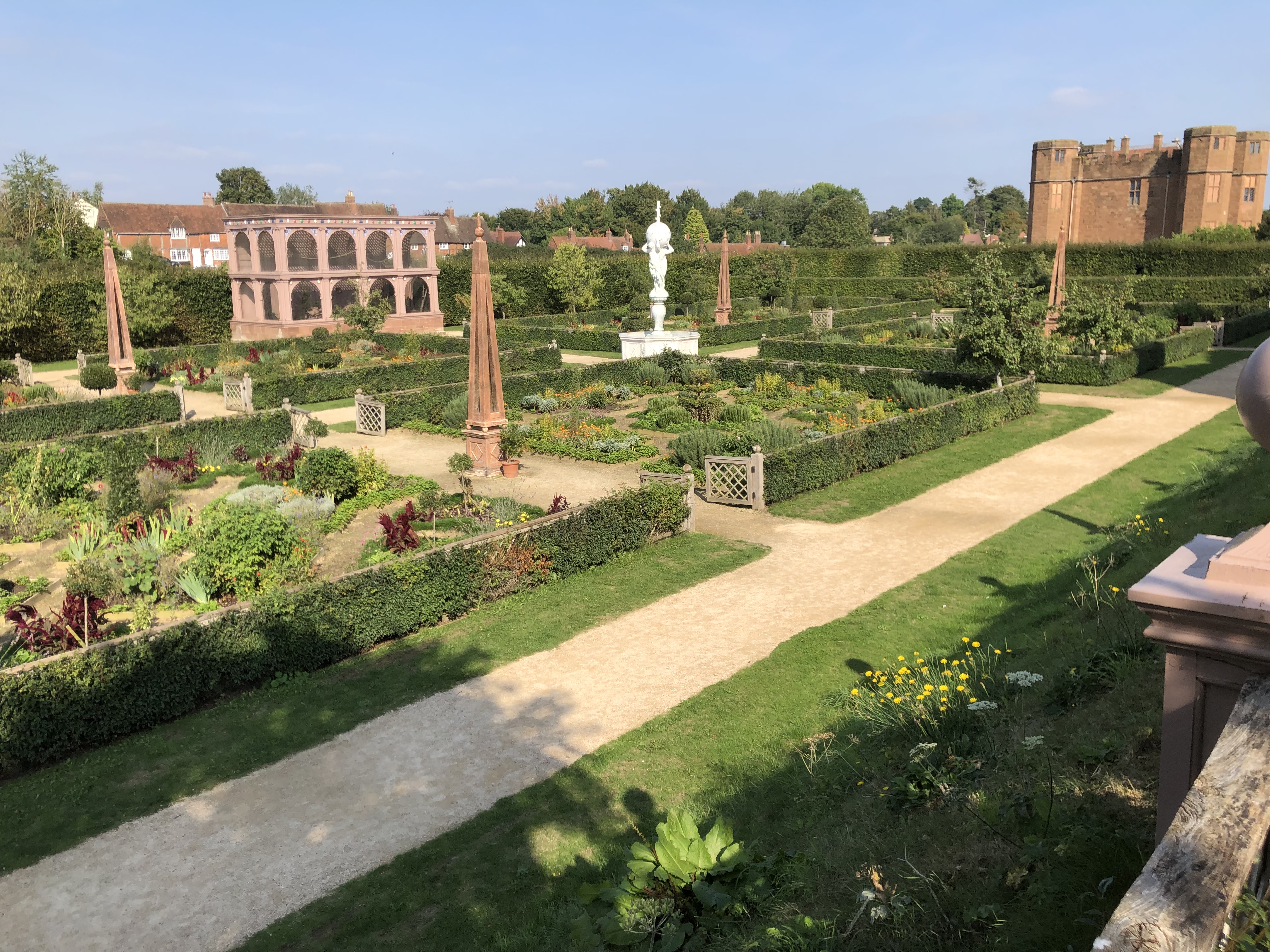
Para2The gardens of early modern England would appear unfamiliar to the modern-day reader.
Victorian naturalist Henry Ellacombe investigated Elizabeth gardens and concluded
some of the following similarities:
Flower gardens focused on uniformity and formality.
The ideal shape for gardens was a square surrounded by a high hedge of holly, hornbeam,
or brick wall.
Main walkways were enclosed by trees or shrubs, formed into hedges and then shaped
into topiary art.
Square and surrounded by walkways, compartmentalized gardens were further divided
into knots, “beds that were arranged into patterns”.
Gardens featured no lawns, only flower beds and pathways.
Gardens were decorated with ornaments such as statues, mazes, rocks, and fountains.
Gardens were considered to be a continuation of homes.
Para3According to experts at the Royal Botanic Gardens at Kew, Elizabethan gardens were
designed for either function or social applications. Many gardens would be used to
produce vegetables, herbs, or fruits. Other gardens were utilized for social purposes
or simply for decoration. Gardens of wealthier people were the most formal and often
used in the summer for entertainment and social gatherings.
Plants and Flowers of Shakespeare
Para4Henry Ellacombe’s book on plant-lore and garden-lore, available through Project Gutenberg,
provides description on both the symbolic meaning behind individual plants and the
structure and formation of gardens. Quotations from Shakespeare’s works are also provided
with each plant discussed.
Para5While gardens as a whole are utilized by Shakespeare and other playwrights as stages
for themes and plots, the specific plants and flowers also hold significance. Individual
flowers and plants have their own symbolic meaning that many audience members would
have been aware of. The meanings behind these plants and flowers aid in the portrayal
of the themes in Shakespeare’s plays, as the specific meanings tie in closely with
the characters and themes. Perhaps the most famous example of the symbolic meaning
of plants occurs in Hamlet, when the mad Ophelia distributes various herbs and flowers to members of the court
as she grieves for her murdered father, Polonius, and laments the loss of her relationship
with Hamlet prior to her death in Act 4. For example, she keeps the plant rue for
herself, one widely known in the period used to bring about menstruation; many critics
point out that this would signify to audiences that Ophelia was with child.
Sources
Ellacombe, Henry Nicholson. The Plant-lore & Garden-craft of Shakespeare. W. Satchell and Co, 1884.
Myers, Katherine.
Studies in the History of Gardens & Designed Landscapes vol. 40, no. 2, 2020, pp. 171–190.Men as plants increase: botanical meaning in Shakespeare’s The Winter’s Tale.
Scott, Charlotte.
Introduction.Shakespeare’s Nature: From Cultivation to Culture. Oxford UP, 2014.
Tigner, Amy L.
The Winter’s Tale: Gardens and the Marvels of Transformation.English Literary Renaissance vol. 36, no. 1, 2006, pp. 114–134.
Open-Access Digital Resources
Best, Michael.
A knot or design for a garden.Shakespeare’s Life and Times. Internet Shakespeare Editions. University of Victoria, 04 Jan. 2011, https://internetshakespeare.uvic.ca/Library/SLT/society/huswifery/gardenknot.html. Accessed 4 Nov. 2023.
Candy, Melissa et al.
Plants in Shakespeare.Royal Botanic Gardens Kew, 22 Apr. 2022, https://www.kew.org/read-and-watch/plants-in-shakespeare. Accessed 11 Feb. 2026.
Things To See And Do: Elizabethan Garden.English Heritage, https://www.english-heritage.org.uk/visit/places/kenilworth-castle/things-to-do/#section2. Accessed 4 Nov. 2023.
Folger Shakespeare Library Staff.
Inside the Elizabethan Garden.The Folger Shakespeare Library, 18 Jun. 2018. https://www.folger.edu/blogs/folger-story/inside-the-elizabethan-garden/. Accessed 11 Feb. 2026.
Joynes, Melissa.
Gardens in Shakespeare.Shakespeare Birthplace Trust, 9 Sep. 2016, https://www.shakespeare.org.uk/explore-shakespeare/blogs/heritage-open-days-garden-event/. Accessed 11 Feb. 2026.
Smith-Bernstein, Isabel.
Themes: Ophelia’s Garden.Utah Shakespeare Festival, https://www.bard.org/study-guides/themes-ophelias-garden/. Accessed 11 Feb. 2026.
Image Sources
Merrett, David. Elizabethan garden at Kenilworth Castle, Warwickshire. 2022. Photograph. Flickr. https://www.flickr.com/photos/davehamster/52376998285/in/photostream/.
Prosopography
Kate McPherson
Kate McPherson is Professor of English and Honors Program Director at Utah Valley
University (Orem, UT, USA). In 2015, she began working to redevelop Shakespeare’s Life and Times, created by Michael Best, into the Early Modern England Encyclopedia. Her other publications include commentary on Pericles and The Comedy of Errors for the New Oxford Shakespeare (2016); the co-edited volumes Stages of Engagement: Drama and Religion in Post-Reformation England with James Mardock (Duquesne University Press, 2014) and Shakespeare Expressed: Page, Stage, and Classroom in Shakespeare and His Contemporaries, with Kathryn M. Moncrief and Sarah Enloe (Fairleigh Dickinson University Press,
2013). With Kathryn M. Moncrief, Kate has also two edited collections, Performing Pedagogy in Early Modern England: Gender, Instruction, and Performance (Ashgate, 2011) and Performing Maternity in Early Modern England (Ashgate 2008). She has also published numerous articles on early modern maternity
in scholarly journals. Kate participated in the 2008 National Endowment for the Humanities
Institute,
Shakespeare’s Blackfriars: The Study, the Stage, the Classroom,at the American Shakespeare Center. She also served as Play Seminar Director, a public humanities position, for the Utah Shakespeare Festival in 2017 and 2018.
Kate Wrayton
Kate Wrayton was a student at the University of Fraser Valley.
Leah Hamby
Leah Hamby is the primary encoder for the Early Modern England Encyclopedia. Aside from encoding, she also works as an editor for the project and contributed
several articles of her own. She has been working on the EMEE since February 2023. As of February 2026, she is soon to graduate with honours from
Utah Valley University with a major in history and a minor in creative writing. Her
other work with the LEMDO program includes remediating William Kemp’s Kemp’s Nine Day’s Wonder for the Digital Renaissance Editions.
Melissa Walter
Melissa Walter is Associate Professor of English at the University of the Fraser Valley.
Her research focuses on early modern English drama and English and European prose
fiction. She is the author of The Italian Novella and Shakespeare’s Comic Heroines (U of Toronto, 2019), and co-editor, with Dennis Britton, of Rethinking Shakespeare Source Study: Authors, Audiences, Digital Technologies (Routledge, 2018). Her work on English theatre and the European novella has appeared
in several edited collections, including Transnational Exchange in Early Modern Theater (Ashgate, 2008), and Transnational Mobility in Early Modern Theater (Ashgate, 2012). She has also written about
Translation and Identity in the Dialogues in English and Malaiane Languages(Indographies, ed. Jonathan Gil Harris. Palgrave 2012). At the University of the Fraser Valley, she is a lead coordinator of UFV’s Shakespeare and Reconciliation Garden.
Michael Best
Michael Best is Professor Emeritus at the University of Victoria, BC. He founded the
Internet Shakespeare Editions in 1996, and was Coordinating Editor until 2017, contributing two editions to the
ISE: King John and King Lear (the latter also available in print from Broadview Press). In print, he has published editions of works of Elizabethan magic and huswifery,
a collection of letters from the Australian goldfields, and Shakespeare on the Art of Love (2008). He contributed regular columns for the Shakespeare Newsletter on
Electronic Shakespeares,and has written many articles and chapters for both print and online books and journals, principally on questions raised by the new medium in the editing and publication of texts. He has delivered papers and plenary lectures on electronic media and the Internet Shakespeare Editions at conferences in Canada, the USA, the UK, Spain, Australia, and Japan.
Navarra Houldin
Training and Documentation Lead 2025–present. LEMDO project manager 2022–2025. Textual
remediator 2021–present. Navarra Houldin (they/them) completed their BA with a major
in history and minor in Spanish at the University of Victoria in 2022. Their primary
research was on gender and sexuality in early modern Europe and Latin America. They
are continuing their education through an MA program in Gender and Social Justice
Studies at the University of Alberta where they will specialize in Digital Humanities.
Orgography
LEMDO Team (LEMD1)
The LEMDO Team is based at the University of Victoria and normally comprises the project
director, the lead developer, project manager, junior developers(s), remediators,
encoders, and remediating editors.
University of Victoria (UVIC1)
https://www.uvic.ca/Metadata
| Authority title | Gardens and Nature in Shakespeare |
| Type of text | Critical |
| Publisher | University of Victoria on the Linked Early Modern Drama Online Platform |
| Series | Early Modern England Encyclopedia |
| Source |
By Kate Wrayton, inspired by Michael Best’s Shakespeare’s Life and Times, Internet Shakespeare Editions
|
| Editorial declaration | This document uses Canadian English spelling |
| Edition | Released with Early Modern England Encyclopedia 1.0 |
| Sponsor(s) |
Early Modern England EncyclopediaAnthology Leads: Kate McPherson and Kate Moncrief.
|
| Encoding description | Encoded in TEI P5 according to the LEMDO Customization and Encoding Guidelines |
| Document status | published, peer-reviewed |
| Funder(s) |
Social Sciences and Humanities Research Council of Canada
Mitacs Globalink Research Internship Utah Valley University |
| License/availability |
Intellectual copyright in this entry is held by Kate McPherson on behalf of the contributors. Copyright on the TEI-XML markup is held by the University of Victoria on behalf of the LEMDO Team. The content and TEI-XML markup in this file are licensed under a CC BY-NC_ND 4.0 license. This file is freely downloadable without permission under the following conditions:
(1) credit must be given to the authors, EMEE, and LEMDO in any subsequent use of
the files and /or data; (2) this availability statement must remain in the file; (3)
the content cannot be adapted or repurposed (except for quotations for the purposes
of academic review and citation); and (4) commercial uses are not permitted without
the knowledge and consent of the authors, EMEE, and LEMDO. Neither the content nor
the code in this file is licensed for training large language models (LLMs), ingestion
into an LLM, or any use in any artificial intelligence applications; such uses are
considered to be commercial uses and are strictly prohibited.
|