
Fish Markets in Early Modern England
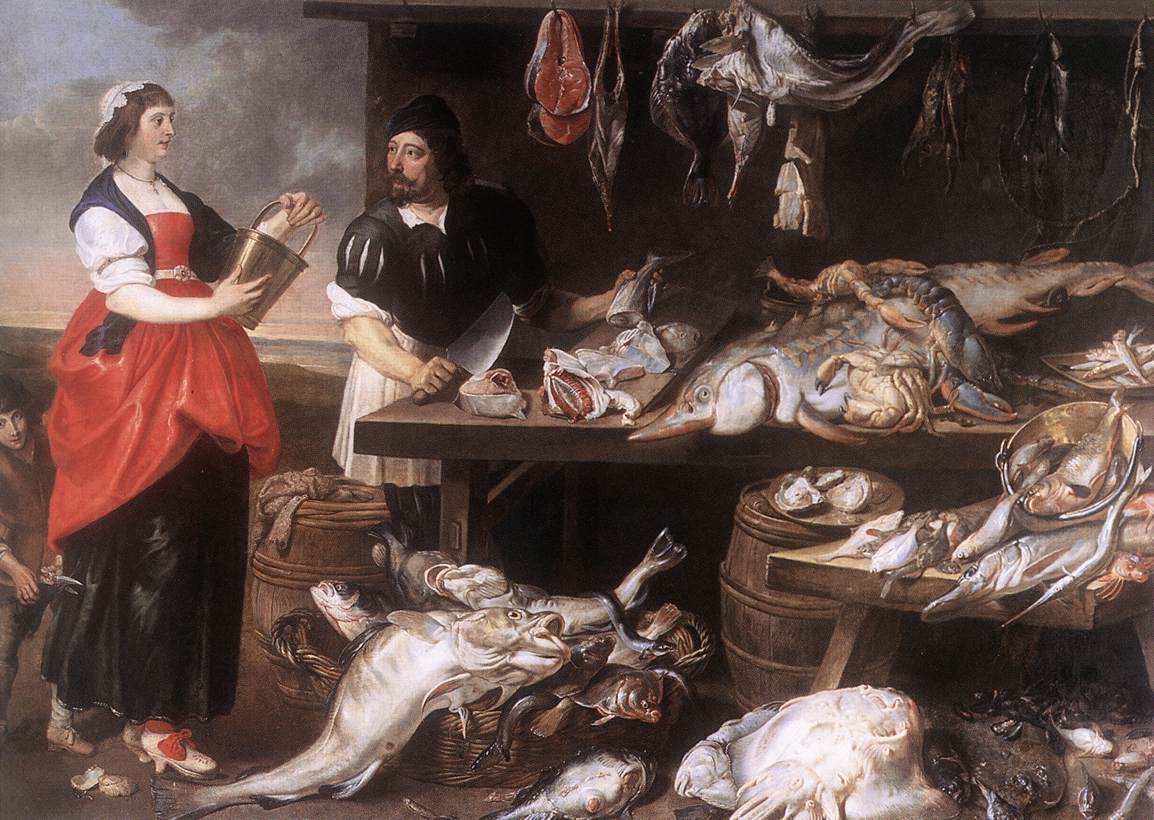
Fresh Fish: An Important Food Source
Para1In early modern England, markets in most towns featured fresh, locally grown food
products including meat, poultry, fish, fruits, dairy products, and vegetables. Most
meat and fish needed to be bought daily to either eat or preserve by smoking or salting.
England, Wales, and Scotland all have ample coastline and many seaside fishing villages
provided fresh fish from the ocean, although individuals also fished local streams
and rivers for trout or other freshwater fish. Wealthy estates also kept fish ponds
to grow their own freshwater fish like pike, bream, and carp. According to experts
at the International Fishery of the 16th century,
Fish was a source of protein that was easy to preserve, transport, purchase, and prepare.Religion and economics also played a role in how much fish people consumed.
Who Sold Fish?
Para2Because of the English people’s extensive consumption of fish, fishing as an occupation
became prominent, second only to farming for food procurement. Markets were particular
about which fishmongers (the term for a person who sells fish) supplied them. In the
nation’s capital, London, fishmongers would either have to be a member of a livery company (a trade guild) or a freeman
of London. Markets favored Londoners over countrymen, who were considered strangers
in the rapidly growing city. The cost of what was sold at these markets was regulated
by city officials such as the Lord Mayor or city counsellors. Known fish markets in
London occurred at Stocks Market, Billingsgate, Fish Street, Leadenhall, and others.
Religion and Economics
Para3Due to religious recommendations that originated with the Catholic Church but continued
in Protestant England, fish was eaten extensively during Lent, the season of penance
and fasting prior to Easter. Citizens abstained from meat and instead ate fish on
Friday and Saturday. During Elizabeth I’s reign, eating fish was also promoted to
bolster the Navy, since they caught and sold fish to raise revenue. Later, Wednesday
was added as a fish day during Lent in part to create more jobs for the Navy seamen.
Fasting from other meats was required by law, more to support the fisheries than for
religious reasons, but the enforcement of the law fell to ecclesiastical courts. These
strict dietary laws were mocked in Thomas Middleton’s A Chaste Maid in Cheapside in a scene where two odious promoters (minor officials from a local parish) stop passers-by to inspect their baskets, confiscating
those that have meat (intending to eat it themselves, of course).
Para4Historians like Liza Picard and Keith Thomas emphasize that eating fish during Lent
became more than a religious practice; it was a way to support mariners, fishermen,
fishmongers, and the port towns they came from. Public markets were also an important
social hub, a place not just to obtain food but also to get news about other townsfolk,
town happenings, and who would be punished for criminal offences. The information
gathered at markets and during exchanges with merchants like fishmongers helped define
social differences, which were expressed in food choices.
Sources
Picard, Liza. Elizabeth’s London: Everyday Life in Elizabethan London. St. Martin’s Griffin, 2004.
Thomas, Keith. The Ends of Life: Roads to Fulfillment in Early Modern England. Oxford UP, 2010.
Trijp, Didi van. Fresh Fish: Observation up Close in Late Seventeenth-Century England. Notes and Records of the Royal Society vol. 75, 2021, pp. 311–332.
Open-Access Digital Resources
Best, Michael.
The Fish Market.Shakespeare’s Life and Times. Internet Shakespeare Editions. University of Victoria, 4 Jan. 2011, https://internetshakespeare.uvic.ca/Library/SLT/society/city%20life/fishmarket.html. Accessed 10 Feb. 2026.
The International Fishery of the 16th Century.Heritage: Newfoundland & Labrador, https://www.heritage.nf.ca/articles/exploration/16th-century-fishery.php. Accessed 27 Jun. 2025.
Image Sources
Ultretcht, Adrien van. Fishmonger’s Stall. 1640. Oil on canvas. Wikimedia Commons and The Museum of Fine Arts, Gehtn. https://commons.wikimedia.org/wiki/File:Adriaen_van_Utrecht_-_Fishmonger%27s_Stall_-_WGA24196.jpg.

Prosopography
Ashley Franklin
Ashley Franklin was a student at Utah Valley University.
Kate McPherson
Kate McPherson is Professor of English and Honors Program Director at Utah Valley
University (Orem, UT, USA). In 2015, she began working to redevelop Shakespeare’s Life and Times, created by Michael Best, into the Early Modern England Encyclopedia. Her other publications include commentary on Pericles and The Comedy of Errors for the New Oxford Shakespeare (2016); the co-edited volumes Stages of Engagement: Drama and Religion in Post-Reformation England with James Mardock (Duquesne University Press, 2014) and Shakespeare Expressed: Page, Stage, and Classroom in Shakespeare and His Contemporaries, with Kathryn M. Moncrief and Sarah Enloe (Fairleigh Dickinson University Press,
2013). With Kathryn M. Moncrief, Kate has also two edited collections, Performing Pedagogy in Early Modern England: Gender, Instruction, and Performance (Ashgate, 2011) and Performing Maternity in Early Modern England (Ashgate 2008). She has also published numerous articles on early modern maternity
in scholarly journals. Kate participated in the 2008 National Endowment for the Humanities
Institute,
Shakespeare’s Blackfriars: The Study, the Stage, the Classroom,at the American Shakespeare Center. She also served as Play Seminar Director, a public humanities position, for the Utah Shakespeare Festival in 2017 and 2018.
Leah Hamby
Leah Hamby is the primary encoder for the Early Modern England Encyclopedia. Aside from encoding, she also works as an editor for the project and contributed
several articles of her own. She has been working on the EMEE since February 2023. As of February 2026, she is soon to graduate with honours from
Utah Valley University with a major in history and a minor in creative writing. Her
other work with the LEMDO program includes remediating William Kemp’s Kemp’s Nine Day’s Wonder for the Digital Renaissance Editions.
Michael Best
Michael Best is Professor Emeritus at the University of Victoria, BC. He founded the
Internet Shakespeare Editions in 1996, and was Coordinating Editor until 2017, contributing two editions to the
ISE: King John and King Lear (the latter also available in print from Broadview Press). In print, he has published editions of works of Elizabethan magic and huswifery,
a collection of letters from the Australian goldfields, and Shakespeare on the Art of Love (2008). He contributed regular columns for the Shakespeare Newsletter on
Electronic Shakespeares,and has written many articles and chapters for both print and online books and journals, principally on questions raised by the new medium in the editing and publication of texts. He has delivered papers and plenary lectures on electronic media and the Internet Shakespeare Editions at conferences in Canada, the USA, the UK, Spain, Australia, and Japan.
Navarra Houldin
Training and Documentation Lead 2025–present. LEMDO project manager 2022–2025. Textual
remediator 2021–present. Navarra Houldin (they/them) completed their BA with a major
in history and minor in Spanish at the University of Victoria in 2022. Their primary
research was on gender and sexuality in early modern Europe and Latin America. They
are continuing their education through an MA program in Gender and Social Justice
Studies at the University of Alberta where they will specialize in Digital Humanities.
Orgography
LEMDO Team (LEMD1)
The LEMDO Team is based at the University of Victoria and normally comprises the project
director, the lead developer, project manager, junior developers(s), remediators,
encoders, and remediating editors.
University of Victoria (UVIC1)
https://www.uvic.ca/Metadata
| Authority title | Fish Markets in Early Modern England |
| Type of text | Critical |
| Publisher | University of Victoria on the Linked Early Modern Drama Online Platform |
| Series | Early Modern England Encyclopedia |
| Source |
By Ashley Franklin, inspired by Michael Best’s Shakespeare’s Life and Times, Internet Shakespeare Editions
|
| Editorial declaration | This document uses Canadian English spelling |
| Edition | Released with Early Modern England Encyclopedia 1.0 |
| Sponsor(s) |
Early Modern England EncyclopediaAnthology Leads: Kate McPherson and Kate Moncrief.
|
| Encoding description | Encoded in TEI P5 according to the LEMDO Customization and Encoding Guidelines |
| Document status | published, peer-reviewed |
| Funder(s) |
Social Sciences and Humanities Research Council of Canada
Mitacs Globalink Research Internship Utah Valley University |
| License/availability |
Intellectual copyright in this entry is held by Kate McPherson on behalf of the contributors. Copyright on the TEI-XML markup is held by the University of Victoria on behalf of the LEMDO Team. The content and TEI-XML markup in this file are licensed under a CC BY-NC_ND 4.0 license. This file is freely downloadable without permission under the following conditions:
(1) credit must be given to the authors, EMEE, and LEMDO in any subsequent use of
the files and /or data; (2) this availability statement must remain in the file; (3)
the content cannot be adapted or repurposed (except for quotations for the purposes
of academic review and citation); and (4) commercial uses are not permitted without
the knowledge and consent of the authors, EMEE, and LEMDO. Neither the content nor
the code in this file is licensed for training large language models (LLMs), ingestion
into an LLM, or any use in any artificial intelligence applications; such uses are
considered to be commercial uses and are strictly prohibited.
|