
Falconry
History of the Sport of Falconry
Para1Hawking and falconry date to around 2,000 BC in the ancient Near East. Hittites and
Egyptians used birds of prey to hunt food in places or seasons when food was more
difficult to obtain. Hawks and falcons catch prey faster and at a farther distance
than a person can by using an arrow or spear. Many cultures developed a tradition
of falconry, which requires intensive training of the animal by a skilled falconer
and is thus often associated with higher-status individuals. Falcons and hawks were
used widely in Europe from the early Middle Ages onward, with the sport eventually
falling under the Laws of Ownership that regulated the kinds of birds that could be flown by people according to their
rank. In early modern England, falconry books relied on this sport’s long history
of association with elite classes while using strongly gendered language to enforce
hierarchy.
Shakespeare’s Inclusion of Birds
Para2Falconry occurs in many of Shakespeare’s plays, which may be due to his family’s connections
to birds. His father, John Shakespeare, had applied for a coat of arms in the 1570s,
which was finally approved in 1596. In the grant document submitted by John Shakespeare.
the family’s crest is described as having
a falcon his wings displayed argent silver, standing on a wreath of his colours supporting a spear.Falconry was an elite sport practiced by the nobility, so it was a stretch for the Shakespeares, who were firmly in the middle ranks of English society, to employ this animal on their coat of arms. Falcons appear more often than other birds in Shakespeare’s writing and they are mentioned with more accuracy and variety. Shakespeare also grew up in a mostly rural environment in central England, far from the nation’s capital of London. He may have witnessed elite families from the area’s manors and estates practicing hawking and falconry as a sport.
Shakespeare’s Use of Falconry and Hawking
The Taming of the Shrew
Para3The Taming of the Shrew uses some notorious falconry images as it explores how Petruchio can
tameKaterina. Shakespeare uses the language of masculine dominance to show how a man might train and subdue a woman the same way a falconer trains a bird. Petruchio speaks of his wife as under his possession, which legally she was according to English law. He asserts she is metaphorically a falcon and that she belongs to him like a sporting bird belongs to its owner. Petruchio says he can use hunger to control her:
My falcon now is sharp and passing empty,And till she stoop fly to the lure, she must not be full-gorg’d,For then she never looks upon her lure.Another way I have to man manage my haggard a wild-born hawk,To make her come, and know her keeper’s call.(4.1.190–94)
Para4But Petruchio’s debatable success in teaching Katerina how to behave contrasts with
Hortensio’s failure to teach her sister Bianca similarly acceptable feminine behaviors.
He calls Bianca
this proud disdainful haggard(4.2.39); haggard was another term for falcon.
Para5In the 1611 sequel to Shakespeare’s play, John Fletcher’s comedy, The Woman’s Prize, or The Tamer Tamed, the newly married Maria proclaims herself a
free haggardto Petruchio (1.2.150), reinforcing the dominance motif.
Romeo and Juliet
Para6In Romeo and Juliet, both the title characters use a falconry metaphor. Reversing the gender dynamic
found in The Taming of the Shrew, Juliet wishes she could call Romeo to her like a falconer calls their bird. She
proclaims,
O for a falconer’s voice / To lure this tassel-gentle back again(2.2.158–59). Yet Juliet also compares herself to an untamed hawk, waiting for Romeo to
manmanage her, using the hood of night:
Hood cover my unmanned blood, bating beating like wings in my cheeks,With thy night’s black mantle, till strange love grow bold,Think true love acted simple modesty.(3.2.14–16)
Para7Later, Romeo casts himself as a bird fleeing:
Flies may do this touch Juliet’s lips but I from this must fly(3.3.41).
Para8Shakespeare may have incorporated falconry and hawking into his plays to provide another
metaphor of sexual conquest to audiences, conveying clear messages about the gendery
dynamics of dominance and submission that would have been familiar to many of the
period.
Sources
Benson, Sean.
Studies in Philology, vol. 103, no. 2, Spring 2006, pp. 186–207.If I Do Prove Her Haggard: Shakespeare’s Application of Hawking Tropes to Marriage.
Brown, Carolyn E.
Juliet’s Taming of Romeo.Studies in English Literature, 1500–1900, vol. 36, no. 2, Mar. 1996, p. 333-355.
Canby, Jeanny Vorys.
Falconry (Hawking) in Hittite Lands.Journal of Near Eastern Studies, vol. 61, no. 3, Jul. 2002, p. 161-201.
Open-Access Digital Resources
Best, Michael.
Falconry and hawking.Shakespeare’s Life and Times. Internet Shakespeare Editions. University of Victoria, 4 Jan. 2011, https://internetshakespeare.uvic.ca/Library/SLT/society/husbandry/hawking.html. Accessed 6 Nov. 2023.
Raptor Force.Nature. PBS.org, 4 Jun. 2008, https://www.pbs.org/wnet/nature/raptor-force-history-of-falconry/1108/. Accessed 11 Feb. 2026.
Shakespeare Coat of Arms.Shakespeare Birthplace Trust, https://www.shakespeare.org.uk/explore-shakespeare/shakespedia/william-shakespeare/shakespeare-coat-arms/. Accessed 6 Nov. 2023.
Turberville, George. The Book of Falconry and Hawking. London, 1611. Boston Public Library, https://archive.org/details/bookeoffalconrie00turb/page/n7/mode/2up. Accessed 11 Feb. 2026.
Image Sources
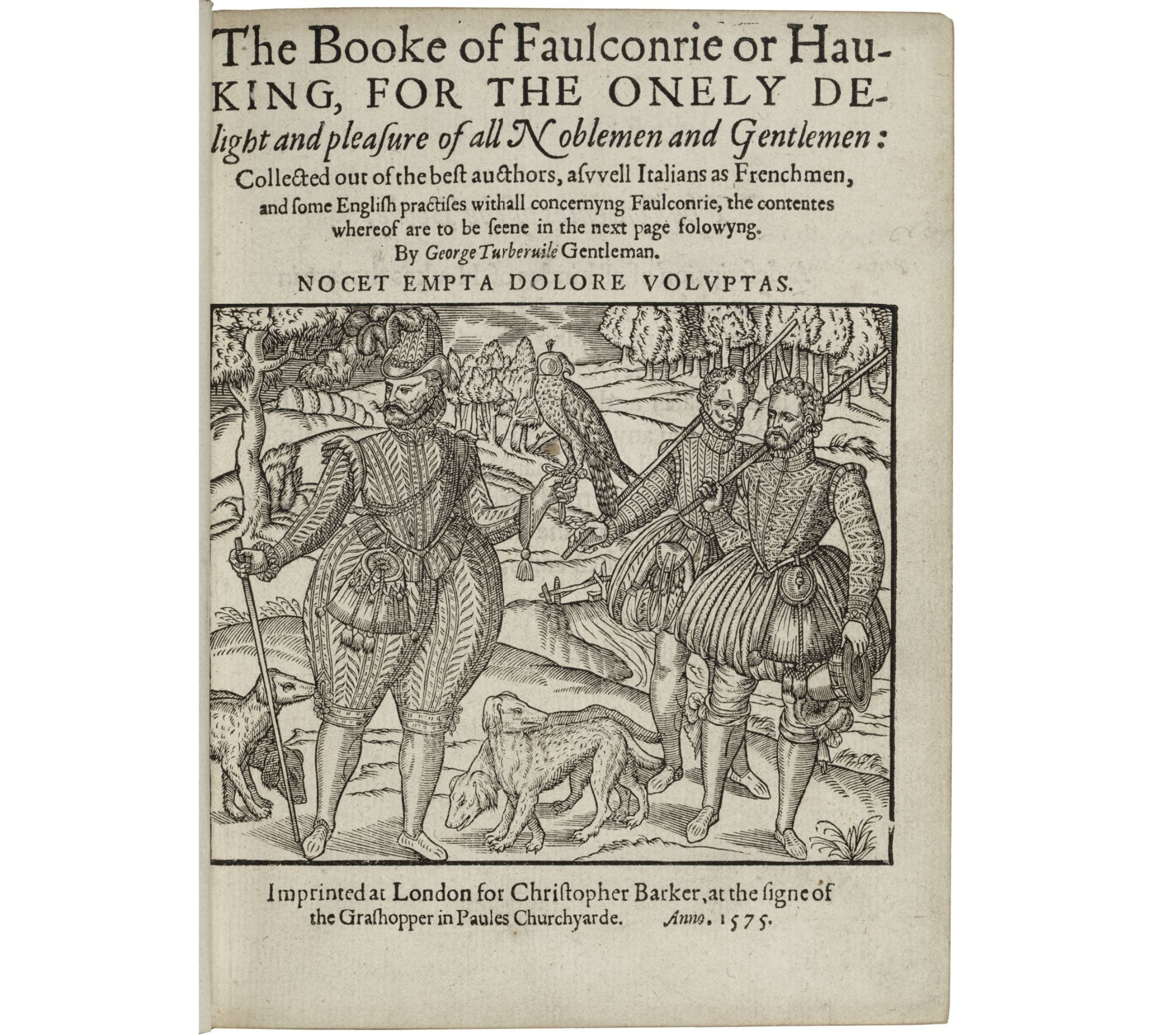
Turberville, George. Title page from The book of falconry or hawking. Christopher Barker, 1575. Folger Shakespeare Library. https://digitalcollections.folger.edu/img17929.
Prosopography
Camryn Watts
Camryn Watts was a student at the University of Fraser Valley.
Janelle Jenstad
Janelle Jenstad is a Professor of English at the University of Victoria, Director
of The Map of Early Modern London, and Director of Linked Early Modern Drama Online. With Jennifer Roberts-Smith and Mark Beatrice Kaethler, she co-edited Shakespeare’s Language in Digital Media: Old Words, New Tools (Routledge). She has edited John Stow’s A Survey of London (1598 text) for MoEML and is currently editing The Merchant of Venice (with Stephen Wittek) and Heywood’s 2 If You Know Not Me You Know Nobody for DRE. Her articles have appeared in Digital Humanities Quarterly, Elizabethan Theatre, Early Modern Literary Studies, Shakespeare Bulletin, Renaissance and Reformation, and The Journal of Medieval and Early Modern Studies. She contributed chapters to Approaches to Teaching Othello (MLA); Teaching Early Modern Literature from the Archives (MLA); Institutional Culture in Early Modern England (Brill); Shakespeare, Language, and the Stage (Arden); Performing Maternity in Early Modern England (Ashgate); New Directions in the Geohumanities (Routledge); Early Modern Studies and the Digital Turn (Iter); Placing Names: Enriching and Integrating Gazetteers (Indiana); Making Things and Drawing Boundaries (Minnesota); Rethinking Shakespeare Source Study: Audiences, Authors, and Digital Technologies (Routledge); and Civic Performance: Pageantry and Entertainments in Early Modern London (Routledge). For more details, see janellejenstad.com.
Kate McPherson
Kate McPherson is Professor of English and Honors Program Director at Utah Valley
University (Orem, UT, USA). In 2015, she began working to redevelop Shakespeare’s Life and Times, created by Michael Best, into the Early Modern England Encyclopedia. Her other publications include commentary on Pericles and The Comedy of Errors for the New Oxford Shakespeare (2016); the co-edited volumes Stages of Engagement: Drama and Religion in Post-Reformation England with James Mardock (Duquesne University Press, 2014) and Shakespeare Expressed: Page, Stage, and Classroom in Shakespeare and His Contemporaries, with Kathryn M. Moncrief and Sarah Enloe (Fairleigh Dickinson University Press,
2013). With Kathryn M. Moncrief, Kate has also two edited collections, Performing Pedagogy in Early Modern England: Gender, Instruction, and Performance (Ashgate, 2011) and Performing Maternity in Early Modern England (Ashgate 2008). She has also published numerous articles on early modern maternity
in scholarly journals. Kate participated in the 2008 National Endowment for the Humanities
Institute,
Shakespeare’s Blackfriars: The Study, the Stage, the Classroom,at the American Shakespeare Center. She also served as Play Seminar Director, a public humanities position, for the Utah Shakespeare Festival in 2017 and 2018.
Leah Hamby
Leah Hamby is the primary encoder for the Early Modern England Encyclopedia. Aside from encoding, she also works as an editor for the project and contributed
several articles of her own. She has been working on the EMEE since February 2023. As of February 2026, she is soon to graduate with honours from
Utah Valley University with a major in history and a minor in creative writing. Her
other work with the LEMDO program includes remediating William Kemp’s Kemp’s Nine Day’s Wonder for the Digital Renaissance Editions.
Melissa Walter
Melissa Walter is Associate Professor of English at the University of the Fraser Valley.
Her research focuses on early modern English drama and English and European prose
fiction. She is the author of The Italian Novella and Shakespeare’s Comic Heroines (U of Toronto, 2019), and co-editor, with Dennis Britton, of Rethinking Shakespeare Source Study: Authors, Audiences, Digital Technologies (Routledge, 2018). Her work on English theatre and the European novella has appeared
in several edited collections, including Transnational Exchange in Early Modern Theater (Ashgate, 2008), and Transnational Mobility in Early Modern Theater (Ashgate, 2012). She has also written about
Translation and Identity in the Dialogues in English and Malaiane Languages(Indographies, ed. Jonathan Gil Harris. Palgrave 2012). At the University of the Fraser Valley, she is a lead coordinator of UFV’s Shakespeare and Reconciliation Garden.
Michael Best
Michael Best is Professor Emeritus at the University of Victoria, BC. He founded the
Internet Shakespeare Editions in 1996, and was Coordinating Editor until 2017, contributing two editions to the
ISE: King John and King Lear (the latter also available in print from Broadview Press). In print, he has published editions of works of Elizabethan magic and huswifery,
a collection of letters from the Australian goldfields, and Shakespeare on the Art of Love (2008). He contributed regular columns for the Shakespeare Newsletter on
Electronic Shakespeares,and has written many articles and chapters for both print and online books and journals, principally on questions raised by the new medium in the editing and publication of texts. He has delivered papers and plenary lectures on electronic media and the Internet Shakespeare Editions at conferences in Canada, the USA, the UK, Spain, Australia, and Japan.
Navarra Houldin
Training and Documentation Lead 2025–present. LEMDO project manager 2022–2025. Textual
remediator 2021–present. Navarra Houldin (they/them) completed their BA with a major
in history and minor in Spanish at the University of Victoria in 2022. Their primary
research was on gender and sexuality in early modern Europe and Latin America. They
are continuing their education through an MA program in Gender and Social Justice
Studies at the University of Alberta where they will specialize in Digital Humanities.
Orgography
LEMDO Team (LEMD1)
The LEMDO Team is based at the University of Victoria and normally comprises the project
director, the lead developer, project manager, junior developers(s), remediators,
encoders, and remediating editors.
University of Victoria (UVIC1)
https://www.uvic.ca/Metadata
| Authority title | Falconry |
| Type of text | Critical |
| Publisher | University of Victoria on the Linked Early Modern Drama Online Platform |
| Series | Early Modern England Encyclopedia |
| Source |
By Camryn Watts, inspired by Michael Best’s Shakespeare’s Life and Times, Internet Shakespeare Editions
|
| Editorial declaration | This document uses Canadian English spelling |
| Edition | Released with Early Modern England Encyclopedia 1.0 |
| Sponsor(s) |
Early Modern England EncyclopediaAnthology Leads: Kate McPherson and Kate Moncrief.
|
| Encoding description | Encoded in TEI P5 according to the LEMDO Customization and Encoding Guidelines |
| Document status | published, peer-reviewed |
| Funder(s) |
Social Sciences and Humanities Research Council of Canada
Mitacs Globalink Research Internship Utah Valley University |
| License/availability |
Intellectual copyright in this entry is held by Kate McPherson on behalf of the contributors. Copyright on the TEI-XML markup is held by the University of Victoria on behalf of the LEMDO Team. The content and TEI-XML markup in this file are licensed under a CC BY-NC_ND 4.0 license. This file is freely downloadable without permission under the following conditions:
(1) credit must be given to the authors, EMEE, and LEMDO in any subsequent use of
the files and /or data; (2) this availability statement must remain in the file; (3)
the content cannot be adapted or repurposed (except for quotations for the purposes
of academic review and citation); and (4) commercial uses are not permitted without
the knowledge and consent of the authors, EMEE, and LEMDO. Neither the content nor
the code in this file is licensed for training large language models (LLMs), ingestion
into an LLM, or any use in any artificial intelligence applications; such uses are
considered to be commercial uses and are strictly prohibited.
|