
Exit, pursued by a bear
Para1The appearance of the bear in the last stage direction of Act 3, Scene 3 of The Winter’s Tale is possibly the most well-known stage direction in the history of Shakespeare’s plays.
It occurs after a courtier, Antigonus, abandons the baby Perdita in Bohemia after
fleeing the court of Leontes. Antigonus is abruptly chased off-stage by a bear and
mauled to death, at which point the Shepherd appears and confirms to the audience
that Antigonus really has been killed. At this moment, halfway through the play, The Winter’s Tale transforms into a comedy of love and reunion, abruptly shifting from the tragic tale
of jealously and betrayal with which it begin. Though it is a brutal way for Antigonus
to die,
exit, pursued by a bearprompts a necessary catharsis for the audience, allowing the viewer to relax, laugh, and shift their mind to the new comedic tone.
The Bear in Elizabethan England
Para2
I have seen Sackerson loose twenty times, and have taken him by the chain, but, I warrant you, the women have so cried and shrieked at it that it passed.The Merry Wives of Windsor 1.1.269
Para3To the audience attending Shakespeare’s plays, a bear would have been the most well-known
wild creature. Bears were a very common form of entertainment and a popular bear-baiting
ring, the Bear Garden, operated near the Globe Theatre. Much like theatre, bear-baiting
appealed to both the upper and lower classes, and it was a favourite pastime of royalty
and commoners alike. Bear-baiting became known as a uniquely English activity and
was so entwined with popular culture that a celebrity bear of the time, Sackerson,
was mentioned by name in Shakespeare’s The Merry Wives of Windsor. The bears involved in this popular blood sport were perceived as creatures of sheer
might and natural power, but in the context of bear-baiting and its popularity, bears
also became humourous animals.
Tragedy to Comedy
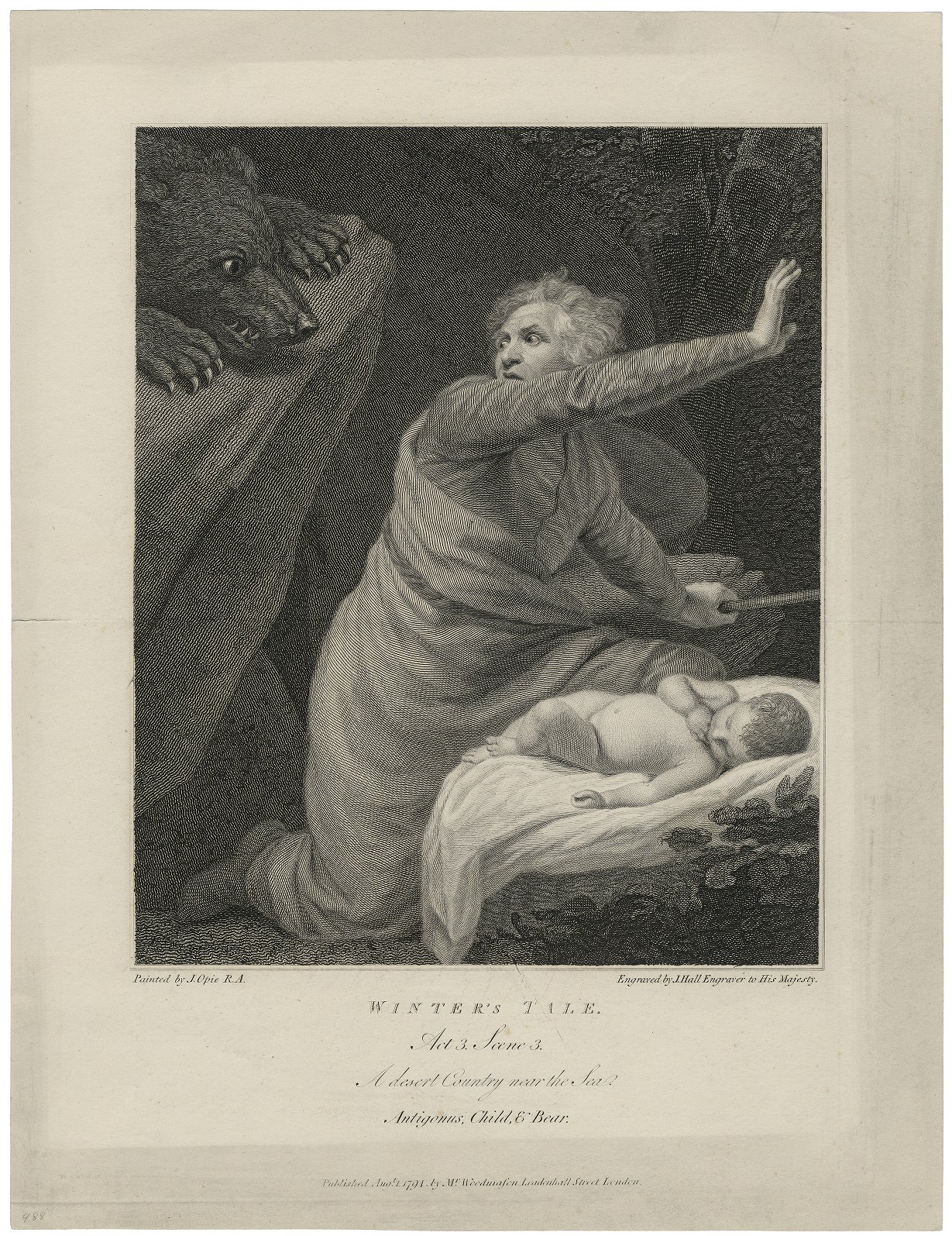
Antigonus, Child, & Bear,painted by John Opie, engraving by John Hall. 1794. Folger Digital Image Collection. Public Domain.
Para4
Thou meet'st with things dying, I with things newborn.The Winter’s Tale 3.3.1554
Para5Broadly speaking, themes of life and death are incorporated in a play to create separation
between tragedy and comedy. Death features heavily in the first half of The Winter’s Tale and this focus ends only when Antigonus is killed by the bear. Literary scholar Andrew
Gurr suggests that Antigonus’ death marks the precise moment The Winter’s Tale becomes a comedy. To Philip Goldfarb Styrt, Antigonus’ mauling and death is a kind
of sacrifice, allowing space for new life to begin since Perdita, who does survive
her abandonment, returns to her rightful place as a princess by the end of the play.
The suddenness of the bear’s appearance also serves a dramatic function. Gurr discusses
that, when confronted with something frightening, the audience experiences a
fear reaction(424); once the shock is over, they are relieved and often laugh. The viewer’s mind is therefore ready for the complete tonal shift that comes directly after Antigonus’ death.
Para6Since any staging of The Winter’s Tale would struggle to incorporate a real bear just for one stage direction, the appearance
of the bear also plays into the humour and allows the audience some catharsis. As
described by the Shepherd, the bear is enormous and incredibly powerful, strong enough
to
tear out Antigonus’ shoulderbone(3.3.1536). The reality is that the bear was more than likely played by an actor in a costume, and the discrepancy between the described size and what the audience has just seen as the
bearis a dramatic wink at the viewer. However, scholars have not ruled out the King’s Men using an actual bear for performances, given the availability of live animals from the nearby Bear Garden.
Para7The dramatic shock of Antigonus’ death releases the audience from the tension of the
preceding tragedy of the first half of The Winter’s Tale, in which a lifelong friendship and a happy marriage are destroyed by baseless jealousy.
While the stage direction itself has taken on a life of its own,
exit, pursued by a bearrepresents Shakespeare’s deep knowledge of dramatic tricks and conventions, and how those principles can be used to guide an entire audience right from one genre to another.
Sources
Hagen, Tanya and Sally-Beth MacLean.
How to Track a Bear in Southwark: A Learning Module.Medieval English Theatre, vol. 37, 2015, p. 90.
De Somogyi, Nick.
Shakespeare and the Naming of Bears.New Theatre Quarterly, vol. 34, no. 3, 2018, pp. 216–234.
De Somogyi, Nick.
Shakespeare and the Three Bears.New Theatre Quarterly, vol. 27, no. 2, 2011, pp. 99–113.
Gurr, Andrew. The Bear, the Statue, and Hysteria In The Winter’s Tale. Shakespeare Quarterly, vol. 34, no. 4, 1983, pp. 420–425.
McPartland, Perry.
References to the Doubling of Autolycus and the Bear in Shakespeare’s The Winter’s Tale.Notes and Queries, vol. 66, no. 3, 10 Sep. 2019, pp. 454–457.
Styrt, Philip Goldfarb.
Resistance Theory, Antigonus, and the Bear in The Winter’s Tale.Studies in English Literature 1500–1900, vol. 57, no. 2, 2017, pp. 389–406.
Open-Access Digital Resources
Bear Garden.Records of Early English Drama, University of Toronto, https://library2.utm.utoronto.ca/otra/reed/content/bear-garden. Accessed 6 Oct. 2023.
Kelley, Shannon.
Bear Garden.The Map of Early Modern London. Edited by Janelle Jenstad, University of Victoria, 30 Jun. 2021, https://mapoflondon.uvic.ca/BEAR1.htm. Accessed 11 Feb. 2026.
Image Source
Opie, John, painter. Engraved by John Hall.
Antigonus, Child, & Bear.1794. Engraving. Folger Digital Collections. Call number ART File S528w1 no.21.https://digitalcollections.folger.edu/img29382.
Prosopography
Kate McPherson
Kate McPherson is Professor of English and Honors Program Director at Utah Valley
University (Orem, UT, USA). In 2015, she began working to redevelop Shakespeare’s Life and Times, created by Michael Best, into the Early Modern England Encyclopedia. Her other publications include commentary on Pericles and The Comedy of Errors for the New Oxford Shakespeare (2016); the co-edited volumes Stages of Engagement: Drama and Religion in Post-Reformation England with James Mardock (Duquesne University Press, 2014) and Shakespeare Expressed: Page, Stage, and Classroom in Shakespeare and His Contemporaries, with Kathryn M. Moncrief and Sarah Enloe (Fairleigh Dickinson University Press,
2013). With Kathryn M. Moncrief, Kate has also two edited collections, Performing Pedagogy in Early Modern England: Gender, Instruction, and Performance (Ashgate, 2011) and Performing Maternity in Early Modern England (Ashgate 2008). She has also published numerous articles on early modern maternity
in scholarly journals. Kate participated in the 2008 National Endowment for the Humanities
Institute,
Shakespeare’s Blackfriars: The Study, the Stage, the Classroom,at the American Shakespeare Center. She also served as Play Seminar Director, a public humanities position, for the Utah Shakespeare Festival in 2017 and 2018.
Leah Hamby
Leah Hamby is the primary encoder for the Early Modern England Encyclopedia. Aside from encoding, she also works as an editor for the project and contributed
several articles of her own. She has been working on the EMEE since February 2023. As of February 2026, she is soon to graduate with honours from
Utah Valley University with a major in history and a minor in creative writing. Her
other work with the LEMDO program includes remediating William Kemp’s Kemp’s Nine Day’s Wonder for the Digital Renaissance Editions.
Maecyn Klassen
Maecyn Klassen was a student at the University of Fraser Valley.
Melissa Walter
Melissa Walter is Associate Professor of English at the University of the Fraser Valley.
Her research focuses on early modern English drama and English and European prose
fiction. She is the author of The Italian Novella and Shakespeare’s Comic Heroines (U of Toronto, 2019), and co-editor, with Dennis Britton, of Rethinking Shakespeare Source Study: Authors, Audiences, Digital Technologies (Routledge, 2018). Her work on English theatre and the European novella has appeared
in several edited collections, including Transnational Exchange in Early Modern Theater (Ashgate, 2008), and Transnational Mobility in Early Modern Theater (Ashgate, 2012). She has also written about
Translation and Identity in the Dialogues in English and Malaiane Languages(Indographies, ed. Jonathan Gil Harris. Palgrave 2012). At the University of the Fraser Valley, she is a lead coordinator of UFV’s Shakespeare and Reconciliation Garden.
Michael Best
Michael Best is Professor Emeritus at the University of Victoria, BC. He founded the
Internet Shakespeare Editions in 1996, and was Coordinating Editor until 2017, contributing two editions to the
ISE: King John and King Lear (the latter also available in print from Broadview Press). In print, he has published editions of works of Elizabethan magic and huswifery,
a collection of letters from the Australian goldfields, and Shakespeare on the Art of Love (2008). He contributed regular columns for the Shakespeare Newsletter on
Electronic Shakespeares,and has written many articles and chapters for both print and online books and journals, principally on questions raised by the new medium in the editing and publication of texts. He has delivered papers and plenary lectures on electronic media and the Internet Shakespeare Editions at conferences in Canada, the USA, the UK, Spain, Australia, and Japan.
Navarra Houldin
Training and Documentation Lead 2025–present. LEMDO project manager 2022–2025. Textual
remediator 2021–present. Navarra Houldin (they/them) completed their BA with a major
in history and minor in Spanish at the University of Victoria in 2022. Their primary
research was on gender and sexuality in early modern Europe and Latin America. They
are continuing their education through an MA program in Gender and Social Justice
Studies at the University of Alberta where they will specialize in Digital Humanities.
Orgography
LEMDO Team (LEMD1)
The LEMDO Team is based at the University of Victoria and normally comprises the project
director, the lead developer, project manager, junior developers(s), remediators,
encoders, and remediating editors.
University of Victoria (UVIC1)
https://www.uvic.ca/Metadata
| Authority title | Exit, pursued by a bear |
| Type of text | Critical |
| Publisher | University of Victoria on the Linked Early Modern Drama Online Platform |
| Series | Early Modern England Encyclopedia |
| Source |
By Maecyn Klassen, inspired by Michael Best’s Shakespeare’s Life and Times, Internet Shakespeare Editions
|
| Editorial declaration | This document uses Canadian English spelling |
| Edition | Released with Early Modern England Encyclopedia 1.0 |
| Sponsor(s) |
Early Modern England EncyclopediaAnthology Leads: Kate McPherson and Kate Moncrief.
|
| Encoding description | Encoded in TEI P5 according to the LEMDO Customization and Encoding Guidelines |
| Document status | published, peer-reviewed |
| Funder(s) |
Social Sciences and Humanities Research Council of Canada
Mitacs Globalink Research Internship Utah Valley University |
| License/availability |
Intellectual copyright in this entry is held by Kate McPherson on behalf of the contributors. Copyright on the TEI-XML markup is held by the University of Victoria on behalf of the LEMDO Team. The content and TEI-XML markup in this file are licensed under a CC BY-NC_ND 4.0 license. This file is freely downloadable without permission under the following conditions:
(1) credit must be given to the authors, EMEE, and LEMDO in any subsequent use of
the files and /or data; (2) this availability statement must remain in the file; (3)
the content cannot be adapted or repurposed (except for quotations for the purposes
of academic review and citation); and (4) commercial uses are not permitted without
the knowledge and consent of the authors, EMEE, and LEMDO. Neither the content nor
the code in this file is licensed for training large language models (LLMs), ingestion
into an LLM, or any use in any artificial intelligence applications; such uses are
considered to be commercial uses and are strictly prohibited.
|