
Early Modern English Perceptions of Islam
Para1In early modern England, believers in and converts to Islam were most often termed
Mohametans or Musselmen if they originated from Persia or places in the Ottoman Empire. More occasionally,
Moor or Morisco were used if they were from North Africa. The English perception of the Islamic world
was heavily influenced by trade with the Ottoman and Persian Empires. Distrusted as
apostates by the Englishmen they encountered, Muslims nevertheless played a role in
English trade and in popular culture. Misinformation regarding Islam was widespread.
Allies
Para2During the early modern period, England had a civil relationship with the Ottoman
Empire. From 1511 on, English ships freely sailed the Mediterranean, trading regularly
with Beirut, Istanbul, and Tangier, as well as Persia, Hormuz, and the Mughal empire,
all of which were Muslim nations. Following the Ottoman-Venetian war of 1570–1573,
English ships began to replace Venetian ships in the trade with Turkey. In 1581, English
merchants secured the trading monopoly with the Ottoman Empire through the creation
of the Levant Company, frequently known as the Turkey Company. A royal charter signed
by Queen Elizabeth I established the monopoly, which was extended to Venice in 1592.
This greatly expanded trade for England and increased the diplomatic interactions
between England and the Ottoman Empire. Some relations between England and the Barbary
Coast of North Africa in the 17th century also existed, with Elizabeth I establishing
an ambassador in Morocco. England also participated in trade with Istanbul, another
Muslim city.
Misinformation
Para3While England may have had friendly relations with the Ottoman empire and other Islamic
nations during the early modern period, much distrust persisted against Islam, which
stemmed from misinformation, religious beliefs, and fear. Negative views of Islam
permeated English culture, including false views of Muslims being sensualists, idolaters,
savages, and anti-Christian. The largest reason for these negative views was the spread
of false information. Little reliable information on Islam made it to England during
the early modern period, brought only intermittently by diplomats, merchants, and
travelers. Frequently, information came from Italian and French sources translated
into English. These sources were unreliable as they were often mistranslated, and
many Europeans encountering Turks already had a tainted view of Muslims.
Religious Differences
Para4Religious differences were the primary reason that England and the rest of Europe
othered the Sunni Muslim Ottomans, although they held a slightly more positive view
of the Shi’a Muslim Persian Empire. English Protestants in the early modern period
had a strong disdain for Catholics. They saw a connection in religious practice between
Catholicism and Islam, and therefore viewed Islam through the lens of anti-Catholicism
and already had a framework for criticism and distrust of Muslim beliefs. Islam was
then considered a threat to the English national identity and to the Crown itself,
as England perceived Catholicism to be. English writers commonly demonized the Ottoman
Empire through sermons and treatises. Distrust against Islam was also fueled by imperial
envy. The Ottoman-Venetian war of 1570–1573 lead to the Muslim capture of large regions
of Europe, causing England to view the Ottomans as dangerous as well as anti-Christian.
Public Perception
Para5The English population’s view on Islam was widely influenced by the church, literature,
and theatre. Histories that were written about the Ottoman empire in the late 16th
century portrayed Muslims as, in the words of literary scholar Linda McJannet,
devilish automatons, who murder and pillage without any evidence of recognizable human feeling(qtd. in Topinka 123). These histories informed the preachers, novelists, dramatists, and poets who had little or no contact personally with Muslims. No translation of the Qur’an existed in English until the mid-17th century, leaving the English to rely on faulty interpretations of it. Nabil Matar reports that early modern Englishmen subsequently based their opinions on
literary tropes from the popular miracle and mystery plays […] that both misrepresented and demeaned Muslims(214).
Para6Theatre audiences in England also saw plays about Muslim Turks
in which the protagonists raged or lusted, killed their children or enslaved and brutalized Christians(Matar 219). This of course stemmed from the hurtful literature that already existed. Between 1579 and 1624 over sixty dramatic works that included Islamic themes, characters, or settings were produced in England. This increase in the inclusion of Islam in dramatic works was largely due to the mystery and sensationalism around Islam created by the lack of trustworthy historical contexts and reliable translations.
Para7In the late 17th century, more historically accurate writings about Islam and the
Muslim empires became available to English readers. These were written by travellers,
chroniclers, theologians, captives, playwrights and diplomats and were spread to all
literate members of English society.
Sources
Cannon, J. A.
Levant Company.The Oxford Companion to British History. Oxford UP, 2009.
Hawkes, David.
Islam and the Economy of the Senses in Renaissance English Literature.Senses & Society, vol. 5, no. 1, Mar. 2010, pp. 144–159.
Matar, Nabil.
Britons and Muslims in the Early Modern Period: From Prejudice to (a Theory of) Toleration.Patterns of Prejudice, vol. 43, no. 3/4, Jul. 2009, pp. 213–231.
Taşdelen, Pınar.
The Ottomans and the Turks within the Context of Medieval and the Elizabethan English Poetry.Hacettepe University Journal of Turkish Studies, vol. 12, no. 22, Mar. 2015, pp. 253–276.
Topinka, Robert J.
Islam, England, and Identity in the Early Modern Period: A Review of Recent Scholarship.Mediterranean Studies, vol. 18, Jan. 2009, pp. 114–130.
Open-Access Digital Resources
Beirouti, Charles.
Medieval and Early Modern Orients, 19 April 2021, https://memorients.com/articles/like-the-miss-led-papists-anti-catholicism-and-early-modern-english-views-of-islam. Accessed 10 Feb. 2022.Like the Miss-Led Papists: Anti-Catholicism and Early Modern English Views of Islam.
Das, Nandini et al.
Mohamentan.Keywords of Race, Identity, and Mobility in Early Modern England. Amsterdam U, 2021. https://library.oapen.org/viewer/web/viewer.html?file=/bitstream/handle/20.500.12657/50188/9789048552283.pdf?sequence=1&isAllowed=y%20which%20is%20reachable%20from%20this%20site:%20%C2%A0http://www.tideproject.uk/tide-keywords/. Accessed 10 Feb. 2022.
Vaughan, Virginia Mason.
Critical Approaches to Othello.British Library, 15 Mar. 2016, https://web.archive.org/web/20160604235411/https://www.bl.uk/shakespeare/articles/critical-approaches-to-othello. Archived 20 Mar. 2016.
Image Sources
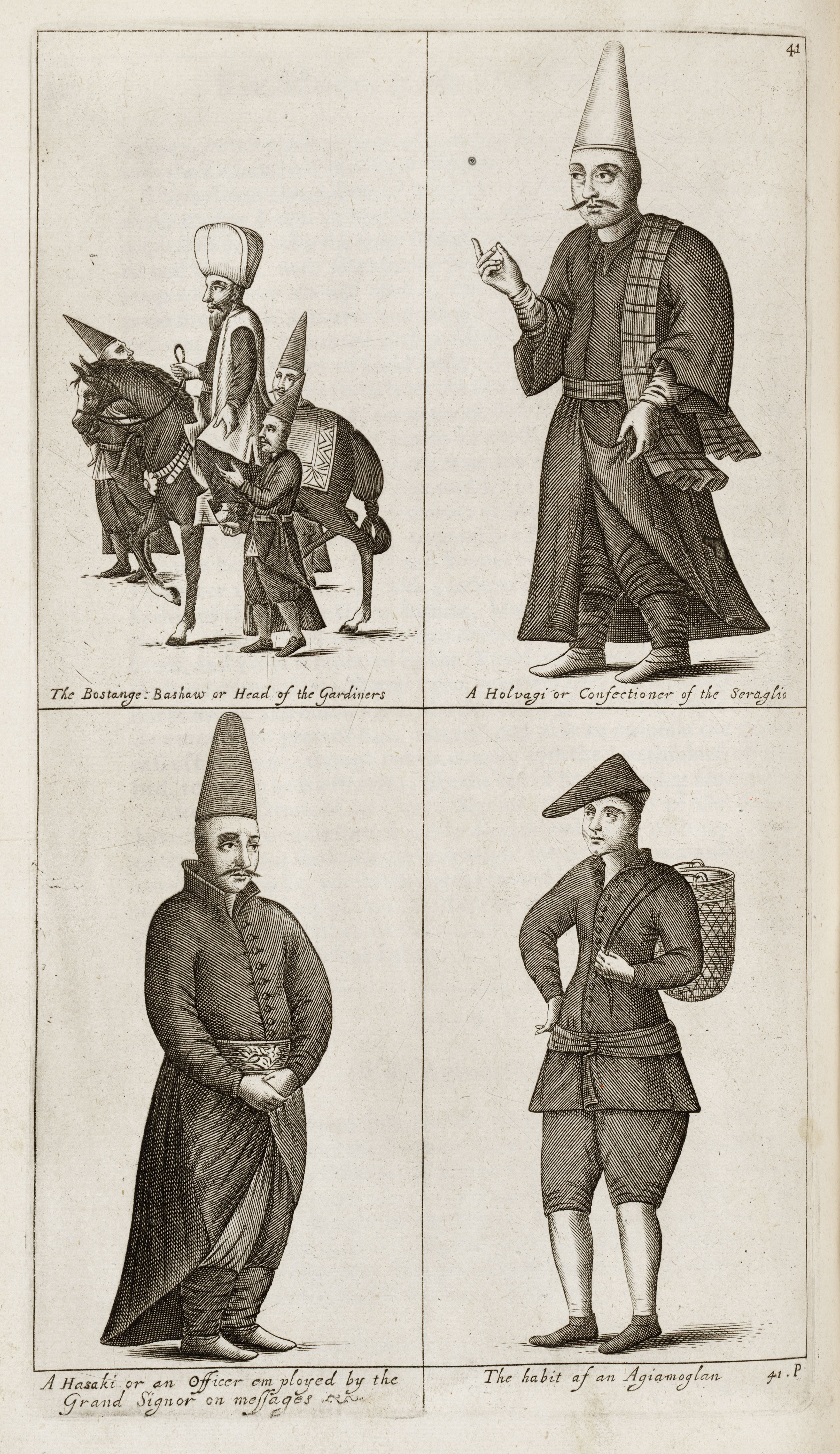
Rycaut, Paul. Plate Facing Page 41 in The present state of the Ottoman Empire. 1670. Folger Shakespeare Library. https://digitalcollections.folger.edu/img9275.
Prosopography
Jaimie Carr
Jaimie Carr was a student at the University of Fraser Valley.
Kate McPherson
Kate McPherson is Professor of English and Honors Program Director at Utah Valley
University (Orem, UT, USA). In 2015, she began working to redevelop Shakespeare’s Life and Times, created by Michael Best, into the Early Modern England Encyclopedia. Her other publications include commentary on Pericles and The Comedy of Errors for the New Oxford Shakespeare (2016); the co-edited volumes Stages of Engagement: Drama and Religion in Post-Reformation England with James Mardock (Duquesne University Press, 2014) and Shakespeare Expressed: Page, Stage, and Classroom in Shakespeare and His Contemporaries, with Kathryn M. Moncrief and Sarah Enloe (Fairleigh Dickinson University Press,
2013). With Kathryn M. Moncrief, Kate has also two edited collections, Performing Pedagogy in Early Modern England: Gender, Instruction, and Performance (Ashgate, 2011) and Performing Maternity in Early Modern England (Ashgate 2008). She has also published numerous articles on early modern maternity
in scholarly journals. Kate participated in the 2008 National Endowment for the Humanities
Institute,
Shakespeare’s Blackfriars: The Study, the Stage, the Classroom,at the American Shakespeare Center. She also served as Play Seminar Director, a public humanities position, for the Utah Shakespeare Festival in 2017 and 2018.
Leah Hamby
Leah Hamby is the primary encoder for the Early Modern England Encyclopedia. Aside from encoding, she also works as an editor for the project and contributed
several articles of her own. She has been working on the EMEE since February 2023. As of February 2026, she is soon to graduate with honours from
Utah Valley University with a major in history and a minor in creative writing. Her
other work with the LEMDO program includes remediating William Kemp’s Kemp’s Nine Day’s Wonder for the Digital Renaissance Editions.
Melissa Walter
Melissa Walter is Associate Professor of English at the University of the Fraser Valley.
Her research focuses on early modern English drama and English and European prose
fiction. She is the author of The Italian Novella and Shakespeare’s Comic Heroines (U of Toronto, 2019), and co-editor, with Dennis Britton, of Rethinking Shakespeare Source Study: Authors, Audiences, Digital Technologies (Routledge, 2018). Her work on English theatre and the European novella has appeared
in several edited collections, including Transnational Exchange in Early Modern Theater (Ashgate, 2008), and Transnational Mobility in Early Modern Theater (Ashgate, 2012). She has also written about
Translation and Identity in the Dialogues in English and Malaiane Languages(Indographies, ed. Jonathan Gil Harris. Palgrave 2012). At the University of the Fraser Valley, she is a lead coordinator of UFV’s Shakespeare and Reconciliation Garden.
Michael Best
Michael Best is Professor Emeritus at the University of Victoria, BC. He founded the
Internet Shakespeare Editions in 1996, and was Coordinating Editor until 2017, contributing two editions to the
ISE: King John and King Lear (the latter also available in print from Broadview Press). In print, he has published editions of works of Elizabethan magic and huswifery,
a collection of letters from the Australian goldfields, and Shakespeare on the Art of Love (2008). He contributed regular columns for the Shakespeare Newsletter on
Electronic Shakespeares,and has written many articles and chapters for both print and online books and journals, principally on questions raised by the new medium in the editing and publication of texts. He has delivered papers and plenary lectures on electronic media and the Internet Shakespeare Editions at conferences in Canada, the USA, the UK, Spain, Australia, and Japan.
Navarra Houldin
Training and Documentation Lead 2025–present. LEMDO project manager 2022–2025. Textual
remediator 2021–present. Navarra Houldin (they/them) completed their BA with a major
in history and minor in Spanish at the University of Victoria in 2022. Their primary
research was on gender and sexuality in early modern Europe and Latin America. They
are continuing their education through an MA program in Gender and Social Justice
Studies at the University of Alberta where they will specialize in Digital Humanities.
Orgography
LEMDO Team (LEMD1)
The LEMDO Team is based at the University of Victoria and normally comprises the project
director, the lead developer, project manager, junior developers(s), remediators,
encoders, and remediating editors.
University of Victoria (UVIC1)
https://www.uvic.ca/Metadata
| Authority title | Early Modern English Perceptions of Islam |
| Type of text | Critical |
| Publisher | University of Victoria on the Linked Early Modern Drama Online Platform |
| Series | Early Modern England Encyclopedia |
| Source |
By Jaimie Carr, inspired by Michael Best’s Shakespeare’s Life and Times, Internet Shakespeare Editions
|
| Editorial declaration | This document uses Canadian English spelling |
| Edition | Released with Early Modern England Encyclopedia 1.0 |
| Sponsor(s) |
Early Modern England EncyclopediaAnthology Leads: Kate McPherson and Kate Moncrief.
|
| Encoding description | Encoded in TEI P5 according to the LEMDO Customization and Encoding Guidelines |
| Document status | published, peer-reviewed |
| Funder(s) |
Social Sciences and Humanities Research Council of Canada
Mitacs Globalink Research Internship Utah Valley University |
| License/availability |
Intellectual copyright in this entry is held by Kate McPherson on behalf of the contributors. Copyright on the TEI-XML markup is held by the University of Victoria on behalf of the LEMDO Team. The content and TEI-XML markup in this file are licensed under a CC BY-NC_ND 4.0 license. This file is freely downloadable without permission under the following conditions:
(1) credit must be given to the authors, EMEE, and LEMDO in any subsequent use of
the files and /or data; (2) this availability statement must remain in the file; (3)
the content cannot be adapted or repurposed (except for quotations for the purposes
of academic review and citation); and (4) commercial uses are not permitted without
the knowledge and consent of the authors, EMEE, and LEMDO. Neither the content nor
the code in this file is licensed for training large language models (LLMs), ingestion
into an LLM, or any use in any artificial intelligence applications; such uses are
considered to be commercial uses and are strictly prohibited.
|