
Elite Elizabethan Fashion
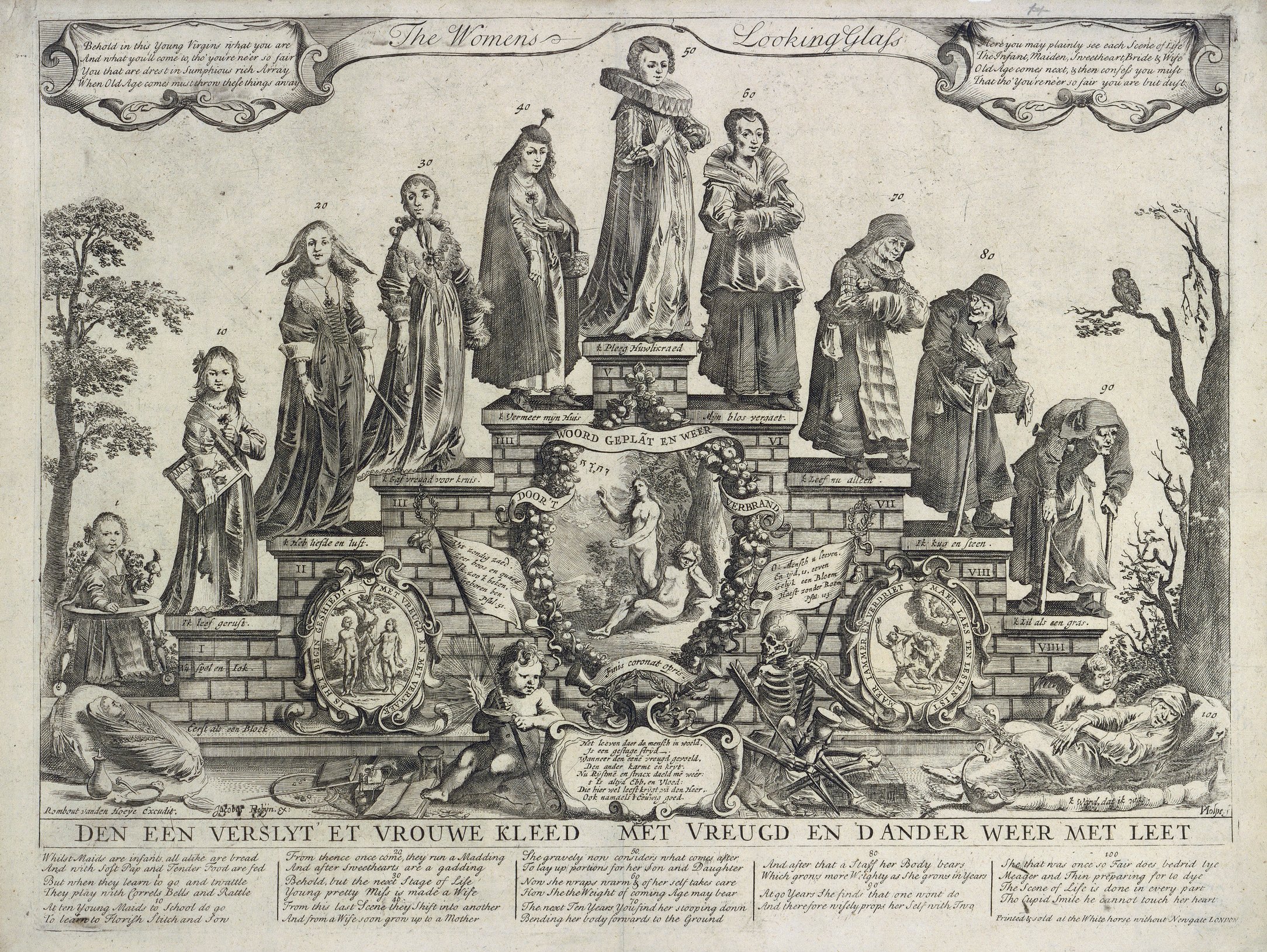
Overview
Para1In the early modern period, as now, fashion offered people a visible way to communicate
their status, wealth, and ideology, as well as stay modestly covered and comfortable.
In England’s highly stratified society, a person’s clothing indicated many aspects
of their identity. Sumptuary laws regulated what colors, fabrics, decoration, and
even weapons a person was legally allowed to wear based on their rank. Only nobles
were allowed to wear fabrics like silk and velvet.
Para2Officials in the Church of England supported sumptuary laws. Starting in 1563, a sermon
entitled
Against Excess of Apparelwas regularly preached around England, a rite that continued through the reign of King James I.
Para3Common people were prohibited from wearing specific types of rich fabrics and particular
colors. However, starting in the 1580s and again in 1604, the strictest of the sumptuary
laws were loosened to allow for the increasing numbers wealthy commoners such as merchants
to wear richly made or decorated clothing.
Para4It is worth noting that actors wearing costumes in the theater were exempt from these
laws, much to the irritation of some Puritans. Actors often impersonated rulers and
nobles, so many theatrical costumes featured indicators of high status, which religious
conservatives objected to as inherently untruthful and deceitful.
Fabrics and Colors
Para5English sumptuary laws controlled who was allowed to wear what colors and fabrics
based on social class. For example, purple was only for the royal family. Crimson,
which was made with rare ingredients, indicated immense wealth and was reserved for
royalty and high-ranking officials in the church. Indigo was similarly limited to
the highest members of the nobility and royalty. Regular red fabrics, which were dyed
with common madder root (producing a less brilliant color), was worn by people of
all classes, but especially by soldiers. Anyone from any station could wear the following
colors: black (but fine, darkly dyed black cloth was very expensive), pink, orange,
brown, gray, green, and yellow. Blue was worn by both upper and lower classes, but
it was mostly used by servants.
Para6Expensive fabrics like velvet (from Italy), cotton and silks (from the Middle East),
fine furs like sable, and lace were widely available, both domestically produced and
imported from elsewhere in Europe. These fabrics were limited to the nobility and
gentry. The lower classes most commonly wore clothing made from domestically produced
materials such as wool, linen, leather, and sheepskin.
Lord’s Clothing
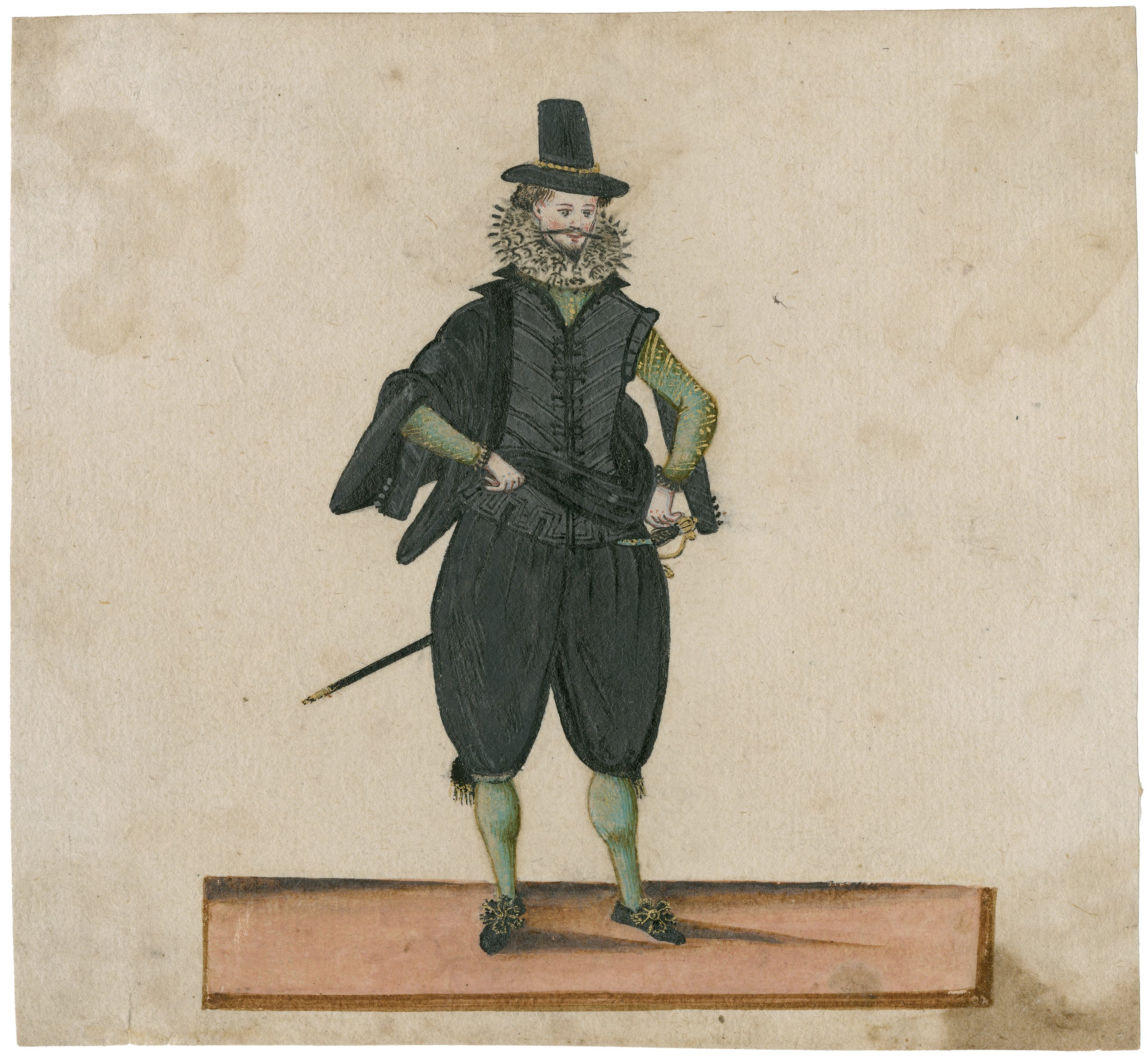
Para7Gentlemen wore many layers of clothing, although not as many as gentlewomen. The gentlemen
likely wore
gown (a long fabric robe, often trimmed with fur) or a doublet (a tight jacket of
fabric or leather that buttoned up the front)
separate detachable sleeves (tied to the doublet)
cuffs (sometimes plain, sometimes made of lace or embroidered linen)
breeches (knee-lengthh trousers)
a belt
a ruff (an elaborate piece of neckwear made of starched and pleated linen or lace)
a cloak
shoes
a hat
Para8For undergarments, men wore linen or lightweight woolen shirts, often quite long to
tuck into outer clothing instead of underpants. Linen shirts were changed and washed
frequently. Men also wore stockings or hose (one for each leg) of wool and occasionally
silk. Some fashionable men chose to wear a codpiece (a prominent, often decorative,
pouch to hold and highlight male genitalia).
Para9Like women, men kept their heads covered a great deal. Gentlemen wore various types
of headgear, which might include
a coif or biggin (a fitted fabric cap often worn by older men, sometimes under a hat)
tall-crowned hats with brims (almost like top hats today) of velvet or silk, usually
decorated with feathers, jewels, brooches, or ribbons
low-crowned hats with brims, decorated similarly to the tall-crowned ones
Women’s Clothing
Para10Women’s clothing was complex and fit tightly to her figure. Elite women wore a dress
with many separate parts placed over elaborate underclothing, while women of lower
rank wore outfits that featured fewer complex pieces.
Para11Elite women’s underclothes had as many as ten different items:
smocks, shifts, or chemise (an underdress of linen or wool, usually changed daily)
corset or inner bodice (to accentuate, narrow, or flatten aspects of a woman’s body)
a roll (around the waist to accentuate the hips)
stockings or hose (knee length socks)
farthingale (hoop skirt)
Para12For exterior layers, high-ranking ladies also wore
stomacher (a stiffened triangle design along front of the skirt, below the bodice)
a petticoat (an underskirt)
a kirtle (a kind of overskirt)
forepart (like an apron)
bodice or corset (a stiff, vest-like garment covering the torso and shoulders)
sleeves, inner and outer (tied onto the bodice)
a partlet (often of sheer linen, covering the neckline area to keep the outfit modest)
skirt or gown (often of heavily decorated fabric)
Sometimes a ruff
Para13Ladies also wore cloaks when outdoors, as well as shoes, and a hat or other head covering.
Women were expected to cover their heads most of the time and so wore various kinds
of hats or other headgear, which might include
a white linen coif (a fitted cap hiding most of the hair)
a French hood (a small hood with a curved border at the front and material falling
to the shoulder at the back)
the Mary Stuart hood (made of sheer cloth and edged with lace)
a caul, or hairnet (made of gold mesh, silk thread, or even human hair, worn alone or under
a hat)
Para14Like men, elite women wore elaborate hats, such as the taffeta pipkin, a brimmed hat
trimmed with ostrich feathers and jewels, and the court bonnet, a velvet pillbox adorned
with the same.
Sources
Huang, Helen Q., et al.. Elizabethan Costume Design and Construction. Focal Press, 2015.
Haywood, Maria. Rich Apparel: Clothing and the Law in Henry VIII’s England. Ashgate Publishing Co., 2009.
Open-Access Digital Resources
Alchin, Linda.
Elizabethan Clothing.Elizabethan Era, 7 Feb. 2017, https://www.elizabethan-era.org.uk/elizabethan-clothing.htm. Accessed 15 Nov. 2018.
Alchin, Linda.
Meaning of Colors in the Elizabethan Era.Elizabethan Era, 7 Feb. 2017, https://www.elizabethan-era.org.uk/meaning-colors.htm. Accessed 15 Nov. 2018.
Alchin, Linda.
Tudor Clothes for the Rich.The Tudors, 7 Feb. 2017, https://www.sixwives.info/tudor-clothes-for-the-rich.htm. Accessed 15 Nov. 2018.
Best, Michael.
Court Fashions.Shakespeare’s Life and Times. Internet Shakespeare Editions. University of Victoria, 4 Jan. 2011, https://internetshakespeare.uvic.ca/Library/SLT/society/court%20life/fashion.html. Accessed 13 Nov. 2018.
Best, Michael.
Elizabethan Fashions.Shakespeare’s Life and Times. Internet Shakespeare Editions. University of Victoria, 4 Jan. 2011, https://internetshakespeare.uvic.ca/Library/SLT/stage/costumes/fashion.html. Accessed 4 Jun. 2023.
Best, Michael.
Fashion and Colour.Shakespeare’s Life and Times. Internet Shakespeare Editions. University of Victoria, 4 Jan. 2011, https://internetshakespeare.uvic.ca/Library/SLT/stage/costumes/colour.html. Accessed 13 Nov. 2018.
Image Sources
A Gentleman Wearing a Black Doublet, Breeches, and Hat.From Royal, military and court costumes of the time of James I. c. 1615. Folger Shakespeare Library.
Nolpe, Pieter. Woman in Twelve Different Stages of Life. N.d. Engraving. Folger Digital Collections. ART Box A265 no. 2. https://digitalcollections.folger.edu/img3150.
Prosopography
Kaitlin Zaugg
Kaitlin Zaugg was a student at Utah Valley University.
Kate McPherson
Kate McPherson is Professor of English and Honors Program Director at Utah Valley
University (Orem, UT, USA). In 2015, she began working to redevelop Shakespeare’s Life and Times, created by Michael Best, into the Early Modern England Encyclopedia. Her other publications include commentary on Pericles and The Comedy of Errors for the New Oxford Shakespeare (2016); the co-edited volumes Stages of Engagement: Drama and Religion in Post-Reformation England with James Mardock (Duquesne University Press, 2014) and Shakespeare Expressed: Page, Stage, and Classroom in Shakespeare and His Contemporaries, with Kathryn M. Moncrief and Sarah Enloe (Fairleigh Dickinson University Press,
2013). With Kathryn M. Moncrief, Kate has also two edited collections, Performing Pedagogy in Early Modern England: Gender, Instruction, and Performance (Ashgate, 2011) and Performing Maternity in Early Modern England (Ashgate 2008). She has also published numerous articles on early modern maternity
in scholarly journals. Kate participated in the 2008 National Endowment for the Humanities
Institute,
Shakespeare’s Blackfriars: The Study, the Stage, the Classroom,at the American Shakespeare Center. She also served as Play Seminar Director, a public humanities position, for the Utah Shakespeare Festival in 2017 and 2018.
Leah Hamby
Leah Hamby is the primary encoder for the Early Modern England Encyclopedia. Aside from encoding, she also works as an editor for the project and contributed
several articles of her own. She has been working on the EMEE since February 2023. As of February 2026, she is soon to graduate with honours from
Utah Valley University with a major in history and a minor in creative writing. Her
other work with the LEMDO program includes remediating William Kemp’s Kemp’s Nine Day’s Wonder for the Digital Renaissance Editions.
Michael Best
Michael Best is Professor Emeritus at the University of Victoria, BC. He founded the
Internet Shakespeare Editions in 1996, and was Coordinating Editor until 2017, contributing two editions to the
ISE: King John and King Lear (the latter also available in print from Broadview Press). In print, he has published editions of works of Elizabethan magic and huswifery,
a collection of letters from the Australian goldfields, and Shakespeare on the Art of Love (2008). He contributed regular columns for the Shakespeare Newsletter on
Electronic Shakespeares,and has written many articles and chapters for both print and online books and journals, principally on questions raised by the new medium in the editing and publication of texts. He has delivered papers and plenary lectures on electronic media and the Internet Shakespeare Editions at conferences in Canada, the USA, the UK, Spain, Australia, and Japan.
Navarra Houldin
Training and Documentation Lead 2025–present. LEMDO project manager 2022–2025. Textual
remediator 2021–present. Navarra Houldin (they/them) completed their BA with a major
in history and minor in Spanish at the University of Victoria in 2022. Their primary
research was on gender and sexuality in early modern Europe and Latin America. They
are continuing their education through an MA program in Gender and Social Justice
Studies at the University of Alberta where they will specialize in Digital Humanities.
Orgography
LEMDO Team (LEMD1)
The LEMDO Team is based at the University of Victoria and normally comprises the project
director, the lead developer, project manager, junior developers(s), remediators,
encoders, and remediating editors.
University of Victoria (UVIC1)
https://www.uvic.ca/Metadata
| Authority title | Elite Elizabethan Fashion |
| Type of text | Critical |
| Publisher | University of Victoria on the Linked Early Modern Drama Online Platform |
| Series | Early Modern England Encyclopedia |
| Source |
By Kaitlin Zaugg and Kate McPherson, inspired by Michael Best’s Shakespeare’s Life and Times, Internet Shakespeare Editions
|
| Editorial declaration | This document uses Canadian English spelling |
| Edition | Released with Early Modern England Encyclopedia 1.0 |
| Sponsor(s) |
Early Modern England EncyclopediaAnthology Leads: Kate McPherson and Kate Moncrief.
|
| Encoding description | Encoded in TEI P5 according to the LEMDO Customization and Encoding Guidelines |
| Document status | published |
| Funder(s) |
Social Sciences and Humanities Research Council of Canada
Mitacs Globalink Research Internship Utah Valley University |
| License/availability |
Unless otherwise noted, intellectual copyright in EMEE Anthology pages is held by
Kate McPherson on behalf of the contributors. Copyright on the TEI-XML markup is held by the University of Victoria on behalf of the LEMDO Team. The content and TEI-XML markup in this file are licensed under a CC BY-NC-ND 4.0 license. This file is freely downloadable without permission under the following conditions:
(1) credit must be given to the authors, EMEE, and LEMDO in any subsequent use of
the files and /or data; (2) this availability statement must remain in the file; (3)
the content cannot be adapted or repurposed (except for quotations for the purposes
of academic review and citation); and (4) commercial uses are not permitted without
the knowledge and consent of the authors, EMEE, and LEMDO. Neither the content nor
the code in this file is licensed for training large language models (LLMs), ingestion
into an LLM, or any use in any artificial intelligence applications; such uses are
considered to be commercial uses and are strictly prohibited.
|