
Elizabeth I
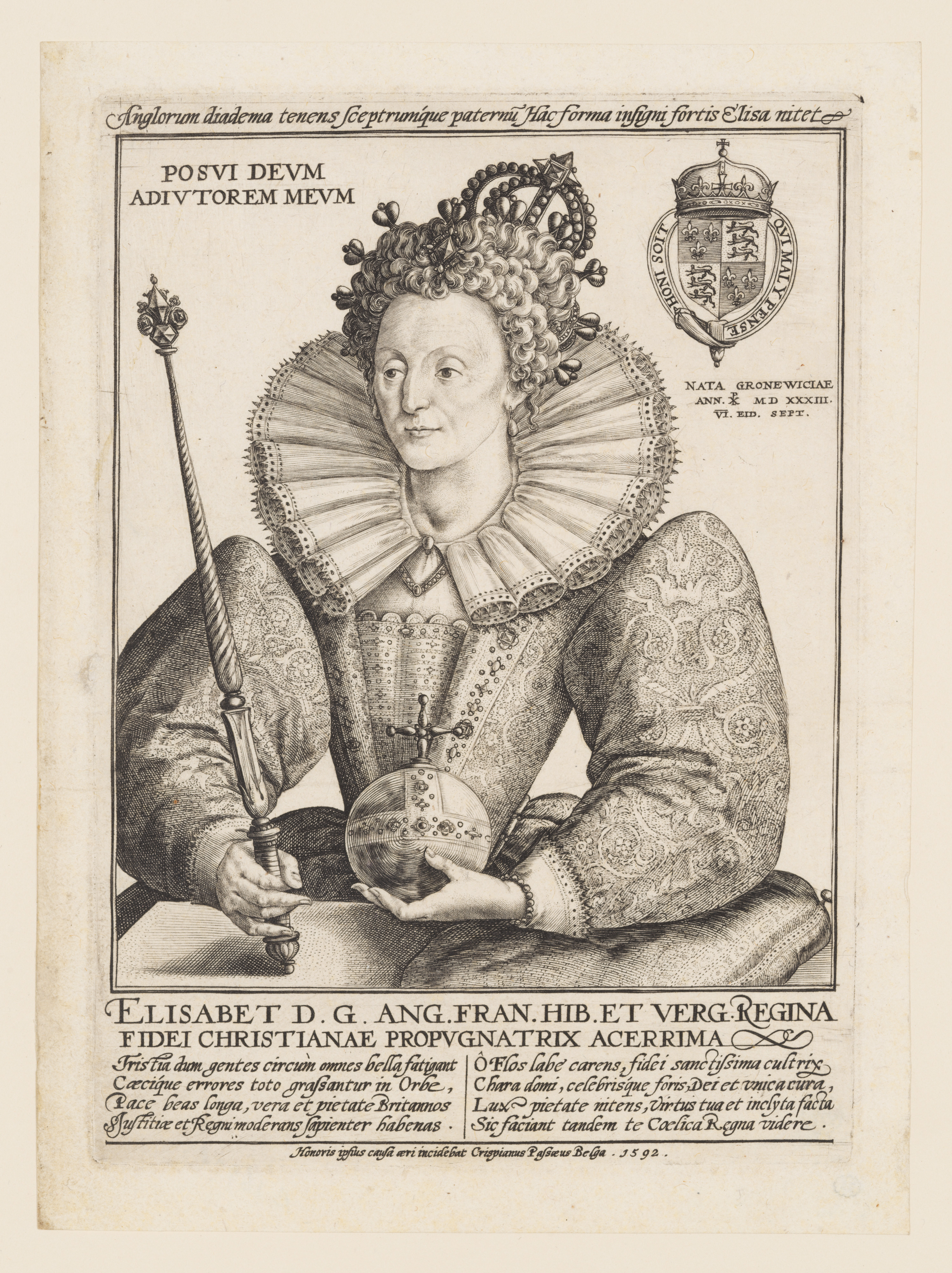
The Virgin Queen
Para1Elizabeth I, called the Virgin Queen, Gloriana, or Good Queen Bess, ruled as Queen
of England and Ireland from November of 1558 until her death in March of 1603. She
followed her two half-siblings Edward VI and Mary I to the throne and was the last
ruler in the Tudor line. The time during her rule has become known as the Elizabethan
era and is considered the golden age of the English Renaissance, during which art,
poetry, and theater flourished. The Elizabethan era was marked by Queen Elizabeth
firmly but diplomatically returning England to the Protestant Reformation and concretely
establishing the Church of England.
Femininity and Rule
Para2Ascending to the throne at age 25, Elizabeth was unmarried and was immediately pressured
by advisors to marry. Just one year before her half-sister Mary’s death, Calvinist
preacher John Knox wrote in his The First Blast of the Trumpet Against the Monstrous Regiment of Women that
God hath revealed to some in this our age that it is more than a monster in nature that a woman should reign and bear empire above man.While this particular assertion was likely in direct response to the violence experienced by England under Mary’s rule, similar patriarchal sentiments about Elizabeth were widely held, as it was believed a woman needed a man to curb her unruly nature. Critics of the time considered Elizabeth’s rule improper or even incomplete until she was married.
Para3But Elizabeth never married, remaining presumably celibate and childless. Though some
believed this departure from the normal path for women was to her detriment, she used
it her advantage. Elizabeth may not have had a bloodline successor, but remaining
unmarried ensured that she held maximum power over the affairs and crown of England,
rather than her falling subject to the rule of a husband. Elizabeth also manipulated
foreign and domestic suitors into thinking they had a hold on her heart, and therefore,
the crown. Elizabeth’s romantic posturing convinced even close advisers and friends,
also effectively manipulating her councilors into never forcing her into marriage.
Para4Some historians speculate that an early negative relationship may have soured Elizabeth
on marriage. Thomas Seymour was the last husband of Elizabeth’s stepmother, Catherine
Parr, King Henry VIII’s widow. Elizabeth spent formative years of her adolescence
living with Parr and Seymour, where Seymour showed questionable and potentially abusive
interest in Elizabeth. Following Parr’s death, history suggests Seymour intended to
marry Elizabeth, possibly as a political grab foreseeing her ascension to the English
throne.
Chastity
Para5Celibacy was expected of women until they were married, and even with the reformed
ideas of the Protestant faith, chastity and virginity were considered a woman’s greatest
assets. Chastity had a broader definition than we know it today and extended to behaviors
and thoughts in and out of marriage. A married woman who was faithful to her husband
was considered chaste; a young maid who was a virgin, yet shrewish and disobedient
to her father, was not.
Para6For Elizabeth, her chastity extended beyond that of even the typical definition of
the time. Her celibacy birthed her nickname the Virgin Queen, and this title led to
an almost cult-like praise of Elizabeth’s chastity. Inscribed on copper plate from
1641 reads the following,
She was, she is, what can there more can be said, / In Earth the first, in Heaven the second maid.Allusions such as this by artists and other figures comparing Elizabeth to the Virgin Mary were common, linking her divine mandate as queen to a higher kind of divinity.
Sources
Knox, John. The First Blast of the Trumpet: Against the Monstrous Regiment of Women. Vol. 2, The English Scholar’s Library of Old and Modern Works, 1878.
Kizelbach, Urszula.
Iconicizing Kingship in Elizabethan England: Strategic Acting by Queen Elizabeth I.Studia Anglica Posnaniensia: International Review of English Studies, no. 2–3, 2012, p. 147-160.
Stump, David, and Susan M. Felch. Elizabeth I and Her Age: Authoritative Texts Commentary and Criticism. W. W. Norton and Company, 2009.
Open-Access Digital Resources
Berry, Ciara.
Elizabeth I (R.1558–1603).The Royal Family, 3 Aug. 2018, https://www.royal.uk/elizabeth-i. Accessed 4 Jun. 2023.
Best, Michael.
The Virgin Queen.Shakespeare’s Life and Times. Internet Shakespeare Editions. University of Victoria, 4 Jan, 2011, https://internetshakespeare.uvic.ca/Library/SLT/history/elizabeth/virgin.html. Accessed 18 Oct. 2018.
Morrill, John S., and Stephen J. Greenblatt.
Elizabeth I.Encyclopædia Britannica, 2 Nov. 2018, https://www.britannica.com/biography/Elizabeth-I. Accessed 19 Oct. 2018.
Whitelock, Anna.
Elizabeth I’s Love Life: Was She Really a “Virgin Queen”?History Extra, Immediate Media Company, 14 Apr. 2015, https://www.historyextra.com/period/elizabethan/elizabeth-i-love-life-was-she-virgin-queen-robert-dudley-earl-essex/. Accessed 18 Oct. 2018.
Image Sources
Passe the Elder, Crispijn de. Queen Elizabeth I. 1592. Engraving. The Metropolitan Museum of Art. Object number: 28.97.101. https://www.metmuseum.org/art/collection/search/364401.
Prosopography
Kate McPherson
Kate McPherson is Professor of English and Honors Program Director at Utah Valley
University (Orem, UT, USA). In 2015, she began working to redevelop Shakespeare’s Life and Times, created by Michael Best, into the Early Modern England Encyclopedia. Her other publications include commentary on Pericles and The Comedy of Errors for the New Oxford Shakespeare (2016); the co-edited volumes Stages of Engagement: Drama and Religion in Post-Reformation England with James Mardock (Duquesne University Press, 2014) and Shakespeare Expressed: Page, Stage, and Classroom in Shakespeare and His Contemporaries, with Kathryn M. Moncrief and Sarah Enloe (Fairleigh Dickinson University Press,
2013). With Kathryn M. Moncrief, Kate has also two edited collections, Performing Pedagogy in Early Modern England: Gender, Instruction, and Performance (Ashgate, 2011) and Performing Maternity in Early Modern England (Ashgate 2008). She has also published numerous articles on early modern maternity
in scholarly journals. Kate participated in the 2008 National Endowment for the Humanities
Institute,
Shakespeare’s Blackfriars: The Study, the Stage, the Classroom,at the American Shakespeare Center. She also served as Play Seminar Director, a public humanities position, for the Utah Shakespeare Festival in 2017 and 2018.
Lauren Johnson
Lauren Johnson was an Honors student at Utah Valley University.
Leah Hamby
Leah Hamby is the primary encoder for the Early Modern England Encyclopedia. Aside from encoding, she also works as an editor for the project and contributed
several articles of her own. She has been working on the EMEE since February 2023. As of February 2026, she is soon to graduate with honours from
Utah Valley University with a major in history and a minor in creative writing. Her
other work with the LEMDO program includes remediating William Kemp’s Kemp’s Nine Day’s Wonder for the Digital Renaissance Editions.
Michael Best
Michael Best is Professor Emeritus at the University of Victoria, BC. He founded the
Internet Shakespeare Editions in 1996, and was Coordinating Editor until 2017, contributing two editions to the
ISE: King John and King Lear (the latter also available in print from Broadview Press). In print, he has published editions of works of Elizabethan magic and huswifery,
a collection of letters from the Australian goldfields, and Shakespeare on the Art of Love (2008). He contributed regular columns for the Shakespeare Newsletter on
Electronic Shakespeares,and has written many articles and chapters for both print and online books and journals, principally on questions raised by the new medium in the editing and publication of texts. He has delivered papers and plenary lectures on electronic media and the Internet Shakespeare Editions at conferences in Canada, the USA, the UK, Spain, Australia, and Japan.
Navarra Houldin
Training and Documentation Lead 2025–present. LEMDO project manager 2022–2025. Textual
remediator 2021–present. Navarra Houldin (they/them) completed their BA with a major
in history and minor in Spanish at the University of Victoria in 2022. Their primary
research was on gender and sexuality in early modern Europe and Latin America. They
are continuing their education through an MA program in Gender and Social Justice
Studies at the University of Alberta where they will specialize in Digital Humanities.
Orgography
LEMDO Team (LEMD1)
The LEMDO Team is based at the University of Victoria and normally comprises the project
director, the lead developer, project manager, junior developers(s), remediators,
encoders, and remediating editors.
University of Victoria (UVIC1)
https://www.uvic.ca/Metadata
| Authority title | Elizabeth I |
| Type of text | Critical |
| Publisher | University of Victoria on the Linked Early Modern Drama Online Platform |
| Series | Early Modern England Encyclopedia |
| Source |
By Lauren Johnson, inspired by Michael Best’s Shakespeare’s Life and Times, Internet Shakespeare Editions
|
| Editorial declaration | This document uses Canadian English spelling |
| Edition | Released with Early Modern England Encyclopedia 1.0 |
| Sponsor(s) |
Early Modern England EncyclopediaAnthology Leads: Kate McPherson and Kate Moncrief.
|
| Encoding description | Encoded in TEI P5 according to the LEMDO Customization and Encoding Guidelines |
| Document status | published, peer-reviewed |
| Funder(s) |
Social Sciences and Humanities Research Council of Canada
Mitacs Globalink Research Internship Utah Valley University |
| License/availability |
Intellectual copyright in this entry is held by Kate McPherson on behalf of the contributors. Copyright on the TEI-XML markup is held by the University of Victoria on behalf of the LEMDO Team. The content and TEI-XML markup in this file are licensed under a CC BY-NC_ND 4.0 license. This file is freely downloadable without permission under the following conditions:
(1) credit must be given to the authors, EMEE, and LEMDO in any subsequent use of
the files and /or data; (2) this availability statement must remain in the file; (3)
the content cannot be adapted or repurposed (except for quotations for the purposes
of academic review and citation); and (4) commercial uses are not permitted without
the knowledge and consent of the authors, EMEE, and LEMDO. Neither the content nor
the code in this file is licensed for training large language models (LLMs), ingestion
into an LLM, or any use in any artificial intelligence applications; such uses are
considered to be commercial uses and are strictly prohibited.
|