
The Death of Elizabeth I
Para1On the 24th of March 1603, Queen Elizabeth I died after ruling England for 44 years.
After several months of decline and eventual refusal to eat or speak, she died at
Richmond Palace after a few days in a coma. She was 69 years old and, against the
odds, had managed to rule England as a single female monarch for many decades. Her
death affected the entire nation, the balance of power in Europe, but also the theater:
Shakespeare and his company changed patrons from the Lord Chamberlain to the new King,
and they changed the topics for new plays written after 1603.
The Funeral
Para2The Queen’s funeral occurred about five weeks later, commencing on April 28th. It
featured an enormous amount of pageantry, with more than 1,000 mourners walking behind
the carriage transporting her body, which was sealed in a coffin. Many more thousands
of citizens lined the streets.
Para3Chronicler John Stowe records that her mourners raised
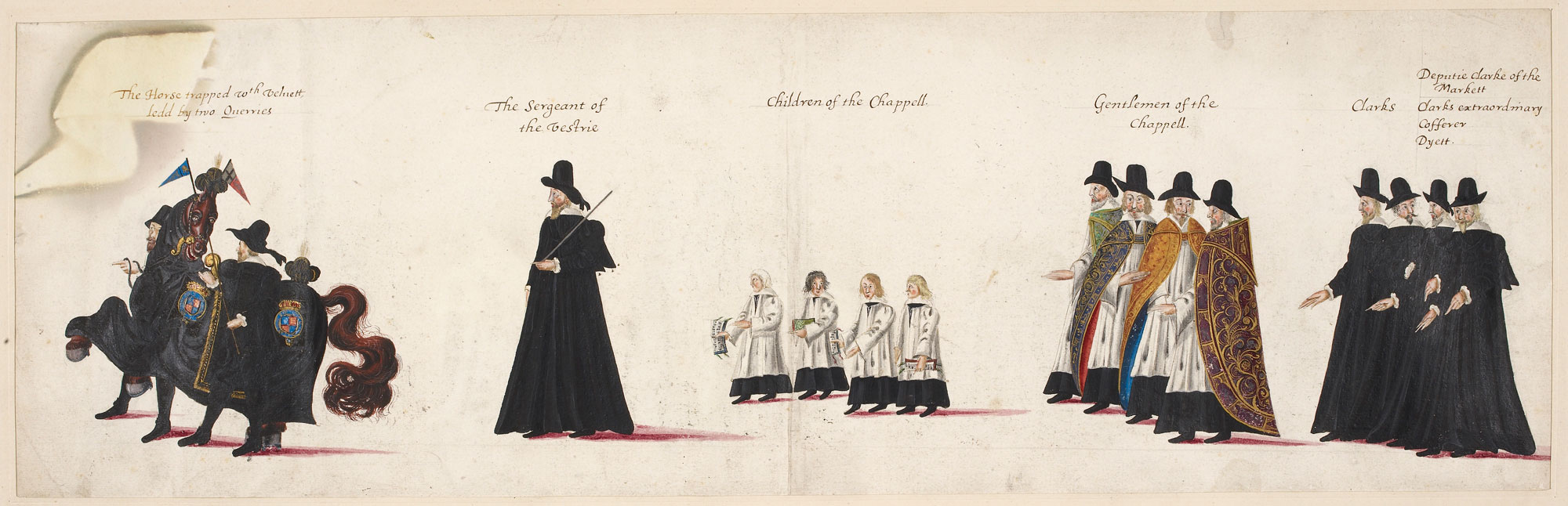
such a general sighing, groaning and weeping as the like hath not been seen or known in the memory of man.Extensive drawings were made of the occasion, the some of the first ever of an English royal funeral. The drawing below shows some of the members of the procession, including Children of the Chapel Royal, who were some of the boy players whom Hamlet complains about as the
aery of children(2.2.39) in Shakespeare’s play.
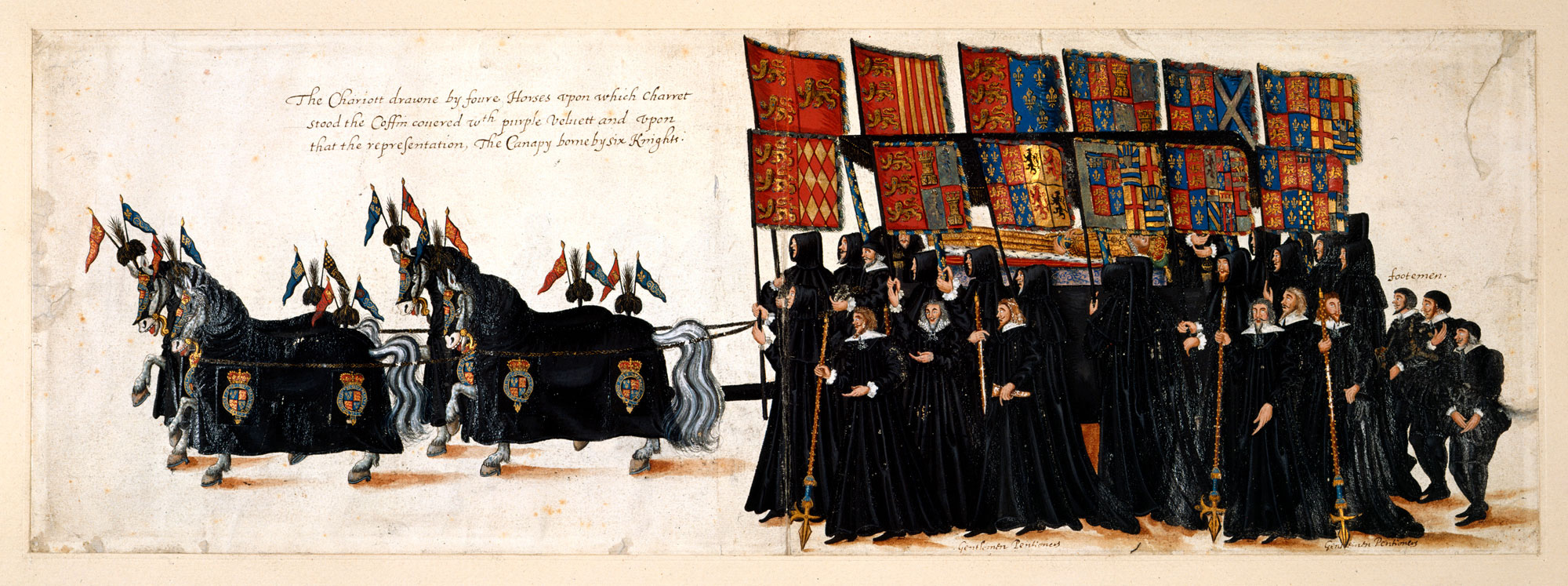
Para4The depiction of the procession offers valuable insight into Elizabethan funeral practices.
The mourners depicted include both noblemen and commoners, as well as the clothes
they wore, the arms carried by the men, and the trappings of the horses. It also shows
Elizabeth’s effigy (a waxen image of the monarch) atop a chariot drawn by four horses
and accompanied by barons with heraldic flags.
Para5Her wooden coffin was covered in purple velvet, carried on a chariot drawn by four
grey horses with black drapery. A carved effigy in colored wood was placed atop the
coffin, while her actual body was encased in lead inside.
Shakespeare and the Queen
Para6According to Ben Jonson, Shakespeare’s plays were admired by Elizabeth. He wrote in
a dedicatory poem in the First Folio (1623):
Scholars have no direct record of what Elizabeth I thought of Shakespeare’s plays, but the frequency of The Lord Chamberlain’s Men performing at court supports Jonson’s opinion. During the last ten years of Elizabeth’s reign, the Lord Chamberlain’s Men were clearly the company most favored by the court, performing at court 32 times, compared to 37 performances by all other companies combined.Sweet Swan of Avon! What a sight it wereTo see thee in our waters yet appearAnd make those flights upon the banks of ThamesThat so did take Eliza and our James.(On Shakespeare,lines 71–74)
Sources
Collinson, Patrick.
Elizabeth I (1533–1603).Oxford Dictionary of National Biography. Oxford UP,2012.
Doran, Susan. Queen Elizabeth I. New York UP, 2003.
Stump, David, and Susan M. Felch. Elizabeth I and Her Age: Authoritative Texts Commentary and Criticism. W. W. Norton and Company, 2009.
Woodward, Jennifer. The Theatre of Death: The Ritual Management of Royal Funerals in Renaissance England,
1570–1625. Boydell Press, 1997.
Open-Access Digital Resources
Berry, Ciara.
Elizabeth I (R.1558–1603).The Royal Family, 3 Aug. 2018, https://www.royal.uk/elizabeth-i. Accessed 4 Jun. 2023.
Best, Michael.
The Death of Elizabeth I.Shakespeare’s Life and Times.Internet Shakespeare Editions. University of Victoria, 4 Jan. 2011, https://internetshakespeare.uvic.ca/Library/SLT/life/maturity/elizabeth.html. Accessed 19 Feb. 2023.
Elizabeth I.Westminster Abbey, https://www.westminster-abbey.org/abbey-commemorations/royals/elizabeth-i. Accessed 19 Feb. 2023.
Image Sources
Funeral Procession of Queen Elizabeth. 1603. The British Library. Shelfmark Add. 35324. https://www.imagesonline.bl.uk/asset/11780/.
A Horse Trapped with Velvet, led by Two Attendants; the Sergeant of the Vestry and
Children of the Chapel Royal. n.d. MS. The British Library.
Prosopography
Kate McPherson
Kate McPherson is Professor of English and Honors Program Director at Utah Valley
University (Orem, UT, USA). In 2015, she began working to redevelop Shakespeare’s Life and Times, created by Michael Best, into the Early Modern England Encyclopedia. Her other publications include commentary on Pericles and The Comedy of Errors for the New Oxford Shakespeare (2016); the co-edited volumes Stages of Engagement: Drama and Religion in Post-Reformation England with James Mardock (Duquesne University Press, 2014) and Shakespeare Expressed: Page, Stage, and Classroom in Shakespeare and His Contemporaries, with Kathryn M. Moncrief and Sarah Enloe (Fairleigh Dickinson University Press,
2013). With Kathryn M. Moncrief, Kate has also two edited collections, Performing Pedagogy in Early Modern England: Gender, Instruction, and Performance (Ashgate, 2011) and Performing Maternity in Early Modern England (Ashgate 2008). She has also published numerous articles on early modern maternity
in scholarly journals. Kate participated in the 2008 National Endowment for the Humanities
Institute,
Shakespeare’s Blackfriars: The Study, the Stage, the Classroom,at the American Shakespeare Center. She also served as Play Seminar Director, a public humanities position, for the Utah Shakespeare Festival in 2017 and 2018.
Leah Hamby
Leah Hamby is the primary encoder for the Early Modern England Encyclopedia. Aside from encoding, she also works as an editor for the project and contributed
several articles of her own. She has been working on the EMEE since February 2023. As of February 2026, she is soon to graduate with honours from
Utah Valley University with a major in history and a minor in creative writing. Her
other work with the LEMDO program includes remediating William Kemp’s Kemp’s Nine Day’s Wonder for the Digital Renaissance Editions.
Michael Best
Michael Best is Professor Emeritus at the University of Victoria, BC. He founded the
Internet Shakespeare Editions in 1996, and was Coordinating Editor until 2017, contributing two editions to the
ISE: King John and King Lear (the latter also available in print from Broadview Press). In print, he has published editions of works of Elizabethan magic and huswifery,
a collection of letters from the Australian goldfields, and Shakespeare on the Art of Love (2008). He contributed regular columns for the Shakespeare Newsletter on
Electronic Shakespeares,and has written many articles and chapters for both print and online books and journals, principally on questions raised by the new medium in the editing and publication of texts. He has delivered papers and plenary lectures on electronic media and the Internet Shakespeare Editions at conferences in Canada, the USA, the UK, Spain, Australia, and Japan.
Navarra Houldin
Training and Documentation Lead 2025–present. LEMDO project manager 2022–2025. Textual
remediator 2021–present. Navarra Houldin (they/them) completed their BA with a major
in history and minor in Spanish at the University of Victoria in 2022. Their primary
research was on gender and sexuality in early modern Europe and Latin America. They
are continuing their education through an MA program in Gender and Social Justice
Studies at the University of Alberta where they will specialize in Digital Humanities.
Orgography
LEMDO Team (LEMD1)
The LEMDO Team is based at the University of Victoria and normally comprises the project
director, the lead developer, project manager, junior developers(s), remediators,
encoders, and remediating editors.
University of Victoria (UVIC1)
https://www.uvic.ca/Metadata
| Authority title | The Death of Elizabeth I |
| Type of text | Critical |
| Publisher | University of Victoria on the Linked Early Modern Drama Online Platform |
| Series | Early Modern England Encyclopedia |
| Source |
By Kate McPherson, inspired by Michael Best’s Shakespeare’s Life and Times, Internet Shakespeare Editions
|
| Editorial declaration | This document uses Canadian English spelling |
| Edition | Released with Early Modern England Encyclopedia 1.0 |
| Sponsor(s) |
Early Modern England EncyclopediaAnthology Leads: Kate McPherson and Kate Moncrief.
|
| Encoding description | Encoded in TEI P5 according to the LEMDO Customization and Encoding Guidelines |
| Document status | published |
| Funder(s) |
Social Sciences and Humanities Research Council of Canada
Mitacs Globalink Research Internship Utah Valley University |
| License/availability |
Unless otherwise noted, intellectual copyright in EMEE Anthology pages is held by
Kate McPherson on behalf of the contributors. Copyright on the TEI-XML markup is held by the University of Victoria on behalf of the LEMDO Team. The content and TEI-XML markup in this file are licensed under a CC BY-NC-ND 4.0 license. This file is freely downloadable without permission under the following conditions:
(1) credit must be given to the authors, EMEE, and LEMDO in any subsequent use of
the files and /or data; (2) this availability statement must remain in the file; (3)
the content cannot be adapted or repurposed (except for quotations for the purposes
of academic review and citation); and (4) commercial uses are not permitted without
the knowledge and consent of the authors, EMEE, and LEMDO. Neither the content nor
the code in this file is licensed for training large language models (LLMs), ingestion
into an LLM, or any use in any artificial intelligence applications; such uses are
considered to be commercial uses and are strictly prohibited.
|