
Elizabeth Becomes Queen
Overview
Para1Queen Elizabeth Tudor ascended the throne of England on November 17th, 1558 at age
25 after the death of her half-sister, Mary Tudor. Elizabeth’s reign brought both
hope and uncertainty to a country full of political and religious turmoil. Her Protestant
values brought optimism to many for the return of the Protestant religion introduced
by Elizabeth’s father, King Henry VIII, along with weariness from devout Catholics
about the new religion of the country. Uncertainty also surrounded Elizabeth’s unmarried
status, which would continue for the rest of her life. Marriage would have formed
alliances and produced an heir to the throne, but it would also have meant the loss
of some of her authority as monarch. Elizabeth’s ascension to the throne is now viewed
as the birth of a new era for England.
Procession and Pageants
Para2The coronation was preceded by Elizabeth’s procession through the streets between
the Tower of London and Westminster Abbey with stops for five elaborate pageants sponsored
by the City of London along the way. The pageants featured many allegorical characters
such as Wisdom, Justice, Pure Religion, and Love of Subjects or vices such as Insolence,
Ignorance, and Superstition. In one pageant, eight children enacted the eight blessings
of God. At one point, it was reported that Elizabeth spoke directly to the people:
Her Grace, by holding up her hands and merry countenance to such as stood far off, and most tender and gentle language to those that stood nigh to her Grace, did declare herself no less thankfully to receive her people’s good will, than they lovingly opened it unto her.
Para3The procession was a tradition to ensure that the citizens of England, specifically
those in the city of London, were familiar with and respected their new monarch. It
also offered a chance for the City of London officials and the members of the powerful
trade guilds and livery companies to communicate to the new queen the values they
wanted her to emulate.
Para4At one point, the City presented the Queen with a thousand gold marks in a crimson
satin purse. She spoke in thanks,
I thank my Lord Mayor, his brethren and you all. And whereas your request is that I should continue your good Lady and Queen, be ye ensured that I will be as good unto you as ever queen was unto her people. No will in me can lack, neither, do I trust, shall there lack any power. And persuade yourselves that for the safety and quietness of you all, I will not spare, if need be to spend my blood. God thank you all.
Coronation
Para5Elizabeth I’s coronation took place on January 15th, 1559 almost two months after
her ascension to the throne. The astronomer and mathematician John Dee chose the date
of the coronation. The coronation was presented in the traditional Latin, and the
crowning and anointing was performed by Owen Oglethorpe, a Catholic bishop. Although
the coronation was performed by a Catholic bishop, documentation exists that Queen
Elizabeth was not present for the Catholic mass served at the coronation.
Religion
Para6Elizabeth’s ascension to the throne also meant the nation would refocus on the Protestant
religion introduced by King Henry VIII in 1536 and practiced by most of the commoners
in London. Although Elizabeth claimed the religion of her father rather than Catholicism,
her actions at the beginning of her reign were viewed as more moderate in approach.
She kept Catholic symbols such as the cross and minimized the importance of sermons,
something very important to the Protestant religion. This moderation helped ease the
transition of the new queen and set up her reign as a beloved monarch of the people.
Sources
Levin, Carole.
The Queen Elizabeth I Society: The First Ten Years.Explorations in Renaissance Culture, no. 1, 2011, p. 5-17.
Knight, Sarah, et al.. The Progresses, Pageants, and Entertainments of Queen Elizabeth I. Oxford UP, 2007.
Starkey, David. Elizabeth: The Struggle for the Throne. Harper, 2001.
Stump, Donald and Susan M. Felch. Elizabeth I and Her Age: A Norton Critical Edition. W.W. Norton, 2009.
Open-Access Digital Resources
Best, Michael.
Elizabeth’s Accession to the Throne.Shakespeare’s Life and Times. Internet Shakespeare Editions. University of Victoria, 4 Jan. 2011, 2023. https://internetshakespeare.uvic.ca/Library/SLT/history/elizabeth/accession.html. Accessed 18 Nov. 2018.
Farris, Charles.
Elizabeth I’s Coronation Procession from the Tower of London.Historic Royal Palaces, https://www.hrp.org.uk/blog/elizabeth-i-s-coronation-procession-from-the-tower-of-london/. Accessed 27 Jan. 2026.
Rowse, A.L.
The Coronation of Queen Elizabeth: On January 16th, 1559, England’s Twenty-Five-Year-Old Sovereign Left Whitehall to Be Crowned Queen.History Today, vol. 3, no. 5, May 1953, https://www.historytoday.com/archive/coronation-queen-elizabeth. Accessed 21 Mar 2026.
Image Source
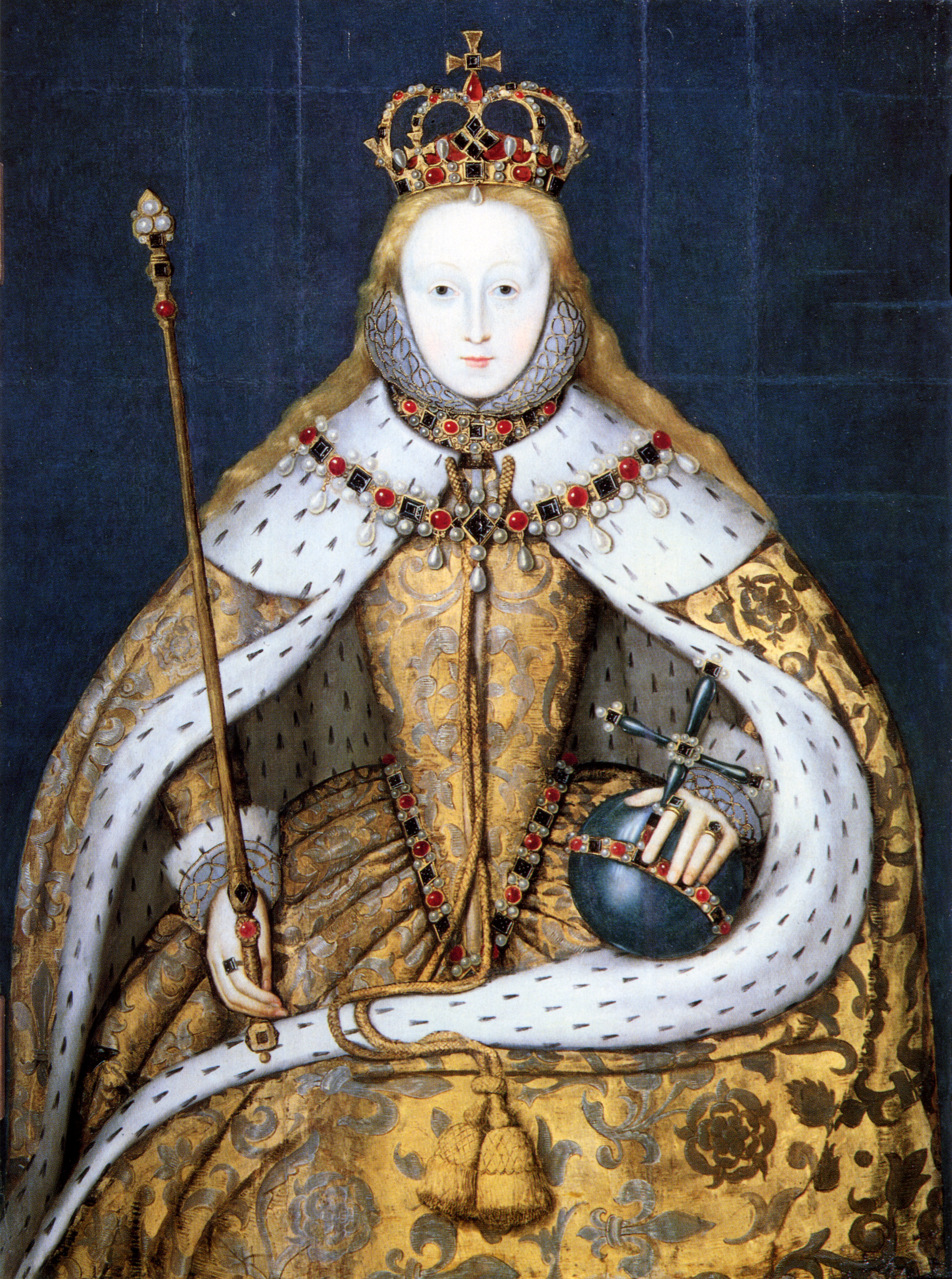
Queen Elizabeth I. C. 1600. Oil on panel. National Portrait Gallery. Wikimedia. https://commons.wikimedia.org/wiki/File:Elizabeth_I_in_coronation_robes_detail.jpg.

Prosopography
Kate McPherson
Kate McPherson is Professor of English and Honors Program Director at Utah Valley
University (Orem, UT, USA). In 2015, she began working to redevelop Shakespeare’s Life and Times, created by Michael Best, into the Early Modern England Encyclopedia. Her other publications include commentary on Pericles and The Comedy of Errors for the New Oxford Shakespeare (2016); the co-edited volumes Stages of Engagement: Drama and Religion in Post-Reformation England with James Mardock (Duquesne University Press, 2014) and Shakespeare Expressed: Page, Stage, and Classroom in Shakespeare and His Contemporaries, with Kathryn M. Moncrief and Sarah Enloe (Fairleigh Dickinson University Press,
2013). With Kathryn M. Moncrief, Kate has also two edited collections, Performing Pedagogy in Early Modern England: Gender, Instruction, and Performance (Ashgate, 2011) and Performing Maternity in Early Modern England (Ashgate 2008). She has also published numerous articles on early modern maternity
in scholarly journals. Kate participated in the 2008 National Endowment for the Humanities
Institute,
Shakespeare’s Blackfriars: The Study, the Stage, the Classroom,at the American Shakespeare Center. She also served as Play Seminar Director, a public humanities position, for the Utah Shakespeare Festival in 2017 and 2018.
Leah Hamby
Leah Hamby is the primary encoder for the Early Modern England Encyclopedia. Aside from encoding, she also works as an editor for the project and contributed
several articles of her own. She has been working on the EMEE since February 2023. As of February 2026, she is soon to graduate with honours from
Utah Valley University with a major in history and a minor in creative writing. Her
other work with the LEMDO program includes remediating William Kemp’s Kemp’s Nine Day’s Wonder for the Digital Renaissance Editions.
Marley Chamberlain
Marley Chamberlain was a student at Utah Valley University.
Michael Best
Michael Best is Professor Emeritus at the University of Victoria, BC. He founded the
Internet Shakespeare Editions in 1996, and was Coordinating Editor until 2017, contributing two editions to the
ISE: King John and King Lear (the latter also available in print from Broadview Press). In print, he has published editions of works of Elizabethan magic and huswifery,
a collection of letters from the Australian goldfields, and Shakespeare on the Art of Love (2008). He contributed regular columns for the Shakespeare Newsletter on
Electronic Shakespeares,and has written many articles and chapters for both print and online books and journals, principally on questions raised by the new medium in the editing and publication of texts. He has delivered papers and plenary lectures on electronic media and the Internet Shakespeare Editions at conferences in Canada, the USA, the UK, Spain, Australia, and Japan.
Navarra Houldin
Training and Documentation Lead 2025–present. LEMDO project manager 2022–2025. Textual
remediator 2021–present. Navarra Houldin (they/them) completed their BA with a major
in history and minor in Spanish at the University of Victoria in 2022. Their primary
research was on gender and sexuality in early modern Europe and Latin America. They
are continuing their education through an MA program in Gender and Social Justice
Studies at the University of Alberta where they will specialize in Digital Humanities.
Orgography
LEMDO Team (LEMD1)
The LEMDO Team is based at the University of Victoria and normally comprises the project
director, the lead developer, project manager, junior developers(s), remediators,
encoders, and remediating editors.
University of Victoria (UVIC1)
https://www.uvic.ca/Metadata
| Authority title | Elizabeth Becomes Queen |
| Type of text | Critical |
| Publisher | University of Victoria on the Linked Early Modern Drama Online Platform |
| Series | Early Modern England Encyclopedia |
| Source |
By Marley Chamberlain, inspired by Michael Best’s Shakespeare’s Life and Times, Internet Shakespeare Editions
|
| Editorial declaration | This document uses Canadian English spelling |
| Edition | Released with Early Modern England Encyclopedia 1.0 |
| Sponsor(s) |
Early Modern England EncyclopediaAnthology Leads: Kate McPherson and Kate Moncrief.
|
| Encoding description | Encoded in TEI P5 according to the LEMDO Customization and Encoding Guidelines |
| Document status | published, peer-reviewed |
| Funder(s) |
Social Sciences and Humanities Research Council of Canada
Mitacs Globalink Research Internship Utah Valley University |
| License/availability |
Intellectual copyright in this entry is held by Kate McPherson on behalf of the contributors. Copyright on the TEI-XML markup is held by the University of Victoria on behalf of the LEMDO Team. The content and TEI-XML markup in this file are licensed under a CC BY-NC_ND 4.0 license. This file is freely downloadable without permission under the following conditions:
(1) credit must be given to the authors, EMEE, and LEMDO in any subsequent use of
the files and /or data; (2) this availability statement must remain in the file; (3)
the content cannot be adapted or repurposed (except for quotations for the purposes
of academic review and citation); and (4) commercial uses are not permitted without
the knowledge and consent of the authors, EMEE, and LEMDO. Neither the content nor
the code in this file is licensed for training large language models (LLMs), ingestion
into an LLM, or any use in any artificial intelligence applications; such uses are
considered to be commercial uses and are strictly prohibited.
|