
Elizabeth Cary
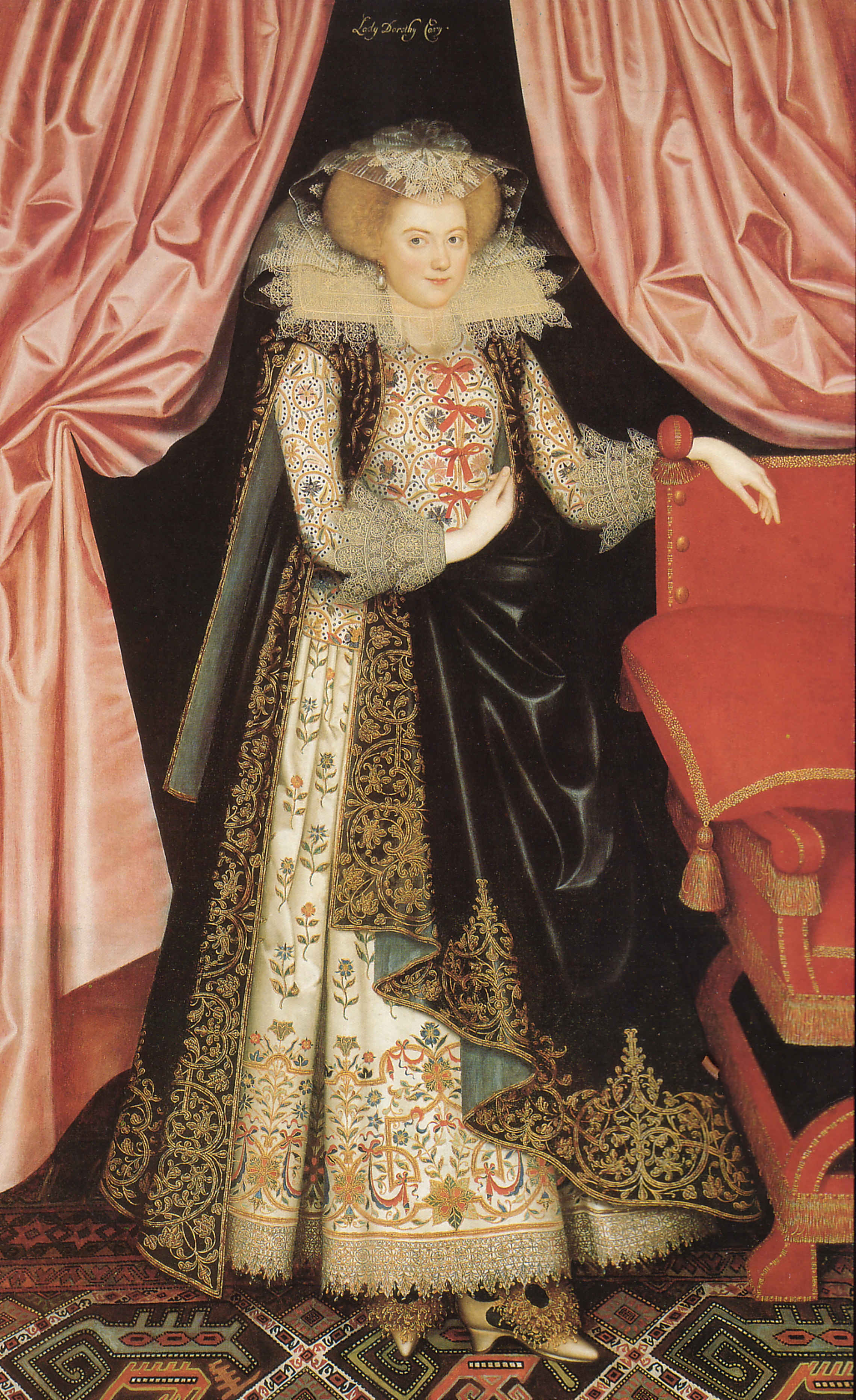
Elizabeth Cary (1585–1639)
Para1Elizabeth Cary was an accomplished noblewoman who pioneered many firsts for women
of her time. From a young age, she was bookish, reading Catholic and Protestant religious
texts in her youth. This practice was encouraged by her parents, who employed a tutor
who taught her to speak French fluently. She subsequently taught herself how to speak
Spanish, Italian, Latin, Hebrew, and Transylvanian.
Para2Upon her marriage at age 17, her in-laws barred her from reading books, so she began
to write poetry, which she believed was the highest form of literacy. Cary and her
husband, Sir Henry Cary (later elevated to Viscount Falkland, subsequently making
Elizabeth Viscountess Falkland), were not acquainted prior to the marriage, which
was socially advantageous for her and financially advantageous for her husband. She
birthed eleven children between 1603 and 1624, six daughters and five sons, all of
whom she lost custody of after converting to Catholicism in 1626 and being placed
under brief house arrest by King Charles I.
Para3Her conversion led to her formal separation from her husband and was met with disapproval
from her parents; her father disinherited her while her mother refused to take her
back after the separation. In 1633, after her husband’s death and living in poverty
for many years, she regained custody of most of her minor children. She resorted to
kidnapping two of her sons in 1636 to have her family back together, three years before
she died in London in 1639, where she is also buried.
The Tragedy of Mariam (1613)
Para4Although scholars argue whether or not this was the first play written by Cary, The Tragedy of Mariam, Fair Queen of Jewry is her earliest surviving piece and the first original English play written by a
woman. It is the first English play to explore the account of Herod the Great’s marriage
to his second wife, Mariam.
Para5Several parallels exist between the character of Mariam and Cary: both are ambitious,
unhappy wives to an authoritative husband. The play is a closet drama, most likely
written to be read in a small, private circle of women, not performed on stage. Cary
describes all of the action through the dialogue as opposed to physical actions or
stage directions. Closet drama was popular with early modern women writers so they
could have a private place to enjoy drama without endangering their reputations.
The History of the Life, Reign and Death of Edward II, or The History of the most Unfortunate Prince, King Edward II (published 1680)
Para6In possibly a mere 10 days in 1627, Cary wrote The History of the Life, Reign, and Death of Edward II, a political piece based on the English King Edward II. Although there were already
a number of plays and biographies written about him, Cary’s included an intricate
and well-written section about Edward’s wife, Queen Isabel, which is unique compared
to other texts. Cary’s Edward II was not published until long after her death in 1680, when it was published anonymously
by one of her daughters. This same daughter also wrote Elizabeth’s biography, Lady Falkland: Her Life, making Cary the first female English author to have a written biography.
Other Works
Para7Although only a small amount of Cary’s work has survived, several missing poems and
stories are hinted at in her surviving works, including the full plays of The Lives of St. Agnes, St. Elizabeth of Portugal, and St Mary Magdalene; verses of The Life of Tamburlaine and The Virgin Mary; and translations of Seneca and Blosius.
Para8Aside from her original published pieces, she also made an English translation of
Abraham Ortelius’s L’Epitome du Théâtre du Monde (1588), titled The Mirror of the Worlde in 1598 when she was only 13, which was finally published in 2012. It is believed
to be one of the first English versions of the original text, and it provides information
and context to the authors and texts that influenced the young Cary.
Sources
Alfar, Cristina León.
Elizabeth Cary’s Female Trinity: Breaking Custom with Mosaic Law in The Tragedy of Mariam.Early Modern Women, vol. 3, 2008, pp. 61–103.
Cary, Elizabeth. The Tragedy of Mariam, the Fair Queen of Jewry. Broadview Press, 2000.
Heller, Jennifer L.
Space, Violence, and Bodies in Middleton and Cary.Studies in English Literature, 1500–1900, vol. 45, no. 2, 2005, pp. 425–441.
Hodgson-Wright, Stephanie.
Cary, Elizabeth, Viscountess Falkland (1585–1639).Oxford Dictionary of National Biography. Oxford UP, 2014.
Mackay, Elizabeth Ann.
Shrew(d) Maternities, Elizabeth Cary’s Life, and Filial Equivocations.Tulsa Studies in Women’s Literature, vol. 33, no. 2, 2014, pp. 23–50.
Perry, Nandra.
The Sound of Silence: Elizabeth Cary and the Christian Hero.English Literary Renaissance, vol. 38, no. 1, 2008, pp. 106–141.
Wolfe, Heather.
The Literary Career and Legacy of Elizabeth Cary.Seventeenth-Century News. Fall-Winter, 2007, vol. 65, no. 3–4, pp. 1613–1680.
Open-Access Digital Resources
Beal, Peter. Elizabeth Cary, Viscountess Falkland. Catalog of English Literary Manuscripts, 1450–1700. https://celm-ms.org.uk/introductions/CaryElizabethViscountessFalkland.html. Accessed 11 Feb. 2026.
Elizabeth Cary, Viscountess Falkland, Writer, Translator & Catholic Recusant.The Twickenham Museum, 12 Mar. 2014, https://twickenham-museum.org.uk/people/writers-poets-and-historians/elizabeth-cary-viscountess-falkland/. Accessed 11 Feb. 2026.
Prosopography
Kate McPherson
Kate McPherson is Professor of English and Honors Program Director at Utah Valley
University (Orem, UT, USA). In 2015, she began working to redevelop Shakespeare’s Life and Times, created by Michael Best, into the Early Modern England Encyclopedia. Her other publications include commentary on Pericles and The Comedy of Errors for the New Oxford Shakespeare (2016); the co-edited volumes Stages of Engagement: Drama and Religion in Post-Reformation England with James Mardock (Duquesne University Press, 2014) and Shakespeare Expressed: Page, Stage, and Classroom in Shakespeare and His Contemporaries, with Kathryn M. Moncrief and Sarah Enloe (Fairleigh Dickinson University Press,
2013). With Kathryn M. Moncrief, Kate has also two edited collections, Performing Pedagogy in Early Modern England: Gender, Instruction, and Performance (Ashgate, 2011) and Performing Maternity in Early Modern England (Ashgate 2008). She has also published numerous articles on early modern maternity
in scholarly journals. Kate participated in the 2008 National Endowment for the Humanities
Institute,
Shakespeare’s Blackfriars: The Study, the Stage, the Classroom,at the American Shakespeare Center. She also served as Play Seminar Director, a public humanities position, for the Utah Shakespeare Festival in 2017 and 2018.
Kirsten Fleming
Kirsten Fleming was a student at the University of Fraser Valley.
Leah Hamby
Leah Hamby is the primary encoder for the Early Modern England Encyclopedia. Aside from encoding, she also works as an editor for the project and contributed
several articles of her own. She has been working on the EMEE since February 2023. As of February 2026, she is soon to graduate with honours from
Utah Valley University with a major in history and a minor in creative writing. Her
other work with the LEMDO program includes remediating William Kemp’s Kemp’s Nine Day’s Wonder for the Digital Renaissance Editions.
Melissa Walter
Melissa Walter is Associate Professor of English at the University of the Fraser Valley.
Her research focuses on early modern English drama and English and European prose
fiction. She is the author of The Italian Novella and Shakespeare’s Comic Heroines (U of Toronto, 2019), and co-editor, with Dennis Britton, of Rethinking Shakespeare Source Study: Authors, Audiences, Digital Technologies (Routledge, 2018). Her work on English theatre and the European novella has appeared
in several edited collections, including Transnational Exchange in Early Modern Theater (Ashgate, 2008), and Transnational Mobility in Early Modern Theater (Ashgate, 2012). She has also written about
Translation and Identity in the Dialogues in English and Malaiane Languages(Indographies, ed. Jonathan Gil Harris. Palgrave 2012). At the University of the Fraser Valley, she is a lead coordinator of UFV’s Shakespeare and Reconciliation Garden.
Michael Best
Michael Best is Professor Emeritus at the University of Victoria, BC. He founded the
Internet Shakespeare Editions in 1996, and was Coordinating Editor until 2017, contributing two editions to the
ISE: King John and King Lear (the latter also available in print from Broadview Press). In print, he has published editions of works of Elizabethan magic and huswifery,
a collection of letters from the Australian goldfields, and Shakespeare on the Art of Love (2008). He contributed regular columns for the Shakespeare Newsletter on
Electronic Shakespeares,and has written many articles and chapters for both print and online books and journals, principally on questions raised by the new medium in the editing and publication of texts. He has delivered papers and plenary lectures on electronic media and the Internet Shakespeare Editions at conferences in Canada, the USA, the UK, Spain, Australia, and Japan.
Navarra Houldin
Training and Documentation Lead 2025–present. LEMDO project manager 2022–2025. Textual
remediator 2021–present. Navarra Houldin (they/them) completed their BA with a major
in history and minor in Spanish at the University of Victoria in 2022. Their primary
research was on gender and sexuality in early modern Europe and Latin America. They
are continuing their education through an MA program in Gender and Social Justice
Studies at the University of Alberta where they will specialize in Digital Humanities.
Orgography
LEMDO Team (LEMD1)
The LEMDO Team is based at the University of Victoria and normally comprises the project
director, the lead developer, project manager, junior developers(s), remediators,
encoders, and remediating editors.
University of Victoria (UVIC1)
https://www.uvic.ca/Metadata
| Authority title | Elizabeth Cary |
| Type of text | Critical |
| Publisher | University of Victoria on the Linked Early Modern Drama Online Platform |
| Series | Early Modern England Encyclopedia |
| Source |
By Kirsten Fleming, inspired by Michael Best’s Shakespeare’s Life and Times, Internet Shakespeare Editions
|
| Editorial declaration | This document uses Canadian English spelling |
| Edition | Released with Early Modern England Encyclopedia 1.0 |
| Sponsor(s) |
Early Modern England EncyclopediaAnthology Leads: Kate McPherson and Kate Moncrief.
|
| Encoding description | Encoded in TEI P5 according to the LEMDO Customization and Encoding Guidelines |
| Document status | published, peer-reviewed |
| Funder(s) |
Social Sciences and Humanities Research Council of Canada
Mitacs Globalink Research Internship Utah Valley University |
| License/availability |
Intellectual copyright in this entry is held by Kate McPherson on behalf of the contributors. Copyright on the TEI-XML markup is held by the University of Victoria on behalf of the LEMDO Team. The content and TEI-XML markup in this file are licensed under a CC BY-NC_ND 4.0 license. This file is freely downloadable without permission under the following conditions:
(1) credit must be given to the authors, EMEE, and LEMDO in any subsequent use of
the files and /or data; (2) this availability statement must remain in the file; (3)
the content cannot be adapted or repurposed (except for quotations for the purposes
of academic review and citation); and (4) commercial uses are not permitted without
the knowledge and consent of the authors, EMEE, and LEMDO. Neither the content nor
the code in this file is licensed for training large language models (LLMs), ingestion
into an LLM, or any use in any artificial intelligence applications; such uses are
considered to be commercial uses and are strictly prohibited.
|