
King Edward VI
Birth
Para1Edward Tudor, the only son of Henry VIII and his third wife Jane Seymour, was born
October 12, 1537, in Hampton Court Palace. Edward’s birth led to great celebration,
as he was the 46-year-old King’s only legitimate and long-awaited son. His mother
was Jane Seymour, King Henry VIII’s third wife. His mother died 12 days after his
birth from complications of childbirth. He had two older half-sisters: Mary, his sister
from his father’s first wife, Catherine of Aragon, and Elizabeth, from his father’s
second wife, Anne Boleyn.
Care and Education
Para2Due to the king’s intense desire to have a surviving male heir, young Edward was kept
in relative seclusion from the court in an effort to prevent illness. Other than one
severe bout of illness at age four, probably from malaria, and having poor eyesight,
Edward was generally healthy. As he grew, he enjoyed hunting and was quite athletic.
He received a robust humanist education and enjoyed learning. By age seven, Edward
was reading Erasmus’s edition of Aesop in Latin. Many of his letters and diaries survive, revealing his strong personality.
His tutors were all of the reformed Protestant faith, which strongly influenced Edward,
who showed great stubbornness and great piety.
Child King
Para3At age nine, Edward succeeded his father as King when Henry VIII died on January 28,
1547. About a month after Henry VIII’s death, Edward was crowned following a spectacular
five-hour procession through London to Westminster Abbey in a doublet of white velvet
with cloth of silver and gold, patterned with knots of diamonds and pearls.
Para4Prior to his death, Henry VIII created a Council of Regency to rule until Edward came
of age. The young king’s uncle, Edward Seymour, duke of Somerset, held supreme power as Lord Protector within the council and made decisions in Edward’s name. Power struggles
inevitably ensued, and Edward Seymour was overthrown by John Dudley, earl of Warwick
and duke of Northumberland, also of the Council of Regency, in 1549. Northumberland
himself fell from power in 1553. Both men were eventually executed, and Edward VI
is said to have watched both executions without much emotion.
Protestant Reforms
Para5Members of the Council of Regency were all advocates for the Protestant Reformation
of England that began with King Henry VIII. Protestantism became even more firmly
rooted in England during the reign of Edward VI. Under the Council’s direction, the
Church of England implemented a Book of Common Prayer in 1549 to make a uniform worship service in English.
Para6Under the influence of Archbishop Thomas Cramer, Edward VI and his Council also oversaw
the purifying of the Church of England of many of its medieval Catholic remnants,
particularly the visual ones in churches that appeared in stone, wood, and glass.
Stained glass windows were removed, frescoes painted over, and many statues of saints
were literally defaced (with noses knocked off) or removed entirely. Other cultural
aspects of English life also were discontinued or discouraged, including religious
pageants on holy days, the performance of mystery plays, and more pagan or folk celebration
such as maypoles. This series of changes and pressures continued into the 17th century
as Puritanism gained influence.
Illness and Death
Para7In February 1553, the 15 year-old, unmarried Edward VI contracted an upper-respiratory
infection that progressively got worse. In June, physicians determined that his illness
was chronic and historians believe it may have been tuberculosis. With the next successor
to the throne being his half-sister, Mary, who remained a staunch Catholic, the Council
of Regency sought a more suitable, Protestant option to rule England. Influenced by
the Council, Edward VI drafted a convoluted succession plan that changed his will
and disinherited both of his purportedly illegitimate half-sisters to keep them from
the throne, instead favoring Lady Jane Grey, who was the great-granddaugter of King
Henry VII.
Para8Edward VI died on July 6, 1553, at the age of 15. Days later, the Lord Protector John
Dudley appointed his daughter-in-law, Lady Jane Grey, as the Queen of England; however,
she was overthrown the next month after a rule of only nine days due to the overwhelming
support for Edward’s half-sister Mary, who became Mary I, Queen of England and Ireland.
Sources
Guy, J.A. The Children of Henry VIII. Oxford UP, 2013.
Hoak, Dale.
Edward VI (1537–1553), king of England and Ireland.Oxford Dictionary of National Biography. Oxford UP, 2014.
Loach, Jennifer. Edward VI. Yale UP, 1999.
Open-Access Digital Resources
Best, Michael.
A Child King: Edward VI.Shakespeare’s Life and Times. Internet Shakespeare Editions. University of Victoria, 4 Jan. 2011, https://internetshakespeare.uvic.ca/Library/SLT/history/henry%20VIII/edwardvi.html. Accessed 10 Nov. 2018.
Edward VI (1537–1553).BBC History, 2014, https://www.bbc.co.uk/history/historic_figures/edward_vi_king.shtml. Accessed 10 Nov. 2018.
Morrill, John S. et al.
Edward VI: King of England and Ireland.Encyclopaedia Britannica, 21 Mar. 2026, https://britannica.com/biography/Edward-VI. Accessed 10 Nov. 2018.
Image Source
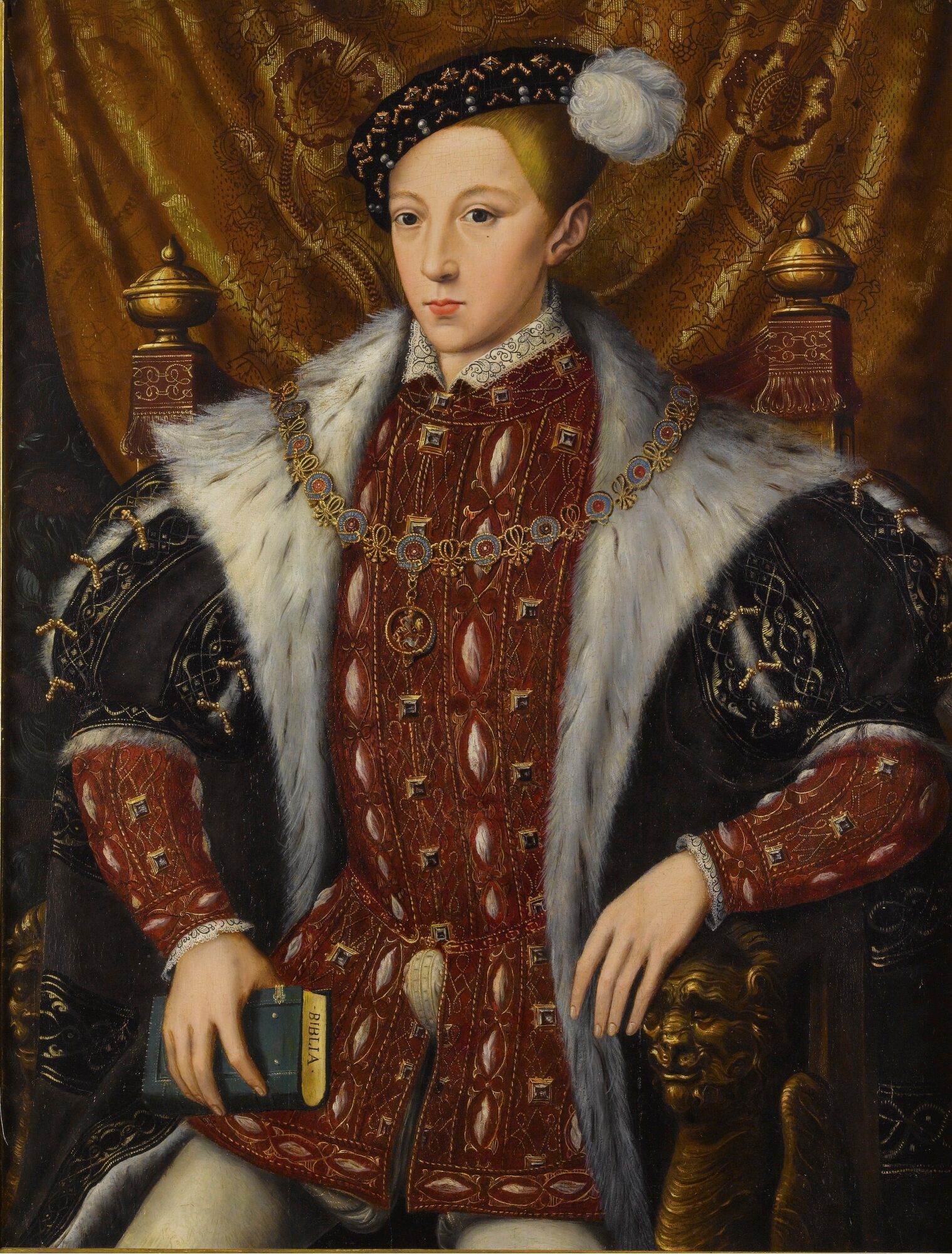
Scrots, William, attributed to. Portrait of Edward VI of England. c. 1552. Wikimedia. https://upload.wikimedia.org/wikipedia/commons/e/e5/Circle_of_William_Scrots_Edward_VI_of_England.jpg.

Prosopography
Kate McPherson
Kate McPherson is Professor of English and Honors Program Director at Utah Valley
University (Orem, UT, USA). In 2015, she began working to redevelop Shakespeare’s Life and Times, created by Michael Best, into the Early Modern England Encyclopedia. Her other publications include commentary on Pericles and The Comedy of Errors for the New Oxford Shakespeare (2016); the co-edited volumes Stages of Engagement: Drama and Religion in Post-Reformation England with James Mardock (Duquesne University Press, 2014) and Shakespeare Expressed: Page, Stage, and Classroom in Shakespeare and His Contemporaries, with Kathryn M. Moncrief and Sarah Enloe (Fairleigh Dickinson University Press,
2013). With Kathryn M. Moncrief, Kate has also two edited collections, Performing Pedagogy in Early Modern England: Gender, Instruction, and Performance (Ashgate, 2011) and Performing Maternity in Early Modern England (Ashgate 2008). She has also published numerous articles on early modern maternity
in scholarly journals. Kate participated in the 2008 National Endowment for the Humanities
Institute,
Shakespeare’s Blackfriars: The Study, the Stage, the Classroom,at the American Shakespeare Center. She also served as Play Seminar Director, a public humanities position, for the Utah Shakespeare Festival in 2017 and 2018.
Leah Hamby
Leah Hamby is the primary encoder for the Early Modern England Encyclopedia. Aside from encoding, she also works as an editor for the project and contributed
several articles of her own. She has been working on the EMEE since February 2023. As of February 2026, she is soon to graduate with honours from
Utah Valley University with a major in history and a minor in creative writing. Her
other work with the LEMDO program includes remediating William Kemp’s Kemp’s Nine Day’s Wonder for the Digital Renaissance Editions.
Michael Best
Michael Best is Professor Emeritus at the University of Victoria, BC. He founded the
Internet Shakespeare Editions in 1996, and was Coordinating Editor until 2017, contributing two editions to the
ISE: King John and King Lear (the latter also available in print from Broadview Press). In print, he has published editions of works of Elizabethan magic and huswifery,
a collection of letters from the Australian goldfields, and Shakespeare on the Art of Love (2008). He contributed regular columns for the Shakespeare Newsletter on
Electronic Shakespeares,and has written many articles and chapters for both print and online books and journals, principally on questions raised by the new medium in the editing and publication of texts. He has delivered papers and plenary lectures on electronic media and the Internet Shakespeare Editions at conferences in Canada, the USA, the UK, Spain, Australia, and Japan.
Navarra Houldin
Training and Documentation Lead 2025–present. LEMDO project manager 2022–2025. Textual
remediator 2021–present. Navarra Houldin (they/them) completed their BA with a major
in history and minor in Spanish at the University of Victoria in 2022. Their primary
research was on gender and sexuality in early modern Europe and Latin America. They
are continuing their education through an MA program in Gender and Social Justice
Studies at the University of Alberta where they will specialize in Digital Humanities.
Rachel Armstrong
Rachel Armstrong was a student at Utah Valley University.
Orgography
LEMDO Team (LEMD1)
The LEMDO Team is based at the University of Victoria and normally comprises the project
director, the lead developer, project manager, junior developers(s), remediators,
encoders, and remediating editors.
University of Victoria (UVIC1)
https://www.uvic.ca/Metadata
| Authority title | King Edward VI |
| Type of text | Critical |
| Publisher | University of Victoria on the Linked Early Modern Drama Online Platform |
| Series | Early Modern England Encyclopedia |
| Source |
By Rachel Armstrong, inspired by Michael Best’s Shakespeare’s Life and Times, Internet Shakespeare Editions
|
| Editorial declaration | This document uses Canadian English spelling |
| Edition | Released with Early Modern England Encyclopedia 1.0 |
| Sponsor(s) |
Early Modern England EncyclopediaAnthology Leads: Kate McPherson and Kate Moncrief.
|
| Encoding description | Encoded in TEI P5 according to the LEMDO Customization and Encoding Guidelines |
| Document status | published, peer-reviewed |
| Funder(s) |
Social Sciences and Humanities Research Council of Canada
Mitacs Globalink Research Internship Utah Valley University |
| License/availability |
Intellectual copyright in this entry is held by Kate McPherson on behalf of the contributors. Copyright on the TEI-XML markup is held by the University of Victoria on behalf of the LEMDO Team. The content and TEI-XML markup in this file are licensed under a CC BY-NC_ND 4.0 license. This file is freely downloadable without permission under the following conditions:
(1) credit must be given to the authors, EMEE, and LEMDO in any subsequent use of
the files and /or data; (2) this availability statement must remain in the file; (3)
the content cannot be adapted or repurposed (except for quotations for the purposes
of academic review and citation); and (4) commercial uses are not permitted without
the knowledge and consent of the authors, EMEE, and LEMDO. Neither the content nor
the code in this file is licensed for training large language models (LLMs), ingestion
into an LLM, or any use in any artificial intelligence applications; such uses are
considered to be commercial uses and are strictly prohibited.
|