
Education for Girls
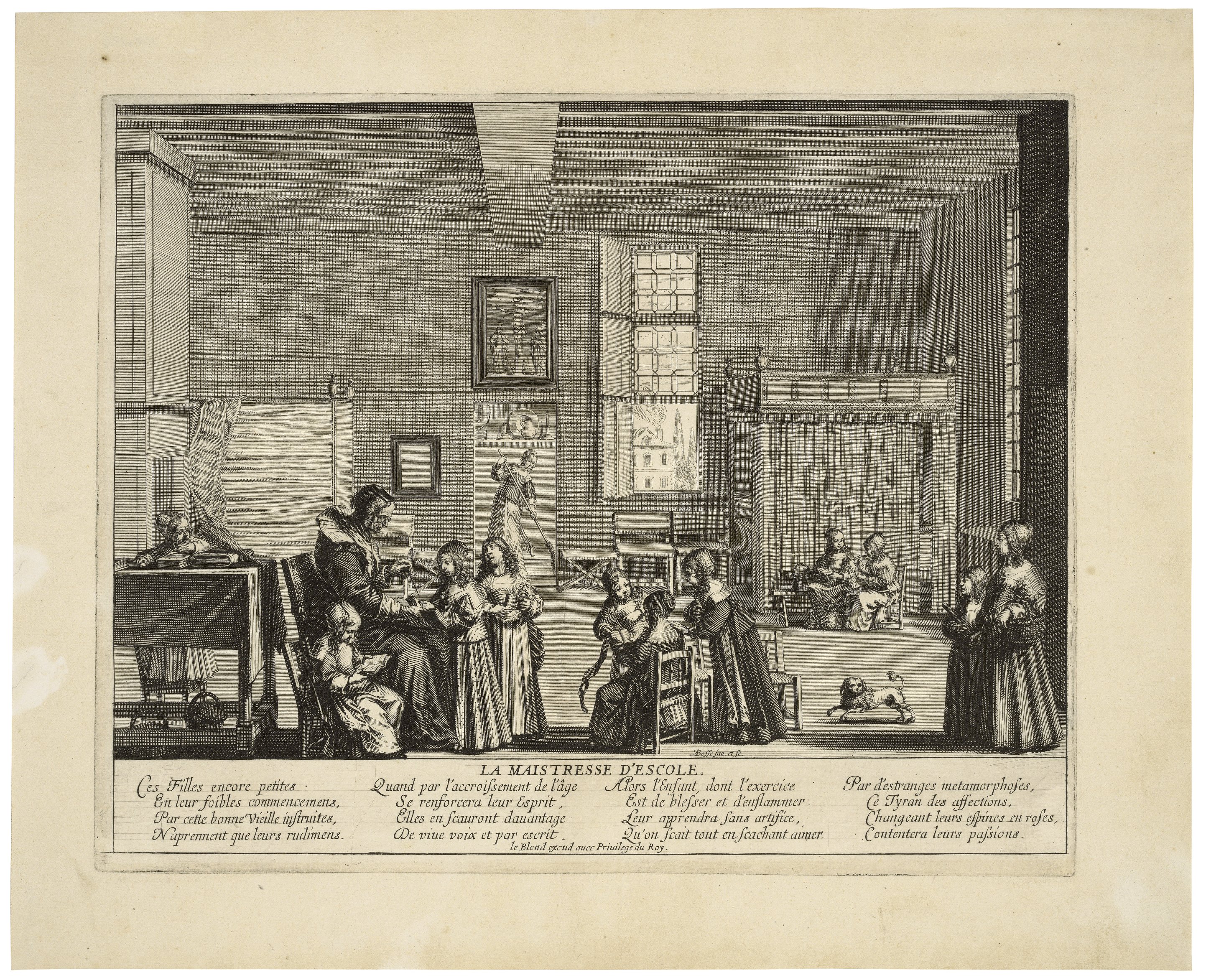
The Schoolmistress,engraving by Abraham Bosse, c. 1638. Courtesy of the Folger Shakespeare Library. Public Domain.
Para1Formal education for girls in early modern Europe was generally not encouraged, apart
from some daughters of the nobility. The rise of humanism and its great emphasis on
broad knowledge meant that a very few girls from elite families did receive a thorough
education in languages and the classics, but humanism also defined women’s roles as
primarily in the home. The Protestant Reformation and its emphasis on individuals
studying Scripture in their own language did mean that more people overall, including
girls, learned to read in early modern England.
Para2In general, the subject matter for female education focused primarily on piety, chastity,
and the large set of skills involved in housewifery. Girls from elite families might
share a brother’s tutor for a short time to study literature and classical language.
Girls from prosoperous families learned to read, write, and sew by attending an informal
town or village school called a dame or petty school, although many were taught these
basic skills at home. Poorer girls generally remained illiterate and were educated
in necessary household, agricultural, or trades skills.
Curriculum for Elite Women
Para3Women who belonged to elite families may or may not have been formally educated. Two
of Henry VIII’s wives (Catherine of Aragon and Catherine Parr) were well educated
in the humanist tradition, including learning to read and write in Latin and other
modern languages. Queen Elizabeth I was also very well educated, spoke six languages,
and is known to have loved to read. Catherine of Aragon’s tutor, Juan Luis Vives,
published a book entitled The Instruction of a Christian Woman (1540); he grounded his text in the messages of Christian fathers like Jerome and
focused mainly on the virtue of modesty, with intellectual pursuits as a sideline.
He comments that
When she shall be taught to read, let those books be taken in hand that may teach good manners. And when she shall learn to write, let not her example be void verses, nor wanton or trifling songs, but some sad sentence, prudent and chaste, taken out of holy scripture.
Para4Girls of the upper ranks were expected to learn the proper manner to govern a large,
complex household, sometimes with dozens of servants. They were also expected to understand
how to conduct themselves properly in a social setting, so elite women also learned
subjects such as music and dancing. These expectations were usually tied to a woman’s
precise social class, generally determined by her father’s or her husband’s status.
.
Humanism Waned
Para5Towards the end of the sixteenth century, the practice of training noble women as
intellectuals became less fashionable. Education became lighter and focused on conversational
material, household management, and piety. The purpose for education shifted into
making women better companions for their husbands.
Fostering
Para6Girls who belong to the wealthier social classes were often placed in households of
a family friend friend or acquaintance in the position of lady in waiting or companion
in a fostering process. These placements were arranged by the girl’s family, typically
between ages 9-14. At this new household, the girls would learn to read more complex
texts, write, keep accounts and manage a household. Girls would also learn desirable
social skills at these foster homes such as playing a musical instrument, singing,
and dancing.
Formal Education
Para7In the mid-sixteenth century, due to the influence of Protestant ideas, some girls
were allowed to attend the growing number of town grammar schools, many founded in
the name of King Edward VI or sponsored by a local trade guild. However, many prohibited
girls from attending or limited their attendance after age nine. A few boarding schools
for girls, such as Godstow, existed in England to replicate the education offered
in nunneries in Europe, but these were for wealthier families willing to pay tuition.
Universities did not admit women.
Expectations for Women
Para8Girls were expected to get married, have children, and manage household duties. Unmarried
women had few career options. A small number trained as dame school or petty school
teachers in a guild school, a school funded by a trade association such as the Merchant
Tailors. Once trained, she would be responsible for teaching children how to read,
write, and sew.
Para9Girls learned to avoid idleness and instead focus on modesty, obedience, and silence.
Young girls were allowed some time to play but most of their time was spent working
on small household tasks that increased in complexity as the girl aged. They would
occupy their time learning sewing, spinning, weaving, mending, decorative needlework,
the properties of herbs and how to prepare basic medicines from them, in addition
to playing a musical instrument like the lute or virginal, or reading a suitable book,
most likely one with a religious emphasis.
Sources
Aughterson, Kate.
Education.In Renaissance Woman: Constructions of Femininity in England. Routledge, 1995. pp. 165–186.
Balmuth, Miriam.
Female Education in 16th & 17th Century England: Influences, Attitudes, and Trends.Canadian Woman Studies/les cahiers de la femme vol. 9, no. 3 and 4, 1988, pp. 17–20.
Cressy, David. Education in Tudor and Stuart England. St. Martin’s Press, 1976.
Jewell, Helen M. Education in Early Modern England. Red Globe Press, 1999.
Kathryn R. McPherson and Moncrief, Kathryn M.. Performing Pedagogy in Early Modern England. Routledge, 2011.
Open-Access Digital Resources
Best, Michael.
The Education of Girls.Shakespeare’s Life and Times.Internet Shakespeare Editions. University of Victoria, 4 Jan. 2011, https://internetshakespeare.uvic.ca/Library/SLT/ideas/education/girls.html. Accessed 16 Nov. 2018.
Feldmann, Horst.
Still Influential: The Protestant Emphasis on Schooling.Comparative Sociology vol. 17, no. 5, 2018, pp. 641–678. DOI https://doi.org/10.1163/15691330-12341474. Accessed 27 Feb. 2023.
Gillard, Derek.
Education in England: A History.Education in England, May 2018., http://www.educationengland.org.uk/history/. Accessed 27 Feb. 2023.
Image Source
Bosse, Abraham.
La Maistresse D’Escole.c. 1638. Engraving. Folger Shakespeare Library. https://digitalcollections.folger.edu/img1957.
Prosopography
Courtney Follett
Courtney Follett was a student at Utah Valley University.
Kate McPherson
Kate McPherson is Professor of English and Honors Program Director at Utah Valley
University (Orem, UT, USA). In 2015, she began working to redevelop Shakespeare’s Life and Times, created by Michael Best, into the Early Modern England Encyclopedia. Her other publications include commentary on Pericles and The Comedy of Errors for the New Oxford Shakespeare (2016); the co-edited volumes Stages of Engagement: Drama and Religion in Post-Reformation England with James Mardock (Duquesne University Press, 2014) and Shakespeare Expressed: Page, Stage, and Classroom in Shakespeare and His Contemporaries, with Kathryn M. Moncrief and Sarah Enloe (Fairleigh Dickinson University Press,
2013). With Kathryn M. Moncrief, Kate has also two edited collections, Performing Pedagogy in Early Modern England: Gender, Instruction, and Performance (Ashgate, 2011) and Performing Maternity in Early Modern England (Ashgate 2008). She has also published numerous articles on early modern maternity
in scholarly journals. Kate participated in the 2008 National Endowment for the Humanities
Institute,
Shakespeare’s Blackfriars: The Study, the Stage, the Classroom,at the American Shakespeare Center. She also served as Play Seminar Director, a public humanities position, for the Utah Shakespeare Festival in 2017 and 2018.
Leah Hamby
Leah Hamby is the primary encoder for the Early Modern England Encyclopedia. Aside from encoding, she also works as an editor for the project and contributed
several articles of her own. She has been working on the EMEE since February 2023. As of February 2026, she is soon to graduate with honours from
Utah Valley University with a major in history and a minor in creative writing. Her
other work with the LEMDO program includes remediating William Kemp’s Kemp’s Nine Day’s Wonder for the Digital Renaissance Editions.
Michael Best
Michael Best is Professor Emeritus at the University of Victoria, BC. He founded the
Internet Shakespeare Editions in 1996, and was Coordinating Editor until 2017, contributing two editions to the
ISE: King John and King Lear (the latter also available in print from Broadview Press). In print, he has published editions of works of Elizabethan magic and huswifery,
a collection of letters from the Australian goldfields, and Shakespeare on the Art of Love (2008). He contributed regular columns for the Shakespeare Newsletter on
Electronic Shakespeares,and has written many articles and chapters for both print and online books and journals, principally on questions raised by the new medium in the editing and publication of texts. He has delivered papers and plenary lectures on electronic media and the Internet Shakespeare Editions at conferences in Canada, the USA, the UK, Spain, Australia, and Japan.
Navarra Houldin
Training and Documentation Lead 2025–present. LEMDO project manager 2022–2025. Textual
remediator 2021–present. Navarra Houldin (they/them) completed their BA with a major
in history and minor in Spanish at the University of Victoria in 2022. Their primary
research was on gender and sexuality in early modern Europe and Latin America. They
are continuing their education through an MA program in Gender and Social Justice
Studies at the University of Alberta where they will specialize in Digital Humanities.
Orgography
LEMDO Team (LEMD1)
The LEMDO Team is based at the University of Victoria and normally comprises the project
director, the lead developer, project manager, junior developers(s), remediators,
encoders, and remediating editors.
University of Victoria (UVIC1)
https://www.uvic.ca/Metadata
| Authority title | Education for Girls |
| Type of text | Critical |
| Publisher | University of Victoria on the Linked Early Modern Drama Online Platform |
| Series | Early Modern England Encyclopedia |
| Source |
By Courtney Follett and Kate McPherson, inspired by Michael Best’s Shakespeare’s Life and Times, Internet Shakespeare Editions
|
| Editorial declaration | This document uses Canadian English spelling |
| Edition | Released with Early Modern England Encyclopedia 1.0 |
| Sponsor(s) |
Early Modern England EncyclopediaAnthology Leads: Kate McPherson and Kate Moncrief.
|
| Encoding description | Encoded in TEI P5 according to the LEMDO Customization and Encoding Guidelines |
| Document status | published |
| Funder(s) |
Social Sciences and Humanities Research Council of Canada
Mitacs Globalink Research Internship Utah Valley University |
| License/availability |
Unless otherwise noted, intellectual copyright in EMEE Anthology pages is held by
Kate McPherson on behalf of the contributors. Copyright on the TEI-XML markup is held by the University of Victoria on behalf of the LEMDO Team. The content and TEI-XML markup in this file are licensed under a CC BY-NC-ND 4.0 license. This file is freely downloadable without permission under the following conditions:
(1) credit must be given to the authors, EMEE, and LEMDO in any subsequent use of
the files and /or data; (2) this availability statement must remain in the file; (3)
the content cannot be adapted or repurposed (except for quotations for the purposes
of academic review and citation); and (4) commercial uses are not permitted without
the knowledge and consent of the authors, EMEE, and LEMDO. Neither the content nor
the code in this file is licensed for training large language models (LLMs), ingestion
into an LLM, or any use in any artificial intelligence applications; such uses are
considered to be commercial uses and are strictly prohibited.
|