
Education for Boys
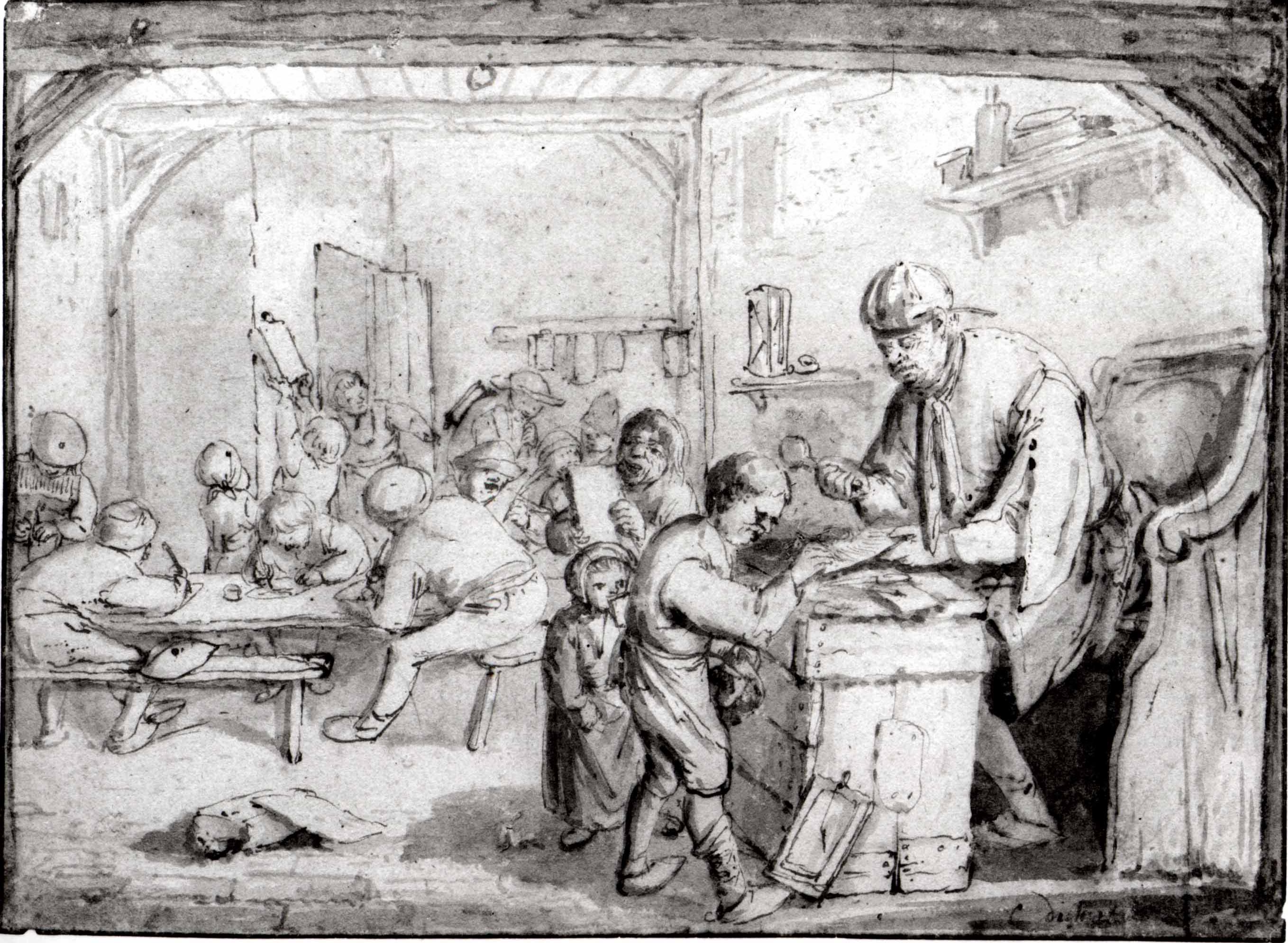
The Schoolmaster,an ink on paper drawing by Dutch artist Cornelius Dusart, c. 1680. This unruly scene depicts boys of different ages reading, writing, and perhaps fighting in a simple classroom. Courtesy of the Metropolitan Museum of Art. Public Domain.
Overview
Para1Formal education was primarily reserved for young boys from the middle or upper social
classes. Many of these privileged boys attended grammar school from age seven to fourteen.
The number of boys enrolling in grammar school increased in the Elizabethan period
as part of the Protestant emphasis on education. After grammar school or extensive
private tutoring, a select few elite English students might continue their education
at the University of Oxford or Cambridge if their intellectual abilities and finances
permitted. Scholarships for bright boys who lacked resources were rare but did exist.
More commonly, boys and young men would begin an apprenticeship in a career path.
Grammar School
Para2Although children from nobility were often taught by private tutors at home, most
boys of the prosperous classes attended a local grammar school. These grammar schools
enrolled the sons of prosperous minor landowners, merchants, skilled artisans and
tradesmen, and lawyers. Starting in the 16th century, large numbers of grammar schools
were founded throughout England to raise literacy, which was crucial for the newly
Protestant nation. New doctrine encouraged each person to study the Bible individually,
so literacy was tied to piety. The general purpose for education during this period
was to instruct students in literacy but also on how to behave themselves appropriately
based on their social class and to become better members of a Protestant nation.
Curriculum and Methods
Para3Boys learned to read and to write English in a petty school and then in Latin in a
grammar school. They also studied basic principles of Christianity. From ages seven
to ten, students focused on spelling, grammar, rhetoric, and basic Latin. Most commonly,
the schoolmaster spoke only in Latin and required students to do the same. Boys were
expected to become proficient in Latin, the language of the educated population throughout
Europe, or face physical punishment, including beatings with a birch rod. Discipline
was strict.
Para4Students from ages ten to fourteen advanced their Latin skills but were sometimes
also trained in arithmetic, philosophy, religious studies, literature, and occasionally
Greek. Classical Latin authors such as Ovid, Cicero, and Catullus anchored the curriculum.
Para5Teachers during this period relied on rigid teaching modes such as memorization and
recitation, believing them the most accurate form of learning. New ideas about education
were promoted by writers like Roger Ascham, who tutored Queen Elizabeth I. His book
The Schoolmaster, published in 1570 after his death, advocated for educating boys using more humanistic
approaches.
Para6The typical school day began at 6:00 AM and ended at 5:00 PM, with a lunch break of
an hour or more. School for these students continued for around forty-one weeks per
year, with only a few weeks off for holiday breaks.
Further Education
Para7After grammar school, some elite young men either went to a university or to study
the law at the Inns of Court. At either the University of Oxford or the University
of Cambridge, they would have to be admitted to one of the colleges, where they studied
the traditional medieval curriculum of theology, supplemented by studies in grammar,
rhetoric, and logic, alongside astronomy, geometry, arithmetic, and music. It was
an education designed in the Middle Ages to prepare men for the priesthood, and so
newer knowledge and literature were not formally studied. Young men could earn a baccalaureate
degree in about three years, and a few earned a master’s degree after two more.
Para8At one of the Inns of Court, young men read law, but there were no formal classes
or tutorial system. Instead, the young men lived at one of the four Inns of Court,
attended court sessions, and read law for seven years prior to being called to the
bar.
Para9The vast majority of boys and young men began work in a family business, or they started
an apprenticeship to prepare for a career. Most boys began apprenticeships between
ages 11-14. Boys seeking to enter a skilled trade completed seven years of apprenticeship
before becoming eligible to be a journeyman and begin working for wages, usually in
their early 20s.
Sources
Jewell, Helen M. Education in Early Modern England. Red Globe Press, 1999.
Kathryn R. McPherson and Moncrief, Kathryn M.. Performing Pedagogy in Early Modern England. Routledge, 2011.
Preiss, Richard, and Deanne Williams. Childhood, Education and the Stage in Early Modern England. Cambridge University Press, 2017.
Open-Access Digital Resources
Best, Michael.
The Education of Boys.Shakespeare’s Life and Times. Internet Shakespeare Editions. University of Victoria, 4 Jan, 2011, https://internetshakespeare.uvic.ca/Library/SLT/ideas/education/boys.html. Accessed 17 Sep. 2018.
Best, Michael.
Roger Ascham.Shakespeare’s Life and Times.Internet Shakespeare Editions. University of Victoria, 4 Jan, 2011, https://internetshakespeare.uvic.ca/Library/SLT/literature/prose/ascham.html. Accessed 17 Sep. 2018.
Gillard, Derek.
Education in England: A History.Education in England, May 2018, http://www.educationengland.org.uk/history/. Accessed 27 Feb. 2023.
Wrightson, Keith.
Education: Cultural Influences Underlying an Increase in Schooling.Lecture at Yale University. Bewminate.com, edited by Matthew MacIntosh, 29 Oct. 2009, https://brewminate.com/education-and-literacy-in-early-modern-england/. Accessed 24 Feb. 2023.
Image Source
Dusart, Cornelius.
The Schoolmaster. c. 1680. Ink on paper. The Metropolitan Museum of Art. https://www.metmuseum.org/art/collection/search/459316.
Prosopography
Courtney Follett
Courtney Follett was a student at Utah Valley University.
Kate McPherson
Kate McPherson is Professor of English and Honors Program Director at Utah Valley
University (Orem, UT, USA). In 2015, she began working to redevelop Shakespeare’s Life and Times, created by Michael Best, into the Early Modern England Encyclopedia. Her other publications include commentary on Pericles and The Comedy of Errors for the New Oxford Shakespeare (2016); the co-edited volumes Stages of Engagement: Drama and Religion in Post-Reformation England with James Mardock (Duquesne University Press, 2014) and Shakespeare Expressed: Page, Stage, and Classroom in Shakespeare and His Contemporaries, with Kathryn M. Moncrief and Sarah Enloe (Fairleigh Dickinson University Press,
2013). With Kathryn M. Moncrief, Kate has also two edited collections, Performing Pedagogy in Early Modern England: Gender, Instruction, and Performance (Ashgate, 2011) and Performing Maternity in Early Modern England (Ashgate 2008). She has also published numerous articles on early modern maternity
in scholarly journals. Kate participated in the 2008 National Endowment for the Humanities
Institute,
Shakespeare’s Blackfriars: The Study, the Stage, the Classroom,at the American Shakespeare Center. She also served as Play Seminar Director, a public humanities position, for the Utah Shakespeare Festival in 2017 and 2018.
Leah Hamby
Leah Hamby is the primary encoder for the Early Modern England Encyclopedia. Aside from encoding, she also works as an editor for the project and contributed
several articles of her own. She has been working on the EMEE since February 2023. As of February 2026, she is soon to graduate with honours from
Utah Valley University with a major in history and a minor in creative writing. Her
other work with the LEMDO program includes remediating William Kemp’s Kemp’s Nine Day’s Wonder for the Digital Renaissance Editions.
Michael Best
Michael Best is Professor Emeritus at the University of Victoria, BC. He founded the
Internet Shakespeare Editions in 1996, and was Coordinating Editor until 2017, contributing two editions to the
ISE: King John and King Lear (the latter also available in print from Broadview Press). In print, he has published editions of works of Elizabethan magic and huswifery,
a collection of letters from the Australian goldfields, and Shakespeare on the Art of Love (2008). He contributed regular columns for the Shakespeare Newsletter on
Electronic Shakespeares,and has written many articles and chapters for both print and online books and journals, principally on questions raised by the new medium in the editing and publication of texts. He has delivered papers and plenary lectures on electronic media and the Internet Shakespeare Editions at conferences in Canada, the USA, the UK, Spain, Australia, and Japan.
Navarra Houldin
Training and Documentation Lead 2025–present. LEMDO project manager 2022–2025. Textual
remediator 2021–present. Navarra Houldin (they/them) completed their BA with a major
in history and minor in Spanish at the University of Victoria in 2022. Their primary
research was on gender and sexuality in early modern Europe and Latin America. They
are continuing their education through an MA program in Gender and Social Justice
Studies at the University of Alberta where they will specialize in Digital Humanities.
Orgography
LEMDO Team (LEMD1)
The LEMDO Team is based at the University of Victoria and normally comprises the project
director, the lead developer, project manager, junior developers(s), remediators,
encoders, and remediating editors.
University of Victoria (UVIC1)
https://www.uvic.ca/Metadata
| Authority title | Education for Boys |
| Type of text | Critical |
| Publisher | University of Victoria on the Linked Early Modern Drama Online Platform |
| Series | Early Modern England Encyclopedia |
| Source |
By Courtney Follett and Kate McPherson, inspired by Michael Best’s Shakespeare’s Life and Times, Internet Shakespeare Editions
|
| Editorial declaration | This document uses Canadian English spelling |
| Edition | Released with Early Modern England Encyclopedia 1.0 |
| Sponsor(s) |
Early Modern England EncyclopediaAnthology Leads: Kate McPherson and Kate Moncrief.
|
| Encoding description | Encoded in TEI P5 according to the LEMDO Customization and Encoding Guidelines |
| Document status | published |
| Funder(s) |
Social Sciences and Humanities Research Council of Canada
Mitacs Globalink Research Internship Utah Valley University |
| License/availability |
Unless otherwise noted, intellectual copyright in EMEE Anthology pages is held by
Kate McPherson on behalf of the contributors. Copyright on the TEI-XML markup is held by the University of Victoria on behalf of the LEMDO Team. The content and TEI-XML markup in this file are licensed under a CC BY-NC-ND 4.0 license. This file is freely downloadable without permission under the following conditions:
(1) credit must be given to the authors, EMEE, and LEMDO in any subsequent use of
the files and /or data; (2) this availability statement must remain in the file; (3)
the content cannot be adapted or repurposed (except for quotations for the purposes
of academic review and citation); and (4) commercial uses are not permitted without
the knowledge and consent of the authors, EMEE, and LEMDO. Neither the content nor
the code in this file is licensed for training large language models (LLMs), ingestion
into an LLM, or any use in any artificial intelligence applications; such uses are
considered to be commercial uses and are strictly prohibited.
|