
A Play of Errors and Confusion
Recorded Performance of The Comedy of Errors
Para1Official records indicate Shakespeare’s playing company, the Lord Chamberlain’s Men,
performed The Comedy of Errors at Gray’s Inn, the largest of the London Inns of Court where young gentlemen studied
law, on December 28th, 1594. The play was part of the Christmas law revels, the first Yuletide festivities in four years due to the recent long outbreak of
bubonic plague. Gray’s Inn was noted for its elaborate masques and revels. In that
year, the festivities extended the full twelve days of Christmas, from the 27th of
December to the 6th of January.
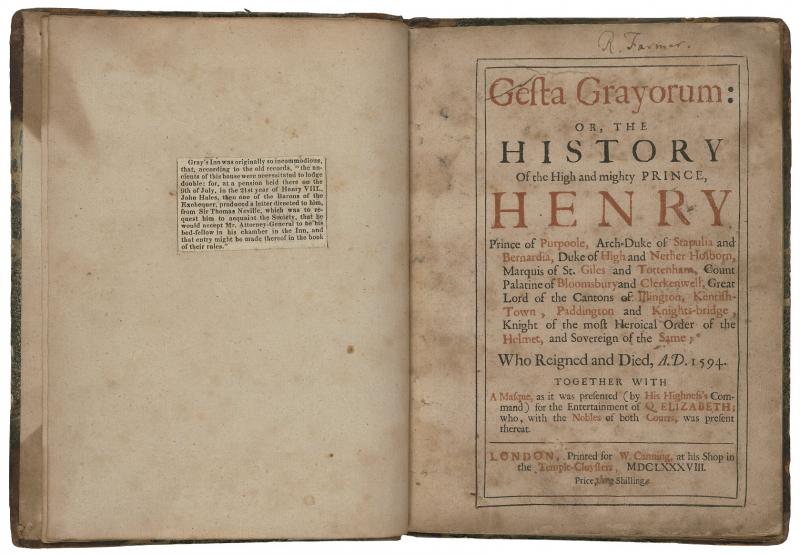
Para2A book written in 1595 (but not published until 1688) called Gesta Grayorum (Gray’s Performances) describes the evening that became known as The Night of Errors. It notes that
A Comedy of Errors (like to Plautus his Menechmus) was played by the Players.The hubbub that followed gave the night its infamous name.
Para3Gesta Grayorum observes that the crowd was large and unruly, so it was
thought good not to offer any thing of Account, saving Dancing and Revelling with Gentlewomen... and a Comedy of Errors... which was played by the Players.It continues:
So that Night was begun, and continued to the end, in nothing but Confusion and Errors; whereupon, it was ever afterwards called, The Night of Errors.
Para4Other commentary about the performance includes the mild complaint that the players
were
foistedon the members of Gray’s Inn, and they are characterized as
a Company of base and common Fellows, to make up our Disorders with a Play of Errors and Confusions.These complaints appear to shift the blame for the rowdy night from the audience to the entertainers. In an ending fitting for a comedy and law students, a mock-trial held the next day blamed the incident on a sorcerer.
Gray’s Inn and Early Modern Theater
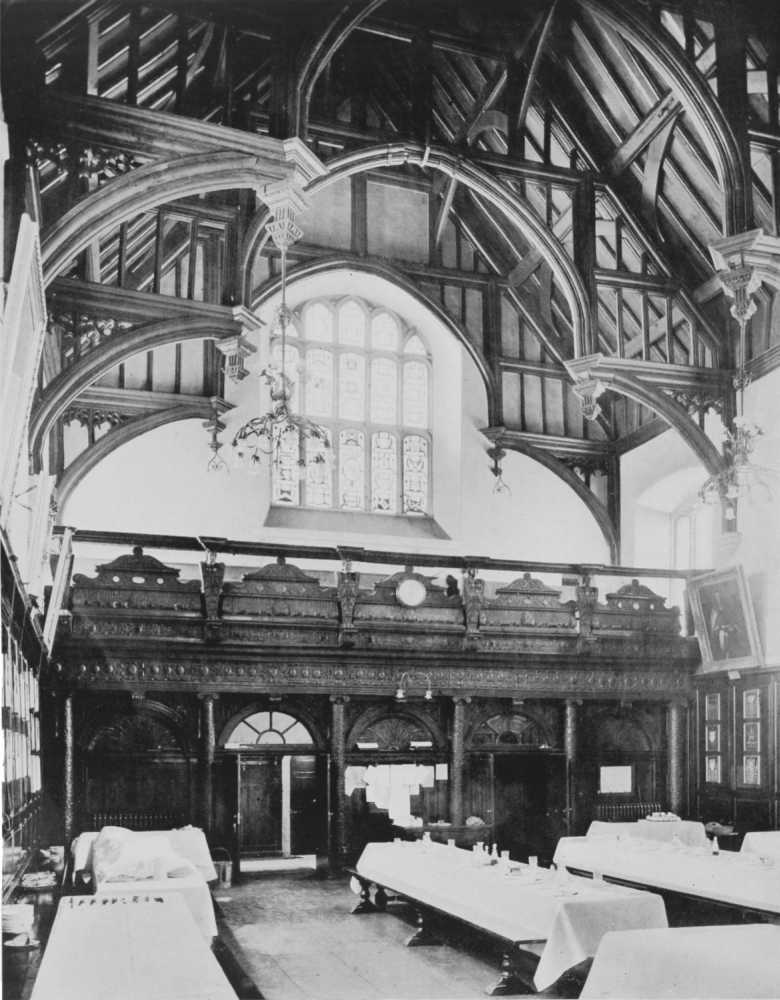
Para5Gray’s Inn, like most colleges, used its great hall for formal dinners and performances
as well as for its Christmas festivities. Many notable figures from the English early
modern period trained as lawyers at Gray’s Inn, including Lord Burleigh, who was Queen
Elizabeth’s most trusted courtier and Secretary of State, the privateer and explorer
Sir Walter Raleigh, the Queen’s spymaster Sir Francis Walsingham, author and scientist
Lord Francis Bacon, and also Shakespeare’s patron, Henry Wriothesley, third Earl of
Southampton. The hall hosted numerous forms of entertainment for its elite students,
patrons, and alumni.
A Two-Show Day?
Para6Curiously, court records for payments for the Queen’s Christmas festivities records
note that Shakespeare, Burbage, and Kempe were paid £10 for a performance of the same
play that day before the Queen at Greenwich. Perhaps this means that there was an
afternoon performance of The Comedy of Errors at Greenwich, and the company simply took the six-mile journey up the Thames into
the City on London and on to Gray’s Inn for an evening show.
Key Print Sources
Knapp, Margaret, and Michal Kobialka.
Shakespeare and the Prince of Purpoole: The 1594 Production of The Comedy of Errors at Gray’s Inn Hall.Theatre History Studies, vol. 4, no. 71, 1 Jan. 1984, pp. 70–81.
Potter, Lois. The Life of William Shakespeare: a Critical Biography. Wiley-Blackwell, 7 May 2012. pp. 151–155.
The Comedy of Errors.The Oxford Companion to Shakespeare, edited by Michael Dobson, Stanley Wells, Will Sharpe, and Erin Sullivan, 2nd ed., Oxford University Press, 2015, pp. 84–86.
Key Online Sources
Best, Michael. A Comedy of Errors and Confusion. Shakespeare’s Life and Times. Internet Shakespeare Editions, https://internetshakespeare.uvic.ca/Library/SLT/life/youth/errors.html. Accessed 20 Feb. 2023.
Gray’s Inn: Inn of Court.Shakespearean London Theatres, https://shalt.dmu.ac.uk/locations/grays-inn/indepth.html. Accessed 20 Feb. 2023.
Nelson, Alan H.
Gesta Grayorum: References to Shakespeare’s Comedy of Errors at Gray’s Inn Revels 1594–95.Shakespeare Documented, 25 Jan. 2020, DOI 10.37078/208.
Prosopography
Janelle Jenstad
Janelle Jenstad is a Professor of English at the University of Victoria, Director
of The Map of Early Modern London, and Director of Linked Early Modern Drama Online. With Jennifer Roberts-Smith and Mark Beatrice Kaethler, she co-edited Shakespeare’s Language in Digital Media: Old Words, New Tools (Routledge). She has edited John Stow’s A Survey of London (1598 text) for MoEML and is currently editing The Merchant of Venice (with Stephen Wittek) and Heywood’s 2 If You Know Not Me You Know Nobody for DRE. Her articles have appeared in Digital Humanities Quarterly, Elizabethan Theatre, Early Modern Literary Studies, Shakespeare Bulletin, Renaissance and Reformation, and The Journal of Medieval and Early Modern Studies. She contributed chapters to Approaches to Teaching Othello (MLA); Teaching Early Modern Literature from the Archives (MLA); Institutional Culture in Early Modern England (Brill); Shakespeare, Language, and the Stage (Arden); Performing Maternity in Early Modern England (Ashgate); New Directions in the Geohumanities (Routledge); Early Modern Studies and the Digital Turn (Iter); Placing Names: Enriching and Integrating Gazetteers (Indiana); Making Things and Drawing Boundaries (Minnesota); Rethinking Shakespeare Source Study: Audiences, Authors, and Digital Technologies (Routledge); and Civic Performance: Pageantry and Entertainments in Early Modern London (Routledge). For more details, see janellejenstad.com.
Kate McPherson
Kate McPherson is Professor of English and Honors Program Director at Utah Valley
University (Orem, UT, USA). In 2015, she began working to redevelop Shakespeare’s Life and Times, created by Michael Best, into the Early Modern England Encyclopedia. Her other publications include commentary on Pericles and The Comedy of Errors for the New Oxford Shakespeare (2016); the co-edited volumes Stages of Engagement: Drama and Religion in Post-Reformation England with James Mardock (Duquesne University Press, 2014) and Shakespeare Expressed: Page, Stage, and Classroom in Shakespeare and His Contemporaries, with Kathryn M. Moncrief and Sarah Enloe (Fairleigh Dickinson University Press,
2013). With Kathryn M. Moncrief, Kate has also two edited collections, Performing Pedagogy in Early Modern England: Gender, Instruction, and Performance (Ashgate, 2011) and Performing Maternity in Early Modern England (Ashgate 2008). She has also published numerous articles on early modern maternity
in scholarly journals. Kate participated in the 2008 National Endowment for the Humanities
Institute,
Shakespeare’s Blackfriars: The Study, the Stage, the Classroom,at the American Shakespeare Center. She also served as Play Seminar Director, a public humanities position, for the Utah Shakespeare Festival in 2017 and 2018.
Leah Hamby
Leah Hamby is the primary encoder for the Early Modern England Encyclopedia. Aside from encoding, she also works as an editor for the project and contributed
several articles of her own. She has been working on the EMEE since February 2023. As of February 2026, she is soon to graduate with honours from
Utah Valley University with a major in history and a minor in creative writing. Her
other work with the LEMDO program includes remediating William Kemp’s Kemp’s Nine Day’s Wonder for the Digital Renaissance Editions.
Michael Best
Michael Best is Professor Emeritus at the University of Victoria, BC. He founded the
Internet Shakespeare Editions in 1996, and was Coordinating Editor until 2017, contributing two editions to the
ISE: King John and King Lear (the latter also available in print from Broadview Press). In print, he has published editions of works of Elizabethan magic and huswifery,
a collection of letters from the Australian goldfields, and Shakespeare on the Art of Love (2008). He contributed regular columns for the Shakespeare Newsletter on
Electronic Shakespeares,and has written many articles and chapters for both print and online books and journals, principally on questions raised by the new medium in the editing and publication of texts. He has delivered papers and plenary lectures on electronic media and the Internet Shakespeare Editions at conferences in Canada, the USA, the UK, Spain, Australia, and Japan.
Navarra Houldin
Training and Documentation Lead 2025–present. LEMDO project manager 2022–2025. Textual
remediator 2021–present. Navarra Houldin (they/them) completed their BA with a major
in history and minor in Spanish at the University of Victoria in 2022. Their primary
research was on gender and sexuality in early modern Europe and Latin America. They
are continuing their education through an MA program in Gender and Social Justice
Studies at the University of Alberta where they will specialize in Digital Humanities.
Orgography
LEMDO Team (LEMD1)
The LEMDO Team is based at the University of Victoria and normally comprises the project
director, the lead developer, project manager, junior developers(s), remediators,
encoders, and remediating editors.
University of Victoria (UVIC1)
https://www.uvic.ca/Metadata
| Authority title | A Play of Errors and Confusion |
| Type of text | Critical |
| Publisher | University of Victoria on the Linked Early Modern Drama Online Platform |
| Series | Early Modern England Encyclopedia |
| Source |
By Kate McPherson, inspired by Michael Best’s Shakespeare’s Life and Times, Internet Shakespeare Editions
|
| Editorial declaration | This document uses Canadian English spelling |
| Edition | Released with Early Modern England Encyclopedia 1.0 |
| Sponsor(s) |
Early Modern England EncyclopediaAnthology Leads: Kate McPherson and Kate Moncrief.
|
| Encoding description | Encoded in TEI P5 according to the LEMDO Customization and Encoding Guidelines |
| Document status | published |
| Funder(s) |
Social Sciences and Humanities Research Council of Canada
Mitacs Globalink Research Internship Utah Valley University |
| License/availability |
Unless otherwise noted, intellectual copyright in EMEE Anthology pages is held by
Kate McPherson on behalf of the contributors. Copyright on the TEI-XML markup is held by the University of Victoria on behalf of the LEMDO Team. The content and TEI-XML markup in this file are licensed under a CC BY-NC-ND 4.0 license. This file is freely downloadable without permission under the following conditions:
(1) credit must be given to the authors, EMEE, and LEMDO in any subsequent use of
the files and /or data; (2) this availability statement must remain in the file; (3)
the content cannot be adapted or repurposed (except for quotations for the purposes
of academic review and citation); and (4) commercial uses are not permitted without
the knowledge and consent of the authors, EMEE, and LEMDO. Neither the content nor
the code in this file is licensed for training large language models (LLMs), ingestion
into an LLM, or any use in any artificial intelligence applications; such uses are
considered to be commercial uses and are strictly prohibited.
|