
Districts in London
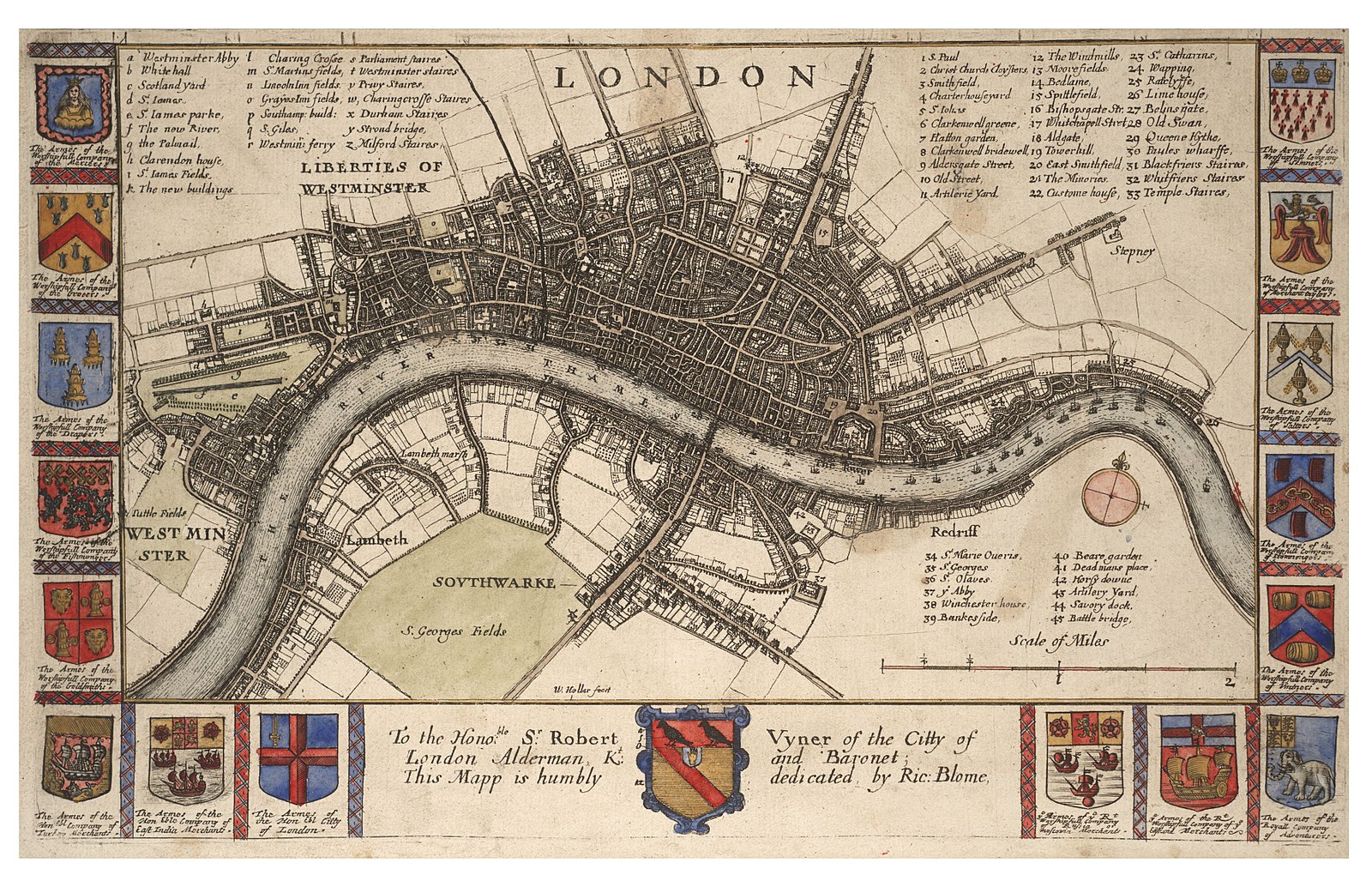
London in 1600
Para1In 1600, London had an estimated population of 200,000 people. These citizens and
residents came from every social level, a huge number of trades, and many nationalities.
The city and its surrounding communities had grown rapidly, doubling in size between
1550 and 1600. Though there were many different districts (or neighborhoods) which
surrounded the official City of London, several stand out as particularly important
in the drama of the period.
River Thames
Para2Though the River Thames is not a neighborhood in which people worked or lived, it
was central to the city’s life and character. It was a major factor in London as a
place of growing business and commerce in the European world. The Thames provided
an important port where goods from all over the world could be traded, bought, and
shipped back out again. It was that center of commerce which led many international
merchants to immigrate to London to build their businesses, creating a culturally
diverse atmosphere of languages and customs.
Westminster and Whitehall
Para3During the reigns of Queen Elizabeth I and King James I, the royal court would travel
between the districts of Westminster (home of Westminster Abbey), Whitehall (the largest
palace at the time), Greenwich, Richmond, Hampton Court, and Windsor Castle. The royal
court moved from one location to another because the sanitation capabilities of each
location would be overwhelmed by the large number of people which comprised the royal
court. Many courtiers built grand houses adjacent to both Westminster and Whitehall.
Para4Westminster Abbey was the coronation place of the Kings and Queens of England while
nearby Westminster Hall was the
king's principal palaceaccording to chronicler John Stowe. Westminster Hall was built soon after the Norman Conquest by King William II, around 1100 CE. King Richard II remodeled the Hall, and in an ironic twist of fate, was himself the first to be tried there in 1399, shortly after it was finished. Westminster Abbey still stands and remains the site of coronations (most recently of King Charles III in 2023), but of the massive complex of medieval and early modern buildings once in the area, only Westminster Hall and the Banqueting House from Whitehall Palace survive.
Shoreditch and Bankside
Para5In 1574 a law was created which prohibited theatres, which were growing in popularity,
from being built within the city limits of London. Because of this law, many theatres
were built just outside of London’s city limits in suburbs just north of the City
such as Shoreditch or just across the river in Southwark to escape the regulations.
Para6Shoreditch was the home of the first permanent theatre building, called The Theatre,
which was built in 1576 by James Burbage and later used by his son, the actor Richard
Burbage and his company. This same company eventually became The Lord Chamberlain’s
Men and included William Shakespeare. Shakespeare became part-owner (a sharer) in
The Lord Chamberlain’s Men. The company had a dispute about the lease of The Theater
with the landowner, so the troupe took the building apart and carried the pieces across
the Thames. They rebuilt the theatre in the Bankside district of Southwark and named
it the Globe Theatre in 1599.
Para7The company also performed plays at the Curtain Theater in Shoreditch, which is currently
undergoing excavation by the Museum of London after its foundations were discovered
in 2012.
Southwark
Para8Located in the district of Southwark is Southwark Cathedral, but in the 16th and 17th
centuries, the area was also an entertainment district, housing several theaters such
as The Swan and The Rose (where Christopher Marlowe’s plays were performed), but also
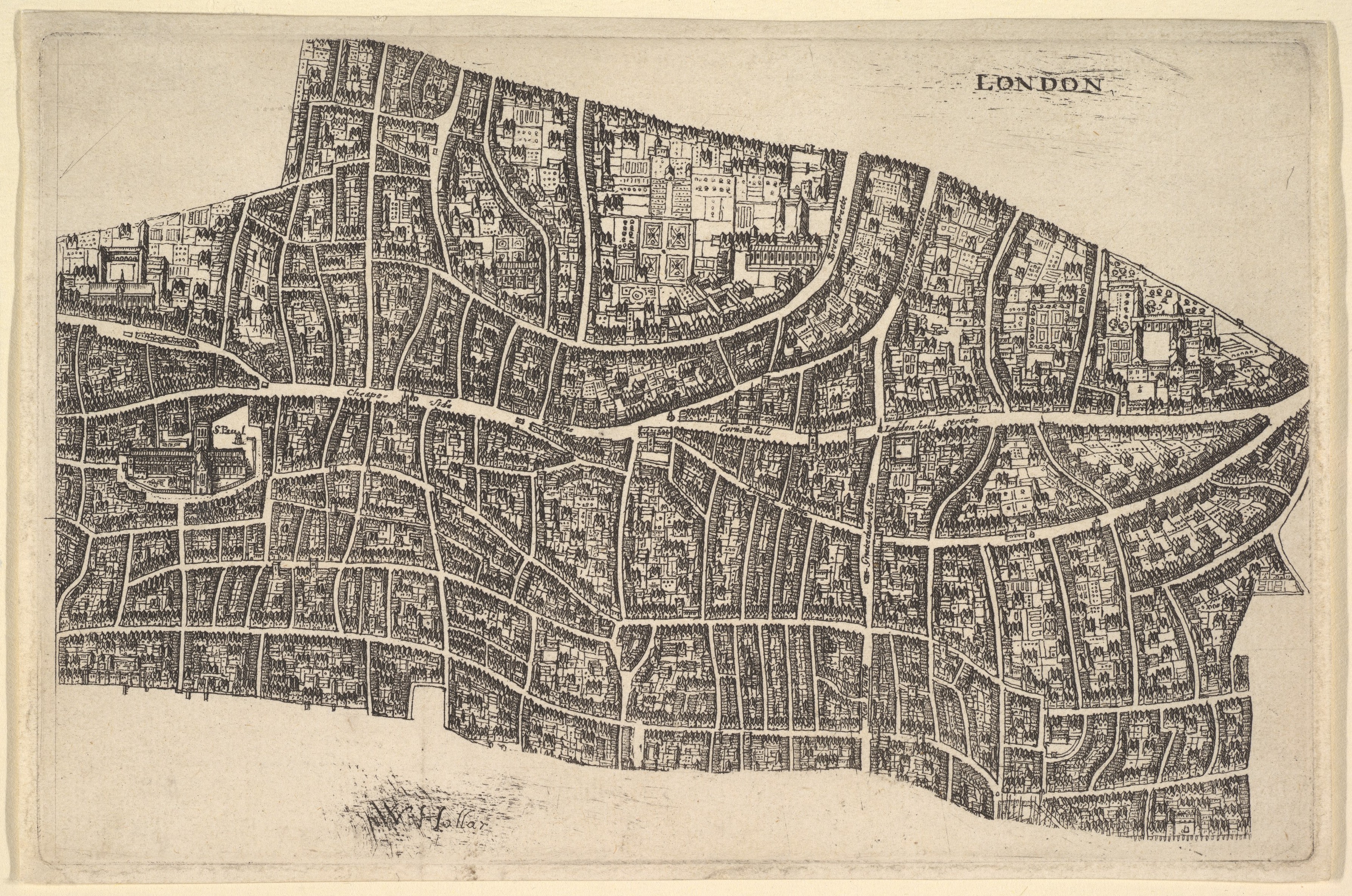
bear-baiting arenas and brothels. Using the vantage point of the steeple of Southwark
Cathedral, Wenceslaus Hollar was able to draw a map of London before the great fire
of 1666.
Smithfield
Para9Smithfield has a diverse history that goes back a thousand years to when Romans occupied
Britain. The district had a plethora of natural resources, including open fertile
fields, the freshwater Fleet River, and a natural protective border on the west side
which made this a popular area to occupy. In 1123, the area received its first charter
to build a priory (a small monastery) called St. Bartholomew the Great, also known
today as St. Bart’s. Soon several other religious buildings were built around the
town center of Smithfield just inside the city walls. St. Bart’s started a small annual
fair meant to sell cloth, but the fair soon became renowned throughout Europe and
attracted buyers and sellers from several different countries. The fair had gained
so much popularity that by Shakespeare’s time it had expanded from being three days
long to two weeks long. Playwright Ben Jonson immortalized the raucous atmosphere
of the fair’s merchants, puppetry performances, music, crime, and food in his 1614
play Bartholomew Fair.
Para10The network of churches and priories in Smithfield created the base of the modern
medical system in Britain. It became a place known for medical research and study.
Due to the large population and international visitors, people in Smithfield came
in contact with a variety of diseases and diverse injuries, so patients were plentiful;
these factors led to major medical discoveries such as the circulation of blood by
William Harvey in 1628.
Para11The open fields outside of Smithfield were the site of two important aspects of London
life. The first was that Smithfield was a part of the execution triad in London, with
the Tower of London and Tyburn being the other two. Smithfield was mainly the site
for executions of religious dissenters.
Para12The second use of the open fields was the meat market. Chronicler John Stowe’s Survey of London notes the division of the city into distinct neighborhoods, often associated with
a trade:
[…] the brewers for the more part remain near to the friendly water of the Thames; the butchers in Eastcheape, St. Nicholas shambles, and the Stockes market; the hosiers of old time in Hosier lane, near unto Smithfield, are since removed into Cordwayner street […] labourers every work-day are to be found in Cheape, about Soper’s land end; horse-coursers and sellers of oxen, sheep, swine, and such like, remain in their old market of Smithfield.Up until the 1800’s, Smithfield was an open-air market for the selling and butchering of livestock. The meat market still exists today, though it has been rebuilt as an indoor market.
Sources
Picard, Liza. Elizabeth’s London: Everyday Life in Elizabethan London. St. Martin’s Press, 2003.
Porter, Stephen. Everyday Life in Tudor England: Life in the City of Thomas Cromwell, William Shakespeare,
& Anne Boleyn. Amberley Publishing, 2016.
Stowe, John. A Survey of London. Ed. C.L. Kingsford. Cambridge UP, 2015.
Open-Access Digital Resources
Best, Michael.
Districts Within London.Shakespeare’s Life and Times. Internet Shakespeare Editions. University of Victoria, 4 Jan. 2011, https://internetshakespeare.uvic.ca/Library/SLT/society/city%20life/citylondonparts.html. Accessed 11 Feb. 2026.
Jenstad, Janelle A.. The Map of Early Modern London. University of Victoria, 4 May 2022, https://mapoflondon.uvic.ca/. Accessed 11 Feb. 2026.
The History of Smithfield Market.Museum of London, 4 Apr. 2019, https://www.londonmuseum.org.uk/collections/london-stories/history-smithfield-market/. Accessed 11 Feb. 2026.
Rasmussen, Eric and Ian De Jong.
Shakespeare’s London.The British Library. 2 Oct. 2015. https://www.britishlibrary.cn/en/articles/shakespeares-london/. Accessed 25 Jun. 2026.
Trickey, Alice.
10 Locations for Discovering William Shakespeare’s London.Guide London, 28 Apr. 2017. https://www.guidelondon.org.uk/blog/around-london/10-locations-for-discovering-william-shakespeares-london/. Accessed 11 Feb. 2026.
Image Sources
Hollar, Wenceslaus. London Before the Great Fire. 1666–1677. Etching. The Metropolitan Museum of Art. Object number: 56.581.8. https://www.metmuseum.org/art/collection/search/361738.
Hollar, Wenceslaus. Plan of London Before the Fire. State 2, variant. N.d. Wikimedia Commons. https://commons.wikimedia.org/wiki/File:Wenceslas_Hollar_-_Plan_of_London_before_the_fire_%28State_2%29,_variant.jpg.

Prosopography
Kate McPherson
Kate McPherson is Professor of English and Honors Program Director at Utah Valley
University (Orem, UT, USA). In 2015, she began working to redevelop Shakespeare’s Life and Times, created by Michael Best, into the Early Modern England Encyclopedia. Her other publications include commentary on Pericles and The Comedy of Errors for the New Oxford Shakespeare (2016); the co-edited volumes Stages of Engagement: Drama and Religion in Post-Reformation England with James Mardock (Duquesne University Press, 2014) and Shakespeare Expressed: Page, Stage, and Classroom in Shakespeare and His Contemporaries, with Kathryn M. Moncrief and Sarah Enloe (Fairleigh Dickinson University Press,
2013). With Kathryn M. Moncrief, Kate has also two edited collections, Performing Pedagogy in Early Modern England: Gender, Instruction, and Performance (Ashgate, 2011) and Performing Maternity in Early Modern England (Ashgate 2008). She has also published numerous articles on early modern maternity
in scholarly journals. Kate participated in the 2008 National Endowment for the Humanities
Institute,
Shakespeare’s Blackfriars: The Study, the Stage, the Classroom,at the American Shakespeare Center. She also served as Play Seminar Director, a public humanities position, for the Utah Shakespeare Festival in 2017 and 2018.
Kimberly Wallace
Kimberly Wallace was a student at the University of Fraser Valley.
Leah Hamby
Leah Hamby is the primary encoder for the Early Modern England Encyclopedia. Aside from encoding, she also works as an editor for the project and contributed
several articles of her own. She has been working on the EMEE since February 2023. As of February 2026, she is soon to graduate with honours from
Utah Valley University with a major in history and a minor in creative writing. Her
other work with the LEMDO program includes remediating William Kemp’s Kemp’s Nine Day’s Wonder for the Digital Renaissance Editions.
Michael Best
Michael Best is Professor Emeritus at the University of Victoria, BC. He founded the
Internet Shakespeare Editions in 1996, and was Coordinating Editor until 2017, contributing two editions to the
ISE: King John and King Lear (the latter also available in print from Broadview Press). In print, he has published editions of works of Elizabethan magic and huswifery,
a collection of letters from the Australian goldfields, and Shakespeare on the Art of Love (2008). He contributed regular columns for the Shakespeare Newsletter on
Electronic Shakespeares,and has written many articles and chapters for both print and online books and journals, principally on questions raised by the new medium in the editing and publication of texts. He has delivered papers and plenary lectures on electronic media and the Internet Shakespeare Editions at conferences in Canada, the USA, the UK, Spain, Australia, and Japan.
Navarra Houldin
Training and Documentation Lead 2025–present. LEMDO project manager 2022–2025. Textual
remediator 2021–present. Navarra Houldin (they/them) completed their BA with a major
in history and minor in Spanish at the University of Victoria in 2022. Their primary
research was on gender and sexuality in early modern Europe and Latin America. They
are continuing their education through an MA program in Gender and Social Justice
Studies at the University of Alberta where they will specialize in Digital Humanities.
Orgography
LEMDO Team (LEMD1)
The LEMDO Team is based at the University of Victoria and normally comprises the project
director, the lead developer, project manager, junior developers(s), remediators,
encoders, and remediating editors.
University of Victoria (UVIC1)
https://www.uvic.ca/Metadata
| Authority title | Districts in London |
| Type of text | Critical |
| Publisher | University of Victoria on the Linked Early Modern Drama Online Platform |
| Series | Early Modern England Encyclopedia |
| Source |
By Kimberly Wallace, inspired by Michael Best’s Shakespeare’s Life and Times, Internet Shakespeare Editions
|
| Editorial declaration | This document uses Canadian English spelling |
| Edition | Released with Early Modern England Encyclopedia 1.0 |
| Sponsor(s) |
Early Modern England EncyclopediaAnthology Leads: Kate McPherson and Kate Moncrief.
|
| Encoding description | Encoded in TEI P5 according to the LEMDO Customization and Encoding Guidelines |
| Document status | published, peer-reviewed |
| Funder(s) |
Social Sciences and Humanities Research Council of Canada
Mitacs Globalink Research Internship Utah Valley University |
| License/availability |
Intellectual copyright in this entry is held by Kate McPherson on behalf of the contributors. Copyright on the TEI-XML markup is held by the University of Victoria on behalf of the LEMDO Team. The content and TEI-XML markup in this file are licensed under a CC BY-NC_ND 4.0 license. This file is freely downloadable without permission under the following conditions:
(1) credit must be given to the authors, EMEE, and LEMDO in any subsequent use of
the files and /or data; (2) this availability statement must remain in the file; (3)
the content cannot be adapted or repurposed (except for quotations for the purposes
of academic review and citation); and (4) commercial uses are not permitted without
the knowledge and consent of the authors, EMEE, and LEMDO. Neither the content nor
the code in this file is licensed for training large language models (LLMs), ingestion
into an LLM, or any use in any artificial intelligence applications; such uses are
considered to be commercial uses and are strictly prohibited.
|