
Cutpurses
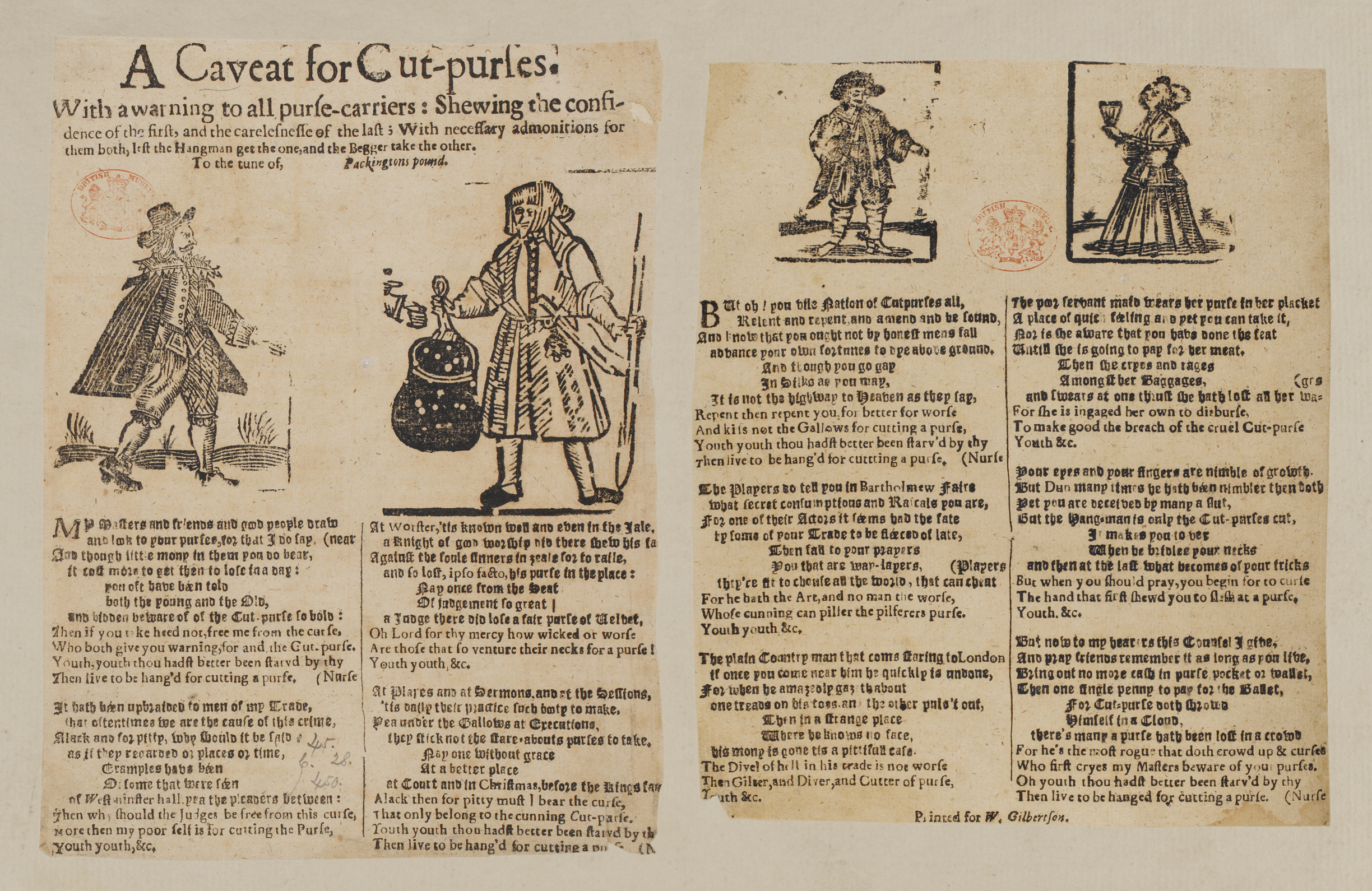
A Caveat for Cut-purses,c. 1647–1665. Courtesy of The English Broadside Ballads Archive. Original copy in The British Library. CC BY 4.0..
Para1A cutpurse was the common word for pickpocket in early modern England. Many clothing
items did not feature sewn-in pockets, so people had purses of fabric or leather on
strings that were tied around the waist or to a belt. The origin of the term comes
from late middle English and it references thieves who would cut these suspended purses,
which mainly held coins. The playwright and poet Ben Jonson features a ballad about
the cutpurse in his popular 1604 comedy, Bartholomew Fair.
Para2Cutpursing made up about 10% of the property crimes in early modern England and was
most often perpetrated by males, although historians believe that female participation
in crime is underreported during the era.
Life of a Cutpurse
Para3Successful cutpurses were like most successful thieves, with a quiet approach, quick
hands, and an even quicker escape. If a cutpurse was caught during a performance at
a theatre, he/she would be tied up to the stage and the audience was encouraged to
throw food and verbal abuse at the culprit. The punishment for cutpurses was both
physical and emotional abuse, followed by other physical sanctions handed out by a
magistrate such as whipping, branding, ear-clipping, or being placed in the stocks.
Serial offenders might even be hanged.
Cutpurses in Shakespeare’s Plays
Para4One of the most recognized cutpurses in Shakespeare’s plays is Pistol from Henry V. Pistol is a solider who marries the hostess of the local tavern in the London neighborhood
of Eastcheap. Very brash and quarrelsome, Pistol is eventually revealed to be a coward
and he flees to England to become a cutpurse. A cutpurse is also referenced in Hamlet. Prince Hamlet, while speaking harshly with his mother, Queen Gertrude, says,
a murderer and a villain; a slave that is not twentieth part the tithe of your precedent lord; a vice of kings; a cutpurse of the empire and the rule, that from a shelf the precious diadem stole, and put it in his pocket!(3.4.110). Cutpurses carried a strong negative connotation, similar to how society today regards muggers and other petty thieves.
Edgworth in Bartholomew Fair
Para5Ben Jonson’s 1614 city comedy Bartholomew Fair depicts the raucous world of this annual London fair, complete with petty criminals,
lovers, clueless officials, brothel keepers and more. The thief Ezekial Edgworth is
a cutpurse, who is falsely introduced to the misguided Justice Overdo as an honest
clerk. He participates in several schemes during the play, including picking pockets
and stealing a marriage certificate. His accomplice Nightengale sings
A Caveat for Cutpursesduring the play.
Moll Cutpurse
Para6Mary Frith (c.1584–1659), who went by the name Moll Cutpurse, was a famous criminal
in 17th century London. She was a thief, broker of stolen goods, talented entertainer
in taverns and theaters, and was notorious for parading through London wearing men’s
clothes. Numerous references to her were made in the period, including a play in which
she is the central character, Thomas Middleton and Thomas Dekker’s play The Roaring Girl, published in 1611 but likely performed earlier. One reported incident claims that
the cross-dressed Mary Frith took the stage after the play to perform some songs and
give bawdy speeches, and so similar afterpieces in London theater were banned because
they encouraged debauchery and crime, specifically the work of cutpurses. She was
sent to Bridewell, a house of correction for women, several times and had to perform
public penance, which she apparently did while drunk. Her raucous life and presence
in Middleton and Dekker’s play glamourised her criminal activities, but most cutpurses
of the period perpetrated their petty crime in relative obscurity until (or if) they
were caught and punished.
Sources
Eastwood, Adrienne.
A Tribe of Roaring Girls: Crime and Gender in Early Modern England.Explorations in Renaissance Culture vol. 44, no. 2, 2018, pp. 202–219.
Liapi, Lena. Roguery in Print: Crime and Culture in Early Modern London. Boydell Press, 2019.
Walker, Garthine. Crime, Gender, and Social Order in Early Modern England. Cambridge UP, 2003.
Open-Access Digital Resources
Best, Michael.
A Cutpurse.Shakespeare’s Life and Times. Internet Shakespeare Editions. University of Victoria, 4 Jan. 2011, https://internetshakespeare.uvic.ca/Library/SLT/history/crime%20and%20the%20law/cutpurse.html. Accessed 21 Feb. 2023.
cutpurse, n.OED Online, Oxford UP, 2022, www.oed.com/view/Entry/46392. Accessed 24 Feb. 2023.
Jenstad, Janelle A.. The Map of Early Modern London. University of Victoria, 4 May 2022, https://mapoflondon.uvic.ca/. Accessed 11 Feb. 2026.
Fearn, Esther.
Moll Cutpurse.Encyclopedia Britannica, 22 Jul. 2022, https://www.britannica.com/biography/Moll-Cutpurse. Accessed 24 Feb. 2023.
Mary Frith, Moll Cutpurse, The Roaring Girl.East End Women’s Museum, 20 Nov. 2016, https://eastendwomensmuseum.org/blog/mary-frith. Accessed 24 Feb. 2023.
Shakespeare, William. Henry the Fourth, Part 2. Folger Digital Texts. Edited by Barbara Mowat and Paul Werstine. The Folger Shakespeare Library, https://www.folger.edu/explore/shakespeares-works/henry-iv-part-2/. Accessed 24 Feb. 2023.
Shakespeare, William. Hamlet, Prince of Denmark. Folger Digital Texts. Edited by Barbara Mowat and Paul Werstine. The Folger Shakespeare Library. https://www.folger.edu/explore/shakespeares-works/hamlet/. Accessed 24 Feb. 2023.
Image Source
Jonson, Ben.
A Caveat for Cut-purses.c. 1647–1665. The English Broadside Ballads Archive. https://ebba.english.ucsb.edu/ballad/30274/album.
Prosopography
Elijah Aubrey
Elijah Aubrey was a student at Utah Valley University.
Kate McPherson
Kate McPherson is Professor of English and Honors Program Director at Utah Valley
University (Orem, UT, USA). In 2015, she began working to redevelop Shakespeare’s Life and Times, created by Michael Best, into the Early Modern England Encyclopedia. Her other publications include commentary on Pericles and The Comedy of Errors for the New Oxford Shakespeare (2016); the co-edited volumes Stages of Engagement: Drama and Religion in Post-Reformation England with James Mardock (Duquesne University Press, 2014) and Shakespeare Expressed: Page, Stage, and Classroom in Shakespeare and His Contemporaries, with Kathryn M. Moncrief and Sarah Enloe (Fairleigh Dickinson University Press,
2013). With Kathryn M. Moncrief, Kate has also two edited collections, Performing Pedagogy in Early Modern England: Gender, Instruction, and Performance (Ashgate, 2011) and Performing Maternity in Early Modern England (Ashgate 2008). She has also published numerous articles on early modern maternity
in scholarly journals. Kate participated in the 2008 National Endowment for the Humanities
Institute,
Shakespeare’s Blackfriars: The Study, the Stage, the Classroom,at the American Shakespeare Center. She also served as Play Seminar Director, a public humanities position, for the Utah Shakespeare Festival in 2017 and 2018.
Leah Hamby
Leah Hamby is the primary encoder for the Early Modern England Encyclopedia. Aside from encoding, she also works as an editor for the project and contributed
several articles of her own. She has been working on the EMEE since February 2023. As of February 2026, she is soon to graduate with honours from
Utah Valley University with a major in history and a minor in creative writing. Her
other work with the LEMDO program includes remediating William Kemp’s Kemp’s Nine Day’s Wonder for the Digital Renaissance Editions.
Michael Best
Michael Best is Professor Emeritus at the University of Victoria, BC. He founded the
Internet Shakespeare Editions in 1996, and was Coordinating Editor until 2017, contributing two editions to the
ISE: King John and King Lear (the latter also available in print from Broadview Press). In print, he has published editions of works of Elizabethan magic and huswifery,
a collection of letters from the Australian goldfields, and Shakespeare on the Art of Love (2008). He contributed regular columns for the Shakespeare Newsletter on
Electronic Shakespeares,and has written many articles and chapters for both print and online books and journals, principally on questions raised by the new medium in the editing and publication of texts. He has delivered papers and plenary lectures on electronic media and the Internet Shakespeare Editions at conferences in Canada, the USA, the UK, Spain, Australia, and Japan.
Navarra Houldin
Training and Documentation Lead 2025–present. LEMDO project manager 2022–2025. Textual
remediator 2021–present. Navarra Houldin (they/them) completed their BA with a major
in history and minor in Spanish at the University of Victoria in 2022. Their primary
research was on gender and sexuality in early modern Europe and Latin America. They
are continuing their education through an MA program in Gender and Social Justice
Studies at the University of Alberta where they will specialize in Digital Humanities.
Orgography
LEMDO Team (LEMD1)
The LEMDO Team is based at the University of Victoria and normally comprises the project
director, the lead developer, project manager, junior developers(s), remediators,
encoders, and remediating editors.
University of Victoria (UVIC1)
https://www.uvic.ca/Metadata
| Authority title | Cutpurses |
| Type of text | Critical |
| Publisher | University of Victoria on the Linked Early Modern Drama Online Platform |
| Series | Early Modern England Encyclopedia |
| Source |
By Elijah Aubrey and Kate McPherson, inspired by Michael Best’s Shakespeare’s Life and Times, Internet Shakespeare Editions
|
| Editorial declaration | This document uses Canadian English spelling |
| Edition | Released with Early Modern England Encyclopedia 1.0 |
| Sponsor(s) |
Early Modern England EncyclopediaAnthology Leads: Kate McPherson and Kate Moncrief.
|
| Encoding description | Encoded in TEI P5 according to the LEMDO Customization and Encoding Guidelines |
| Document status | published |
| Funder(s) |
Social Sciences and Humanities Research Council of Canada
Mitacs Globalink Research Internship Utah Valley University |
| License/availability |
Unless otherwise noted, intellectual copyright in EMEE Anthology pages is held by
Kate McPherson on behalf of the contributors. Copyright on the TEI-XML markup is held by the University of Victoria on behalf of the LEMDO Team. The content and TEI-XML markup in this file are licensed under a CC BY-NC-ND 4.0 license. This file is freely downloadable without permission under the following conditions:
(1) credit must be given to the authors, EMEE, and LEMDO in any subsequent use of
the files and /or data; (2) this availability statement must remain in the file; (3)
the content cannot be adapted or repurposed (except for quotations for the purposes
of academic review and citation); and (4) commercial uses are not permitted without
the knowledge and consent of the authors, EMEE, and LEMDO. Neither the content nor
the code in this file is licensed for training large language models (LLMs), ingestion
into an LLM, or any use in any artificial intelligence applications; such uses are
considered to be commercial uses and are strictly prohibited.
|