
Courtiers in Early Modern England
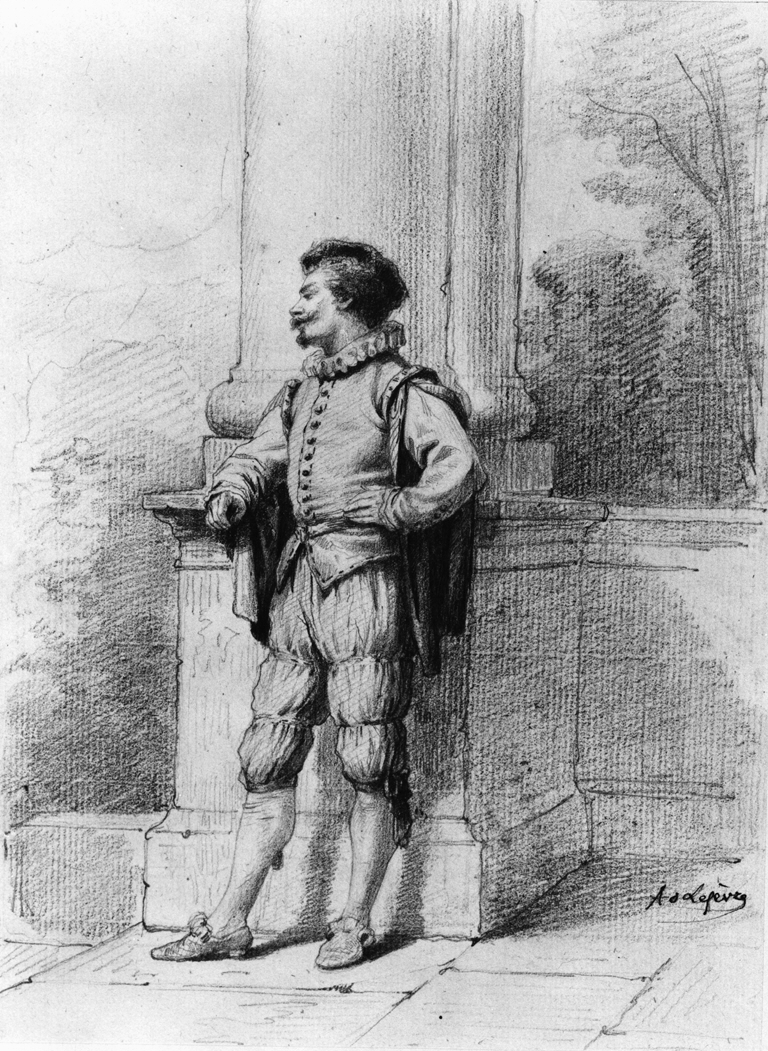
Courtiers
Para1The term courtier refers to the “members in the monarch’s court”; it is a loose term encompassing both
the aristocracy and nobility, the very rich and famous, and those court officials,
administrators, and even some upper servants. These attendees made their way into
the court in a number of ways, such as inheriting a spot from a predecessor, paying
for it with gold or labors on behalf of the monarch, or being gifted the spot by someone
of a higher status.
Para2But with a place in the monarch’s court came duty, strict rules, and the chance for
significant rises and falls in fortune; some noble courtiers would work in the stables
as Master of the Horse while other nobles worked in monarch’s private chambers helping
with clothes or even toileting. Naturally, hundreds of servants worked the halls,
kitchens, and gardens, along with other tasks around the court, although they were
not considered courtiers.
Para3At Hampton Court Palace during the reign of Henry VIII, upwards of 1,000 courtiers
plus their many servants stuffed the palace rooms. Courtyards, hallways, gardens,
and audience chambers were filled with people, all seeking advancement, pleasure,
connection, influence, and wealth.
Access to Power
Para4Courtiers both male and female primarily sought proximity to the monarch or the monarch’s
inner circle. This level of connection is what conveyed importance and influence at
the court. The higher a person’s status, the closer they got to the monarch and their
private chambers in the palace. Some middle or lower ranking courtiers might only
ever glimpse the monarch moving from private rooms or a chapel into larger, more public
audience chambers.
Para5To retain access to this power, courtiers had to please the monarch and the monarch’s
inner circle of favorite nobles and advisors. Courtiers remained at court until the
monarch gave them permission to depart. They were also expected to follow the court
as it moved from palace to palace and even sometimes when visiting great houses throughout
the nation. Courtiers followed the royals, and they had to bring their own servants.
There was a practical reason why the court had to shift from place to place—the palaces
needed cleaning (including the emptying of latrines) and food and livestock had to
be replenished after the enormous meals required by the court.
Fashion
Para6Courtiers were expected to maintain a certain level of etiquette at court. Their clothes
and overall fashion had to conform with current style and trends, or else they were
at risk of losing their rank in the court. Their appearance was as important as their
personality and deeds. As it is stated in Thomas Hoby’s 1588 The Book of the Courtier, a translation of the 1528 Il Libro del Cortegiano by Count Baldassare Castiglione,
Outward beauty is a true sign of inner goodness.Not only was it extremely important to know the current styles, but they changed often, and so it was difficult and very expensive for courtiers to keep up. Records indicate that a man’s suit of black doublet, hose, and sleeves for court could cost as much as a year’s rent on a modest home in London.
Etiquette
Para7On top of a courtier’s rank, esteem, and influence being reliant on style and fashion,
their body language and manners also required much conformity. When joining the court,
they were given a set of rules that included specific terms and conditions such as
how to sit correctly, what foot should be in front of the other when sitting, what
women can and can’t do with men (including linking arms or hands), and even what they
should enjoy doing in the court, such as forcing them to enjoy particular sports.
Para8Even the dances they were to perform were expected to be perfect, a difficult task
due to the dance steps being altered as often as fashionable garments. In short,
courtiers led a highly regulated, expensive, and restrictive life. They had to be
very aware of every action they performed, everything they wore, and everything they
said when attending the court, or they may lose their good standing with the monarch.
But the rewards were immense in terms of gaining wealth and influence.
Sources
Loades, D.M.. Intrigue and Treason; The Tudor Court 1547-1558. Pearson-Longman, 2004.
Stump, Donald, and Susan M. Felch. Elizabeth I and Her Age: A Norton Critical Edition. W.W. Norton, 2009.
Vanhoutte, Jacqueline. Age in Love: Shakespeare and the Elizabethan Court. U of Nebraska P, 2019.
Whitelock, Anna. The Queen’s Bed: An Intimate History of Elizabeth’s Court. Sarah Crichton Books, 2014.
Open-Access Digital Resources
Best, Michael.
The Ideal Courtier.Shakespeare’s Life and Times. Internet Shakespeare Editions. University of Victoria, 4 Jan. 2011, https://internetshakespeare.uvic.ca/Library/SLT/society/court%20life/courtier.html. Accessed 11 Nov. 2018.
Castiglione, Baldassarre. The Book of the Courtier. Translated by Thomas Hoby. David Nutt, 1900, https://archive.org/details/bookofcourtierfr00castuoft/page/n7/mode/2up. Accessed 22 Mar. 2026.
Life at the Tudor Court.Historic Royal Palaces, https://www.hrp.org.uk/hampton-court-palace/history-and-stories/the-royal-court-in-the-tudor-period/. Accessed 23 Feb. 2023.
Image Source
Lefevre, Adolphe-René. Courtier Standing by a Column. c. 1860. Graphite on laid paper. The Walters Museum. Creative Commons License. https://art.thewalters.org/object/37.1630/.
Prosopography
Hannah Lewis
Hannah Lewis was a student at Utah Valley University.
Kate McPherson
Kate McPherson is Professor of English and Honors Program Director at Utah Valley
University (Orem, UT, USA). In 2015, she began working to redevelop Shakespeare’s Life and Times, created by Michael Best, into the Early Modern England Encyclopedia. Her other publications include commentary on Pericles and The Comedy of Errors for the New Oxford Shakespeare (2016); the co-edited volumes Stages of Engagement: Drama and Religion in Post-Reformation England with James Mardock (Duquesne University Press, 2014) and Shakespeare Expressed: Page, Stage, and Classroom in Shakespeare and His Contemporaries, with Kathryn M. Moncrief and Sarah Enloe (Fairleigh Dickinson University Press,
2013). With Kathryn M. Moncrief, Kate has also two edited collections, Performing Pedagogy in Early Modern England: Gender, Instruction, and Performance (Ashgate, 2011) and Performing Maternity in Early Modern England (Ashgate 2008). She has also published numerous articles on early modern maternity
in scholarly journals. Kate participated in the 2008 National Endowment for the Humanities
Institute,
Shakespeare’s Blackfriars: The Study, the Stage, the Classroom,at the American Shakespeare Center. She also served as Play Seminar Director, a public humanities position, for the Utah Shakespeare Festival in 2017 and 2018.
Leah Hamby
Leah Hamby is the primary encoder for the Early Modern England Encyclopedia. Aside from encoding, she also works as an editor for the project and contributed
several articles of her own. She has been working on the EMEE since February 2023. As of February 2026, she is soon to graduate with honours from
Utah Valley University with a major in history and a minor in creative writing. Her
other work with the LEMDO program includes remediating William Kemp’s Kemp’s Nine Day’s Wonder for the Digital Renaissance Editions.
Michael Best
Michael Best is Professor Emeritus at the University of Victoria, BC. He founded the
Internet Shakespeare Editions in 1996, and was Coordinating Editor until 2017, contributing two editions to the
ISE: King John and King Lear (the latter also available in print from Broadview Press). In print, he has published editions of works of Elizabethan magic and huswifery,
a collection of letters from the Australian goldfields, and Shakespeare on the Art of Love (2008). He contributed regular columns for the Shakespeare Newsletter on
Electronic Shakespeares,and has written many articles and chapters for both print and online books and journals, principally on questions raised by the new medium in the editing and publication of texts. He has delivered papers and plenary lectures on electronic media and the Internet Shakespeare Editions at conferences in Canada, the USA, the UK, Spain, Australia, and Japan.
Navarra Houldin
Training and Documentation Lead 2025–present. LEMDO project manager 2022–2025. Textual
remediator 2021–present. Navarra Houldin (they/them) completed their BA with a major
in history and minor in Spanish at the University of Victoria in 2022. Their primary
research was on gender and sexuality in early modern Europe and Latin America. They
are continuing their education through an MA program in Gender and Social Justice
Studies at the University of Alberta where they will specialize in Digital Humanities.
Orgography
LEMDO Team (LEMD1)
The LEMDO Team is based at the University of Victoria and normally comprises the project
director, the lead developer, project manager, junior developers(s), remediators,
encoders, and remediating editors.
University of Victoria (UVIC1)
https://www.uvic.ca/Metadata
| Authority title | Courtiers in Early Modern England |
| Type of text | Critical |
| Publisher | University of Victoria on the Linked Early Modern Drama Online Platform |
| Series | Early Modern England Encyclopedia |
| Source |
By Hannah Lewis, inspired by Michael Best’s Shakespeare’s Life and Times, Internet Shakespeare Editions
|
| Editorial declaration | This document uses Canadian English spelling |
| Edition | Released with Early Modern England Encyclopedia 1.0 |
| Sponsor(s) |
Early Modern England EncyclopediaAnthology Leads: Kate McPherson and Kate Moncrief.
|
| Encoding description | Encoded in TEI P5 according to the LEMDO Customization and Encoding Guidelines |
| Document status | published, peer-reviewed |
| Funder(s) |
Social Sciences and Humanities Research Council of Canada
Mitacs Globalink Research Internship Utah Valley University |
| License/availability |
Intellectual copyright in this entry is held by Kate McPherson on behalf of the contributors. Copyright on the TEI-XML markup is held by the University of Victoria on behalf of the LEMDO Team. The content and TEI-XML markup in this file are licensed under a CC BY-NC_ND 4.0 license. This file is freely downloadable without permission under the following conditions:
(1) credit must be given to the authors, EMEE, and LEMDO in any subsequent use of
the files and /or data; (2) this availability statement must remain in the file; (3)
the content cannot be adapted or repurposed (except for quotations for the purposes
of academic review and citation); and (4) commercial uses are not permitted without
the knowledge and consent of the authors, EMEE, and LEMDO. Neither the content nor
the code in this file is licensed for training large language models (LLMs), ingestion
into an LLM, or any use in any artificial intelligence applications; such uses are
considered to be commercial uses and are strictly prohibited.
|