
Cosmological Disorder in King Lear’s Tragic Universe
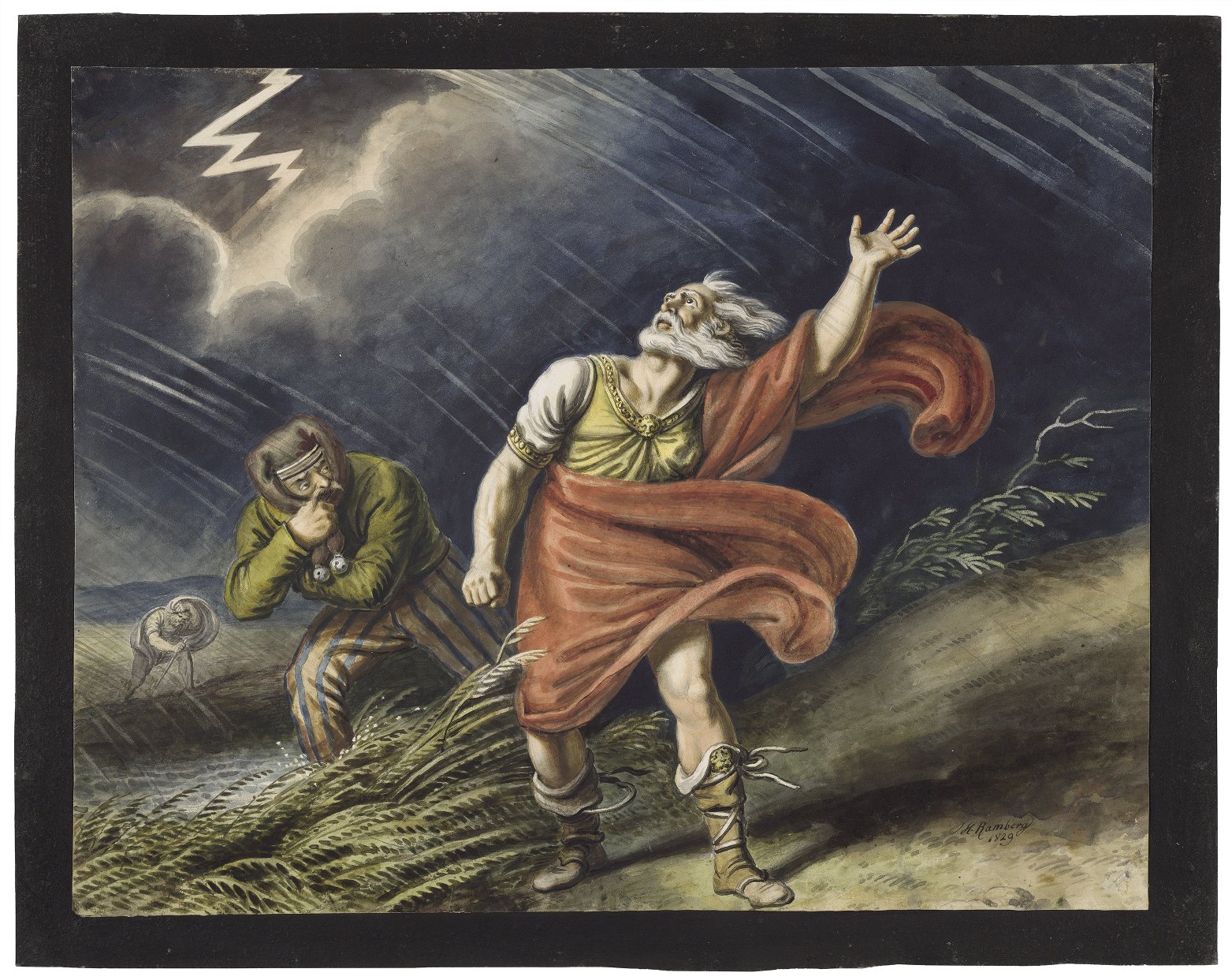
King Lear, III, 2, Another Part of the Heath, enter Lear and the Fool,1829. Courtesy Folger Digital Image Collection. Public Domain.
Para1Fate, planetary movements, storms, politics, family dynamics, and psychological imbalance.
Shakespeare has everything about King Lear’s existence intensify his tragedy. The
magnitude of disorder and pathos creates a sense of a greater power trembling in the
background of the play’s tragic universe. However, Shakespeare leaves the interpretation
of the cause of Lear’s tragedy up to the audience. One main cause the play explores
is cosmological disorder.
Cosmological Disorder
Para2King Lear is ambiguous about fate, providence, and the existence of an overarching order to
the cosmos. Many scholars like Natalie Elliot believe that the mix of religion, superstition,
and new scientific perspectives in the play could echo the conflicting explanations
circulating in Elizabethan society. Was the earth the centre of the galaxy or was
it the sun? What happens when scientific explanations of the natural world refute
religious ones? According to Elliot, Shakespeare explores
…how we are personally affected by the uncertainties that cosmological science can introduce, or what it means when scientists claim that our first-hand experience is illusory, or how we respond when science probes into matters of the heart(33). For example, this tension between different systems of thought appears in the exchange between the Earl of Gloucester and his villainous son Edmund on the role of astrology.
Astrological Disorder
Para3Even the planetary movements in King Lear are apparently out of order. In Act 1 Scene 2, Gloucester famously connects the
machinations, hollowness, treachery, and all ruinous disorders…to the
…late eclipses in the sun and moon(1.2.443–444; 1.2.434). Gloucester uses astrology not like a science to understand the world in general, but as an attempt to understand the causes of the harmful events that happen in his life. Because of this, his application of astrology is more mystical or superstitious than scientific. Gloucester typifies the early modern view that divine powers controlled the celestial bodies which influence earthly events.
Para4Notably, Shakespeare’s audience may not have viewed Gloucester as overly superstitious
because his reasoning follows the well-understood and practiced astrology in popular
English almanacs of the time. Almanacs typically contained a calendar, important church
dates, positions of planets and stars, weather forecasts, astrological predictions,
and other information.
Para5Directly after his father exits in Act 1, Scene 2, Edmund parodies how humans use
astrological and spiritual influences to explain their pain and suffering instead
of addressing their own behavior and choices:
…when we are sick in fortune—often the surfeits of our own behavior—we make guilty of our disasters the sun, the moon, and the stars, as if we were villains on necessity; fools by heavenly compulsion; knaves, thieves, and treachers by spherical predominance; drunkards, liars, and adulterers by an enforced obedience of planetary influence; and all that we are evil in, by a divine thrusting on.(1.2.448–453)
Para6Edmund’s skepticism could be inspired, in part, by Niccolò Machiavelli’s The Prince, claims scholar Michael Best. Edmund’s opinions could also look far ahead to a Darwinian
survival of the fittest or a Hobbesian man-as-brute perspective (Kernan 18–19). Scholar
Phebe Jensen points out that Edmund’s total rejection of astrological providence is
likely fairly radical for his time because even those who opoosed astrology usually
still believed in celestial influence in the early 17th century. The references to
astrology in King Lear are also a way that Shakespeare gives his plays a
cosmic and universal dimension(Laroque 32) and a way for him to question ideas of fate, the origins of evil, the nature of humans, and their connection to the world and the divine.
Sources
Elliot, Natalie.
Shakespeare’s Worlds of Science.The New Atlantis, vol. 54, 2018, pp. 30–50.
Jensen, Phebe.
Causes in Nature: Popular Astrology in King Lear.Shakespeare Quarterly, vol. 69, no. 4, 2019, pp. 205–227.
Laroque, Francois.
TheSpectacular Science, Technology and Superstition in the Age of Shakespeare, edited by Sophie Chiari and Mickael Popelard. Edinburgh UP, 2017, pp. 29–42.Scienceof Astrology in Shakespeare’s Sonnets, Romeo and Juliet and King Lear.
Kernan, Alvin B.
King Lear and the Shakespearean Pageant of History.On King Lear, edited by Lawrence Danson, Princeton UP, 2014, pp. 7–24.
Open-Access Digital Resources
almanac, n.OED Online, Oxford UP, March 2021, https://www.oed.com/dictionary/almanac_n. Accessed 6 Mar. 2021.
Best, Michael.
Ideas: disorder and the stars.Shakespeare’s Life and Times, Internet Shakespeare Editions, University of Victoria, 4 Jan. 2011, https://internetshakespeare.uvic.ca/Library/SLT/plays/king%20lear/learintellect.html. Accessed 31 Aug. 2021.
Witmore, Michael, and Natalie Elliot.
Shakespeare, Science, and Art.Shakespeare Unlimited: Folger Shakespeare Library. Episode 158, 23 Dec. 2020, https://www.folger.edu/shakespeare-unlimited/science-art-natalie-elliot. Accessed 24 Feb. 2023.
Image Sources
Cousin, Jehan.
Fortuna Adrastia, Plate CXXIX.The Book of Fortune: Two Hundred Unpublished Drawings. ca. 1522–1593. p. 178. France. Paris: Librairie de l’art, 1883. HathiTrust. https://hdl.handle.net/2027/gri.ark:/13960/t2p55zg4z?urlappend=%3Bseq=178, Image Rights. Accessed 18 May 2024.
Ramberg, Johann Heinrich.
King Lear, III, 2, Another part of the heath, enter Lear and the fool graphic.1829. Folger Digital Image Collection, Digital image File Name 36303, https://digitalcollections.folger.edu/img36303. Accessed 18 May 2024.
Prosopography
Kate McPherson
Kate McPherson is Professor of English and Honors Program Director at Utah Valley
University (Orem, UT, USA). In 2015, she began working to redevelop Shakespeare’s Life and Times, created by Michael Best, into the Early Modern England Encyclopedia. Her other publications include commentary on Pericles and The Comedy of Errors for the New Oxford Shakespeare (2016); the co-edited volumes Stages of Engagement: Drama and Religion in Post-Reformation England with James Mardock (Duquesne University Press, 2014) and Shakespeare Expressed: Page, Stage, and Classroom in Shakespeare and His Contemporaries, with Kathryn M. Moncrief and Sarah Enloe (Fairleigh Dickinson University Press,
2013). With Kathryn M. Moncrief, Kate has also two edited collections, Performing Pedagogy in Early Modern England: Gender, Instruction, and Performance (Ashgate, 2011) and Performing Maternity in Early Modern England (Ashgate 2008). She has also published numerous articles on early modern maternity
in scholarly journals. Kate participated in the 2008 National Endowment for the Humanities
Institute,
Shakespeare’s Blackfriars: The Study, the Stage, the Classroom,at the American Shakespeare Center. She also served as Play Seminar Director, a public humanities position, for the Utah Shakespeare Festival in 2017 and 2018.
Leah Hamby
Leah Hamby is the primary encoder for the Early Modern England Encyclopedia. Aside from encoding, she also works as an editor for the project and contributed
several articles of her own. She has been working on the EMEE since February 2023. As of February 2026, she is soon to graduate with honours from
Utah Valley University with a major in history and a minor in creative writing. Her
other work with the LEMDO program includes remediating William Kemp’s Kemp’s Nine Day’s Wonder for the Digital Renaissance Editions.
Melissa Walter
Melissa Walter is Associate Professor of English at the University of the Fraser Valley.
Her research focuses on early modern English drama and English and European prose
fiction. She is the author of The Italian Novella and Shakespeare’s Comic Heroines (U of Toronto, 2019), and co-editor, with Dennis Britton, of Rethinking Shakespeare Source Study: Authors, Audiences, Digital Technologies (Routledge, 2018). Her work on English theatre and the European novella has appeared
in several edited collections, including Transnational Exchange in Early Modern Theater (Ashgate, 2008), and Transnational Mobility in Early Modern Theater (Ashgate, 2012). She has also written about
Translation and Identity in the Dialogues in English and Malaiane Languages(Indographies, ed. Jonathan Gil Harris. Palgrave 2012). At the University of the Fraser Valley, she is a lead coordinator of UFV’s Shakespeare and Reconciliation Garden.
Michael Best
Michael Best is Professor Emeritus at the University of Victoria, BC. He founded the
Internet Shakespeare Editions in 1996, and was Coordinating Editor until 2017, contributing two editions to the
ISE: King John and King Lear (the latter also available in print from Broadview Press). In print, he has published editions of works of Elizabethan magic and huswifery,
a collection of letters from the Australian goldfields, and Shakespeare on the Art of Love (2008). He contributed regular columns for the Shakespeare Newsletter on
Electronic Shakespeares,and has written many articles and chapters for both print and online books and journals, principally on questions raised by the new medium in the editing and publication of texts. He has delivered papers and plenary lectures on electronic media and the Internet Shakespeare Editions at conferences in Canada, the USA, the UK, Spain, Australia, and Japan.
Navarra Houldin
Training and Documentation Lead 2025–present. LEMDO project manager 2022–2025. Textual
remediator 2021–present. Navarra Houldin (they/them) completed their BA with a major
in history and minor in Spanish at the University of Victoria in 2022. Their primary
research was on gender and sexuality in early modern Europe and Latin America. They
are continuing their education through an MA program in Gender and Social Justice
Studies at the University of Alberta where they will specialize in Digital Humanities.
Sarah Brown
Sarah Brown was a student at the University of Fraser Valley.
Orgography
LEMDO Team (LEMD1)
The LEMDO Team is based at the University of Victoria and normally comprises the project
director, the lead developer, project manager, junior developers(s), remediators,
encoders, and remediating editors.
University of Victoria (UVIC1)
https://www.uvic.ca/Metadata
| Authority title | Cosmological Disorder in King Lear’s Tragic Universe |
| Type of text | Critical |
| Publisher | University of Victoria on the Linked Early Modern Drama Online Platform |
| Series | Early Modern England Encyclopedia |
| Source |
By Sarah Brown, inspired by Michael Best’s Shakespeare’s Life and Times, Internet Shakespeare Editions
|
| Editorial declaration | This document uses Canadian English spelling |
| Edition | Released with Early Modern England Encyclopedia 1.0 |
| Sponsor(s) |
Early Modern England EncyclopediaAnthology Leads: Kate McPherson and Kate Moncrief.
|
| Encoding description | Encoded in TEI P5 according to the LEMDO Customization and Encoding Guidelines |
| Document status | published, peer-reviewed |
| Funder(s) |
Social Sciences and Humanities Research Council of Canada
Mitacs Globalink Research Internship Utah Valley University |
| License/availability |
Intellectual copyright in this entry is held by Kate McPherson on behalf of the contributors. Copyright on the TEI-XML markup is held by the University of Victoria on behalf of the LEMDO Team. The content and TEI-XML markup in this file are licensed under a CC BY-NC_ND 4.0 license. This file is freely downloadable without permission under the following conditions:
(1) credit must be given to the authors, EMEE, and LEMDO in any subsequent use of
the files and /or data; (2) this availability statement must remain in the file; (3)
the content cannot be adapted or repurposed (except for quotations for the purposes
of academic review and citation); and (4) commercial uses are not permitted without
the knowledge and consent of the authors, EMEE, and LEMDO. Neither the content nor
the code in this file is licensed for training large language models (LLMs), ingestion
into an LLM, or any use in any artificial intelligence applications; such uses are
considered to be commercial uses and are strictly prohibited.
|