
Civil Law in Early Modern England
History of Legal Systems
Para1Throughout the middle ages and into the early modern period, European law was divided
into two primary categories:
Canon Law, regarding issues ranging from marriage to wills and supervised by religious
leaders
Secular law, or civil law, administered by the courts of the monarch
Para2Legal scholars draw a distinction between common law (uncodified) and civil law (codified
by statutes), but this entry uses civil law more broadly to refer to the entire secular
judicial system in early modern England.
Para3Prior to the reign of Henry II (1154–1189), England lacked a centralized mechanism
for dispensing justice. Interpretations of laws and legal proceedings varied widely
among localities. Henry II created different courts and appointed justices in order
to implement a more consistent system of justice. This new system became known as
Common Law and was based on the principle that rulings made by the King’s court were
made according to the common custom of the realm as opposed to local decisions.
Common Law Courts versus Courts of Equity
Para4Henry II’s consolidation of secular justice gave rise to two parallel court systems:
common law courts and courts of equity, both of which dealt with criminal cases and
civil disputes.
Para5Common law courts resolved litigation mainly through legal precedent, or the judicial
decisions already made in previous cases and maintained over time through court records.
These courts dealt with cases involving real property and contracts. Courts were presided
over by a judge, and verdicts were reached with juries of twelve men of equal social
status as the defendant. Common law courts were often tedious and inflexible, susceptible
to corruption, and could award only monetary damages. Rivalries among these courts
also developed as they competed for business and influence.
Para6There were three kinds of common law courts:
Court of Common Pleas: the lowest court that handled the bulk of disputes among private
citizens. Verdicts could be appealed to the Court of the King’s Bench.
Court of the King’s Bench: concerned with cases involving the monarch and business
not claimed by other courts.
Court of the Exchequer Chamber: specialized in crown financial rights and heard cases
referred by the Court of the King’s Bench.
Para7The limitations of the common law courts led to instances of injustice and gave rise
to the second court system, the courts of equity. The courts of equity were not bound
by legal precedent and instead derived their authority directly from the monarch and
Privy Council, which gave them far greater power. While the goal of common law courts
was to make the injured party whole, the courts of equity were concerned with providing equitable relief. In addition
to awarding monetary damages, these courts could impose injunctions that compelled
a party to do or refrain from doing a specified action. Despite their considerable
power, these courts were often considered more fair than other courts.
Para8The primary courts of equity included:
Court of Chancery: presided over by the Lord Chancellor, this was the most powerful
court.
Court of the Star Chamber: presided over by Privy Councilors, this court handled issues
concerning the king’s peace, such as treason, espionage, disorderly conduct, and other
crimes.
Court of Requests: concerned with cases involving the poor and servants of the monarch.
Court of the Admiralty: dealt with cases abroad or at sea.
Ecclesiastical courts: operated under the purview of the church and handled moral
offenses.
The Law and Society
Para9The era was highly litigious, and its legal system underwent dramatic changes. Not
only did legal institutions and practices transform but also interpretations of law.
For example, the Treason Act of 1351 identified an inferior form of treason (betrayal
of the monarch) called petty treason, or the slaying of a person to whom one owed
obedience, such as a husband or master. This law had specifically distinguished petty
treason from the charge of murder, which could be mitigated by various factors, and
mandated that petty treason and high treason be prosecuted the same way and carry
the same harsh punishment of death. However, starting in the 1630s, the interpretation
of petty treason shifted to being considered a category of murder, such as manslaughter,
which could be mitigated by extenuating circumstances like provocation.
Literature and Law
Para10The subject of the law also became an interest of writers during this period. Shakespeare,
for instance, held a deep interest and technical knowledge of the law, which he represented
in some of his works, such as The Merchant of Venice, Measure for Measure, and The Winter’s Tale. Scholar Paul Raffield argues that Measure for Measure explores the ways in which rivalries among competing courts affect the lives of everyday
people. The court scenes that Shakespeare depicts are not set in England, so they
do not mirror English legal practices precisely, but they may indicate some public
perception of the law as not fully committed to rendering justice.
Sources
Curran, Kevin. Shakespeare and Judgment. Edinburgh UP, 2017.
Lockwood, Matthew.
From Treason to Homicide: Changing Conceptions of the Law of Petty Treason in Early Modern England.Journal of Legal History, vol. 34, no. 1, 2013, pp. 31–49.
Raffield, Paul.
The Trials of Shakespeare: Courtroom Drama and Early Modern English Law.Law and Humanities, vol. 8, no. 1, 2014, pp. 53–76.
Open-Access Digital Resources
Best, Michael.
The Civil Law.Shakespeare’s Life and Times.Internet Shakespeare Editions. University of Victoria, 4 Jan. 2011, https://internetshakespeare.uvic.ca/Library/SLT/history/crime%20and%20the%20law/civil.html. Accessed 7 Feb. 2023.
Jokinen, Anniina.
Common Law.Luminarium, 13 April 2009, https://www.luminarium.org/encyclopedia/commonlaw.htm. Accessed 16 Oct. 2018.
English Law and the Role of the Lord Chancellor (1485–1625).Tudor Times, 25 Sept. 2016, https://tudortimes.co.uk/politics-economy/english-law-and-the-role-of-the-lord-chancellor-1485-1625. Accessed 17 Oct. 2018.
Image Source
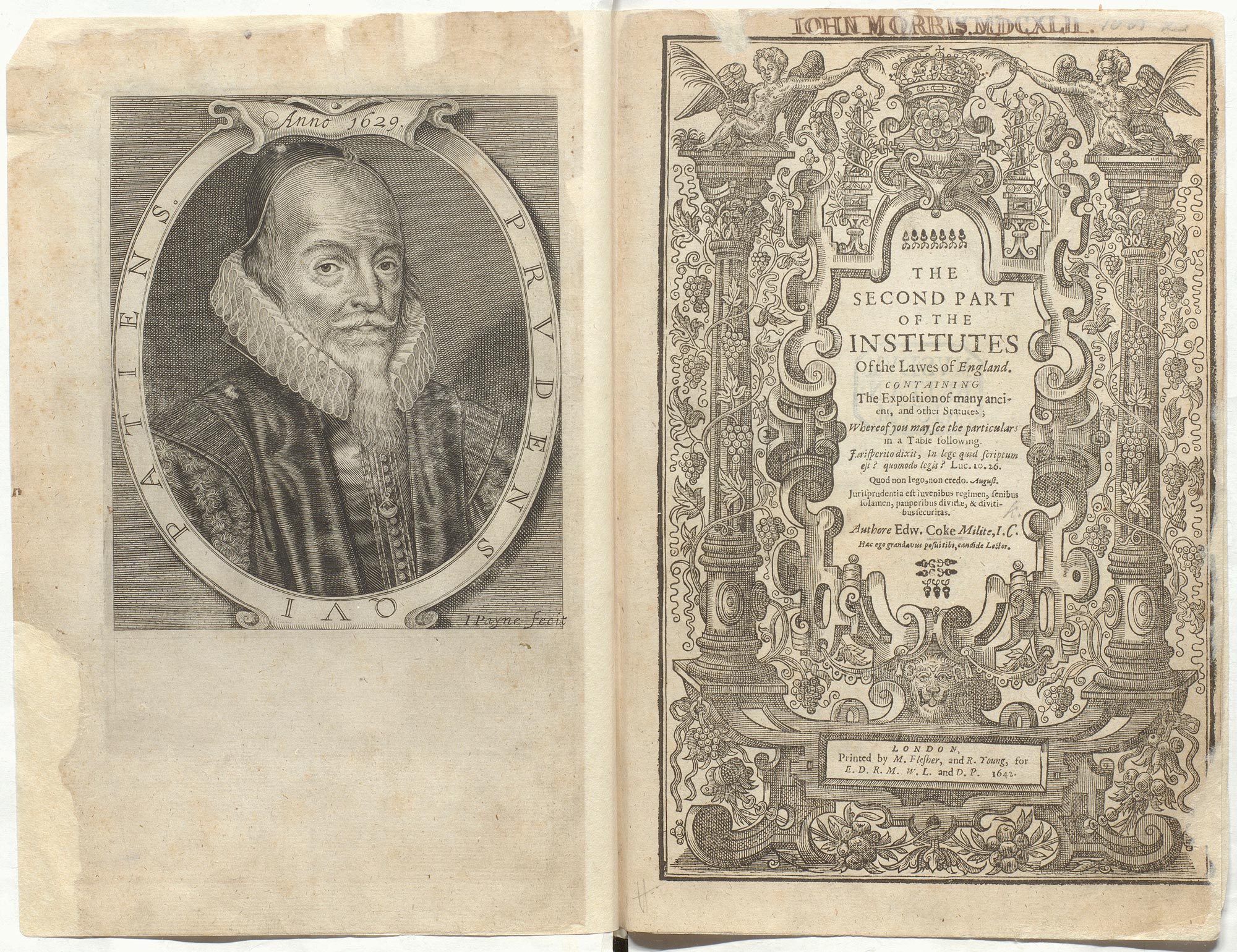
Payne, John. Frontispiece and title page of Edward Coke, The Fourth Part of the Institutes of the
Laws of England: Concerning the Jurisdiction of the Courts (2nd ed.) 1648. Engraving. Wikimedia. https://en.wikipedia.org/wiki/File:Edward_Coke,_The_Fourth_Part_of_the_Institutes_of_the_Laws_of_England_(2nd_ed,_1648,_frontispiece_and_title_page)_-_20131124.jpg.
_-_20131124.jpg)
Prosopography
Brock Burns
Brock Burns was a student at Utah Valley University.
Kate McPherson
Kate McPherson is Professor of English and Honors Program Director at Utah Valley
University (Orem, UT, USA). In 2015, she began working to redevelop Shakespeare’s Life and Times, created by Michael Best, into the Early Modern England Encyclopedia. Her other publications include commentary on Pericles and The Comedy of Errors for the New Oxford Shakespeare (2016); the co-edited volumes Stages of Engagement: Drama and Religion in Post-Reformation England with James Mardock (Duquesne University Press, 2014) and Shakespeare Expressed: Page, Stage, and Classroom in Shakespeare and His Contemporaries, with Kathryn M. Moncrief and Sarah Enloe (Fairleigh Dickinson University Press,
2013). With Kathryn M. Moncrief, Kate has also two edited collections, Performing Pedagogy in Early Modern England: Gender, Instruction, and Performance (Ashgate, 2011) and Performing Maternity in Early Modern England (Ashgate 2008). She has also published numerous articles on early modern maternity
in scholarly journals. Kate participated in the 2008 National Endowment for the Humanities
Institute,
Shakespeare’s Blackfriars: The Study, the Stage, the Classroom,at the American Shakespeare Center. She also served as Play Seminar Director, a public humanities position, for the Utah Shakespeare Festival in 2017 and 2018.
Leah Hamby
Leah Hamby is the primary encoder for the Early Modern England Encyclopedia. Aside from encoding, she also works as an editor for the project and contributed
several articles of her own. She has been working on the EMEE since February 2023. As of February 2026, she is soon to graduate with honours from
Utah Valley University with a major in history and a minor in creative writing. Her
other work with the LEMDO program includes remediating William Kemp’s Kemp’s Nine Day’s Wonder for the Digital Renaissance Editions.
Michael Best
Michael Best is Professor Emeritus at the University of Victoria, BC. He founded the
Internet Shakespeare Editions in 1996, and was Coordinating Editor until 2017, contributing two editions to the
ISE: King John and King Lear (the latter also available in print from Broadview Press). In print, he has published editions of works of Elizabethan magic and huswifery,
a collection of letters from the Australian goldfields, and Shakespeare on the Art of Love (2008). He contributed regular columns for the Shakespeare Newsletter on
Electronic Shakespeares,and has written many articles and chapters for both print and online books and journals, principally on questions raised by the new medium in the editing and publication of texts. He has delivered papers and plenary lectures on electronic media and the Internet Shakespeare Editions at conferences in Canada, the USA, the UK, Spain, Australia, and Japan.
Navarra Houldin
Training and Documentation Lead 2025–present. LEMDO project manager 2022–2025. Textual
remediator 2021–present. Navarra Houldin (they/them) completed their BA with a major
in history and minor in Spanish at the University of Victoria in 2022. Their primary
research was on gender and sexuality in early modern Europe and Latin America. They
are continuing their education through an MA program in Gender and Social Justice
Studies at the University of Alberta where they will specialize in Digital Humanities.
Orgography
LEMDO Team (LEMD1)
The LEMDO Team is based at the University of Victoria and normally comprises the project
director, the lead developer, project manager, junior developers(s), remediators,
encoders, and remediating editors.
University of Victoria (UVIC1)
https://www.uvic.ca/Metadata
| Authority title | Civil Law in Early Modern England |
| Type of text | Critical |
| Publisher | University of Victoria on the Linked Early Modern Drama Online Platform |
| Series | Early Modern England Encyclopedia |
| Source |
By Brock Burns and Kate McPherson, inspired by Michael Best’s Shakespeare’s Life and Times, Internet Shakespeare Editions
|
| Editorial declaration | This document uses Canadian English spelling |
| Edition | Released with Early Modern England Encyclopedia 1.0 |
| Sponsor(s) |
Early Modern England EncyclopediaAnthology Leads: Kate McPherson and Kate Moncrief.
|
| Encoding description | Encoded in TEI P5 according to the LEMDO Customization and Encoding Guidelines |
| Document status | published |
| Funder(s) |
Social Sciences and Humanities Research Council of Canada
Mitacs Globalink Research Internship Utah Valley University |
| License/availability |
Unless otherwise noted, intellectual copyright in EMEE Anthology pages is held by
Kate McPherson on behalf of the contributors. Copyright on the TEI-XML markup is held by the University of Victoria on behalf of the LEMDO Team. The content and TEI-XML markup in this file are licensed under a CC BY-NC-ND 4.0 license. This file is freely downloadable without permission under the following conditions:
(1) credit must be given to the authors, EMEE, and LEMDO in any subsequent use of
the files and /or data; (2) this availability statement must remain in the file; (3)
the content cannot be adapted or repurposed (except for quotations for the purposes
of academic review and citation); and (4) commercial uses are not permitted without
the knowledge and consent of the authors, EMEE, and LEMDO. Neither the content nor
the code in this file is licensed for training large language models (LLMs), ingestion
into an LLM, or any use in any artificial intelligence applications; such uses are
considered to be commercial uses and are strictly prohibited.
|