
Christopher Marlowe: Life, Education, and Legacy
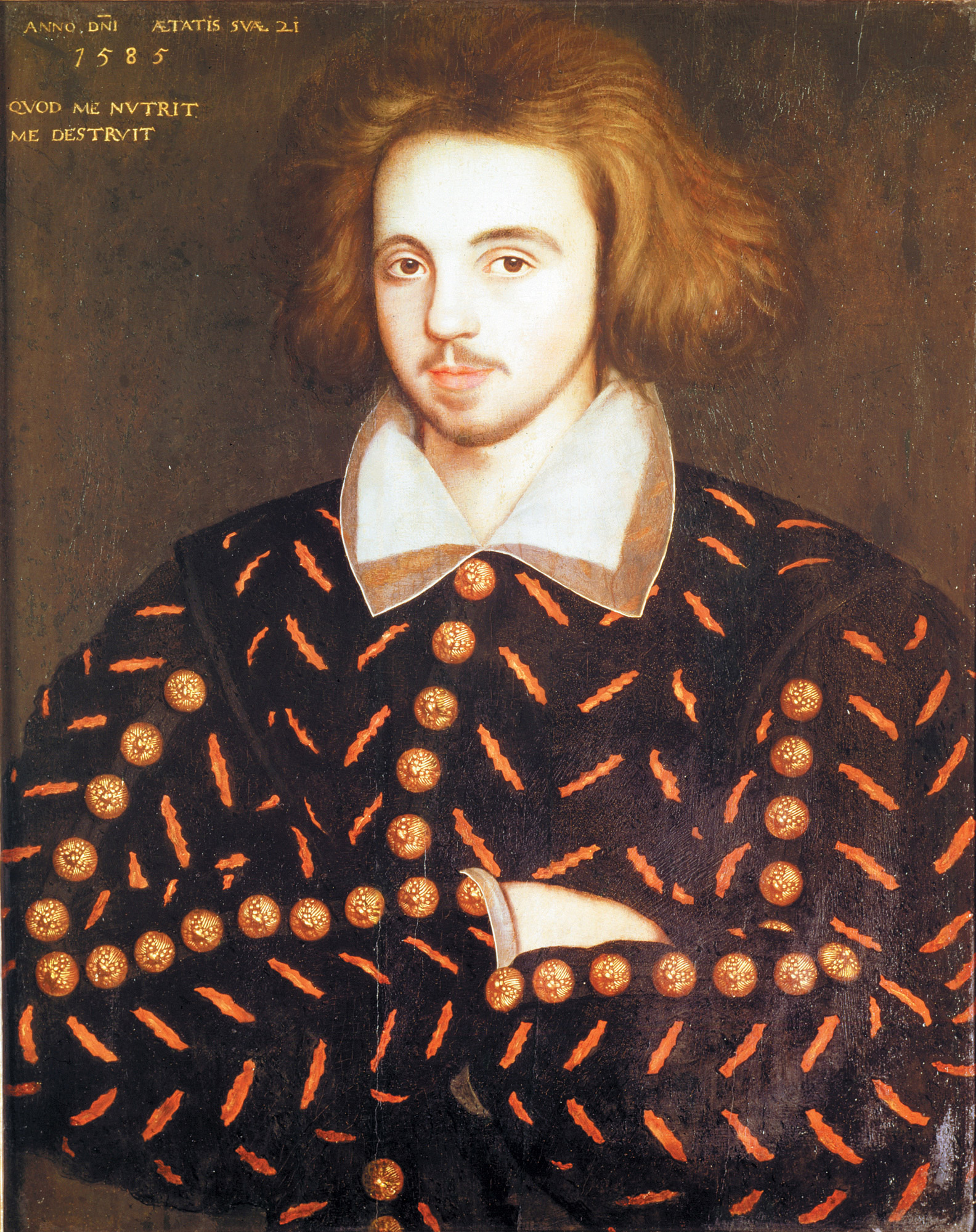
ANNO DNI AETATIS SVAE 21 1585and
QVOD ME NVTRIT ME DESTRVIT,meaning “Aged 21 in 1585” and “that which nourishes me destroys me” respectively. Courtesy of Wikimedia and Corpus Christi College. Public Domain.
Early Life
Para1Christopher Marlowe was born in 1564 into the lower artisanal class in Canterbury,
England as the second of nine children born to shoemaker John Marlowe and his wife
Katherine. His birth was not officially recorded. However, it is likely that he would
have been born a few days prior to his baptism on February 26, 1564. Fellow playwright
William Shakespeare was born only a few months later in April of 1564 in Stratford-upon-Avon,
England.
Para2Canterbury was a small but bustling market town, anchored since the Middle Ages by
pilgrims to its shrine to St. Thomas a Becket. In the late 16th century, the city
was full of immigrants fleeing religious persecution from France and the Netherlands.
Living in Canterbury, it is likely that Marlowe would have heard of the massacre of
French Protestants from these immigrants, which would end up being the basis for his
1592 play Massacre at Paris.
Education
Para3In this period, the education system allowed for the basic education of boys from
the poorer classes by awarding scholarships to some boys
endowed with minds apt for learning(Nicholl). Around six to seven years of age, the boys would begin attending petty school where they would learn the alphabet and catechism, plus the basics of reading in English. After this, they would have attended a local grammar school for six years. In grammar school, they would study Greek and Latin language and literature, and it is here that Marlowe would have encountered Ovid and Virgil for the first time. Virgil in particular was a great influence on Marlowe as his first play was based on Virgil’s Aeneid, called Dido, Queen of Carthage.
Para4We also see multiple allusions to Virgil’s Aeneid in Marlowe’s Tamburlaine The Great:
Philemus: Madam, your father and th’ Arabian King,The first affector of your excellence,Comes now as Turnus ‘gainst Aeneas did,Armed with lance into Egyptian fields,Ready for battle ‘gainst my lord the King.(5.2.314-318)
Zenocrate: But as the gods, to end the Trojans’ toil,Prevented Turnus of LaviniaAnd fatally enriched Aeneas’ love,Must Tamburlaine by their resistless powers,With virtue of a gentle victory,Conclude a league of honour, to my hope.(5.2.326–335)
Para5Marlowe enrolled in King’s School in Canterbury on a scholarship when he turned 14,
which was considered late to be starting school.Scholars speculate he had the financial
backing of Judge Sir Roger Manwood, which may explain the Latin elegy Marlowe wrote
upon Manwood’s death. At 16, he won the Parker scholarship funded by the Archbishop
Matthew Parker to finish his education at Corpus Christi College in Cambridge. After
four years of college, he earned his Bachelor of Arts degree in 1584 and then his
Master of Arts in 1587. Interestingly, Marlowe’s scholarship stipulated recipients
should become clergyman. Since he was supposed to become a clergyman, he was sponsored
for six years rather than the typical three. Joining the clergy was one of the few
ways that a commoner like Marlowe could raise his social status. However, Marlowe
never ended up becoming a member of the clergy, and he most likely never intended
to, because, immediately after graduating, he moved to London and began to write literary
works.
Marlowe’s Sexuality
Para6Speculation in his own time existed about Marlowe being what we would call a gay man,
although a word for that concept did not exist at the time. The most notable reference
is from Richard Baines, who also accused Marlowe of being an atheist; he famously
quotes Marlowe as saying
all they that love not tobacco and boies were fooles.Scholars do not rely only on Baines’ word, but look to some of Marlowe’s writings in which there are possible same-sex romantic relationships; scenes from the 1585 play Dido, Queen of Carthage and the 1592 play Edward II stand out:
Para7Dido, Queen of Carthage:
Jupiter: Come, gentle Ganymede, and play with me;I love thee well, say Juno what she will.
Ganymede: I am much better for your worthless love,That will not shield me from her shrewish blows:To-day, when as I fill’d into your cups,And held the cloth the pleasance while you drank,She reach’d me such rap for that I spill’d,As made the blood run down mine ears.
Jupiter: What! Dares she strike the darling of my thoughts?By Saturn’s soul, and this earth threat’ning air,That, shaken thrice, makes nature’s buildings quake,I vow, if she but once frown on thee more,To hang her, meteor-like, ‘twixt heaven and earth,And bind her hand and foot with golden cords,As once I did for harming Hercules!(1.1.1–15)
Para8This scene offers a loving portrait of the relationship between Jupiter and the boy
Ganymede, whose name became a synonym for male same-sex love during the early modern
period (McHenry and Baker)
Para9In Marlowe’s 1592 history play depicting the life and death of the English monarch,
Edward II (r.1307–1327), the king is very close to a courtier named Piers Gaveston:
Para10Edward II:
Enter Gaveston, reading a letterGaveston: My father is deceas’d! Come, Gaveston,And share the kingdom with thy dearest friend.Ah, words that make me surfeit with delight!What greater bliss can hap to Gaveston,Than live and be the favourite of a king!Sweet prince, I come! These, these thy amorous linesMight have enforc’d me to have swum from France,And like Leander, gasp’s upon the sand,So thou would’st smile, and take me in thine arms.(1.1.1–9)
Para11In referencing the myth of Hero and Leander, Marlowe compares the relationship between
Gaveston and the King to the one between the lovers in the myth. It could also be
said that Marlowe calls attention to male sexual desire due to Neptune’s extensive
pursuit of Leander as he swims towards his beloved.
Para12However, despite what scholars can infer from the language in Dido and Edward II, no concrete proof exists regarding Marlowe’s sexuality. Marlowe could just have
been trying to shock the public or capture the attitudes portrayed in classical literature.
Marlowe the Spy?
Para13Besides being a playwright, around the time of getting his Master of Arts at Cambridge,
Marlowe also became a government agent in the employ of Elizabeth I’s spymaster, Sir
Francis Walsingham. He missed a lot of classes because of how busy he was on Walsingham’s
business, and, at the same time, rumours circulated that he was sympathetic to Catholics.
Due to this distrust and sporadic attendance, Marlowe was almost denied receiving
his degree. It was ultimaately granted was because officers of Elizabeth I’s Privy
council overruled the denial from the University, stating that Marlowe had helped
the queen herself.
Para14Shortly before Marlowe died in 1593, his friend Thomas Kyd, a fellow playwright best
known for The Spanish Tragedy, was arrested on suspicions of treason. Officials claimed to have found a
heretical treatise that Kyd claimed was Marlowe’s(Martin 13). Kyd was tortured until he accused Marlowe of blasphemy, resulting in a warrant for Marlowe’s arrest. However, he would never be brought into custody.
Death
Para15Marlowe died on May 30, 1593, at a tavern in Deptford, a town just outside London.
Marlowe entered an altercation with a friend of his, Ingram Frizer, over how the bill
would be split. Marlowe grabbed Frizer’s dagger and inflicted shallow head wounds.
In the struggle following, Marlowe was given
a mortal wound above his right eye, of the depth of two inches and the width of one inchand died instantly. This detail comes from Frizer’s royal pardon given to him June 28, 1593, which also states that Frizer acted in self-defence. Many scholars presume that Frizer may have been acting on orders from the government to eliminate Marlowe.
Para16After Marlowe’s death, rumour and speculation surrounding his life and death ran rampant.
Marlowe may have been assassinated because he was either a
a rogue spy, an atheistic rebel, or a convenient scapegoat(Martin 13). Marlowe was buried on June 1st, 1593, at St Nicholas’s, Deptford and the location of his grave is unknown.
Important Works
Para17
Dido Queen of Carthage -play, 1584
Tamburlaine the Great Part 1 -play, 1587
Tamburlaine the Great Part 2 -play, 1587
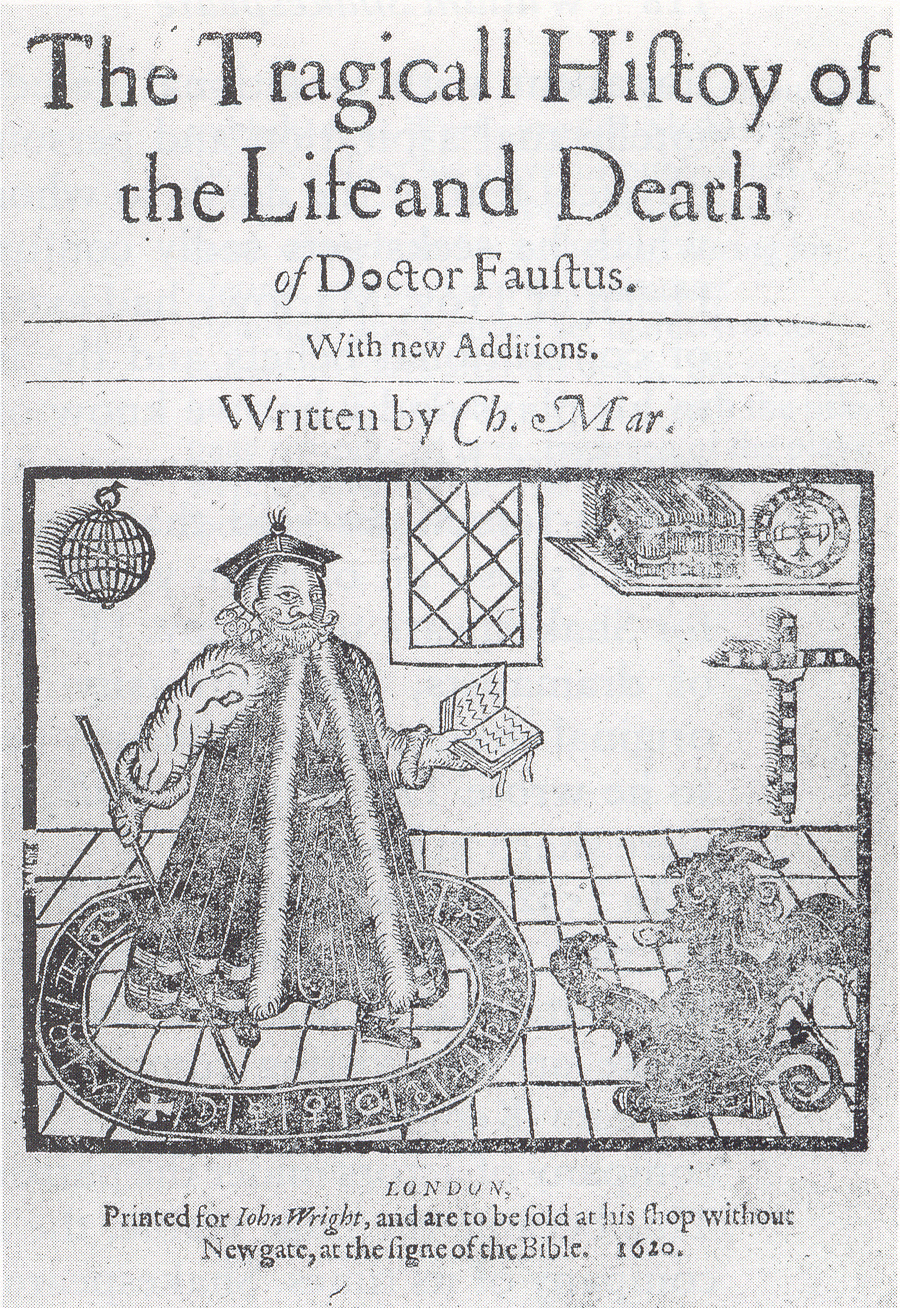
The Tragical History of Doctor Faustus - play, 1588–1592
Edward the Second -play, 1592
The Jew of Malta -play, 1592
Massacre of Paris -play, 1592–1593
Hero and Leander-poem, 1593
Marlowe’s Legacy
Para18Marlowe in particular is known for his dramatic poetry, which made blank verse, poetry
written with regular meter but unrhymed lines, common on the English stage. Often
this is referred to as Marlowe’s Mighty Line so dubbed by the slightly younger playwright Ben Jonson in an elegy called
To the Memory of My Beloved Master William Shakespeare, and What He Hath Left Us,written as an introduction the collected works of Shakespeare’s plays known as The First Folio. Marlowe’s most famous play is Doctor Faustus, a retelling of the fable of a scholar who sells his soul to Satan in return for more knowledge and power.
Para19Chaucer, who wrote centuries before Marlowe in the 1300’s, had used the same line
and iambic pentameter, but it had always rhymed. Marlowe was not the first playwright
to use blank verse, but he most certainly made it popular. His works are frequently
performed in modern playhouses such as The Royal Shakespeare Company and Shakespeare’s
Globe.
Sources
Marlowe, Christopher. Marlowe’s Edward the Second, and Selections from Tamburlaine and the Poems. H. Holt, London: 1894.
Marlowe, Christopher, and Mathew R. Martin.
Christopher Marlowe’s Life.Tamburlaine the Great: Part One and Part Two, Broadview Press, 2014, pp. 9–15.
Marlowe, Christopher, and Thomas Nash. Dido, Queen of Carthage: A Tragedy. D.S. Maurice. London, 1825.
Naylor, Amanda.
Marlowe’s “mighty line”: Amanda Naylor examines the use of language in Christopher Marlowe’s tragic drama Doctor Faustus.The English Review, vol. 20, no. 3, 2010, p. 10.
Nicholl, Charles.
Marlowe Marley, Christopher (bap. 1564, d. 1593), playwright and poet.Oxford Dictionary of National Biography. Oxford UP, 2008.
Stapleton, M.L.
Christopher Marlowe in Context.Renaissance Quarterly, vol. 67, no. 3, Sept. 2014, pp. 1106–1108.
Open-Access Digital Resources
A Portrait of Marlowe?The Marlowe Society, https://www.marlowe-society.org/christopher-marlowe/portrait/. Accessed 16 May 2024.
Bennett, Kristen Abbott.
Marlowe, Christopher (Kit).The Kit Marlowe Project, 2017, https://kitmarlowe.org/encyclopedia/. Accessed 11 Feb. 2026.
The Marlowe Society.The Marlowe Society, 2022, https://www.marlowe-society.org/. Accessed 11 Feb. 2026.
Marlowe, Christopher.
Tamburlaine.Royal Shakespeare Company, https://www.rsc.org.uk/tamburlaine/. Accessed 1 Oct. 2023.
McHenry, Troy, and Helen Baker.
The Public Representation of Homosexual Men in Seventeenth-Century England – A Corpus Based View.Journal of Historical Sociolinguistics 3.2 (2017), 13 Sept. 2017, https://www.degruyter.com/document/doi/10.1515/jhsl-2017-1003/html. Accessed 11 Feb. 2026.
Image Source
Unknown 21-Year Old Man, supposed to be Christopher Marlowe. 1585. Oil on panel. Corpus Christi College. Wikimedia. https://en.m.wikipedia.org/wiki/File:Christopher_Marlowe.jpg.

Wright, John. Title Page of a Late Edition of Christopher Marlowe’s Doctor Faustus, with a Woodcut
Illustration of a Devil Coming up Through a Trapdoor. 1620. Wikimedia. https://en.m.wikipedia.org/wiki/File:Faustus-tragedy.gif.

Prosopography
Alexis Neurauter
Alexis Neurauter was a student at the University of Fraser Valley.
Janelle Jenstad
Janelle Jenstad is a Professor of English at the University of Victoria, Director
of The Map of Early Modern London, and Director of Linked Early Modern Drama Online. With Jennifer Roberts-Smith and Mark Beatrice Kaethler, she co-edited Shakespeare’s Language in Digital Media: Old Words, New Tools (Routledge). She has edited John Stow’s A Survey of London (1598 text) for MoEML and is currently editing The Merchant of Venice (with Stephen Wittek) and Heywood’s 2 If You Know Not Me You Know Nobody for DRE. Her articles have appeared in Digital Humanities Quarterly, Elizabethan Theatre, Early Modern Literary Studies, Shakespeare Bulletin, Renaissance and Reformation, and The Journal of Medieval and Early Modern Studies. She contributed chapters to Approaches to Teaching Othello (MLA); Teaching Early Modern Literature from the Archives (MLA); Institutional Culture in Early Modern England (Brill); Shakespeare, Language, and the Stage (Arden); Performing Maternity in Early Modern England (Ashgate); New Directions in the Geohumanities (Routledge); Early Modern Studies and the Digital Turn (Iter); Placing Names: Enriching and Integrating Gazetteers (Indiana); Making Things and Drawing Boundaries (Minnesota); Rethinking Shakespeare Source Study: Audiences, Authors, and Digital Technologies (Routledge); and Civic Performance: Pageantry and Entertainments in Early Modern London (Routledge). For more details, see janellejenstad.com.
Kate McPherson
Kate McPherson is Professor of English and Honors Program Director at Utah Valley
University (Orem, UT, USA). In 2015, she began working to redevelop Shakespeare’s Life and Times, created by Michael Best, into the Early Modern England Encyclopedia. Her other publications include commentary on Pericles and The Comedy of Errors for the New Oxford Shakespeare (2016); the co-edited volumes Stages of Engagement: Drama and Religion in Post-Reformation England with James Mardock (Duquesne University Press, 2014) and Shakespeare Expressed: Page, Stage, and Classroom in Shakespeare and His Contemporaries, with Kathryn M. Moncrief and Sarah Enloe (Fairleigh Dickinson University Press,
2013). With Kathryn M. Moncrief, Kate has also two edited collections, Performing Pedagogy in Early Modern England: Gender, Instruction, and Performance (Ashgate, 2011) and Performing Maternity in Early Modern England (Ashgate 2008). She has also published numerous articles on early modern maternity
in scholarly journals. Kate participated in the 2008 National Endowment for the Humanities
Institute,
Shakespeare’s Blackfriars: The Study, the Stage, the Classroom,at the American Shakespeare Center. She also served as Play Seminar Director, a public humanities position, for the Utah Shakespeare Festival in 2017 and 2018.
Leah Hamby
Leah Hamby is the primary encoder for the Early Modern England Encyclopedia. Aside from encoding, she also works as an editor for the project and contributed
several articles of her own. She has been working on the EMEE since February 2023. As of February 2026, she is soon to graduate with honours from
Utah Valley University with a major in history and a minor in creative writing. Her
other work with the LEMDO program includes remediating William Kemp’s Kemp’s Nine Day’s Wonder for the Digital Renaissance Editions.
Melissa Walter
Melissa Walter is Associate Professor of English at the University of the Fraser Valley.
Her research focuses on early modern English drama and English and European prose
fiction. She is the author of The Italian Novella and Shakespeare’s Comic Heroines (U of Toronto, 2019), and co-editor, with Dennis Britton, of Rethinking Shakespeare Source Study: Authors, Audiences, Digital Technologies (Routledge, 2018). Her work on English theatre and the European novella has appeared
in several edited collections, including Transnational Exchange in Early Modern Theater (Ashgate, 2008), and Transnational Mobility in Early Modern Theater (Ashgate, 2012). She has also written about
Translation and Identity in the Dialogues in English and Malaiane Languages(Indographies, ed. Jonathan Gil Harris. Palgrave 2012). At the University of the Fraser Valley, she is a lead coordinator of UFV’s Shakespeare and Reconciliation Garden.
Michael Best
Michael Best is Professor Emeritus at the University of Victoria, BC. He founded the
Internet Shakespeare Editions in 1996, and was Coordinating Editor until 2017, contributing two editions to the
ISE: King John and King Lear (the latter also available in print from Broadview Press). In print, he has published editions of works of Elizabethan magic and huswifery,
a collection of letters from the Australian goldfields, and Shakespeare on the Art of Love (2008). He contributed regular columns for the Shakespeare Newsletter on
Electronic Shakespeares,and has written many articles and chapters for both print and online books and journals, principally on questions raised by the new medium in the editing and publication of texts. He has delivered papers and plenary lectures on electronic media and the Internet Shakespeare Editions at conferences in Canada, the USA, the UK, Spain, Australia, and Japan.
Navarra Houldin
Training and Documentation Lead 2025–present. LEMDO project manager 2022–2025. Textual
remediator 2021–present. Navarra Houldin (they/them) completed their BA with a major
in history and minor in Spanish at the University of Victoria in 2022. Their primary
research was on gender and sexuality in early modern Europe and Latin America. They
are continuing their education through an MA program in Gender and Social Justice
Studies at the University of Alberta where they will specialize in Digital Humanities.
Orgography
LEMDO Team (LEMD1)
The LEMDO Team is based at the University of Victoria and normally comprises the project
director, the lead developer, project manager, junior developers(s), remediators,
encoders, and remediating editors.
University of Victoria (UVIC1)
https://www.uvic.ca/Metadata
| Authority title | Christopher Marlowe: Life, Education, and Legacy |
| Type of text | Critical |
| Publisher | University of Victoria on the Linked Early Modern Drama Online Platform |
| Series | Early Modern England Encyclopedia |
| Source |
By Alexis Neurauter, inspired by Michael Best’s Shakespeare’s Life and Times, Internet Shakespeare Editions
|
| Editorial declaration | This document uses Canadian English spelling |
| Edition | Released with Early Modern England Encyclopedia 1.0 |
| Sponsor(s) |
Early Modern England EncyclopediaAnthology Leads: Kate McPherson and Kate Moncrief.
|
| Encoding description | Encoded in TEI P5 according to the LEMDO Customization and Encoding Guidelines |
| Document status | published, peer-reviewed |
| Funder(s) |
Social Sciences and Humanities Research Council of Canada
Mitacs Globalink Research Internship Utah Valley University |
| License/availability |
Intellectual copyright in this entry is held by Kate McPherson on behalf of the contributors. Copyright on the TEI-XML markup is held by the University of Victoria on behalf of the LEMDO Team. The content and TEI-XML markup in this file are licensed under a CC BY-NC_ND 4.0 license. This file is freely downloadable without permission under the following conditions:
(1) credit must be given to the authors, EMEE, and LEMDO in any subsequent use of
the files and /or data; (2) this availability statement must remain in the file; (3)
the content cannot be adapted or repurposed (except for quotations for the purposes
of academic review and citation); and (4) commercial uses are not permitted without
the knowledge and consent of the authors, EMEE, and LEMDO. Neither the content nor
the code in this file is licensed for training large language models (LLMs), ingestion
into an LLM, or any use in any artificial intelligence applications; such uses are
considered to be commercial uses and are strictly prohibited.
|