
Bull-baiting
Introduction
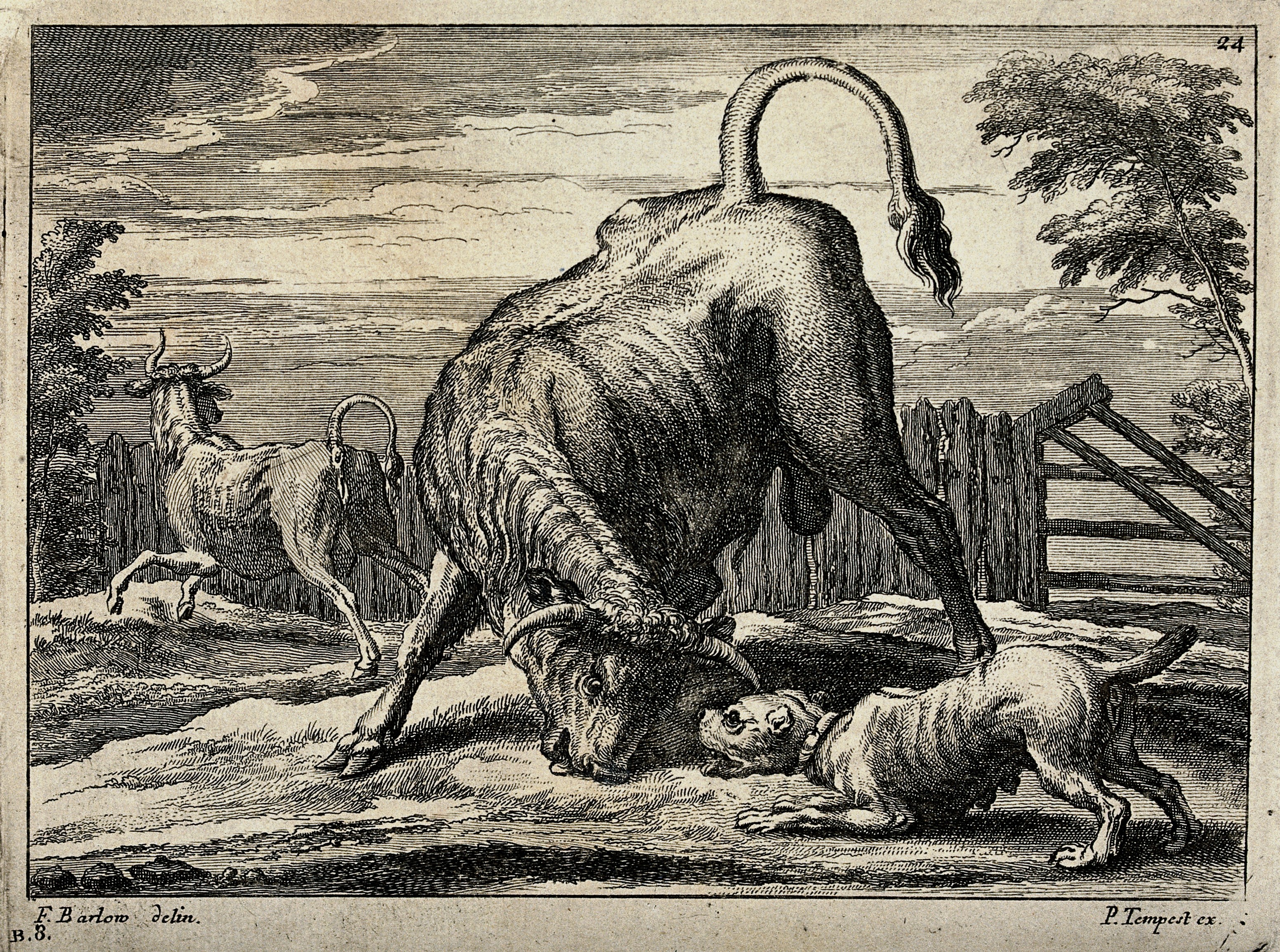
Para1The ferocious sport of bull-baiting was one of the main bloodsport pastimes for English
citizens in the early modern period, attracting men and women of all ages. In bull-baiting,
chained bulls were attacked by dogs who had been released into the arena. The English
enjoyed this blood sport as much as they enjoyed any other friendlier form of amusement,
such as plays, puppet shows, sports like wrestling, and music. Some people opposed
this form of entertainment, mainly the Puritans. Prominent Puritan critic of the theater
Philips Stubbes lamented
What Christian heart can take pleasure to see one poor beast rend, tear and kill another.Despite their efforts to eliminate it, bull-baiting continued to take place up until Parliament outlawed animal blood sports in 1835.
The Bloody Arena
Para2Arenas were purposefully crafted in England to sustain this form of entertainment.
Hundreds of dogs were separated by wooden boards, while bulls and bears were kept
in larger pens. Surrounding the open space where these baitings occurred were stands
which cost viewers two pennies to access. In the 16th century, evidence indicates
London may have had separate bloodsport arenas right beside each other, one adapted
to entertaining its viewers with bull-baiting and the other with bear-baiting, but
only one remained after 1583. Early modern Londoners took delight in watching experienced
bulls and dogs attack each other until severely wounded or dead.
Why Bull-baiting?
Para3Queen Elizabeth herself thoroughly enjoyed watching all different kinds of animal
blood sports. In one 1575 entertainment she attended, 13 bears were provided, although
some of them may have been performers rather than involved in baiting. Bear baiting
and cockfighting were also popular in London and around England. One widely believed
theory was that bull-baiting made the bull’s meat both safe to eat and more tender.
Attitudes of English Citizens in the Early Modern Period
Para4Readers in the 21st century may wonder why the English in the early modern period
were fascinated rather than distraught by bloodsports like bull-baiting. In her book
Brutal Reasoning: Animals, Rationality, and Humanity in Early Modern England, Erica Fudge lays out some of the principal attitudes towards bull-baiting during
this time period:
English people struggled to determine whether animals had reason or not.
Animals were used as a tool to make humans feel superior (192).
From the Theatre to the Arena
Macbeth himself refers to animal baiting when considering his final encounter with
his foes, stating they
have tied me to a stake; I cannot fly, / But, bear-like, I must fight the course.(Macbeth 5.7.1–2) Here reference is made to bear-baiting, a blood sport identical in nature to bull-baiting. The same people who consistently attended these bull, bear, dog, and other animal baiting scenes, also attended live theater, thus revealing the variety and contrast of English pastimes in the early modern period.
Sources
Dawson, Giles E.
London’s Bull-Baiting and Bear-Baiting Arena in 1562.Shakespeare Quarterly, vol. 15, no. 1, 1964, pp. 97–101, DOI 10.2307/2867963.
Fudge, Erica. Brutal Reasoning: Animals, Rationality, and Humanity in Early Modern England. Cornell UP, 2019.
Shakespeare, William. Macbeth. Edited by Barbara Mowat and Paul Werstine, Folger Shakespeare Library, 2013.
Open-Access Digital Resources
Andrews, Evan.
The Gruesome Blood Sports of Shakespearean England.History, A&E Television Networks, 9 Jan. 2019, https://www.history.com/articles/the-gruesome-blood-sports-of-shakespearean-england.Accessed 11 Feb. 2026.
Britannica Editors.
Bearbaiting.Encyclopedia Britannica, 6 Mar. 2018, https://www.britannica.com/sports/bearbaiting. Accessed 5 Jan. 2023.
Image Sources
Barlow, F. A Bull and a bulldog are about to attack eachother in an enlosure while
another bull is running away. Etching. Wellcome Collection. https://wellcomecollection.org/search/images?query=n9ztjj5w#.
Prosopography
Kate McPherson
Kate McPherson is Professor of English and Honors Program Director at Utah Valley
University (Orem, UT, USA). In 2015, she began working to redevelop Shakespeare’s Life and Times, created by Michael Best, into the Early Modern England Encyclopedia. Her other publications include commentary on Pericles and The Comedy of Errors for the New Oxford Shakespeare (2016); the co-edited volumes Stages of Engagement: Drama and Religion in Post-Reformation England with James Mardock (Duquesne University Press, 2014) and Shakespeare Expressed: Page, Stage, and Classroom in Shakespeare and His Contemporaries, with Kathryn M. Moncrief and Sarah Enloe (Fairleigh Dickinson University Press,
2013). With Kathryn M. Moncrief, Kate has also two edited collections, Performing Pedagogy in Early Modern England: Gender, Instruction, and Performance (Ashgate, 2011) and Performing Maternity in Early Modern England (Ashgate 2008). She has also published numerous articles on early modern maternity
in scholarly journals. Kate participated in the 2008 National Endowment for the Humanities
Institute,
Shakespeare’s Blackfriars: The Study, the Stage, the Classroom,at the American Shakespeare Center. She also served as Play Seminar Director, a public humanities position, for the Utah Shakespeare Festival in 2017 and 2018.
Leah Hamby
Leah Hamby is the primary encoder for the Early Modern England Encyclopedia. Aside from encoding, she also works as an editor for the project and contributed
several articles of her own. She has been working on the EMEE since February 2023. As of February 2026, she is soon to graduate with honours from
Utah Valley University with a major in history and a minor in creative writing. Her
other work with the LEMDO program includes remediating William Kemp’s Kemp’s Nine Day’s Wonder for the Digital Renaissance Editions.
Melissa Walter
Melissa Walter is Associate Professor of English at the University of the Fraser Valley.
Her research focuses on early modern English drama and English and European prose
fiction. She is the author of The Italian Novella and Shakespeare’s Comic Heroines (U of Toronto, 2019), and co-editor, with Dennis Britton, of Rethinking Shakespeare Source Study: Authors, Audiences, Digital Technologies (Routledge, 2018). Her work on English theatre and the European novella has appeared
in several edited collections, including Transnational Exchange in Early Modern Theater (Ashgate, 2008), and Transnational Mobility in Early Modern Theater (Ashgate, 2012). She has also written about
Translation and Identity in the Dialogues in English and Malaiane Languages(Indographies, ed. Jonathan Gil Harris. Palgrave 2012). At the University of the Fraser Valley, she is a lead coordinator of UFV’s Shakespeare and Reconciliation Garden.
Michael Best
Michael Best is Professor Emeritus at the University of Victoria, BC. He founded the
Internet Shakespeare Editions in 1996, and was Coordinating Editor until 2017, contributing two editions to the
ISE: King John and King Lear (the latter also available in print from Broadview Press). In print, he has published editions of works of Elizabethan magic and huswifery,
a collection of letters from the Australian goldfields, and Shakespeare on the Art of Love (2008). He contributed regular columns for the Shakespeare Newsletter on
Electronic Shakespeares,and has written many articles and chapters for both print and online books and journals, principally on questions raised by the new medium in the editing and publication of texts. He has delivered papers and plenary lectures on electronic media and the Internet Shakespeare Editions at conferences in Canada, the USA, the UK, Spain, Australia, and Japan.
Natasha Ediger
Natasha Ediger was a student at the University of Fraser Valley.
Navarra Houldin
Training and Documentation Lead 2025–present. LEMDO project manager 2022–2025. Textual
remediator 2021–present. Navarra Houldin (they/them) completed their BA with a major
in history and minor in Spanish at the University of Victoria in 2022. Their primary
research was on gender and sexuality in early modern Europe and Latin America. They
are continuing their education through an MA program in Gender and Social Justice
Studies at the University of Alberta where they will specialize in Digital Humanities.
Orgography
LEMDO Team (LEMD1)
The LEMDO Team is based at the University of Victoria and normally comprises the project
director, the lead developer, project manager, junior developers(s), remediators,
encoders, and remediating editors.
University of Victoria (UVIC1)
https://www.uvic.ca/Metadata
| Authority title | Bull-baiting |
| Type of text | Critical |
| Publisher | University of Victoria on the Linked Early Modern Drama Online Platform |
| Series | Early Modern England Encyclopedia |
| Source |
By Natasha Neudorf Ediger, inspired by Michael Best’s Shakespeare’s Life and Times, Internet Shakespeare Editions
|
| Editorial declaration | This document uses Canadian English spelling |
| Edition | Released with Early Modern England Encyclopedia 1.0 |
| Sponsor(s) |
Early Modern England EncyclopediaAnthology Leads: Kate McPherson and Kate Moncrief.
|
| Encoding description | Encoded in TEI P5 according to the LEMDO Customization and Encoding Guidelines |
| Document status | published, peer-reviewed |
| Funder(s) |
Social Sciences and Humanities Research Council of Canada
Mitacs Globalink Research Internship Utah Valley University |
| License/availability |
Intellectual copyright in this entry is held by Kate McPherson on behalf of the contributors. Copyright on the TEI-XML markup is held by the University of Victoria on behalf of the LEMDO Team. The content and TEI-XML markup in this file are licensed under a CC BY-NC_ND 4.0 license. This file is freely downloadable without permission under the following conditions:
(1) credit must be given to the authors, EMEE, and LEMDO in any subsequent use of
the files and /or data; (2) this availability statement must remain in the file; (3)
the content cannot be adapted or repurposed (except for quotations for the purposes
of academic review and citation); and (4) commercial uses are not permitted without
the knowledge and consent of the authors, EMEE, and LEMDO. Neither the content nor
the code in this file is licensed for training large language models (LLMs), ingestion
into an LLM, or any use in any artificial intelligence applications; such uses are
considered to be commercial uses and are strictly prohibited.
|