
Brewing Beer in Early Modern England
Significance of Ale and Beer in Early Modern England
Para1Fermented beverages, ale, and beer played a significant role in early modern England
as a staple in most people’s daily diet, as well as being intoxicants. Historians
such as Judith Bennet note that ale (a milder tasting drink without the slightly bitter
botantical ingredient of hops) was consumed throughout the day, including at breakfast.
Ale and small beer were considered a safer alternative to milk or water; we now know that they were
safer due to mild amounts of alcohol, estimated by experts at between 1%–3%, that
suppressed microbial growth. People of all social classes, from the nobility to peasants
and laborers, consumed both beer and ale regularly. Food historians like Mary-Anne
Caton have estimated that each English household would consume approximately one gallon
of ale or beer per person, per day to quench their thirst.
Beer Basics
Para2To create these important brews, the English traditionally used a cauldron or kettle,
some malted grain, hops, yeast, a water supply, and fire. Food historian Frank Clark
from Colonial Williamsburg notes that malting is the process of soaking grain, typically
barley, until it just begins to release sugars and sprout, then gently heating it
to stop the growth. Once the water, malted grain, and sometimes hops were added, brewers
would boil the mixture, then add yeast before fermenting it in casks. The fermentation
converts the sugars from the malted grain into ethanol and carbon dioxide, giving
beer or ale its alcohol content and slight fizz.
Para3Different grains were used in different parts of the world for beer brewing, according
to A History of Beer and Brewing by I. S. Hornsey. However, in early modern England, barley was the primary crop used
in the production of ale and beer because it was more receptive to malting. Other
grains that were used were wheat, oats, rye, millet, and maize.
Para4Ale refers to the mixture of malt, water, and yeast and has now become synonymous
with beer. However, before the end of the sixteenth century and the introduction of
hops into the brewing process mainly by Dutch immigrants to England, ale was an unhopped
beverage, according to historian Richard Unger. Hops add a slight bitterness but also
makes beer less likely to spoil than ale. Some early modern brewers used gruit, “a mixture of herbs and spices” to flavour their traditional ale.
Women as Brewers
Para5Brewing ale was a common practice in many English households and was typically the
responsibility of single, married, or widowed women, as noted by Judith Bennett. Many
things could go wrong in the brewing process; for example, a household could have
a shortage of ingredients due to drought or floods, the yeast cultures could die,
or the brew would simply not taste right. According to experts at the Folger Shakespeare
Library’s Folgerpedia, women brewers faced significant amounts of pressure from their husbands or masters
to ensure that their household ale was adequate for consumption. Women, including
Shakespeare’s wife Anne Hathaway, played a significant role in brewing ale up until
the introduction of hops and the inception of commercial brewing in the 18th century.
Judith Bennet claims that it was at this time that England saw the masculinization
of the beer brewing industry, which was historically known as women’s work. A search
of the Folger’s Digital Collection reveals dozens of handwritten recipe books by women
that feature advice about how to brew beer and ale.
Ale vs. Beer
Para6Before hops, ale brewers struggled to store their brew as it spoiled quickly and only
lasted roughly a week, making it insufficient for export and thus not able to keep
up with consumer demands. Historian Kirsten Burton notes this and other facts about
how the introduction of hops changed the brewing industry:
The introduction of hops in the 1500s was not well received in England as most citizens
preferred traditional ale.
Beer brewing flourished and quickly replaced ale as the primary brew throughout 17th-century
urban England.
Brewing beer required more equipment, a greater knowledge and skill set, and it was
more labour intensive than ale. Therefore, many ale brewers hesitated to switch to
beer brewing due to the added cost of hops, labour, and equipment.
Para7Towards the end of the 17th century, entire books were published that assisted both
commercial brewers and home brewers, such as Cerevisiarii Comes: or, the New and True Art of Brewing: Illustrated by Various Examples
in Making Beer, Ale and Other Liquors, published in London in 1692.
Beer in Shakespeare’s Plays
Para8Many early modern plays feature references to beer or ale. Shakespeare’s plays offer
a commentary on beer and ale in the changing environment of the early modern period.
He mocks drunkards like Falstaff in The First and the Second Parts of Henry IV and Christopher Sly in The Taming of the Shrew by having them call frequently for ale while appearing already intoxicated onstage.
He also shows the gendered aspects of brewing in Othello when Iago scornfully references women making an accounting of beer in their household.
Moreover, by referencing small and double beer, Shakespeare evidently understood its
significance and popularity in English households and amongst English drinkers. Mentioning
beer throughout his plays serves to connect his audience who doubtless consumed beer
to the characters who enjoy it as well. Scholar Christina Romanelli suggests that
Shakespeare’s character Mistress Nell Quickly, alewife and owner of the Boar Head
Tavern in the play The First and Second Parts of Henry IV, serves as a representation of the early modern English countrywoman belonging to
the working class, and that Shakespeare would have been familiar with women as brewers,
since the historical record notes his own wife brewed beer.
Sources
Bennett, Judith M. Ale, Beer, and Brewsters in England: Women’s Work in a Changing World, 1300–1600. Oxford UP, 1996.
Burton, Kirsten D.
The Citie Calls for Beere: The Introduction of Hops and the Foundation of Industrial Brewing in Early Modern London.Oklahoma State University, 2010.
Hornsey, I.S. A History of Beer and Brewing. The Royal Society of Chemistry, 2003.
Romanelli, Christina.
Sour Beer at the Boar’s Head: Salvaging Shakespeare’s Alewife, Mistress Quickly.Humanities vol. 8, no.1, 2019, pp.1–15.
Unger, Richard W. Beer in the Middle Ages and the Renaissance. U of Pennsylvania P, 2007.
Open-Access Digital Resources
Best, Michael.
Brewing Beer.Shakespeare’s Life and Times. Internet Shakespeare Editions. University of Victoria, 4 Jan. 2011, https://internetshakespeare.uvic.ca/Library/SLT/society/city%20life/trades/brewer.html. Accessed 18 Oct. 2022.
Caton, Mary-Anne.
Fooles and Fricassees: Food in Shakespeare’s England.Folgerpedia, 2018, https://folgerpedia.folger.edu/Fooles_and_Fricassees:_Food_in_Shakespeare%27s_England. Accessed 19 Oct. 2022.
Herbert, Amanda E. et al.
First Chefs: Fame and Foodways from Britain to the Americas.Folgerpedia, 2021. https://folgerpedia.folger.edu/First_Chefs:_Fame_and_Foodways_from_Britain_to_the_Americas. Accessed 18 Oct. 2022.
Image Sources
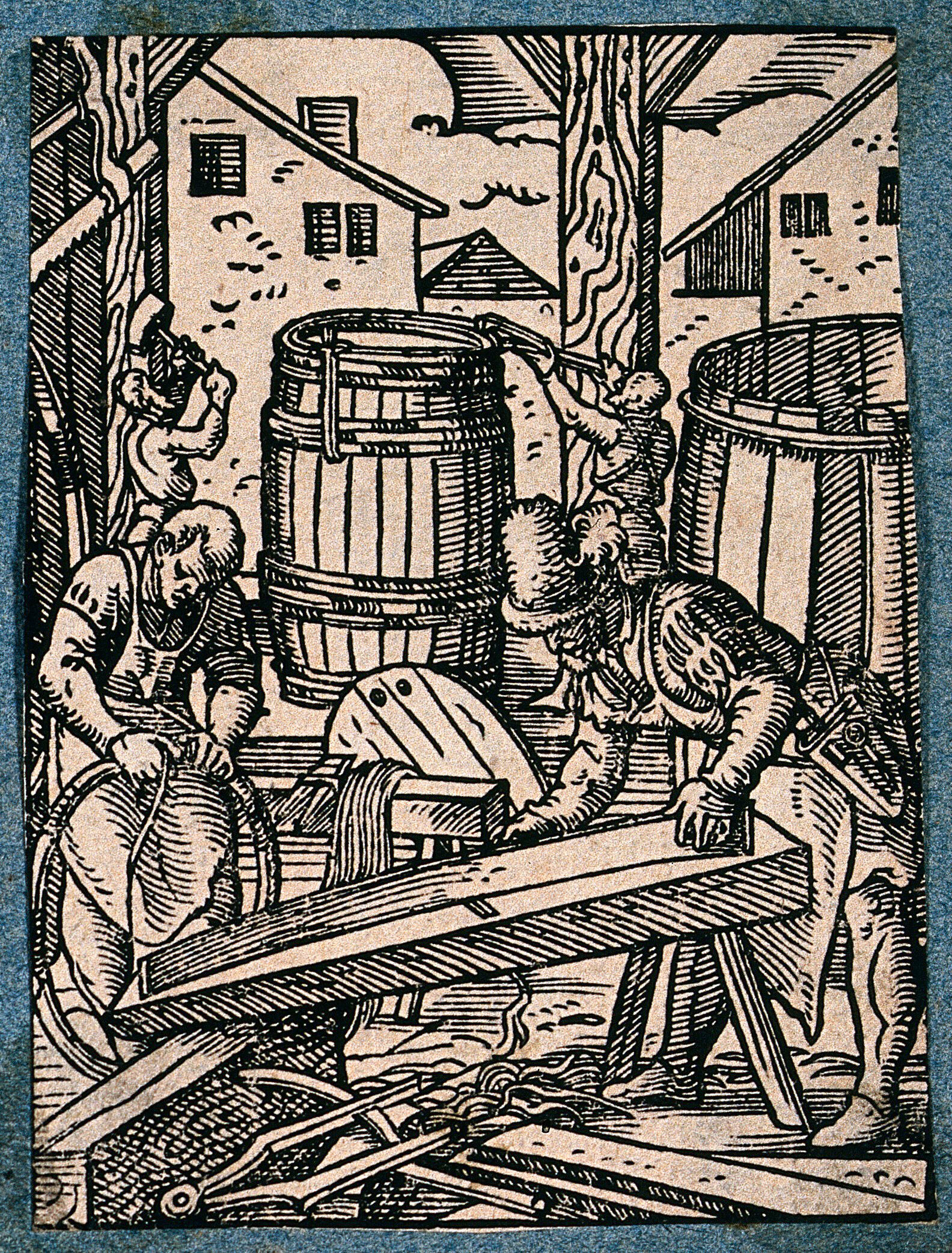
Amman, Jost. A Cooper and his Assistants Making Waterbutts and Barrels for Wine and
Beer. 1568. Woodcut. Wellcome Collection. https://wellcomecollection.org/works/utq3uycu/images?id=f22k3pbt.
Prosopography
Kate McPherson
Kate McPherson is Professor of English and Honors Program Director at Utah Valley
University (Orem, UT, USA). In 2015, she began working to redevelop Shakespeare’s Life and Times, created by Michael Best, into the Early Modern England Encyclopedia. Her other publications include commentary on Pericles and The Comedy of Errors for the New Oxford Shakespeare (2016); the co-edited volumes Stages of Engagement: Drama and Religion in Post-Reformation England with James Mardock (Duquesne University Press, 2014) and Shakespeare Expressed: Page, Stage, and Classroom in Shakespeare and His Contemporaries, with Kathryn M. Moncrief and Sarah Enloe (Fairleigh Dickinson University Press,
2013). With Kathryn M. Moncrief, Kate has also two edited collections, Performing Pedagogy in Early Modern England: Gender, Instruction, and Performance (Ashgate, 2011) and Performing Maternity in Early Modern England (Ashgate 2008). She has also published numerous articles on early modern maternity
in scholarly journals. Kate participated in the 2008 National Endowment for the Humanities
Institute,
Shakespeare’s Blackfriars: The Study, the Stage, the Classroom,at the American Shakespeare Center. She also served as Play Seminar Director, a public humanities position, for the Utah Shakespeare Festival in 2017 and 2018.
Leah Hamby
Leah Hamby is the primary encoder for the Early Modern England Encyclopedia. Aside from encoding, she also works as an editor for the project and contributed
several articles of her own. She has been working on the EMEE since February 2023. As of February 2026, she is soon to graduate with honours from
Utah Valley University with a major in history and a minor in creative writing. Her
other work with the LEMDO program includes remediating William Kemp’s Kemp’s Nine Day’s Wonder for the Digital Renaissance Editions.
Melissa Walter
Melissa Walter is Associate Professor of English at the University of the Fraser Valley.
Her research focuses on early modern English drama and English and European prose
fiction. She is the author of The Italian Novella and Shakespeare’s Comic Heroines (U of Toronto, 2019), and co-editor, with Dennis Britton, of Rethinking Shakespeare Source Study: Authors, Audiences, Digital Technologies (Routledge, 2018). Her work on English theatre and the European novella has appeared
in several edited collections, including Transnational Exchange in Early Modern Theater (Ashgate, 2008), and Transnational Mobility in Early Modern Theater (Ashgate, 2012). She has also written about
Translation and Identity in the Dialogues in English and Malaiane Languages(Indographies, ed. Jonathan Gil Harris. Palgrave 2012). At the University of the Fraser Valley, she is a lead coordinator of UFV’s Shakespeare and Reconciliation Garden.
Michael Best
Michael Best is Professor Emeritus at the University of Victoria, BC. He founded the
Internet Shakespeare Editions in 1996, and was Coordinating Editor until 2017, contributing two editions to the
ISE: King John and King Lear (the latter also available in print from Broadview Press). In print, he has published editions of works of Elizabethan magic and huswifery,
a collection of letters from the Australian goldfields, and Shakespeare on the Art of Love (2008). He contributed regular columns for the Shakespeare Newsletter on
Electronic Shakespeares,and has written many articles and chapters for both print and online books and journals, principally on questions raised by the new medium in the editing and publication of texts. He has delivered papers and plenary lectures on electronic media and the Internet Shakespeare Editions at conferences in Canada, the USA, the UK, Spain, Australia, and Japan.
Michelle Aikema
Michelle Aikema was a student at the University of Fraser Valley.
Navarra Houldin
Training and Documentation Lead 2025–present. LEMDO project manager 2022–2025. Textual
remediator 2021–present. Navarra Houldin (they/them) completed their BA with a major
in history and minor in Spanish at the University of Victoria in 2022. Their primary
research was on gender and sexuality in early modern Europe and Latin America. They
are continuing their education through an MA program in Gender and Social Justice
Studies at the University of Alberta where they will specialize in Digital Humanities.
Orgography
LEMDO Team (LEMD1)
The LEMDO Team is based at the University of Victoria and normally comprises the project
director, the lead developer, project manager, junior developers(s), remediators,
encoders, and remediating editors.
University of Victoria (UVIC1)
https://www.uvic.ca/Metadata
| Authority title | Brewing Beer in Early Modern England |
| Type of text | Critical |
| Publisher | University of Victoria on the Linked Early Modern Drama Online Platform |
| Series | Early Modern England Encyclopedia |
| Source |
By Michelle Aikema, inspired by Michael Best’s Shakespeare’s Life and Times, Internet Shakespeare Editions
|
| Editorial declaration | This document uses Canadian English spelling |
| Edition | Released with Early Modern England Encyclopedia 1.0 |
| Sponsor(s) |
Early Modern England EncyclopediaAnthology Leads: Kate McPherson and Kate Moncrief.
|
| Encoding description | Encoded in TEI P5 according to the LEMDO Customization and Encoding Guidelines |
| Document status | published, peer-reviewed |
| Funder(s) |
Social Sciences and Humanities Research Council of Canada
Mitacs Globalink Research Internship Utah Valley University |
| License/availability |
Intellectual copyright in this entry is held by Kate McPherson on behalf of the contributors. Copyright on the TEI-XML markup is held by the University of Victoria on behalf of the LEMDO Team. The content and TEI-XML markup in this file are licensed under a CC BY-NC_ND 4.0 license. This file is freely downloadable without permission under the following conditions:
(1) credit must be given to the authors, EMEE, and LEMDO in any subsequent use of
the files and /or data; (2) this availability statement must remain in the file; (3)
the content cannot be adapted or repurposed (except for quotations for the purposes
of academic review and citation); and (4) commercial uses are not permitted without
the knowledge and consent of the authors, EMEE, and LEMDO. Neither the content nor
the code in this file is licensed for training large language models (LLMs), ingestion
into an LLM, or any use in any artificial intelligence applications; such uses are
considered to be commercial uses and are strictly prohibited.
|