
Bread and Baking in Early Modern England
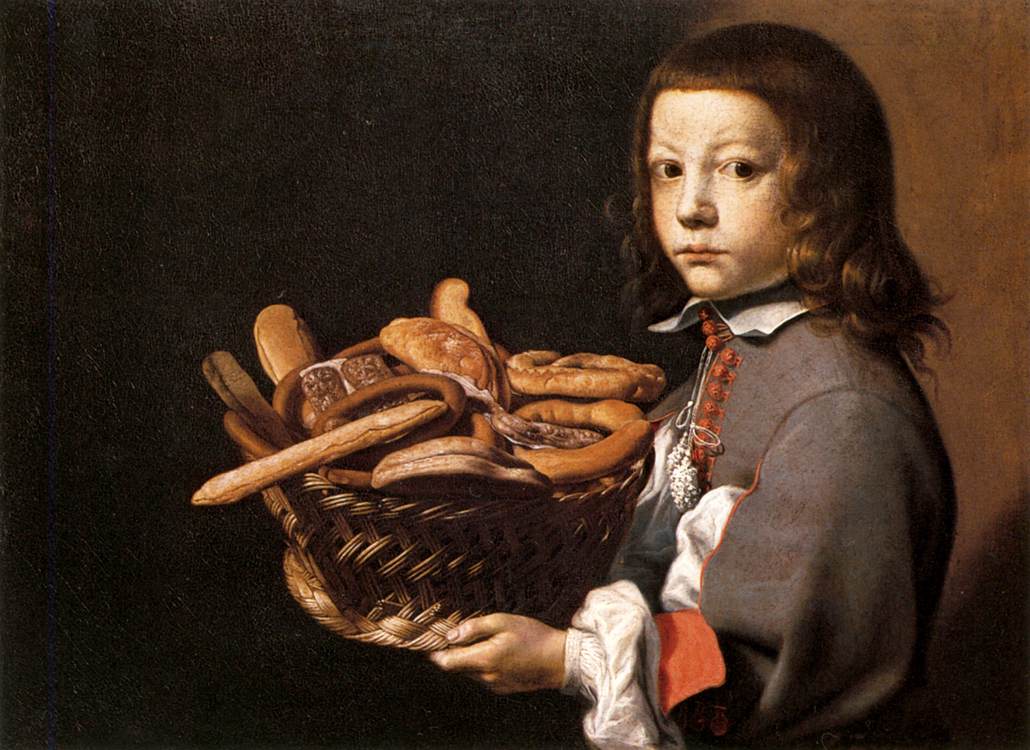
Para1In the early modern period, the wealthy ate foods such as beef, pork, lamb, veal,
venison, and seafood in addition to bread and a few vegetables. However, for the majority
of English people, bread was the staple food and the
biblical staff of life(Lloyd 37). Most days, commoners in early modern England ate bread and pottage, a thick stew of vegetables, grains, and peas or lentils.
Flour & Substitutes in Baking
Para2The Oxford English Dictionary provides a simple and straightforward definition of bread:
A staple food made by mixing flour and water or other liquid (often with yeast or other leavening agent) to form a dough which is then cooked, usually by baking.
Para3In this period in England, bread was made with flour ground from wheat, barley, rye,
oats, peas, lentils, and even acorns. Wheat, which was often called corn (a generic term for grain, rather than the maize native to the Americas), was the
most desirable grain for bread. But the flour base for bread was a challenge for poorer
citizens. If usual grains like wheat or rye were too expensive or scarce, peas and
beans were the next best alternatives for creating a dough. Seeds like acorns were
also a primary source of their flour base, which they roasted then ground into a paste
and baked to produce a traditional flatbread.
Para4Upper-class citizens ate a different type of bread compared to the lower-class. The
ideal loaf for upper-class citizens was white and soft, typically called manchet in Tudor England. Poorer people often ate a half-rye loaf called maslin, which is more difficult to digest due to coarser wheat and the harder crust.
Pastry Baking
Para5Pastries were quite popular as well, and savory pastry crusts were often wrapped around
meat for wealthier citizens. Gervase Markham’s 1615 The English Housewife offers a traditional pastry recipe that pairs with meat dishes:
Of puff paste. Now for the making of puff paste of the best kind, you shall take the finest wheat flour after it hath been a little baked in a pot in the oven, and blend it well with eggs, whites and yolks all together, after the paste is well kneaded, roll out a part thereof as thin as you please, and then spread cold sweet butter over the same, then upon the same butter roll another leaf of the paste as before; and spread it with butter also; and thus roll leaf upon leaf with butter between till it be as thick as you make good: and with it either cover any baked meat, or make paste for venison.(157)
Para6This recipe is quite similar to modern-day croissant recipes, with the layers of butter
between each layer of thin dough. It is a classic, multi-use recipe. Markham also
discusses adding sugar to the dough later for fruit pies or tarts.
Para7A more affordable recipe that the average citizen would most likely use on a day-to-day
basis would be biscuits. Here is a recipe for biscuits used in 1672 by Constance Hall
in a handwritten recipe book. This dish was called Cogs Biskett:
To make Cogs Biskett, Take 3 pound of fine flower well dry’d, a Ounce of Carraway seeds, 6 spoonefull of suger Double Refin’d, 6 spoonefull of Ale, 6 Eggs, the whites of Two, and wett it with warm Milk 2 peny worth of safforn. lett it Lye to Rise.
Para8Bouchard and Tersigni have an excellent translation of this recipe, and even include how to bake it properly in a modern kitchen.
The Baking Station
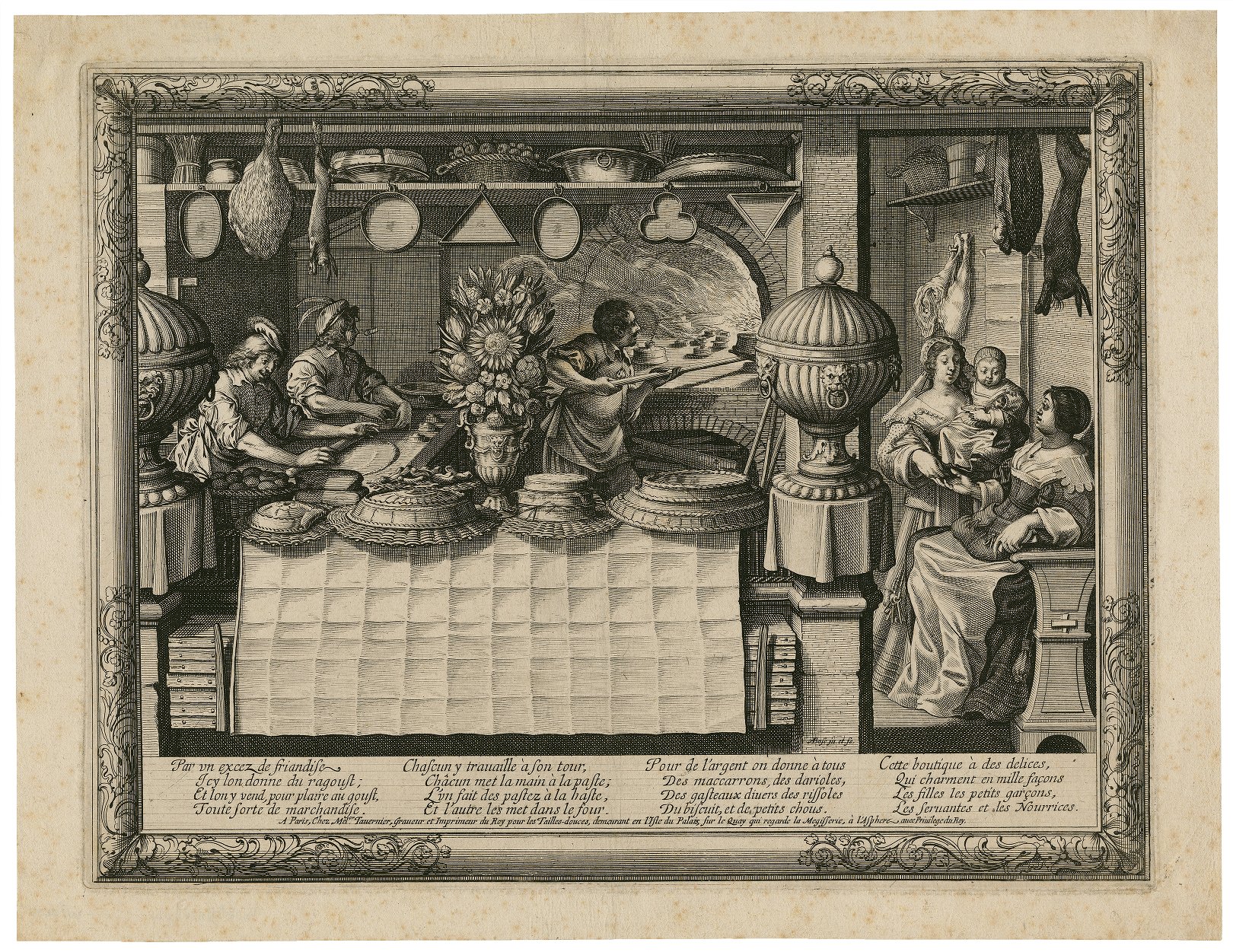
Para9We know from Gervase Markham that, during this time, ovens were primarily made from
bricks or mud construction, preheated, then used to bake bread. The ideal oven should
also be made narrow, square, and easily covered to keep the heat inside.
Para10First, the baker had to build a fire with wood and let it burn to coals. Next, the
baker swept the floor of the oven clean from ashes and other debris and made sure
the temperature inside was hot. Thermometers were not invented until the 18th century,
so in the early modern period, the only way to measure oven temperature was through
observation. Lastly, the shaped loaves were placed inside and baked.
Para11It was also important to incorporate things besides an oven in a bake-house, including
troughs to knead dough, casks for leaven such as beer, and safes to hold flour, bran
or other substitutes. Bakers also needed various meal sieves that could sieve coarse
flour to very fine flour and a large table to knead and mold bread.
Bread and Other Food Prices
Para12Food prices were heavily regulated in the early modern period. The following is a
list of common foods and their prices in 1599:
Bread, ½d (pence) per loaf
Beef , ½d per lb
Eggs, 3 for 1d
Butter, 4d per lb
Cheese, ½d per lb
Beer, ½d per quart.
Para13For context, there are 12 pence (d) in 1 shilling (s), and 20 shillings in a pound
(£). In London, a loaf of wheat bread was to be sold for around 1d depending on its
size. To put the prices in even more perspective, in the same year of 1599, the Earl
of Nottingham proclaimed a set amount that soldiers could be asked to pay for supper.
For foot soldiers, that maximum amount was 3½d out of their 8d a day wage. That supper
was mandated to include
good wheaten breadand lots of other protein sources necessary to keep the soldiers well-fed (Lloyd 40).
Baking Regulations
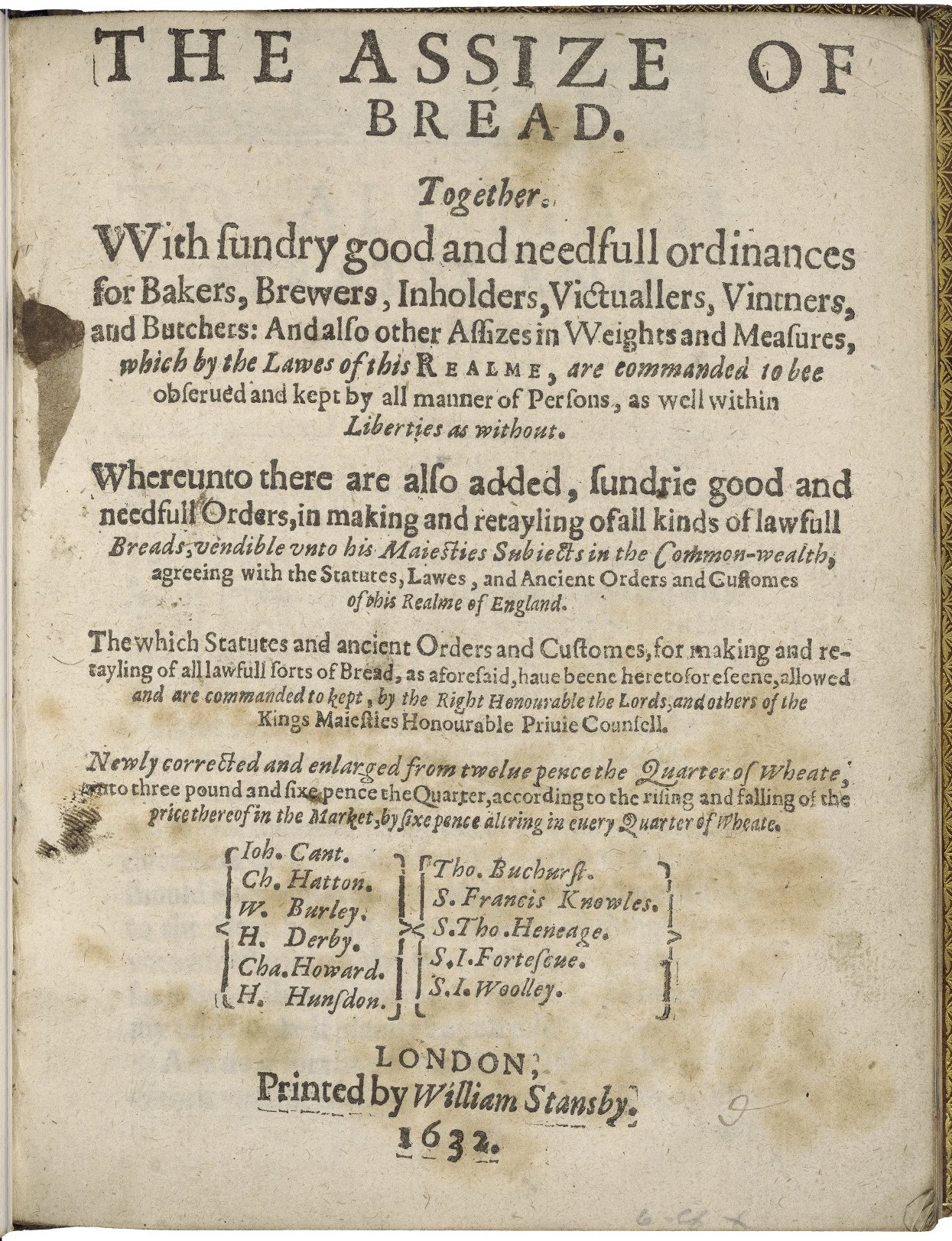
Para14The price and weight of bread were rigorously controlled by local authorities. The
Bakers’ Guild held the responsibility of enforcing the Bread Assize which controlled the prices, quality, weight, and types of bread sold in towns and
villages. The Assize for Bread began in the 13th Century and lasted until the 18th.
Para15All types of bread were sold for fixed prices for a half loaf or a full loaf. These
prices did not change for centuries, but when wheat supplies decreased during a bad
harvest for instance, the price then did go up for a smaller loaf of bread. This was
why it was so important for regular citizens to improvise their bread baking ingredients
by using different ingredients like rye, oats, and acorns.
Para16The Worshipful Company of Bakers notes that the Bakers’ Guild enforced the Bread Assize
from a 2-mile radius within London, or with a circumference of 12 miles around it,
minus the city of Westminster. This Guild had legal power to enforce the Assize laws
and determine fitting punishments for bakers who attempted to evade the regulations:
The penalties for more serious offences were on the first occasion for the offender to be dragged on a hurdle through the dirtiest streets of the City with the faulty loaf hanging from his neck. For the second offence he was pilloried for an hour, and if he broke the law a third time, his oven was pulled down and he had to forswear baking for evermore.
Sources
Civitello, Linda. Baking Powder Wars: The Cutthroat Food Fight That Revolutionized Cooking. University of Illinois Press, 2017.
Lloyd, Paul S. Food and Identity in England, 1540–1640: Eating to Impress. Bloomsbury Academic, 2015.
Markham, Gervase. The English Housewife. Edited by Michael R. Best, McGill-Queen’s University Press, 1986.
Rubel, William. Bread: A Global History. Reaktion Books, 2011.
Open-Access Digital Resources
Baker’s Company.
About us: History.The Worshipful Company of Bakers, 2022, https://bakers.co.uk/. Accessed 11 Feb. 2026.
Caton, Mary Anne.
Fooles and Fricassees: Food in Shakespeare’s England.Folgerpedia, 1999, https://folgerpedia.folger.edu/Fooles_and_Fricassees:_Food_in_Shakespeare%27s_England (see
Pottage & Bread). Accessed 11 Feb. 2026.
Tersigni, Elisa and Jack Bouchard.
Savory Biscuits from a 17th-Century Recipe.Shakespeare & Beyond, Folger Shakespeare Library, 9 Nov. 2018, https://www.folger.edu/blogs/shakespeare-and-beyond/savory-biscuits-from-a-17th-century-recipe/. Accessed 11 Feb. 2026.
Image Sources
Baschenis, Evaristo. Boy with a Basket of Bread. 1665. Wikimedia. https://commons.wikimedia.org/wiki/File:Evaristo_Baschenis_-_Boy_with_a_Basket_of_Bread_-_WGA1404.jpg.

Bosse, Abraham. The Pastry Chef. 1634. Folger Digital Collections, https://digitalcollections.folger.edu/img35714.
Privy Council. The Assize of Bread. London: William Stansby, 1632. Folger Digital Collections. https://digitalcollections.folger.edu/img2921.
Prosopography
Cindy Castro
Cindy Castro was a student of the University of Fraser Valley.
Janelle Jenstad
Janelle Jenstad is a Professor of English at the University of Victoria, Director
of The Map of Early Modern London, and Director of Linked Early Modern Drama Online. With Jennifer Roberts-Smith and Mark Beatrice Kaethler, she co-edited Shakespeare’s Language in Digital Media: Old Words, New Tools (Routledge). She has edited John Stow’s A Survey of London (1598 text) for MoEML and is currently editing The Merchant of Venice (with Stephen Wittek) and Heywood’s 2 If You Know Not Me You Know Nobody for DRE. Her articles have appeared in Digital Humanities Quarterly, Elizabethan Theatre, Early Modern Literary Studies, Shakespeare Bulletin, Renaissance and Reformation, and The Journal of Medieval and Early Modern Studies. She contributed chapters to Approaches to Teaching Othello (MLA); Teaching Early Modern Literature from the Archives (MLA); Institutional Culture in Early Modern England (Brill); Shakespeare, Language, and the Stage (Arden); Performing Maternity in Early Modern England (Ashgate); New Directions in the Geohumanities (Routledge); Early Modern Studies and the Digital Turn (Iter); Placing Names: Enriching and Integrating Gazetteers (Indiana); Making Things and Drawing Boundaries (Minnesota); Rethinking Shakespeare Source Study: Audiences, Authors, and Digital Technologies (Routledge); and Civic Performance: Pageantry and Entertainments in Early Modern London (Routledge). For more details, see janellejenstad.com.
Kate McPherson
Kate McPherson is Professor of English and Honors Program Director at Utah Valley
University (Orem, UT, USA). In 2015, she began working to redevelop Shakespeare’s Life and Times, created by Michael Best, into the Early Modern England Encyclopedia. Her other publications include commentary on Pericles and The Comedy of Errors for the New Oxford Shakespeare (2016); the co-edited volumes Stages of Engagement: Drama and Religion in Post-Reformation England with James Mardock (Duquesne University Press, 2014) and Shakespeare Expressed: Page, Stage, and Classroom in Shakespeare and His Contemporaries, with Kathryn M. Moncrief and Sarah Enloe (Fairleigh Dickinson University Press,
2013). With Kathryn M. Moncrief, Kate has also two edited collections, Performing Pedagogy in Early Modern England: Gender, Instruction, and Performance (Ashgate, 2011) and Performing Maternity in Early Modern England (Ashgate 2008). She has also published numerous articles on early modern maternity
in scholarly journals. Kate participated in the 2008 National Endowment for the Humanities
Institute,
Shakespeare’s Blackfriars: The Study, the Stage, the Classroom,at the American Shakespeare Center. She also served as Play Seminar Director, a public humanities position, for the Utah Shakespeare Festival in 2017 and 2018.
Leah Hamby
Leah Hamby is the primary encoder for the Early Modern England Encyclopedia. Aside from encoding, she also works as an editor for the project and contributed
several articles of her own. She has been working on the EMEE since February 2023. As of February 2026, she is soon to graduate with honours from
Utah Valley University with a major in history and a minor in creative writing. Her
other work with the LEMDO program includes remediating William Kemp’s Kemp’s Nine Day’s Wonder for the Digital Renaissance Editions.
Melissa Walter
Melissa Walter is Associate Professor of English at the University of the Fraser Valley.
Her research focuses on early modern English drama and English and European prose
fiction. She is the author of The Italian Novella and Shakespeare’s Comic Heroines (U of Toronto, 2019), and co-editor, with Dennis Britton, of Rethinking Shakespeare Source Study: Authors, Audiences, Digital Technologies (Routledge, 2018). Her work on English theatre and the European novella has appeared
in several edited collections, including Transnational Exchange in Early Modern Theater (Ashgate, 2008), and Transnational Mobility in Early Modern Theater (Ashgate, 2012). She has also written about
Translation and Identity in the Dialogues in English and Malaiane Languages(Indographies, ed. Jonathan Gil Harris. Palgrave 2012). At the University of the Fraser Valley, she is a lead coordinator of UFV’s Shakespeare and Reconciliation Garden.
Michael Best
Michael Best is Professor Emeritus at the University of Victoria, BC. He founded the
Internet Shakespeare Editions in 1996, and was Coordinating Editor until 2017, contributing two editions to the
ISE: King John and King Lear (the latter also available in print from Broadview Press). In print, he has published editions of works of Elizabethan magic and huswifery,
a collection of letters from the Australian goldfields, and Shakespeare on the Art of Love (2008). He contributed regular columns for the Shakespeare Newsletter on
Electronic Shakespeares,and has written many articles and chapters for both print and online books and journals, principally on questions raised by the new medium in the editing and publication of texts. He has delivered papers and plenary lectures on electronic media and the Internet Shakespeare Editions at conferences in Canada, the USA, the UK, Spain, Australia, and Japan.
Navarra Houldin
Training and Documentation Lead 2025–present. LEMDO project manager 2022–2025. Textual
remediator 2021–present. Navarra Houldin (they/them) completed their BA with a major
in history and minor in Spanish at the University of Victoria in 2022. Their primary
research was on gender and sexuality in early modern Europe and Latin America. They
are continuing their education through an MA program in Gender and Social Justice
Studies at the University of Alberta where they will specialize in Digital Humanities.
Orgography
LEMDO Team (LEMD1)
The LEMDO Team is based at the University of Victoria and normally comprises the project
director, the lead developer, project manager, junior developers(s), remediators,
encoders, and remediating editors.
University of Victoria (UVIC1)
https://www.uvic.ca/Metadata
| Authority title | Bread and Baking in Early Modern England |
| Type of text | Critical |
| Publisher | University of Victoria on the Linked Early Modern Drama Online Platform |
| Series | Early Modern England Encyclopedia |
| Source |
By Cindy Castro, inspired by Michael Best’s Shakespeare’s Life and Times, Internet Shakespeare Editions
|
| Editorial declaration | This document uses Canadian English spelling |
| Edition | Released with Early Modern England Encyclopedia 1.0 |
| Sponsor(s) |
Early Modern England EncyclopediaAnthology Leads: Kate McPherson and Kate Moncrief.
|
| Encoding description | Encoded in TEI P5 according to the LEMDO Customization and Encoding Guidelines |
| Document status | published, peer-reviewed |
| Funder(s) |
Social Sciences and Humanities Research Council of Canada
Mitacs Globalink Research Internship Utah Valley University |
| License/availability |
Intellectual copyright in this entry is held by Kate McPherson on behalf of the contributors. Copyright on the TEI-XML markup is held by the University of Victoria on behalf of the LEMDO Team. The content and TEI-XML markup in this file are licensed under a CC BY-NC_ND 4.0 license. This file is freely downloadable without permission under the following conditions:
(1) credit must be given to the authors, EMEE, and LEMDO in any subsequent use of
the files and /or data; (2) this availability statement must remain in the file; (3)
the content cannot be adapted or repurposed (except for quotations for the purposes
of academic review and citation); and (4) commercial uses are not permitted without
the knowledge and consent of the authors, EMEE, and LEMDO. Neither the content nor
the code in this file is licensed for training large language models (LLMs), ingestion
into an LLM, or any use in any artificial intelligence applications; such uses are
considered to be commercial uses and are strictly prohibited.
|