Para1Blank verse is a form of poetry or dramatic verse that follows a regular meter, typically
iambic pentameter, but does not have a rhyme scheme. The term arises from the Italian
phrase verso sciolto, meaning poetry without rhyme. The form was first widely used in Italian poetry starting
in the early 16th century for dramatic and epic poetry. In its sound, it resembles
prose for its lack of regular rhyme patterns and can sound relatively natural, more
like everyday speech.
Characteristics
Para2Classic blank verse is generally written in iambic pentameter, with most lines containing
ten syllables alternating unstressed and stressed syllables. To determine if a passage
is in blank verse, try to read it aloud and listen for the regular rhythmic pattern
of iambic pentameter:
Para3It sounds like de-DUM de-DUM de-DUM de-DUM de-DUM
Para4A pentameter line consists of five such rhythmic units or feet, with each de-DUM being an iambic foot. An iambic foot is made up of two syllables with the stress
falling on the second syllable. Pentameter comes from the Greek word meaning five measures.
Historical Context
Para5Blank verse in English originated in the mid-sixteenth century with Henry Howard,
earl of Surrey, who invented an English form based on classical and Italian models
for his translation of Virgil’s Aeneid (c.1554) in unrhymed iambic pentameter. However, it was not until the end of the
century that the unrhymed English pentameters of Howard’s Aeneid were given a name. The phrase blank verse was first used disparagingly by Robert Greene in the preface to Perimedes the Blacksmith in 1588. Greene was the London writer and critic who labeled Shakespeare an upstart crow. The form remained mostly on the periphery of early modern English literary culture
until the late 16th century, but gained popularity as dramatic and poetic works by
Christopher Marlowe and William Shakespeare became successful.
Examples of Blank Verse
Para6The use of blank verse in Elizabethan poetry was not limited to Shakespeare. For instance,
Thomas Sackville and Thomas Norton’s Gorboduc, was the first original English drama in blank verse and was performed for the Queen
in 1561. George Gascoigne’s The Steel Glass was the first original English poem in blank verse using iambic pentameter. Christopher
Marlowe’s blank verse was also influential, emulated by other playwrights of the period,
including Ben Jonson, who dubbed it Marlowe’s mighty line in his valedictory poem to Shakespeare that appeared in the First Folio in 1623. Shakespeare, who scholars such as Gary Taylor have recently demonstrated
was writing in cooperation with Marlowe during this time, was undoubtedly influenced
by Marlowe.
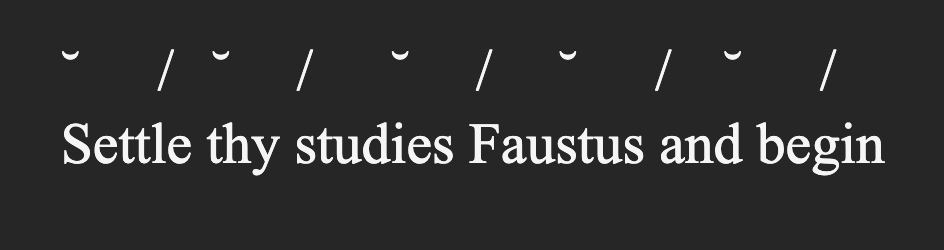
Para7Take the first line of Christopher Marlowe’s 1592 play Doctor Faustus, which shows Faustus speaking of himself using blank verse:
Or the famous opening of Romeo’s address to Juliet as he stands in her family’s garden:
Read Romeo’s question aloud to hear the alternation of the unstressed (˘) and stressed
syllables (/) that give the line its regular rhythm: de-DUM, de-DUM, de-DUM, de-DUM,
de-DUM.
Shakespeare’s Use of Blank Verse
Para8Shakespeare frequently employed this verse pattern and so well-known speeches, such
as Henry V’s St. Crispin’s Day speech or the soliloquies, such as the first one in
Hamlet occur in blank verse.
O, that this too too solid flesh would melt,
Thaw and resolve itself into a dew!
Or that the Everlasting had not fixed
His canon gainst self-slaughter! O God, O God!
How weary, stale, flat and unprofitable
Seem to me all the uses of this world!
(Hamlet sc.2. 129–134)
Para9Shakespeare became a master of blank verse but also expanded its creative capabilities.
He began to craft blank verse that circled away from the stressed tenth syllable.
Scholar Robert Stagg reports that one of his innovations was the use of so-called
feminine endings, with about a quarter of the lines in Hamlet ending with an unstressed eleventh syllable, such as in the line To be or not to be, that is the question. (Hamlet sc.8 57)
Para10Stagg likewise reports that Shakespeare also used other innovations like
shared line, which is when one character begins to speak and another responds to finish
the iambic pentameter line
late caesura, which is a break in the line towards the end of the 10 syllables
capping couplets, which offers two rhyming lines at the end of a speech
Sources
Hardison, O.B.Blank Verse before Milton.Studies in Philology vol. 81, no. 3, 1984, pp. 253–274.
Stagg, Robert. Shakespeare’s Bombastic Blanks.The Review of English Studies vol. 72, no. 307, Nov. 2021, pp. 882–899.
Taylor, Gary et al.The New Oxford Shakespeare: Modern Critical Edition. Oxford UP, 2016.
Weiskott, Eric. The First Recorded References to “Blank Verse”.Notes & Queries vol. 65, no. 4, Dec. 2018, pp. 494–495.
Gabrielle Attieh was a student at the University of Fraser Valley.
Janelle Jenstad
Janelle Jenstad is a Professor of English at the University of Victoria, Director
of The Map of Early Modern London, and Director of Linked Early Modern Drama Online. With Jennifer Roberts-Smith and Mark Beatrice Kaethler, she co-edited Shakespeare’s Language in Digital Media: Old Words, New Tools (Routledge). She has edited John Stow’s A Survey of London (1598 text) for MoEML and is currently editing The Merchant of Venice (with Stephen Wittek) and Heywood’s 2 If You Know Not Me You Know Nobody for DRE. Her articles have appeared in Digital Humanities Quarterly, Elizabethan Theatre, Early Modern Literary Studies, Shakespeare Bulletin, Renaissance and Reformation, and The Journal of Medieval and Early Modern Studies. She contributed chapters to Approaches to Teaching Othello (MLA); Teaching Early Modern Literature from the Archives (MLA); Institutional Culture in Early Modern England (Brill); Shakespeare, Language, and the Stage (Arden); Performing Maternity in Early Modern England (Ashgate); New Directions in the Geohumanities (Routledge); Early Modern Studies and the Digital Turn (Iter); Placing Names: Enriching and Integrating Gazetteers (Indiana); Making Things and Drawing Boundaries (Minnesota); Rethinking Shakespeare Source Study: Audiences, Authors, and Digital Technologies (Routledge); and Civic Performance: Pageantry and Entertainments in Early Modern London (Routledge). For more details, see janellejenstad.com.
Kate McPherson
Kate McPherson is Professor of English and Honors Program Director at Utah Valley
University (Orem, UT, USA). In 2015, she began working to redevelop Shakespeare’s Life and Times, created by Michael Best, into the Early Modern England Encyclopedia. Her other publications include commentary on Pericles and The Comedy of Errors for the New Oxford Shakespeare (2016); the co-edited volumes Stages of Engagement: Drama and Religion in Post-Reformation England with James Mardock (Duquesne University Press, 2014) and Shakespeare Expressed: Page, Stage, and Classroom in Shakespeare and His Contemporaries, with Kathryn M. Moncrief and Sarah Enloe (Fairleigh Dickinson University Press,
2013). With Kathryn M. Moncrief, Kate has also two edited collections, Performing Pedagogy in Early Modern England: Gender, Instruction, and Performance (Ashgate, 2011) and Performing Maternity in Early Modern England (Ashgate 2008). She has also published numerous articles on early modern maternity
in scholarly journals. Kate participated in the 2008 National Endowment for the Humanities
Institute, Shakespeare’s Blackfriars: The Study, the Stage, the Classroom, at the American Shakespeare Center. She also served as Play Seminar Director, a public
humanities position, for the Utah Shakespeare Festival in 2017 and 2018.
Leah Hamby
Leah Hamby is the primary encoder for the Early Modern England Encyclopedia. Aside from encoding, she also works as an editor for the project and contributed
several articles of her own. She has been working on the EMEE since February 2023. As of February 2026, she is soon to graduate with honours from
Utah Valley University with a major in history and a minor in creative writing. Her
other work with the LEMDO program includes remediating William Kemp’s Kemp’s Nine Day’s Wonder for the Digital Renaissance Editions.
Melissa Walter
Melissa Walter is Associate Professor of English at the University of the Fraser Valley.
Her research focuses on early modern English drama and English and European prose
fiction. She is the author of The Italian Novella and Shakespeare’s Comic Heroines (U of Toronto, 2019), and co-editor, with Dennis Britton, of Rethinking Shakespeare Source Study: Authors, Audiences, Digital Technologies (Routledge, 2018). Her work on English theatre and the European novella has appeared
in several edited collections, including Transnational Exchange in Early Modern Theater (Ashgate, 2008), and Transnational Mobility in Early Modern Theater (Ashgate, 2012). She has also written about Translation and Identity in the Dialogues in English and Malaiane Languages (Indographies, ed. Jonathan Gil Harris. Palgrave 2012). At the University of the Fraser Valley,
she is a lead coordinator of UFV’s Shakespeare and Reconciliation Garden.
Michael Best
Michael Best is Professor Emeritus at the University of Victoria, BC. He founded the
Internet Shakespeare Editions in 1996, and was Coordinating Editor until 2017, contributing two editions to the
ISE: King John and King Lear (the latter also available in print from Broadview Press). In print, he has published editions of works of Elizabethan magic and huswifery,
a collection of letters from the Australian goldfields, and Shakespeare on the Art of Love (2008). He contributed regular columns for the Shakespeare Newsletter on Electronic Shakespeares, and has written many articles and chapters for both print and online books and journals,
principally on questions raised by the new medium in the editing and publication of
texts. He has delivered papers and plenary lectures on electronic media and the Internet Shakespeare Editions at conferences in Canada, the USA, the UK, Spain, Australia, and Japan.
Navarra Houldin
Training and Documentation Lead 2025–present. LEMDO project manager 2022–2025. Textual
remediator 2021–present. Navarra Houldin (they/them) completed their BA with a major
in history and minor in Spanish at the University of Victoria in 2022. Their primary
research was on gender and sexuality in early modern Europe and Latin America. They
are continuing their education through an MA program in Gender and Social Justice
Studies at the University of Alberta where they will specialize in Digital Humanities.
Orgography
LEMDO Team (LEMD1)
The LEMDO Team is based at the University of Victoria and normally comprises the project
director, the lead developer, project manager, junior developers(s), remediators,
encoders, and remediating editors.
University of Victoria (UVIC1)
https://www.uvic.ca/
Metadata
Authority title
Blank Verse
Type of text
Critical
Publisher
University of Victoria on the Linked Early Modern Drama Online Platform
Series
Early Modern England Encyclopedia
Source
By Gabrielle Attieh, inspired by Michael Best’s Shakespeare’s Life and Times, Internet Shakespeare Editions
Editorial declaration
This document uses Canadian English spelling
Edition
Released with Early Modern England Encyclopedia 1.0
Sponsor(s)
Early Modern England Encyclopedia
Anthology Leads: Kate McPherson and Kate Moncrief.
Encoding description
Encoded in TEI P5 according to the LEMDO Customization and Encoding Guidelines
Intellectual copyright in this entry is held by Kate McPherson on behalf of the contributors. Copyright on the TEI-XML markup is held by the University of Victoria on behalf of the LEMDO Team. The content and TEI-XML markup in this file are licensed under a CC BY-NC_ND 4.0 license. This file is freely downloadable without permission under the following conditions:
(1) credit must be given to the authors, EMEE, and LEMDO in any subsequent use of
the files and /or data; (2) this availability statement must remain in the file; (3)
the content cannot be adapted or repurposed (except for quotations for the purposes
of academic review and citation); and (4) commercial uses are not permitted without
the knowledge and consent of the authors, EMEE, and LEMDO. Neither the content nor
the code in this file is licensed for training large language models (LLMs), ingestion
into an LLM, or any use in any artificial intelligence applications; such uses are
considered to be commercial uses and are strictly prohibited.