
The Sport of Bear Baiting
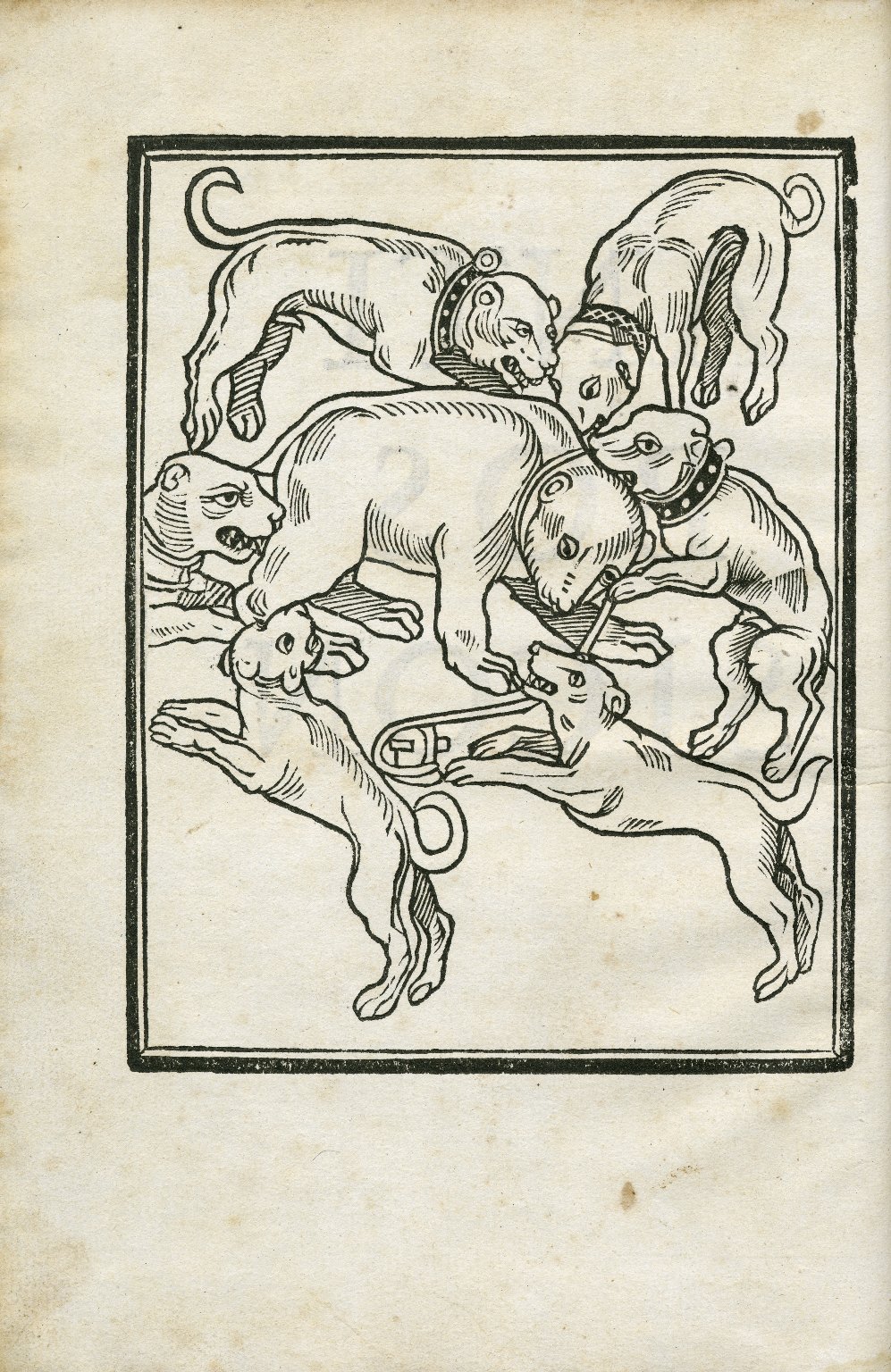
History of Bear Baiting in London
Para1Bear baiting was a gruesome yet popular blood sport during the early modern period.
The sport consisted of chaining a bear to a stake then unleashing dogs into the arena
who would taunt and attack the bear. The sport of bear baiting was typically held
in an arena known as a Bear Garden. Some London playhouses, such as The Hope, were used mainly as theatres, with bear
baiting taking place on specific days when plays were not staged. Once the sport reached
its peak between 1615–1635, the baitings left the theatres altogether and were held
only in specialized arenas. Some scholars like Erica Fudge argue that bear baiting
was symbolic of the various power struggles that were occurring during the Elizabethan
era. Due to the disapproval of Puritan ministers, the sport began a decline in the
late 1630s and it never regained in popularity in England again.
Royal Opinion
Para2This violent sport was initially accepted by the rulers of the era, so much that it
was also known as The King’s Game. The Master of The King’s Game received a small salary from the king in addition
to status in the court. Many men who wanted to get close to the king, thus gaining
influence in the royal court, pursued this position. The Master was also held accountable
for the animals within the arena. People who did not enjoy the sport due to its cruel
nature were obligated to respect it because of royal interest and the approval of
the royal court. But that attitude changed about a decade into the rule of King James
I of England. Starting in 1618, as declared in The Book of Sports, all the ministers for the Church of England were required, by royal order, to inform
their parishioners of sports permitted by the king that could occur on Sundays after
church services, in part due to Puritan opposition to some folk customs in England.
But The Book of Sports banned Sunday bear baiting, initiating the decline of the once popular entertainement.
While it seldom occured after the 1630s, animal baiting was not formally banned in
England until Parliament did so in 1835.
Shakespeare’s View
Para3Shakespeare occasionally compared the situation of his characters to that of the bear
in the arena: tied to a stake surrounded by those who wish harm upon them.
In The Second Part of Henvy VI, Richard of Gloucester asks that
Call hither to the stake my two brave bears,/That with the very shaking of their chains/They may astonish these fell-lurking cursand in reply, Lord Clifford cries,
Are these thy bears? we'll bait thy bears to death./ And manacle the bear-ward in their chains,/If thou darest bring them to the baiting place,(5.1.142–144 and 146–147), using the sport as a metaphor for tormenting enemies.
In King Lear, the captured Earl of Gloucester discovers the cruelty he faces at the hands of Lear’s
daughters and cries out
I am tied to th' stake, and I must stand the course(3.7.56).
In Macbeth, the title character uses the metaphor of being baited when he discovers in the final
battle that he is surrounded and without hope of survival.
Para4Shakespeare’s characters sometimes appear to have a more sensitive approach to bear
baiting, associating themselves with the fate and unfortunate circumstances of the
bear, although in Twelfth Night, Sir Toby says,
to anger him Malvolio we’ll have the bear again, and we’ll fool him black and blue, shall we not, Sir Andrew?,showing that the entertainment value of bear baiting was not absent from the plays.
Sources
Fudge, Erica. Perceiving Animals: Humans and Beasts in Early Modern English Culture. University of Illinois Press, 2002.
Scott-Warren, Jason.
When Theaters Were Bear-Gardens; Or, What’s at Stake in the Comedy of Humors.Shakespeare Quarterly, vol. 54, no. 1, 2003, pp. 63–82.
Open-Access Digital Resources
Andrews, Evan.
The Gruesome Blood Sports of Shakespearean England.History. A&E Television Networks. 30 Jan. 2017; updated 28 May 2025, https://www.history.com/articles/the-gruesome-blood-sports-of-shakespearean-england. Accessed 11 Feb. 2026.
Best, Michael.
City Sports: Bear baiting.Shakespeare’s Life and Times. Internet Shakespeare Editions. University of Victoria, 4 Jan. 2011, https://internetshakespeare.uvic.ca/Library/SLT/society/city%20life/sports.html. Accessed 12 Dec. 2020.
Elizabethan Playhouses and Bear Baiting Arenas Given Protection.Historic England, 26 Sep. 2016, https://historicengland.org.uk/whats-new/news/elizabethan-playhouses-and-bear-baiting-arenas-given-protection. Accessed 12 Dec. 2020.
Kelley, Shannon.
Bear Garden.The Map of Early Modern London. Edited by Janelle Jenstad, University of Victoria, 30 Jun. 2021, https://mapoflondon.uvic.ca/BEAR1.htm. Accessed 11 Feb. 2026.
Lauenstein, Eva.
Exit, Pursued by a Bear.Shakespeare’s Globe, 29 Jan. 2016, https://www.shakespearesglobe.com/discover/blogs-and-features/2016/01/29/exit-pursued-by-a-bear/. Accessed 11 Feb. 2026.
Image Source
Lily, William. Bearbaiting Woodcut. Antibossicon. London, 1521. Folger Shakespeare Library, Digital Image Collection. https://digitalcollections.folger.edu/img1202. Access 11 Feb. 2026.
Prosopography
Janelle Jenstad
Janelle Jenstad is a Professor of English at the University of Victoria, Director
of The Map of Early Modern London, and Director of Linked Early Modern Drama Online. With Jennifer Roberts-Smith and Mark Beatrice Kaethler, she co-edited Shakespeare’s Language in Digital Media: Old Words, New Tools (Routledge). She has edited John Stow’s A Survey of London (1598 text) for MoEML and is currently editing The Merchant of Venice (with Stephen Wittek) and Heywood’s 2 If You Know Not Me You Know Nobody for DRE. Her articles have appeared in Digital Humanities Quarterly, Elizabethan Theatre, Early Modern Literary Studies, Shakespeare Bulletin, Renaissance and Reformation, and The Journal of Medieval and Early Modern Studies. She contributed chapters to Approaches to Teaching Othello (MLA); Teaching Early Modern Literature from the Archives (MLA); Institutional Culture in Early Modern England (Brill); Shakespeare, Language, and the Stage (Arden); Performing Maternity in Early Modern England (Ashgate); New Directions in the Geohumanities (Routledge); Early Modern Studies and the Digital Turn (Iter); Placing Names: Enriching and Integrating Gazetteers (Indiana); Making Things and Drawing Boundaries (Minnesota); Rethinking Shakespeare Source Study: Audiences, Authors, and Digital Technologies (Routledge); and Civic Performance: Pageantry and Entertainments in Early Modern London (Routledge). For more details, see janellejenstad.com.
Julianne Hiscock
Julianne Hiscock was a student at the University of Fraser Valley.
Kate McPherson
Kate McPherson is Professor of English and Honors Program Director at Utah Valley
University (Orem, UT, USA). In 2015, she began working to redevelop Shakespeare’s Life and Times, created by Michael Best, into the Early Modern England Encyclopedia. Her other publications include commentary on Pericles and The Comedy of Errors for the New Oxford Shakespeare (2016); the co-edited volumes Stages of Engagement: Drama and Religion in Post-Reformation England with James Mardock (Duquesne University Press, 2014) and Shakespeare Expressed: Page, Stage, and Classroom in Shakespeare and His Contemporaries, with Kathryn M. Moncrief and Sarah Enloe (Fairleigh Dickinson University Press,
2013). With Kathryn M. Moncrief, Kate has also two edited collections, Performing Pedagogy in Early Modern England: Gender, Instruction, and Performance (Ashgate, 2011) and Performing Maternity in Early Modern England (Ashgate 2008). She has also published numerous articles on early modern maternity
in scholarly journals. Kate participated in the 2008 National Endowment for the Humanities
Institute,
Shakespeare’s Blackfriars: The Study, the Stage, the Classroom,at the American Shakespeare Center. She also served as Play Seminar Director, a public humanities position, for the Utah Shakespeare Festival in 2017 and 2018.
Leah Hamby
Leah Hamby is the primary encoder for the Early Modern England Encyclopedia. Aside from encoding, she also works as an editor for the project and contributed
several articles of her own. She has been working on the EMEE since February 2023. As of February 2026, she is soon to graduate with honours from
Utah Valley University with a major in history and a minor in creative writing. Her
other work with the LEMDO program includes remediating William Kemp’s Kemp’s Nine Day’s Wonder for the Digital Renaissance Editions.
Melissa Walter
Melissa Walter is Associate Professor of English at the University of the Fraser Valley.
Her research focuses on early modern English drama and English and European prose
fiction. She is the author of The Italian Novella and Shakespeare’s Comic Heroines (U of Toronto, 2019), and co-editor, with Dennis Britton, of Rethinking Shakespeare Source Study: Authors, Audiences, Digital Technologies (Routledge, 2018). Her work on English theatre and the European novella has appeared
in several edited collections, including Transnational Exchange in Early Modern Theater (Ashgate, 2008), and Transnational Mobility in Early Modern Theater (Ashgate, 2012). She has also written about
Translation and Identity in the Dialogues in English and Malaiane Languages(Indographies, ed. Jonathan Gil Harris. Palgrave 2012). At the University of the Fraser Valley, she is a lead coordinator of UFV’s Shakespeare and Reconciliation Garden.
Michael Best
Michael Best is Professor Emeritus at the University of Victoria, BC. He founded the
Internet Shakespeare Editions in 1996, and was Coordinating Editor until 2017, contributing two editions to the
ISE: King John and King Lear (the latter also available in print from Broadview Press). In print, he has published editions of works of Elizabethan magic and huswifery,
a collection of letters from the Australian goldfields, and Shakespeare on the Art of Love (2008). He contributed regular columns for the Shakespeare Newsletter on
Electronic Shakespeares,and has written many articles and chapters for both print and online books and journals, principally on questions raised by the new medium in the editing and publication of texts. He has delivered papers and plenary lectures on electronic media and the Internet Shakespeare Editions at conferences in Canada, the USA, the UK, Spain, Australia, and Japan.
Orgography
LEMDO Team (LEMD1)
The LEMDO Team is based at the University of Victoria and normally comprises the project
director, the lead developer, project manager, junior developers(s), remediators,
encoders, and remediating editors.
University of Victoria (UVIC1)
https://www.uvic.ca/Metadata
| Authority title | The Sport of Bear Baiting |
| Type of text | Critical |
| Publisher | University of Victoria on the Linked Early Modern Drama Online Platform |
| Series | Early Modern England Encyclopedia |
| Source |
By Julianne Hiscock, inspired by Michael Best’s Shakespeare’s Life and Times, Internet Shakespeare Editions
|
| Editorial declaration | This document uses Canadian English spelling |
| Edition | Released with Early Modern England Encyclopedia 1.0 |
| Sponsor(s) |
Early Modern England EncyclopediaAnthology Leads: Kate McPherson and Kate Moncrief.
|
| Encoding description | Encoded in TEI P5 according to the LEMDO Customization and Encoding Guidelines |
| Document status | published, peer-reviewed |
| Funder(s) |
Social Sciences and Humanities Research Council of Canada
Mitacs Globablink Research Internship Utah Valley University |
| License/availability |
Intellectual copyright in this entry is held by Kate McPherson on behalf of the contributors. Copyright on the TEI-XML markup is held by the University of Victoria on behalf of the LEMDO Team. The content and TEI-XML markup in this file are licensed under a CC BY-NC_ND 4.0 license. This file is freely downloadable without permission under the following conditions:
(1) credit must be given to the authors, EMEE, and LEMDO in any subsequent use of
the files and /or data; (2) this availability statement must remain in the file; (3)
the content cannot be adapted or repurposed (except for quotations for the purposes
of academic review and citation); and (4) commercial uses are not permitted without
the knowledge and consent of the authors, EMEE, and LEMDO. Neither the content nor
the code in this file is licensed for training large language models (LLMs), ingestion
into an LLM, or any use in any artificial intelligence applications; such uses are
considered to be commercial uses and are strictly prohibited.
|