
Bawdy-Houses
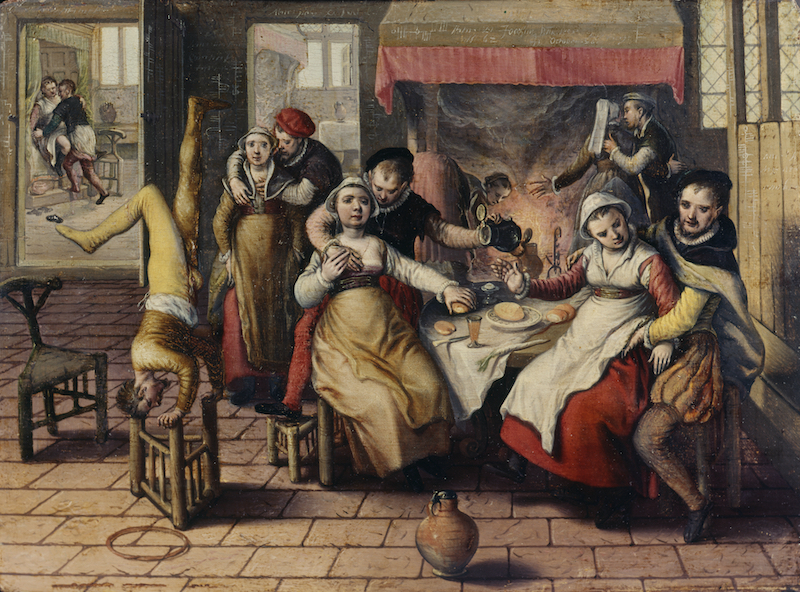
Definition
Para1A bawdy-house was a brothel, whorehouse, or a house of prostitution, sometimes called
a stew. As a standalone building or attached to a tavern or playhouse, a bawdy-house
was the site of considerable vice, crime, and disease in early modern England. Bawds
(the individuals who ran the bawdy house, whether they were male or female) and their
establishments were not welcome inside the walls of The City of London and mostly
inhabited outer suburbs such as Southwark and Smithfield. Despite their existence
on the margins of society, bawdy-houses were a part of everyday life throughout the
period.
Inside the Bawdy-house
Para2In a brothel, men gathered to smoke, eat, drink, hear or sing lewd songs, and pay
for sex. The cost to hire a prostitute in Elizabethan England ranged from sixpence
to half a crown (between 4 and 20 pounds in 2023). The pervasive presence of bawdy-houses
challenged England’s attitudes about morality and class separation because they flouted
these conventions.
Efforts to Suppress Prostitution
Para3Prostitution was technically against both religious and civil law, but officials often
looked the other way because they profited from it. in the 16th and 17th centuries,
governments and the Church of England had concerns over rising crime and disorder,
some of which was tied to the sex trade. They also worried about sexually transmitted
infections, particularly syphilis which ravaged huge swaths of Europe after its spread
from the New World. Finally, the rise of Puritanism prompted new urgency in efforts
to close brothels due to the focus of Puritans on enforcing morality. In 1506, eighteen
bawdy houses were closed along the Bankside of the Thames River (twelve would reopen
not long after). By 1546, crime and disorder had grown so much than Henry VIII issued
a proclamation aimed at a
final closing of all stews.
Para4These efforts did little to curb the spread of prostitution. In fact, the closure
of licensed bawdy-houses had the opposite effect, for many prostitutes were scattered
inside of London and became much harder to police. Unrestrained population growth
during Queen Elizabeth I’s reign, when London doubled in size between 1550 and 1600,
dramatically increased the rate of the poorer classes moving into the swelling slums.
Relative economic prosperity brought more upscale travelers who could afford the services
of sex workers.
Punishments for Prostitution
Para5Even though bawdy houses were very much an open secret, prostitutes and their customers
were subject to public scorn, shaming, and punishment. Up until Elizabeth I’s ascension,
the Church held jurisdiction over sexual offenses of common people in England. Officials
called summoners were sent to each parish to find offenders and bring them to bawdy court. Elizabeth I broadened enforcement when she created a Court of High Commission, which
held concurrent and superior jurisdiction over moral offenses. Both systems were ineffective
and highly susceptible to corruption.
Para6People found guilty of moral crimes could be subjected to various punishments that
typically involved public humiliation:
Whipping
Flogging
Carting (paraded about town behind a cart with a paper explaining the offense)
Penance (being forced to stand clothed only in a sheet before a church congregation)
Fines
Imprisonment
Bawdy-houses in Early Modern Literature
Para7In Christ’s Tears over Jerusalem (1593), Thomas Nash ironically calls a brothel a Nunnery. This is the first instance of using nunnery as slang for a brothel or bawdy-house, according to the Oxford English Dictionary.
Para8Shakespeare also repeatedly alludes to bawdy-houses in his work. Hamlet famously implores
the innocent Ophelia to
get thee to a nunn’ryseveral times (3.1.120; 128–29; 136-37; 139). Critics have debated whether these are straight-forward commands to Ophelia to escape the corruption of the world by entering a convent, or whether Shakespeare implies, like Nash, that there is no escape from the world’s corruption and that Ophelia might as well go to a brothel.
Para9Falstaff, a comedic character in several of Shakespeare’s plays, embodies the revelry
and hedonism found in bawdy-houses. Inside the Boar’s-Head Tavern in the London neighborhood
of Eastcheap, Falstaff is unashamed as he talks about his lifestyle:
Why, there is it: come sing me a bawdy song; makeme merry. I was as virtuously given as a gentlemanneed to be; virtuous enough; swore little; diced notabove seven times a week; went to a bawdy-house oncein a quarter—of an hour; paid money that Iborrowed, three of four times; lived well and ingood compass: and now I live out of all order, out of all compass.(Henry IV, Part 1, 3.3.220-227)
Para10In Measure for Measure, Lord Angelo embodies the strict, moralistic impulse of the Puritans to contain vice
and sexual impurity. His proclamation to close the brothels and end unlawful sexual
activity echoes Henry VIII’s final edict regarding closure of houses of prostitution.
In the play, the young nobleman Claudio is arrested for impregnating Juliet, his fiancee,
but he is sentenced to death to serve as an example against fornication. Such a harsh
sentence would have been viewed as excessive and cruel to Shakespeare’s audience,
and it shows the social tensions involved with the sex trade in early modern England.
Sources
Muenchrath, Anna.
Decapitation, Pregnancy, and the Tongue: The Body as Physical Metaphor in Measure for Measure.Early Modern Literary Studies, vol. 20, no. 1, 2018, pp. 1–19.
Salkeld, Duncan. Shakespeare among the Courtesans: Prostitution, Literature, and Drama, 1500–1650. Routledge, 2012.
Shugg, Wallace.
Prostitution in Shakespeare’s London.Shakespeare Studies, vol. 10, 1977, pp. 291–313.
Open-Access Digital Resources
Best, Michael.
A Bawdy-House.Shakespeare’s Life and Times. Internet Shakespeare Editions. University of Victoria, 4 Jan. 2011, https://internetshakespeare.uvic.ca/Library/SLT/society/city%20life/bawdy-house.html. Accessed 7 Feb. 2023.
Open Source Shakespeare. George Mason University, 2003–2018, https://opensourceshakespeare.org/. Accessed 14 Sep. 2018.
Partridge, Eric. Shakespeare’s Bawdy: A Literary and Psychological Essay and a Comprehensive Glossary. Routledge and Kegan Paul, 1955. Internet Archive, https://archive.org/details/shakespearesbawd0000unse_x2i5/page/n3/mode/2up. Accessed 11 Feb. 2026.
Image Source
Beuckelaer, Joachim. Brothel. Walters Art Museum 37.1784, 1562, https://art.thewalters.org/object/37.1784/.
Prosopography
Brock Burns
Brock Burns was a student at Utah Valley University.
Kate McPherson
Kate McPherson is Professor of English and Honors Program Director at Utah Valley
University (Orem, UT, USA). In 2015, she began working to redevelop Shakespeare’s Life and Times, created by Michael Best, into the Early Modern England Encyclopedia. Her other publications include commentary on Pericles and The Comedy of Errors for the New Oxford Shakespeare (2016); the co-edited volumes Stages of Engagement: Drama and Religion in Post-Reformation England with James Mardock (Duquesne University Press, 2014) and Shakespeare Expressed: Page, Stage, and Classroom in Shakespeare and His Contemporaries, with Kathryn M. Moncrief and Sarah Enloe (Fairleigh Dickinson University Press,
2013). With Kathryn M. Moncrief, Kate has also two edited collections, Performing Pedagogy in Early Modern England: Gender, Instruction, and Performance (Ashgate, 2011) and Performing Maternity in Early Modern England (Ashgate 2008). She has also published numerous articles on early modern maternity
in scholarly journals. Kate participated in the 2008 National Endowment for the Humanities
Institute,
Shakespeare’s Blackfriars: The Study, the Stage, the Classroom,at the American Shakespeare Center. She also served as Play Seminar Director, a public humanities position, for the Utah Shakespeare Festival in 2017 and 2018.
Leah Hamby
Leah Hamby is the primary encoder for the Early Modern England Encyclopedia. Aside from encoding, she also works as an editor for the project and contributed
several articles of her own. She has been working on the EMEE since February 2023. As of February 2026, she is soon to graduate with honours from
Utah Valley University with a major in history and a minor in creative writing. Her
other work with the LEMDO program includes remediating William Kemp’s Kemp’s Nine Day’s Wonder for the Digital Renaissance Editions.
Michael Best
Michael Best is Professor Emeritus at the University of Victoria, BC. He founded the
Internet Shakespeare Editions in 1996, and was Coordinating Editor until 2017, contributing two editions to the
ISE: King John and King Lear (the latter also available in print from Broadview Press). In print, he has published editions of works of Elizabethan magic and huswifery,
a collection of letters from the Australian goldfields, and Shakespeare on the Art of Love (2008). He contributed regular columns for the Shakespeare Newsletter on
Electronic Shakespeares,and has written many articles and chapters for both print and online books and journals, principally on questions raised by the new medium in the editing and publication of texts. He has delivered papers and plenary lectures on electronic media and the Internet Shakespeare Editions at conferences in Canada, the USA, the UK, Spain, Australia, and Japan.
Navarra Houldin
Training and Documentation Lead 2025–present. LEMDO project manager 2022–2025. Textual
remediator 2021–present. Navarra Houldin (they/them) completed their BA with a major
in history and minor in Spanish at the University of Victoria in 2022. Their primary
research was on gender and sexuality in early modern Europe and Latin America. They
are continuing their education through an MA program in Gender and Social Justice
Studies at the University of Alberta where they will specialize in Digital Humanities.
Orgography
LEMDO Team (LEMD1)
The LEMDO Team is based at the University of Victoria and normally comprises the project
director, the lead developer, project manager, junior developers(s), remediators,
encoders, and remediating editors.
University of Victoria (UVIC1)
https://www.uvic.ca/Metadata
| Authority title | Bawdy-Houses |
| Type of text | Critical |
| Publisher | University of Victoria on the Linked Early Modern Drama Online Platform |
| Series | Early Modern England Encyclopedia |
| Source |
By Brock Burns, inspired by Michael Best’s Shakespeare’s Life and Times, Internet Shakespeare Editions
|
| Editorial declaration | This document uses Canadian English spelling |
| Edition | Released with Early Modern England Encyclopedia 1.0 |
| Sponsor(s) |
Early Modern England EncyclopediaAnthology Leads: Kate McPherson and Kate Moncrief.
|
| Encoding description | Encoded in TEI P5 according to the LEMDO Customization and Encoding Guidelines |
| Document status | published, peer-reviewed |
| Funder(s) |
Social Sciences and Humanities Research Council of Canada
Mitacs Globalink Research Internship Utah Valley University |
| License/availability |
Intellectual copyright in this entry is held by Kate McPherson on behalf of the contributors. Copyright on the TEI-XML markup is held by the University of Victoria on behalf of the LEMDO Team. The content and TEI-XML markup in this file are licensed under a CC BY-NC_ND 4.0 license. This file is freely downloadable without permission under the following conditions:
(1) credit must be given to the authors, EMEE, and LEMDO in any subsequent use of
the files and /or data; (2) this availability statement must remain in the file; (3)
the content cannot be adapted or repurposed (except for quotations for the purposes
of academic review and citation); and (4) commercial uses are not permitted without
the knowledge and consent of the authors, EMEE, and LEMDO. Neither the content nor
the code in this file is licensed for training large language models (LLMs), ingestion
into an LLM, or any use in any artificial intelligence applications; such uses are
considered to be commercial uses and are strictly prohibited.
|