
Banquets
Overview
Para1Banquets were hosted in Tudor and Stuart times at the royal courts and at the homes
of the wealthy to celebrate events and individuals. They offered a chance to eat extravagantly
prepared food and ample drinks. Music, pageants, theatrical performances (including
the elaborately costumed performances known as masques), acrobats, and dancing provided
entertainment. Banquets were featured in the literature of the time, including more
festive representations in Shakespeare’s plays like The Taming of the Shrew and more sinister examples in plays like Macbeth.
Setting
Para2Banquets often took place in the great halls of castles, large rooms that could hold
many invited guests. The word banquet is derived from the word bench, which was the
common seat that people used to eat at the tables. Elaborate food in many separate
courses was served for eating and as part of the entertainment, such as a roasted
peacock that then had its tail feathers included in the presented dish. Instead of
wooden dishes or trenchers made of bread, expensive buffet plates were used to serve
the dishes so the food could be admired first, then be dished out by servants to individuals.
The more tiers on these buffet serving dishes, the higher the rank and wealth of the
host of the event.
Food
Para3The food at banquets was served in multiple courses throughout the night. The dishes
focused on various animal proteins, including beef, venison, poultry, pork, and fish.
Vegetables were considered a more common food, so they were not featured much at celebratory
banquets. Ironically, this meant that poorer people who likely never attended a banquet
had a healthier diet than those of higher in social rank. Because of the social status
of vegetables and legumes, the rich tended to focus on meat products, breads, and
desserts. The last course of the meal was often wine or another alcoholic beverage
such as mead, a fermented honey drink. Just as we toast to someone today, early modern
English banquet guests drank to their honored guests or others.
Dessert Banquets
Para4Elaborate multicourse meals with many sweets also become popular as a type of banquet
in the 16th century, since sugar from the labor of enslaved people on Portuguese and
Spanish plantations in South America made this once scarce commodity much more common.
Tudor and Stuart banquets often featured a type of multi-course dessert known a collation.
Based on Italian recipes, the collations may have had as many as 12 dishes (one for
each month) served over three courses.
The first course of the collation featured candied fruits and nuts, confections made
of marzipan (sweetened almond paste), and sweet or spiced biscuits.
The second course served both savory and sweet foods, including roasted meats, meat
pies, breads, and cakes.
The third course of the collation also featured both sweet and savory foods but added
fresh fruits and aged cheeses.
Recipes
Para5Recipe books began to be published in the 16th century but were not in the structured
format that we use today. Recipes were written out as running text, so the ingredients
were included with the actions of the recipe, if they were included at all. Recipe
authors assumed that cooks needed some instruction but not detailed discussion of
cooking techniques. Ingredients and portions of ingredients were often assumed or
glossed over. Measurements were often compared to non-edible items like musket balls
or handfuls.
Entertainment
Para6Besides the food, ample entertainment was also provided to the guests at banquets.
Dramatic interludes would often be performed at these gatherings. Later, masques,
an elite form of theater featuring spectacular costumes and members of the court performing
some scenes, became popular in the Elizabethan era. Masques were more likes sketches,
brief plays designed to create wonder or pay tribute to an event, such as a wedding
or a military victory. They were sometimes included in between the larger acts of
a full-length play. The interludes would be performed by both professional actors
and amateurs alike. These interludes often featured some sort of debatable idea or
symbolic message that amused the audience. Music was performed extensively in banquet
hall by singers and instrumentalists. Drums, recorders, and other wind instruments,
as well as viols (the precursor to violas annd violins as we know them) were among
the instruments.
Social Arrangements
Para7People were separated by rank at banquets. The tables were organized so that a raised
table in the center or one end of the hall would hold the lord and guests of honor.
The nobility sat at the head of the table and room, and each person had a rank until
the very last seat at the tables. Because salt was placed along the table in shallow
dishes called cellars rather than shakers, this is where the phrases above the salt and below the salt come from: if someone sat above the salt or at a position higher than where the salt
cellar was placed, they were of high social position. If they sat below the salt,
they were of an inferior social ranking.
Para8Generally, banquets were thrown to honor a specific guest. Banquets were also held
to impress certain guests, celebrate marriages or betrothals, and commemorate military
victories or diplomatic alliances.
Examples of Banquets in Shakespeare
Para9In the first line of Macbeth Act 3 Scene 4, the title character recognizes the politics involved in banquets:
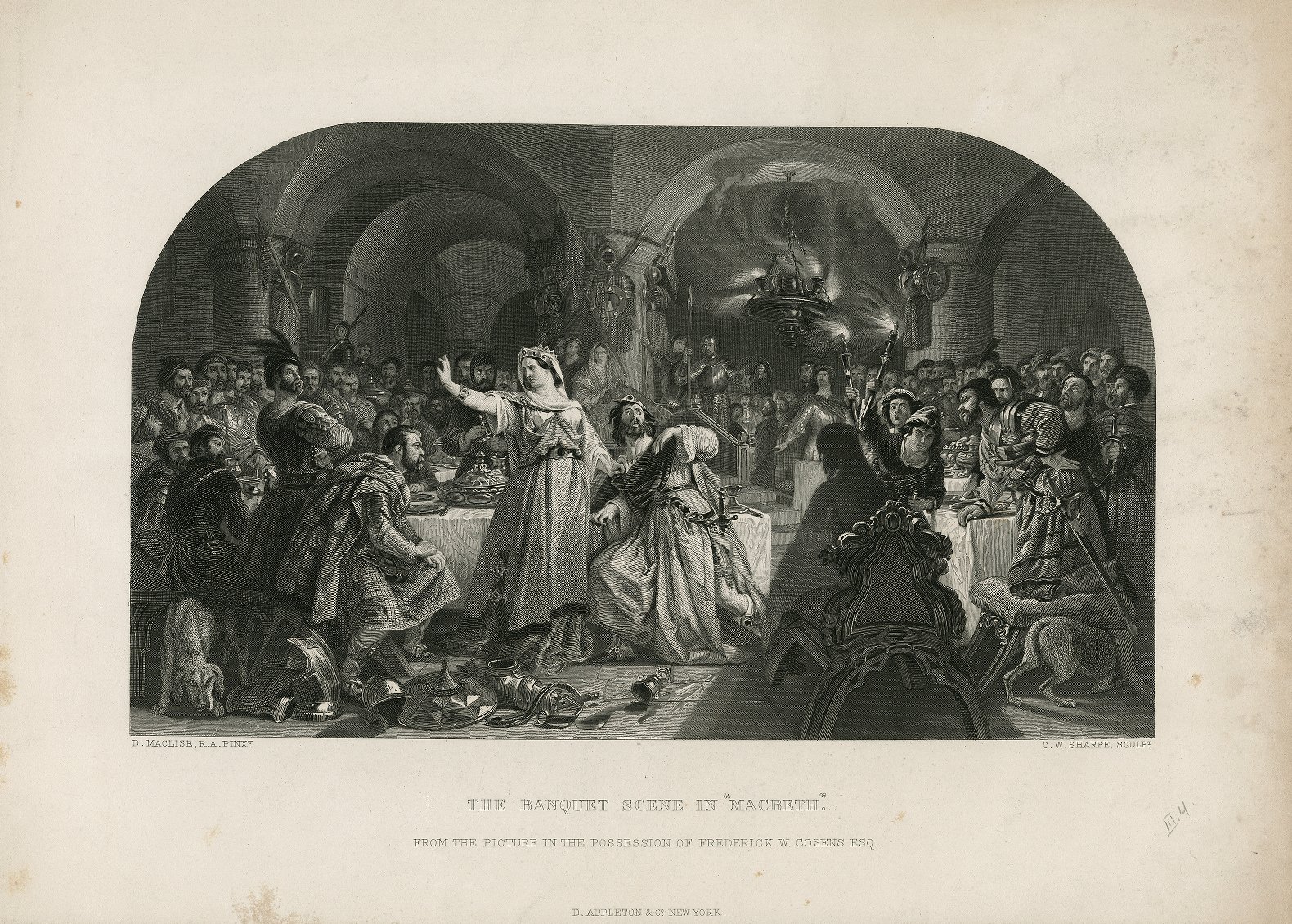
You know your own degrees; sit down.He references the places that each person is required to sit, and that it is so commonplace that the potential seating chart confusion is quickly glossed over. The scene revolves around Macbeth being distracted in the banquet by the ghost of Banquo, the man who he just had murdered. Banquet guests were expected to engage in lively conversation, and to have an outburst like Macbeth’s was considered rude and would have been concerning. As today, the social norms around banquets were ruled by etiquette. As Lady Macbeth tries to have the guests leave, she feels compelled to tell them to not leave by rank, but to just leave.
Para10In the final scenes of The Taming of the Shrew, a banquet provides the setting that allows the characters to have a conversation
that sums up the play’s themes. After the meal is over, the women go into the parlor
to chat. After being summoned in turn by their husbands to resolve a debate about
who has the most obedient wife, Katerina gives her famous speech about women’s duty
to men, causing some characters to win or lose bets with each other. The banquet hall
is used to display Petruchio’s victory over his wife, revealing in the play’s action
the symbolic role that banquets held in early modern culture.
Sources
Richardson, Catherine. Shakespeare and Material Culture. Oxford UP, 2011.
Segan, Francine. Shakespeare’s Kitchen: Renaissance Recipes for the Contemporary Cook. Random House, 2003.
Thirsk, Joan. Food in Early Modern England: Phases, Fads, Fashions, 1500–1760. Hambledon Continuum, 2007.
Open-Access Digital Resources
Above/Below the Salt - Words and Phrases That Come from the Dinner Table.Merriam-Webster, 2018, https://www.merriam-webster.com/wordplay/word-histories-dinner. Accessed 14 Oct. 2018.
Alchin, L.K.
Old Elizabethan Recipes.Elizabethan Era, 2017, https://www.elizabethan-era.org.uk/old-elizabethan-recipes.htm. Accessed 14 Oct. 2018.
Bramley, Anne.
In Shakespeare’s Plays, Mealtimes Were A Recipe For Drama.National Public Radio, 18 Apr. 2016, https://www.npr.org/sections/thesalt/2016/04/18/474409705/in-shakespeare-s-plays-mealtimes-were-a-recipe-for-drama. Accessed 12 Oct. 2018.
Britannica Editors.
Interlude.Encyclopædia Britannica, 2 Mar. 2012, https://www.britannica.com/art/interlude. Accessed 14 Oct. 2018.
Schmidt, Steven.
What, Exactly, Was the Tudor and Stuart Banquet?Manuscript Cookbook Survey, Aug. 2019, https://www.manuscriptcookbookssurvey.org/what-exactly-was-the-tudor-and-stuart-banquet/. Accessed 6 Feb. 2023.
Image Sources
Sharpe, Charles William. The Banquet Scene in MacbethAct III, Scene 4 from the Picture in the Possession of Frederick W. Cosens, Esq. Folger Digital Collections, 2018, https://digitalcollections.folger.edu/img28073.
Prosopography
Elise Curtis
Elise Curtis was an Honors student at Utah Valley University.
Kate McPherson
Kate McPherson is Professor of English and Honors Program Director at Utah Valley
University (Orem, UT, USA). In 2015, she began working to redevelop Shakespeare’s Life and Times, created by Michael Best, into the Early Modern England Encyclopedia. Her other publications include commentary on Pericles and The Comedy of Errors for the New Oxford Shakespeare (2016); the co-edited volumes Stages of Engagement: Drama and Religion in Post-Reformation England with James Mardock (Duquesne University Press, 2014) and Shakespeare Expressed: Page, Stage, and Classroom in Shakespeare and His Contemporaries, with Kathryn M. Moncrief and Sarah Enloe (Fairleigh Dickinson University Press,
2013). With Kathryn M. Moncrief, Kate has also two edited collections, Performing Pedagogy in Early Modern England: Gender, Instruction, and Performance (Ashgate, 2011) and Performing Maternity in Early Modern England (Ashgate 2008). She has also published numerous articles on early modern maternity
in scholarly journals. Kate participated in the 2008 National Endowment for the Humanities
Institute,
Shakespeare’s Blackfriars: The Study, the Stage, the Classroom,at the American Shakespeare Center. She also served as Play Seminar Director, a public humanities position, for the Utah Shakespeare Festival in 2017 and 2018.
Leah Hamby
Leah Hamby is the primary encoder for the Early Modern England Encyclopedia. Aside from encoding, she also works as an editor for the project and contributed
several articles of her own. She has been working on the EMEE since February 2023. As of February 2026, she is soon to graduate with honours from
Utah Valley University with a major in history and a minor in creative writing. Her
other work with the LEMDO program includes remediating William Kemp’s Kemp’s Nine Day’s Wonder for the Digital Renaissance Editions.
Michael Best
Michael Best is Professor Emeritus at the University of Victoria, BC. He founded the
Internet Shakespeare Editions in 1996, and was Coordinating Editor until 2017, contributing two editions to the
ISE: King John and King Lear (the latter also available in print from Broadview Press). In print, he has published editions of works of Elizabethan magic and huswifery,
a collection of letters from the Australian goldfields, and Shakespeare on the Art of Love (2008). He contributed regular columns for the Shakespeare Newsletter on
Electronic Shakespeares,and has written many articles and chapters for both print and online books and journals, principally on questions raised by the new medium in the editing and publication of texts. He has delivered papers and plenary lectures on electronic media and the Internet Shakespeare Editions at conferences in Canada, the USA, the UK, Spain, Australia, and Japan.
Navarra Houldin
Training and Documentation Lead 2025–present. LEMDO project manager 2022–2025. Textual
remediator 2021–present. Navarra Houldin (they/them) completed their BA with a major
in history and minor in Spanish at the University of Victoria in 2022. Their primary
research was on gender and sexuality in early modern Europe and Latin America. They
are continuing their education through an MA program in Gender and Social Justice
Studies at the University of Alberta where they will specialize in Digital Humanities.
Orgography
LEMDO Team (LEMD1)
The LEMDO Team is based at the University of Victoria and normally comprises the project
director, the lead developer, project manager, junior developers(s), remediators,
encoders, and remediating editors.
University of Victoria (UVIC1)
https://www.uvic.ca/Metadata
| Authority title | Banquets |
| Type of text | Critical |
| Publisher | University of Victoria on the Linked Early Modern Drama Online Platform |
| Series | Early Modern England Encyclopedia |
| Source |
By Elise Curtis, inspired by Michael Best’s Shakespeare’s Life and Times, Internet Shakespeare Editions
|
| Editorial declaration | This document uses Canadian English spelling |
| Edition | Released with Early Modern England Encyclopedia 1.0 |
| Sponsor(s) |
Early Modern England EncyclopediaAnthology Leads: Kate McPherson and Kate Moncrief.
|
| Encoding description | Encoded in TEI P5 according to the LEMDO Customization and Encoding Guidelines |
| Document status | published, peer-reviewed |
| Funder(s) |
Social Sciences and Humanities Research Council of Canada
Mitacs Globalink Research Internship Utah Valley University |
| License/availability |
Intellectual copyright in this entry is held by Kate McPherson on behalf of the contributors. Copyright on the TEI-XML markup is held by the University of Victoria on behalf of the LEMDO Team. The content and TEI-XML markup in this file are licensed under a CC BY-NC_ND 4.0 license. This file is freely downloadable without permission under the following conditions:
(1) credit must be given to the authors, EMEE, and LEMDO in any subsequent use of
the files and /or data; (2) this availability statement must remain in the file; (3)
the content cannot be adapted or repurposed (except for quotations for the purposes
of academic review and citation); and (4) commercial uses are not permitted without
the knowledge and consent of the authors, EMEE, and LEMDO. Neither the content nor
the code in this file is licensed for training large language models (LLMs), ingestion
into an LLM, or any use in any artificial intelligence applications; such uses are
considered to be commercial uses and are strictly prohibited.
|