
Sir Francis Bacon, the Father of the Scientific Method
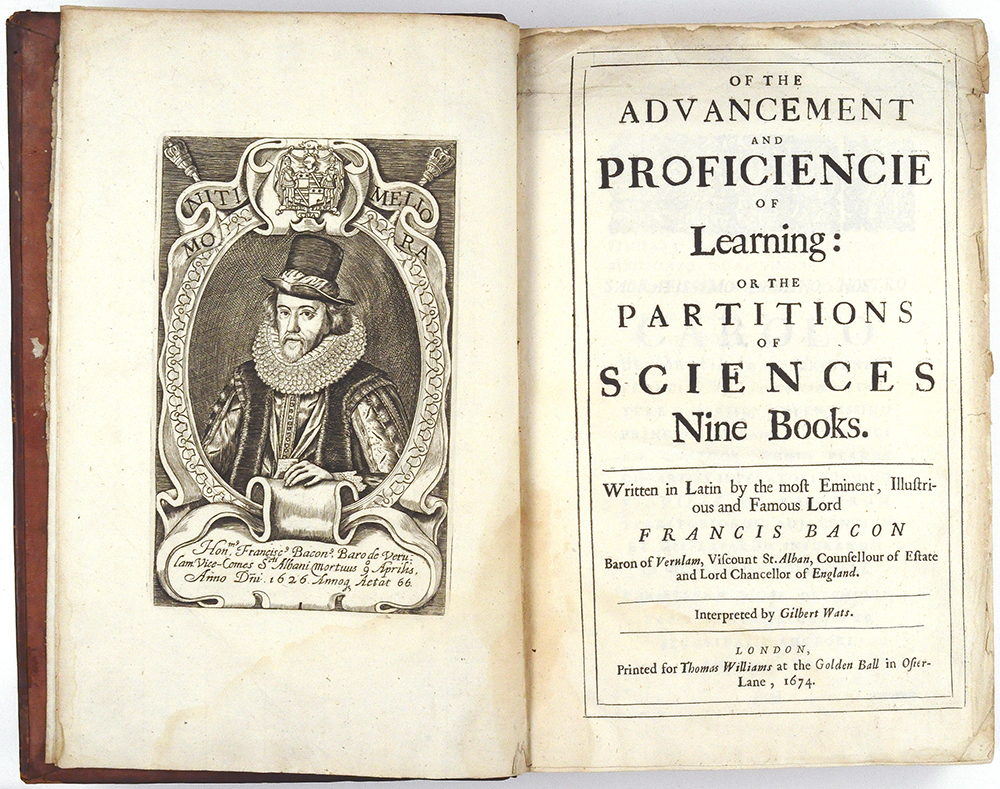
Para1Sir Francis Bacon, 1561–1626, was an innovative writer, politician, and father of
the induction method, better known today as the Scientific Method. His work shaped
the future of scientific study. Much of his revolutionary work took place during his
time in political office as attorney general of England and Wales from 1613–-1617
and later service as the lord high chancellor of England till 1621. He used his power
and influence to change the usually private study of science into one shared through
individuals and sometimes receiving state funding. As he worked to publicize active
research, Bacon realized scientists needed to use a method which could be easily understood;
this led to the development of Bacon’s Scientific Method.
The Scientific Method
Para2The method in its simplest state requires the experimenter to categorize their study
into six basic steps:
Form a question based on observations
Form a hypothesis
Make a prediction
Conduct testing
Analyze data
Report conclusions
Para3These six distinct steps quickly became the standard for experimentation in the early
1600s. The rise in popularity regarding the method led Bacon to elaborate on his original
work written in 1605 to develop his method in greater detail, resulting in his philosophical
book, Novum Organum, to be published in 1620. This foundational text quickly influenced scientists around
the globe as a benchmark for scientific study and became the most popular method of
study today. Researchers today use scientific processes derived from Bacon’s Induction
Method.
Impact on Early Modern Literature
Para4Bacon’s work on the scientific method was inspired by his passion for knowledge; in
fact, it was he who famously stated that knowledge is power. His striving for knowledge
was shared with playwrights. Literary critics like Carla Mazzio have stated that science
and literature must have some kind of dialogue with each other in order to create
a sense of realism and accuracy for audiences in their time.
Para5As Natalie Eliot claims,
Shakespeare explores the philosophical, psychological, and cultural impact of many more scientific fields besides human anatomy, reflecting poetically on theories about germs, atoms, matter, falling bodies, planetary motion, heliocentrism, alchemy, the humors, algebra, Arabic numerals, Pythagorean geometry, the number zero, and the infinite. The inquiries that drove Renaissance science, and the universe it disclosed, are deeply integrated into Shakespeare’s poetic worlds. (32)
Para6Readers and audiences enjoy what they can relate to and understand, so a reference
to astrology, the use of a newly discovered poison, or medical practices congruent
with the times of the playwright are all examples of tactics Shakespeare used to convey
science in his plays.Other playwrights such as Ben Jonson also frequently referenced
scientific discoveries or trends in their works, such as in Jonson’s 1610 play The Alchemist.
Sources
Bynum, William. A Little History of Science. Yale University Press, 2012.
Elliot, Natalie.
Shakespeare’s Worlds of Science.The New Atlantis, no. 54, Jan. 2018, pp. 30-50.
Mazzio, Carlo.
Introduction: Shakespeare and Science, c. 1600.South Central Review, vol. 26, no. 1/2, 2009, pp. 1-23.
Open-Access Digital Resources
Best, Michael.
Francis Bacon and the scientific method.Shakespeare’s Life and Times, Internet Shakespeare Editions, University of Victoria, 04 Jan. 2011, https://internetshakespeare.uvic.ca/Library/SLT/ideas/new%20knowledge/bacon.html. Accessed 11 Feb. 2026.
Experimental Method.Colby College, https://www.colby.edu/reload/biology/BI17x/expt_method.html. Accessed 23 Sept. 2023.
Falk, Dan.
What Shakespeare Knew about Science Excerpt.Scientific American, 23 Apr. 2014, https://www.scientificamerican.com/article/what-shakespeare-knew-about-science-excerpt/. Accessed 11 Feb. 2026.
Klein, Jürgen, and Guido Giglioni.
Francis Bacon.Stanford Encyclopedia of Philosophy, Stanford University, 7 Dec. 2012, https://plato.stanford.edu/entries/francis-bacon/. Accessed 11 Feb. 2026.
Image Sources
Bacon, Francis. Title page of Of The Advancment and Proficiencie of Learning: or the Paritions of Sciences. 1674, Wikimedia Commons, https://commons.wikimedia.org/wiki/File:Francis_Bacon_Advancement_of_Learning_1674.jpg. Accessed 11 Feb. 2026.

Prosopography
Janelle Jenstad
Janelle Jenstad is a Professor of English at the University of Victoria, Director
of The Map of Early Modern London, and Director of Linked Early Modern Drama Online. With Jennifer Roberts-Smith and Mark Beatrice Kaethler, she co-edited Shakespeare’s Language in Digital Media: Old Words, New Tools (Routledge). She has edited John Stow’s A Survey of London (1598 text) for MoEML and is currently editing The Merchant of Venice (with Stephen Wittek) and Heywood’s 2 If You Know Not Me You Know Nobody for DRE. Her articles have appeared in Digital Humanities Quarterly, Elizabethan Theatre, Early Modern Literary Studies, Shakespeare Bulletin, Renaissance and Reformation, and The Journal of Medieval and Early Modern Studies. She contributed chapters to Approaches to Teaching Othello (MLA); Teaching Early Modern Literature from the Archives (MLA); Institutional Culture in Early Modern England (Brill); Shakespeare, Language, and the Stage (Arden); Performing Maternity in Early Modern England (Ashgate); New Directions in the Geohumanities (Routledge); Early Modern Studies and the Digital Turn (Iter); Placing Names: Enriching and Integrating Gazetteers (Indiana); Making Things and Drawing Boundaries (Minnesota); Rethinking Shakespeare Source Study: Audiences, Authors, and Digital Technologies (Routledge); and Civic Performance: Pageantry and Entertainments in Early Modern London (Routledge). For more details, see janellejenstad.com.
Kate McPherson
Kate McPherson is Professor of English and Honors Program Director at Utah Valley
University (Orem, UT, USA). In 2015, she began working to redevelop Shakespeare’s Life and Times, created by Michael Best, into the Early Modern England Encyclopedia. Her other publications include commentary on Pericles and The Comedy of Errors for the New Oxford Shakespeare (2016); the co-edited volumes Stages of Engagement: Drama and Religion in Post-Reformation England with James Mardock (Duquesne University Press, 2014) and Shakespeare Expressed: Page, Stage, and Classroom in Shakespeare and His Contemporaries, with Kathryn M. Moncrief and Sarah Enloe (Fairleigh Dickinson University Press,
2013). With Kathryn M. Moncrief, Kate has also two edited collections, Performing Pedagogy in Early Modern England: Gender, Instruction, and Performance (Ashgate, 2011) and Performing Maternity in Early Modern England (Ashgate 2008). She has also published numerous articles on early modern maternity
in scholarly journals. Kate participated in the 2008 National Endowment for the Humanities
Institute,
Shakespeare’s Blackfriars: The Study, the Stage, the Classroom,at the American Shakespeare Center. She also served as Play Seminar Director, a public humanities position, for the Utah Shakespeare Festival in 2017 and 2018.
Leah Hamby
Leah Hamby is the primary encoder for the Early Modern England Encyclopedia. Aside from encoding, she also works as an editor for the project and contributed
several articles of her own. She has been working on the EMEE since February 2023. As of February 2026, she is soon to graduate with honours from
Utah Valley University with a major in history and a minor in creative writing. Her
other work with the LEMDO program includes remediating William Kemp’s Kemp’s Nine Day’s Wonder for the Digital Renaissance Editions.
Melissa Walter
Melissa Walter is Associate Professor of English at the University of the Fraser Valley.
Her research focuses on early modern English drama and English and European prose
fiction. She is the author of The Italian Novella and Shakespeare’s Comic Heroines (U of Toronto, 2019), and co-editor, with Dennis Britton, of Rethinking Shakespeare Source Study: Authors, Audiences, Digital Technologies (Routledge, 2018). Her work on English theatre and the European novella has appeared
in several edited collections, including Transnational Exchange in Early Modern Theater (Ashgate, 2008), and Transnational Mobility in Early Modern Theater (Ashgate, 2012). She has also written about
Translation and Identity in the Dialogues in English and Malaiane Languages(Indographies, ed. Jonathan Gil Harris. Palgrave 2012). At the University of the Fraser Valley, she is a lead coordinator of UFV’s Shakespeare and Reconciliation Garden.
Michael Best
Michael Best is Professor Emeritus at the University of Victoria, BC. He founded the
Internet Shakespeare Editions in 1996, and was Coordinating Editor until 2017, contributing two editions to the
ISE: King John and King Lear (the latter also available in print from Broadview Press). In print, he has published editions of works of Elizabethan magic and huswifery,
a collection of letters from the Australian goldfields, and Shakespeare on the Art of Love (2008). He contributed regular columns for the Shakespeare Newsletter on
Electronic Shakespeares,and has written many articles and chapters for both print and online books and journals, principally on questions raised by the new medium in the editing and publication of texts. He has delivered papers and plenary lectures on electronic media and the Internet Shakespeare Editions at conferences in Canada, the USA, the UK, Spain, Australia, and Japan.
Navarra Houldin
Training and Documentation Lead 2025–present. LEMDO project manager 2022–2025. Textual
remediator 2021–present. Navarra Houldin (they/them) completed their BA with a major
in history and minor in Spanish at the University of Victoria in 2022. Their primary
research was on gender and sexuality in early modern Europe and Latin America. They
are continuing their education through an MA program in Gender and Social Justice
Studies at the University of Alberta where they will specialize in Digital Humanities.
Tristan Taylor
Tristan Taylor was a student at the University of Fraser Valley.
Orgography
LEMDO Team (LEMD1)
The LEMDO Team is based at the University of Victoria and normally comprises the project
director, the lead developer, project manager, junior developers(s), remediators,
encoders, and remediating editors.
University of Victoria (UVIC1)
https://www.uvic.ca/Metadata
| Authority title | Sir Francis Bacon, the Father of the Scientific Method |
| Type of text | Critical |
| Publisher | University of Victoria on the Linked Early Modern Drama Online Platform |
| Series | Early Modern England Encyclopedia |
| Source |
By Tristan Taylor, inspired by Michael Best’s Shakespeare’s Life and Times, Internet Shakespeare Editions
|
| Editorial declaration | This document uses Canadian English spelling |
| Edition | Released with Early Modern England Encyclopedia 1.0 |
| Sponsor(s) |
Early Modern England EncyclopediaAnthology Leads: Kate McPherson and Kate Moncrief.
|
| Encoding description | Encoded in TEI P5 according to the LEMDO Customization and Encoding Guidelines |
| Document status | published, peer-reviewed |
| Funder(s) |
Social Sciences and Humanities Research Council of Canada
Mitacs Globablink Research Internship |
| License/availability |
Intellectual copyright in this entry is held by Kate McPherson on behalf of the contributors. Copyright on the TEI-XML markup is held by the University of Victoria on behalf of the LEMDO Team. The content and TEI-XML markup in this file are licensed under a CC BY-NC_ND 4.0 license. This file is freely downloadable without permission under the following conditions:
(1) credit must be given to the authors, EMEE, and LEMDO in any subsequent use of
the files and /or data; (2) this availability statement must remain in the file; (3)
the content cannot be adapted or repurposed (except for quotations for the purposes
of academic review and citation); and (4) commercial uses are not permitted without
the knowledge and consent of the authors, EMEE, and LEMDO. Neither the content nor
the code in this file is licensed for training large language models (LLMs), ingestion
into an LLM, or any use in any artificial intelligence applications; such uses are
considered to be commercial uses and are strictly prohibited.
|